Outreach.io Review: No Price, No Trial, No Answers

On this page
Type outreach.io into your browser and watch what happens. You get bounced to outreach.ai.
That redirect is the shortest possible summary of this Outreach.io review. The company changed its domain, its category and its pricing model, and most reviews you'll find still describe the product it sold two years ago.
So this isn't a test drive. It's a look at what Outreach's own live pages, and three review platforms, actually say right now.
Fair warning before you read another line: we build SmartReach.io, a sales engagement platform that competes with Outreach directly. Read this the way you'd read any review written by a competitor. Check the sources. That's why they're linked.
TL;DR for this Outreach.io review
The first thing you notice: outreach.io is now outreach.ai
The homepage headline reads "You didn't hire enough sellers. Now you don't have to." Above it, in small caps: "Agentic AI Platform for Revenue Teams."
The words "sales engagement" don't appear.
- From
- Custom quote (seats plus AI credits)
- Free trial
- None
- Best for
- Large revenue organizations on Salesforce with dedicated sales ops and a procurement cycle.
G2 noticed the shift too. Outreach's breadcrumb there now reads Revenue AI Platforms, not Sales Engagement. TrustRadius still files it under Sales Engagement. Capterra's vendor-supplied description still calls it "the first and only Sales Execution Platform".
Three review sites, three different answers about what this product is. That's not a gotcha, it's a repositioning in progress, and the vendor's own listings haven't caught up with each other yet.
What's new on the platform: Outreach MCP, Outreach Omni, Agent Studio, a Meeting Prep Agent, and Maia, an AI assistant that answers pricing questions in a chat widget. Kaia, the conversation intelligence layer, is still there and still called Kaia.
Why does any of this matter to a buyer? Because the question you're asking has changed. It used to be "is this worth a hundred bucks a seat." Now it's "what does a credit cost, and how many will nine reps burn in a quarter."
What Outreach's pricing page actually says
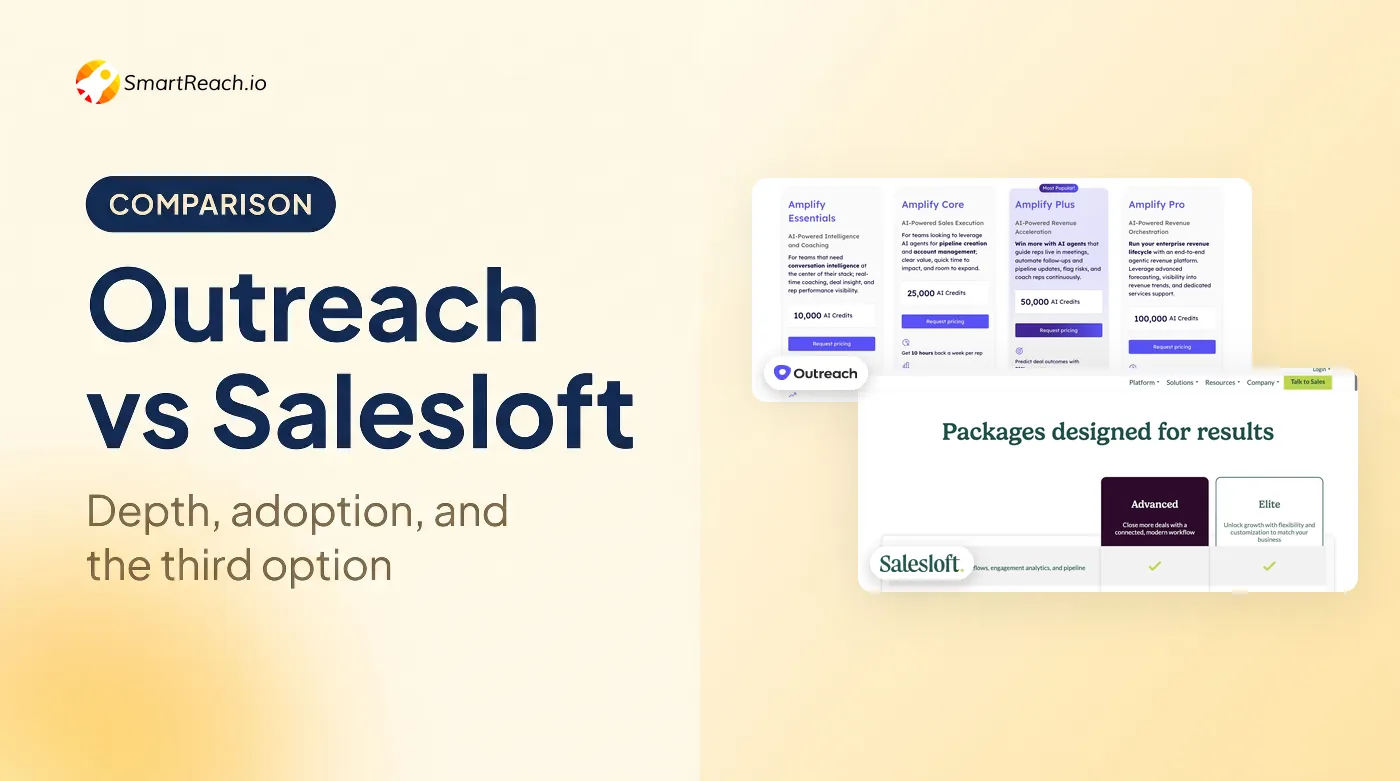
Here's the structure, straight off the page:
| Package | AI credits | API calls | Custom objects | Knowledge | Price |
|---|---|---|---|---|---|
| Amplify Essentials | 10,000 | 250,000 | 5 | 500 MB | Request pricing |
| Amplify Core | 25,000 | 250,000 | 5 | 500 MB | Request pricing |
| Amplify Plus (most popular) | 50,000 | 500,000 | 10 | 750 MB | Request pricing |
| Amplify Pro | 100,000 | 1,000,000 | 20 | 1,500 MB | Request pricing |
The page states the model plainly, and I'll give Outreach credit for the transparency: it "uses a combination of seat-based pricing and consumption-based pricing powered by AI credits."
Two meters, then. One that counts people, one that counts usage.
For a big org, that's arguably fairer than pure per-seat. A rep who barely touches the AI shouldn't cost the same as one running agents all day. The pitch on the page is "pay based on actual AI usage," and as a principle that's reasonable.
The problem is what it does to a budget.
The part nobody can tell you: what it costs
You'll find a lot of confident numbers about Outreach pricing. Roughly $100 per seat per month. Around $1,200 per user per year. Onboarding fees in the five figures.
I'm not putting any of them in this review, because not one traces back to Outreach. They're third-party estimates repeated between blogs until they read like fact. Several of the reviews ranking for this topic state them flatly, with no source.
What is on the record is thinner, and more useful. G2 publishes buyer data drawn from actual purchases, and for Outreach it reports:
That implementation figure is worth pausing on, because our own older version of this review claimed Outreach takes two to three months to set up. Buyer-reported data says about a month. We were wrong, and it's been corrected.
The 12% average discount tells you something else: the list price is negotiable, which is exactly what you'd expect from a platform with no published price. If you go into a quote conversation without a competing bid, you're leaving that discount on the table.
G2 does hold an estimated annual range from 84 purchases, but it masks the figure behind a lead form. Read into that what you like. I'd rather tell you the number is unavailable than invent one.
What the review sites say about Outreach
Three platforms, three samples, and they're strikingly consistent:
| Platform | Rating | Reviews |
|---|---|---|
| G2 | 4.3 / 5 | 3,574 |
| Capterra | 4.4 / 5 | 311 |
| TrustRadius | 8.3 / 10 | 1,040 |
Nearly five thousand reviews landing in the same band is a real signal. Outreach is a solid product that a lot of people use daily and mostly like. Any review implying otherwise is selling you something.
The praise clusters tightly: sequences save real time, the Salesforce integration is deep, reporting gives managers visibility they didn't have. The criticism clusters just as tightly around three things. Price relative to competitors. An interface that gets clunky once you're past the basics. And Salesforce sync trouble when a CRM instance uses custom objects and fields.
That last one is the interesting complaint, because it's specific. Generic "it's complex" feedback tells you nothing. "It breaks on custom Salesforce objects" tells you to bring your actual CRM schema to the demo.
One thing I won't do is quote the angriest one-star reviews at you. There are a few making serious accusations about billing conduct. They're one side of a dispute, unverified, and repeating them would be cheap. If billing terms worry you, ask about auto-renewal and cancellation notice periods in writing before you sign. That's more useful than a screenshot of someone's bad week.
Also worth saying: TrustRadius lists no free version and no trial for Outreach. The site's only door in is "Request a demo". For some buyers that's a dealbreaker on principle, and I understand why. You're being asked to commit to an annual contract for a product you've only watched someone else drive.
What Outreach genuinely does well
Let's be straight about this, because a review that finds nothing good is just an ad.
Forecasting is the real product. Scenario planning, weighted pipeline, parallel forecasts, intraquarter modelling. If your VP of Sales spends the last week of every quarter rebuilding a spreadsheet, Outreach solves a problem most outreach tools don't even attempt.
Kaia is strong. Real-time call transcription, action item detection, topic and sentiment analysis, searchable call history. Conversation intelligence as a category was largely defined by tools like this.
Salesforce depth. Not "we have an integration". Custom objects, field validation, deal grid edits that write back. For an org where Salesforce is the system of record, that depth is hard to replace.
It survives scale. Hundreds of reps, complex territories, governance and audit trails on what the AI agents are allowed to do. That's genuine enterprise engineering, and it isn't cheap to build.
Outreach also publishes customer outcomes worth checking: Amplitude reports saving over $600K a year by consolidating five platforms into Outreach. If you're currently paying for a sequencer, a dialer, a conversation intelligence tool and a forecasting tool separately, consolidation math can flip the whole argument.
The other name on almost every shortlist alongside this one is Salesloft, now inside Clari. We've compared them directly in Outreach vs Salesloft, including which of the two wins each dimension outright.
Where Outreach is the wrong tool
Buy Outreach if
- You run 50+ reps on Salesforce as the system of record.
- Forecast accuracy is a board-level problem, not a nice-to-have.
- You have a sales ops person who owns the tool.
- Procurement cycles and annual contracts are normal for you.
- You're consolidating four tools into one.
Look elsewhere if
- You're under 50 reps and mainly need sequences that land.
- You want to test a platform before a contract exists.
- Deliverability is your bottleneck, not forecasting.
- You need LinkedIn and WhatsApp in the same cadence.
- A variable AI credit line would break your budget.
The honest read: Outreach is priced, packaged and built for a buyer with a procurement department. If that's not you, the friction isn't a bug you can work around. It's the design.
Where SmartReach.io fits, and where it doesn't
SmartReach.io is a cold email software with multichannel outreach capabilities via channels like email, LinkedIn, calls and WhatsApp. It also serves as a sales engagement platform with a built-in lead database and a full deliverability suite. It rates 4.6/5 on G2.
We're the obvious alternative for teams who looked at Outreach and decided the machinery was aimed at someone else. Here's the case, and the counter-case.
Pricing you can read without a call. Email Outreach starts at $29 per month for 1,000 prospects. Plus is $89 with unlimited emails and unlimited users. Pro is $199, Scale is $499. Sales Engagement, which adds calling and LinkedIn, runs $39, $99, $249 and $599. Billing is by active prospects, not seats, so hiring a rep doesn't move the invoice.
Four channels in one sequence. Email, LinkedIn, calling and WhatsApp, with a conditional multichannel drip that moves a quiet prospect to another channel automatically. A reply anywhere pauses the sequence.
Deliverability as a first-class product. Warmup, inbox rotation and ESP matching, pre-send spam testing, blacklist and domain monitoring. You can buy secondary domains and Google, Microsoft 365 or Azure mailboxes inside the platform with SPF, DKIM and DMARC pre-configured. Sending caps at 100 emails per day per account, with about 70 recommended, which keeps the pattern looking human. Google's bulk sender guidelines require spam complaints under 0.3% and full authentication, and automating that setup removes the DNS work most teams get wrong.
Leads included. The B2B Lead Finder ships 300M+ contacts and 50M+ companies with free email verification, so prospecting isn't a second subscription.
You can just try it. A 14-day free trial with 200 prospects, no credit card, no demo gate.
Now the counter-case, because a comparison that dodges this isn't worth reading:
Pros
- Transparent published pricing, billed by prospects rather than seats.
- Unlimited users from the Plus plan, so headcount doesn't tax you.
- Four channels in one cadence with conditional branching.
- Deliverability suite the enterprise platforms treat as an afterthought.
- 300M+ contacts and free verification included.
Cons
- No forecasting engine or scenario planning. If that's why you're buying, Outreach wins.
- No conversation intelligence to match Kaia.
- LinkedIn automation is a $29/month add-on per LinkedIn account, so the real total is higher than the sticker.
- Salesforce integration is solid but not as deep on custom objects.
- Less useful once you're past a few hundred reps.
Let's do the add-on math honestly, since that's where comparisons usually get slippery. Take Priya running a nine-person team on Sales Engagement Plus at $99 a month, with three reps needing LinkedIn automation. That's $99 plus three add-ons at $29, so $186 a month. Not $99. The number on the pricing page isn't the number on your card, and any vendor who lets you believe otherwise is doing you a disservice.
Even so, $186 against an annual enterprise contract with a credit meter attached is a different order of decision.
If you want the fuller field, we keep a running list of Outreach competitors and alternatives and a breakdown of the best sales engagement platforms.
Outreach.io review: the verdict
Outreach didn't get worse. It got more specific.
The platform is deliberately aimed at large revenue organizations now, and the buying process reflects that: no trial, no price, a demo request and a procurement cycle. If you're that buyer, none of this is friction. It's just how enterprise software works, and Outreach is very good at being enterprise software.
If you're not that buyer, the mismatch shows up early. You'll spend three weeks in a sales process to learn a number you could have read on a page elsewhere, for a forecasting engine your team of eight will never open.
My honest opinion, for whatever a competitor's opinion is worth: the credit model is the thing to interrogate hardest. Seat pricing is annoying but predictable. Consumption pricing on a unit the vendor won't define is a blank cheque with a friendly name. Ask, in writing, what one credit buys and what happens when you run out mid-quarter. If the answer is vague, that's your answer.
If you're pricing the rest of the market before that conversation, our audit of cold email automation platforms covers what the mid-market tools cost from their live pricing pages, including the ones with no quote cycle at all.
And whatever you shortlist, run a real campaign on it before you commit. Real list, real copy, two weeks. Reply rate settles arguments that feature tables never will.
Frequently Asked Questions
How much does Outreach.io cost?
Outreach doesn't publish a price. Its pricing page lists four Amplify packages (Essentials, Core, Plus, Pro) and every one says "Request pricing". The model combines per-seat licences with consumption-based AI credits, so two teams of the same size can pay very different amounts.
Does Outreach.io have a free trial?
No. TrustRadius lists no free version and no trial for Outreach, and the site's only call to action is "Request a demo". You evaluate it through a sales process, not by signing up. SmartReach.io runs a 14-day free trial with 200 prospects and no credit card.
What are AI credits in Outreach?
They're the metered unit behind Outreach's AI agents. Packages bundle 10,000 credits at Amplify Essentials up to 100,000 at Amplify Pro, alongside API call and storage limits. Outreach doesn't publish what one credit buys, so credit burn is hard to model before you sign.
Is Outreach.io worth it for a small team?
Rarely. There's no trial, no published price, and no monthly option, so a five-rep team runs a procurement cycle for a platform built around forecasting and deal management it won't use. Buyers on G2 report a month to implement and 11 months to see return.
How long does it take to switch off Outreach?
Plan for weeks, not days. Sequences and templates usually get rebuilt rather than imported, and contact data exports cleanly to CSV. The real work is CRM field mapping and getting reps to change habits. Anyone promising zero downtime hasn't done one.
Can I try a platform before deciding, instead of booking a demo?
Not with Outreach. Its only route in is a demo request. Most alternatives let you self-serve: SmartReach.io gives you 14 days and 200 prospects with no card, which is enough to run a real campaign and judge reply rates rather than a slide deck.
Stop juggling tools
Book more meetings on every channel
Join 5,000+ teams running multichannel outreach from one sequence, with deliverability built in.