9 Best Email Warmup Tools for Cold Outreach, Priced

On this page
Warmup stopped being optional in February 2024. That is when Google and Yahoo began enforcing bulk sender rules, and the thresholds are public: authenticate with SPF, DKIM and DMARC, offer one-click unsubscribe, and keep your spam complaint rate under 0.3%, per Google's own sender guidelines. Microsoft has since applied comparable requirements to Outlook.com traffic.
A brand-new domain has no history against those thresholds. Nothing to judge is not the same as nothing to worry about, and a cold domain that opens with two hundred sends a day looks exactly like the pattern the filters were built to catch.
Email warmup tools exist to build that history on purpose. They send and reply to mail from your inbox on a rising schedule, drag messages out of spam, and keep threads alive until providers have enough evidence to trust you.
The 9 tools below are priced on the thing that decides your bill, which is not the headline number. It is the unit. One vendor charges per mailbox, another per inbox, another per warmup email sent, and a fourth charges nothing because warmup is bundled into the sending tool you already pay for. The same $100 buys wildly different amounts of warmup depending on which of those you picked.
TL;DR: the 9 best email warmup tools
What email warmup actually does
Warmup is the process of raising sending volume from a new address or domain slowly enough that mailbox providers can build a reputation record for you before you ask them to deliver a campaign.
The mechanic is engagement, not volume. A warmup network sends mail to your inbox and your inbox replies. Messages that land in spam get moved to the inbox. Threads continue over days rather than firing once. To a filter, that is the signature of a mailbox a human actually uses.
Three to four weeks is the realistic window for a new domain. Repairing a domain that already has a damaged reputation takes longer, closer to six weeks, because you are overwriting history rather than writing it.
Why it matters for your domain
Reputation attaches to the domain, not to the individual mailbox. That is the fact that decides how you set warmup up, and the one most teams get wrong.
Burn a domain and every mailbox on it goes with it, which is why the safe pattern is a small number of mailboxes per domain rather than one domain worked hard. SmartReach.io recommends holding each mailbox under 40 emails a day and spreading a campaign across roughly 5 mailboxes per domain. Our guide to buying secondary domains for cold email works through the arithmetic.
Warmup also has to keep running after launch. It is not a setup task you complete once. A mailbox that warms for three weeks, then sends campaigns for six months with no warmup underneath it, drifts back toward the filters.
Manual vs automated email warmup
Manual warmup means emailing real people from the new address yourself and getting real replies. It works, and for a single mailbox it is free. It stops working the moment you have more than a couple of inboxes.
| Aspect | Manual warmup | Automated warmup |
|---|---|---|
| Process | You write and reply to every message by hand | Software sends, replies, and rescues from spam |
| Time | Hours a week, every week | Set the ramp once, then monitor |
| Scale | Breaks past 2 or 3 mailboxes | Built for dozens of mailboxes at once |
| Consistency | Depends on you remembering | Same schedule daily, including weekends |
| Reporting | None, unless you build it | Placement, spam rate and reputation dashboards |
| Cost | Free in cash, expensive in hours | $15 to $96 per mailbox a month, or bundled free |
The honest read: manual warmup is fine for one founder mailbox. Anything that resembles an outbound programme needs the automated kind, and the only real question is which pricing unit costs you least at your inbox count.
The 9 best email warmup tools compared
Pricing was checked on 8 September 2026, with the monthly toggle selected where a vendor offers one. Scroll the table sideways to see all columns →
| # | Tool | What it is | Entry price | What the price scales with | Warmup network |
|---|---|---|---|---|---|
| 1 | SmartReach.io | Cold email software with warmup built in | $29/mo | Active prospects, no per-seat pricing | Real inboxes, included free on every plan |
| 2 | TrulyInbox | Standalone warmup | $22/mo annual | Warmup emails sent per day | 18+ providers, unlimited accounts |
| 3 | Mailwarm | Standalone warmup | $69/mo annual | Mailboxes and daily volume | 50,000+ Mailwarm accounts |
| 4 | Folderly | Deliverability diagnostics | $96/mailbox/mo yearly | Mailboxes | Real inboxes, AI content analysis |
| 5 | MailReach | Warmup plus spam testing | $19.50/mailbox/mo | Mailboxes | Real inboxes, opens and replies |
| 6 | Warmup Inbox | Standalone warmup | $15/inbox/mo | Inboxes | 30,000+ real inboxes |
| 7 | Warmbox | Standalone warmup | $19/mo | Fixed inbox bundles | Private inbox network |
| 8 | InboxWarm by OutreachBin | Warmup inside an outreach tool | $19.97/account/mo | Accounts, cheaper on longer terms | Peer-to-peer business network |
| 9 | Smartlead | Sending platform with warmup | $39/mo | Email sends and contacts | Unlimited mailbox connections |
Read the unit column, not the price column. Warmup Inbox at $15 looks cheaper than TrulyInbox at $22 until you have nine inboxes, at which point Warmup Inbox is $135 and TrulyInbox is still $22.
The 9 email warmup tools reviewed
1. SmartReach.io: best when you also send the campaigns
- From
- $29/mo, warmup included
- Free trial
- 14-day free trial, 200 prospects, no card
- Best for
- Teams who would otherwise pay for a warmup subscription and a sending tool separately.
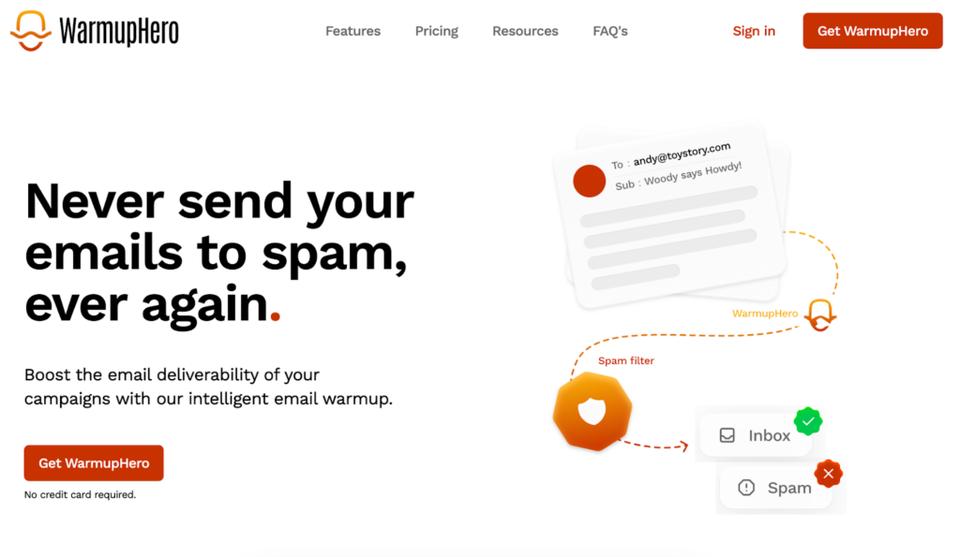
SmartReach.io is a cold email software that ships Warmup Hero free on every plan, so the warmup and the campaign that depends on it sit on one bill instead of two. Its Sales Engagement plans extend the same sequence to LinkedIn, calls and WhatsApp, which is why it also works as a sales engagement platform.
Warmup Hero sends to real inboxes rather than generated addresses, maintains conversation threads with automated replies, pulls messages out of spam and promotions, and reports placement by folder so you can see when a mailbox is actually ready. The ramp is incremental and runs on autopilot once configured, and you can attach a personalised signature so the warmup mail looks like the rest of your sending.
The reason it sits first is arithmetic rather than features. Every other tool on this list is a second subscription on top of whatever sends your campaigns. Warmup Hero is not, and at ten mailboxes that difference is the entire cost of a standalone warmup plan.
Pricing has no per-seat component. Plans scale by active prospects, and every plan above Basic includes unlimited users and unlimited sending email accounts, so adding a teammate or another mailbox does not move the bill.
Pros
- Warmup is included free on every plan, not sold as a separate subscription.
- Free unlimited email validation on the same plan, so list quality and warmup are handled together.
- Email, LinkedIn, calls and WhatsApp run as steps in one sequence.
- No per-seat pricing, and unlimited sending accounts above Basic.
Cons
- You have to run your outreach here to get the warmup, so it is not a fit if your sending tool is fixed.
- Fewer standalone deliverability diagnostics than a dedicated tool like Folderly.
- The warmup network size is not published as a headline number.
- Depth of the multichannel features means a longer first-week setup than a single-purpose warmup app.
2. TrulyInbox: best for agencies, because inboxes are free
- From
- $22/mo billed annually, $29 monthly
- Free trial
- Free plan, 1 account, 10 emails/day
- Best for
- Agencies and teams running many inboxes, where per-inbox pricing would multiply fast.
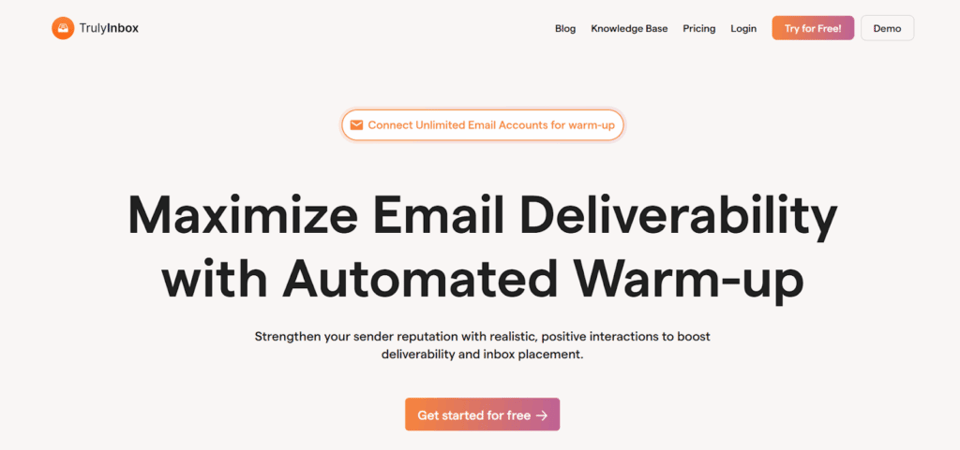
TrulyInbox charges for the volume of warmup email you send rather than the number of inboxes you connect, which is the single most agency-friendly pricing model in this category. Connect five inboxes or fifty, the bill does not move until your daily warmup volume does.
The feature set does not thin out to pay for that. You get a deliverability score with provider-level reports showing where mail lands, four warmup strategies led by an AI Adaptive mode that adjusts sending behaviour to stay human-looking, SPF, DKIM and DMARC verification, and blacklist monitoring on your domain. It works with Google Workspace, Microsoft 365, Zoho, Yahoo and 18 or more other providers.
Paid tiers run $29/mo monthly or $22/mo annually for 200 warmup emails a day, $99/$84 for 1,000 a day, $199/$169 for 3,000, and $479/$407 for 5,000, with custom tiers up to 20,000 a day. The free plan gives 1 account and 10 emails a day, which is a test, not a programme.
Pros
- Volume pricing means unlimited connected accounts on every paid tier.
- AI Adaptive strategy adjusts the sending pattern automatically.
- Authentication checks and blacklist monitoring included, not upsold.
- Genuinely useful free tier for validating the setup before paying.
Cons
- The headline prices are annual. Monthly billing costs roughly 30% more.
- Volume pricing punishes you if you run few inboxes at high volume each.
- Warmup only, so it is a second subscription alongside your sending tool.
- Daily-volume tiers mean a busy month can push you into the next bracket.
3. Mailwarm: best for a simple ramp on a few mailboxes
- From
- $69/mo billed annually
- Free trial
- Not published
- Best for
- Small teams who want a scheduled, provider-level warmup without configuring much.
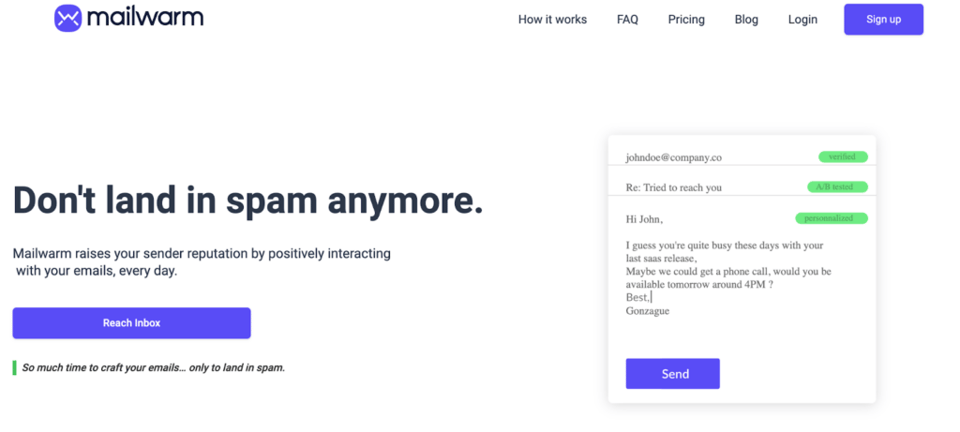
Mailwarm runs a scheduled warmup against a network it states is 50,000+ Mailwarm accounts, with provider-level handling for Gmail, Outlook, Microsoft 365 and SMTP. It is the least configurable tool here, which is the point: you set a schedule and it runs.
You get spam score monitoring, control over the time of day warmup runs, and reporting on progress. There is no attempt to be a deliverability suite.
Plans are billed annually: Starter at $69/mo for 1 mailbox and up to 50 warmup emails a day, Growth at $159/mo for 3 mailboxes and 200 a day, and Scale at $479/mo for 10 mailboxes and 500 a day. A tailored tier covers unlimited mailboxes on request.
Pros
- Very little to configure, so it is running the same day.
- Provider-level warmup rather than one generic pattern.
- Scheduling control over when warmup mail goes out.
- Large stated network of participating accounts.
Cons
- Expensive per mailbox. Starter is $69/mo for a single inbox.
- Prices shown are annual, and no monthly rate is published.
- Thin feature set next to MailReach or Folderly at similar money.
- No free trial published on the pricing page.
4. Folderly: best for diagnosing why mail is failing

- From
- $96/mailbox/mo billed yearly
- Free trial
- Free Inbox Insights tier, 2 tests/month
- Best for
- Teams with a deliverability problem they cannot diagnose, where the cost of staying broken exceeds the subscription.
Folderly is a full deliverability platform that uses AI to analyse email content for spam triggers, fixes the technical faults behind poor placement, and monitors where mail lands, with warmup as one component rather than the product. It is the most expensive option here per mailbox, and it is aimed at a different job.
The content analysis is the differentiator. Rather than only building reputation, Folderly tells you which phrases, structures and authentication gaps are pushing you to spam, then works through fixing them. Team permissions let you manage access across a larger organisation.
The main product is $96 per mailbox a month billed yearly. Inbox Insights, the placement testing product, is sold separately with a free tier at 2 tests a month, $79/mo for 100 tests, or $799/yr. Pulse, the alerting product, has a free tier.
Pros
- Diagnoses the cause of poor placement, not just the symptom.
- AI content analysis flags spam triggers before you send.
- Free Inbox Insights tier lets you test placement before buying anything.
- Team access controls suit larger organisations.
Cons
- $96 per mailbox a month is roughly five times MailReach for the same mailbox count.
- Billed yearly, so the entry commitment is substantial.
- The product is split into three separately priced pieces.
- Overkill if your domains are healthy and you only need a ramp.
5. MailReach: best pure deliverability tool

- From
- $19.50/mailbox/mo
- Free trial
- Free spam test, no account needed
- Best for
- Sales teams and agencies who want warmup and spam testing from one vendor at a predictable per-mailbox rate.
MailReach puts deliverability at the centre rather than treating warmup as an add-on, using a network of real inboxes to generate genuine opens, replies and spam rescues. It is the most straightforwardly priced serious tool in this list.
Warmup raises volume gradually and generates real interactions. Around it sits a spam checker that analyses content, authentication and sending infrastructure before campaigns go live, a deliverability dashboard that monitors placement and flags accounts at risk, and email verification to clean lists before they cause bounces.
The All-in-One plan, which bundles the warmer and the spam tester, is $19.50 per mailbox a month billed monthly, with 20% off on annual billing and a minimum of 20 spam test credits included. Nine mailboxes works out at $175.50 a month. The spam tester is also sold standalone by credit, and the basic email spam test, SPF checker and DKIM checker are free to use without an account.
Pros
- Clear, flat per-mailbox pricing with no tier cliffs.
- Free spam test, SPF and DKIM checkers usable before you buy.
- Warmup and pre-send spam testing from the same vendor.
- Monthly billing with no long-term commitment required.
Cons
- Per-mailbox pricing scales linearly, so twenty mailboxes is $390 a month.
- Warmup only, so it stacks on top of your sending subscription.
- Spam test credits are metered and run out on heavy testing.
- Light on agency management features for multi-client work.
6. Warmup Inbox: best cheap entry point for one sender
- From
- $15/inbox/mo
- Free trial
- 7-day free trial, no card
- Best for
- Solo senders and small teams warming one or two inboxes on a tight budget.
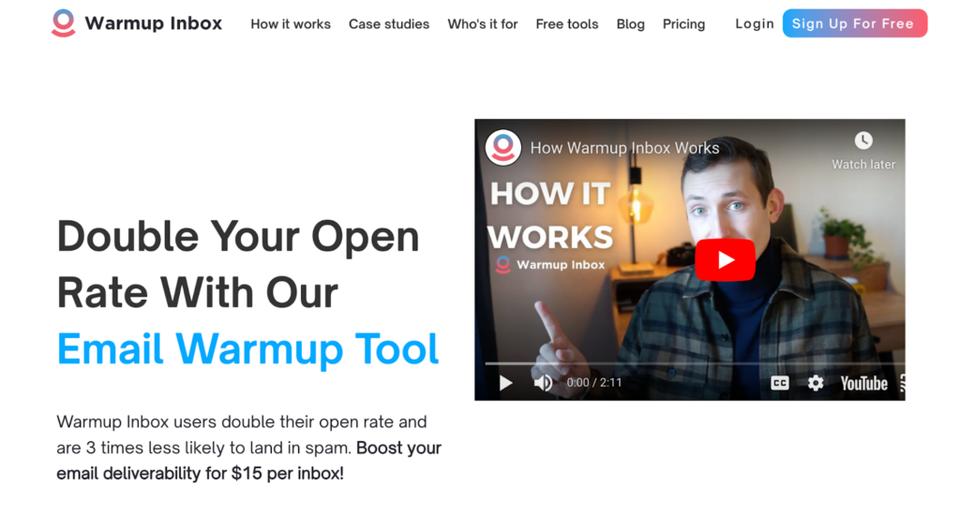
Warmup Inbox runs a network of more than 30,000 real inboxes and prices per inbox, which makes it the cheapest credible way to warm a single mailbox. It fills your inbox with genuine interaction quickly rather than ramping conservatively.
You get domain age tracking, customisable dynamic content, and a health score that tells you whether an inbox is ready to send. It is a focused tool that does one thing.
Basic is $15 per inbox a month for 75 warmup messages a day, Pro is $49 for 250 a day, and Max is $79 for 1,000 a day, each with 20% off on annual billing. Custom plans start at 15 inboxes, with volume discounts past 50. The 7-day free trial needs no card.
Pros
- Cheapest entry price here at $15 for a single inbox.
- 30,000+ real inboxes in the network, not generated addresses.
- Health score gives a clear ready-or-not answer.
- Free trial with no card required.
Cons
- Per-inbox pricing multiplies fast. Ten inboxes on Basic is $150 a month.
- Basic's 75 messages a day is thin for a domain you intend to push.
- Jumping to 250 a day triples the per-inbox price to $49.
- Warmup only, with no sending or campaign features.
7. Warmbox: best fixed-bundle pricing

- From
- $19/mo monthly, $15/mo yearly
- Free trial
- Not published
- Best for
- Teams with a known, stable inbox count who prefer a fixed bundle to per-unit pricing.
Warmbox sells fixed bundles of inboxes rather than charging per unit, applying warmup recipes tuned to different sending profiles. If your inbox count is settled, a bundle is easier to budget than a multiplier.
It uses a private inbox network spanning many countries, lets you customise the timing and daily volume, and checks your IP and domain blacklist status alongside DNS configuration.
Monthly pricing is Solo at $19 for 1 inbox and 50 emails a day, Start-up at $79 for 3 inboxes and 250 a day, and Growth at $159 for 6 inboxes and 500 a day. Yearly billing drops those to $15, $69 and $139. Custom enterprise plans cover higher volumes.
Pros
- Fixed bundles make the bill predictable as you grow into a tier.
- Warmup recipes tuned to different sending profiles.
- Blacklist and DNS configuration checks included.
- Meaningful discount on yearly billing, roughly 20%.
Cons
- Bundles waste money if your inbox count sits just above a tier.
- Six inboxes on Growth is $159, well above volume-priced rivals.
- Network size is not published, so the claim is hard to verify.
- No free trial published on the pricing page.
8. InboxWarm by OutreachBin: cheapest per account on a long commitment
- From
- $19.97/account/mo on 12 months
- Free trial
- Free trial available
- Best for
- Teams willing to commit for six or twelve months in exchange for the lowest per-account rate.
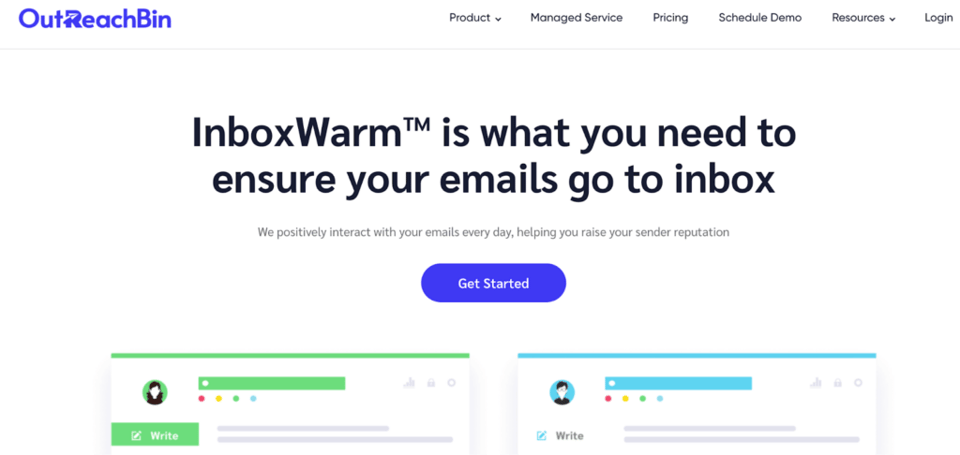
InboxWarm puts every user into a peer-to-peer network, so warmup mail flows between real businesses that are themselves warming inboxes. It sits inside OutreachBin, so the sequencing and the warmup share an account.
The network automatically clears warmup mail out of spam and connects to Gmail, Outlook, SMTP and other common inboxes. Each "stack" covers one email address, and all terms include the same features: unlimited sends, sequences, campaigns, team members, A/B testing, analytics and integrations.
Pricing is per account and rewards commitment: $39.99 a month on a 3-month term, $24.99 on 6 months, and $19.97 on 12 months. There is a free trial and a managed service option for agencies.
Pros
- $19.97 per account on an annual term is competitive against dedicated warmup tools.
- Sequencing and warmup share one account, so no second subscription.
- Peer-to-peer network means real business inboxes.
- Unlimited team members on every term.
Cons
- The best rate requires a 12-month commitment paid on that term.
- The 3-month rate of $39.99 per account is poor value by comparison.
- Per-account pricing still multiplies across a large inbox estate.
- Smaller, less well-known product than the alternatives here.
9. Smartlead: best if you want unlimited mailbox connections
- From
- $39/mo
- Free trial
- Free trial, no card required
- Best for
- Teams who want the sending platform and the warmup in one tool with no per-mailbox charge.
Smartlead is a sending platform that includes automated warmup and lets you connect unlimited mailboxes at no extra charge, rotating sends across them automatically. Like SmartReach.io, it removes the second subscription, though it is priced by send and contact volume instead.
Beyond warmup it covers sequencing, personalisation from recipient data, automated follow-ups that respond to engagement, and reporting on opens, clicks and conversions. It integrates with common CRMs and email providers.
Monthly pricing is Base at $39 for 6,000 sends, Pro at $94 for 90,000, Unlimited Smart at $174 for 150,000, and Unlimited Prime at $379 for 500,000. Annual billing takes about 17% off, bringing Base to $32.50 a month. A free trial needs no card.
Pros
- Unlimited mailbox connections on every plan, with automatic rotation.
- Warmup and sending on one bill rather than two.
- Send volumes on the upper tiers are generous.
- Free trial with no card required.
Cons
- Priced by send and contact volume, so a big list moves you up tiers fast.
- Base at 6,000 sends a month is tight for a real outbound programme.
- Email-first, so multichannel steps are not the strength.
- Warmup is a bundled feature rather than a deliverability specialism.
How to measure email warmup success
Warmup is not finished on a date. It is finished when the numbers say so.
Inbox placement rate. The share of warmup mail landing in the primary inbox rather than spam or promotions. This is the metric that actually answers "is it working". Every tool here reports it; if yours does not, that is a reason to switch.
Spam complaint rate. Google asks bulk senders to stay under 0.3%, and that threshold applies to your campaigns, not your warmup. Warmup exists to buy you room under it.
Deliverability rate. The share of mail accepted by the recipient server, excluding bounces. A steady climb is the signal you want. A flat line after two weeks means something upstream is wrong, usually authentication.
Reply rate inside the warmup network. Providers weigh two-way engagement heavily. A warmup tool generating opens but no replies is doing half the job.
Pair those with the best practices for a cold email campaign, because a warmed domain sending bad mail cools off quickly.
What affects how long warmup takes
Domain age and history. A brand-new domain starts from nothing, which is slow but clean. A domain with a damaged reputation takes longer, because you are overwriting a record rather than creating one.
Authentication. SPF, DKIM and DMARC must be correct before warmup starts, or you are building reputation on a foundation providers will not credit. Our free email authentication checker reports all three for any domain without a signup.
Sending volume and ramp. The ramp matters more than the total. Holding each mailbox under 40 emails a day and spreading volume across roughly 5 mailboxes per domain protects the domain reputation that every mailbox on it shares.
List quality. Bounces damage reputation as fast as spam complaints. Validate before you load a list, not after the bounces arrive.
Content and engagement. Spam-triggering copy undoes warmup. If placement drops the week you launch a campaign, look at the copy before you blame the warmup.
Six warmup mistakes that undo the work
So which email warmup tool should you buy?
Work out your inbox count first, then pick the pricing unit that suits it. That single decision matters more than any feature comparison on this page.
If you also need the sending, buy SmartReach.io. Warmup Hero is included free on every plan from $29 a month, the validation is free and unlimited on the same plan, and the sequences run across email, LinkedIn, calls and WhatsApp. You are not paying a second subscription for the warmup that makes the first one work.
If you run many inboxes, buy TrulyInbox. Volume pricing is the only model here that does not multiply with inbox count, and at ten or more mailboxes nothing else is close.
If you need warmup plus a spam test, buy MailReach at $19.50 per mailbox, and use its free spam checker before you pay for anything.
If mail is already failing and you do not know why, buy Folderly. It is the most expensive per mailbox by a distance, and it is the only one here built to diagnose rather than to ramp.
If you are warming one inbox on a budget, buy Warmup Inbox at $15 and revisit the decision at five inboxes.
Whichever way you go, do the multiplication before you sign. A $15 tool and a $22 tool are not $7 apart once you have ten mailboxes. They are $128 apart.
Email warmup tools FAQ
What is the best email warmup tool?
SmartReach.io is the best pick if you also send the campaigns, because its Warmup Hero is included free on every plan from $29 a month rather than billed as a second subscription. TrulyInbox is the best standalone tool for agencies, because it charges by warmup volume instead of per inbox. MailReach is the best pure deliverability tool at $19.50 per mailbox a month.
What are email warmup tools?
Email warmup tools automatically send and reply to messages from your mailbox on a rising schedule, so mailbox providers see steady two-way engagement before your first campaign lands. They pull messages out of spam, keep threads alive, and report where your mail is placed. SmartReach.io bundles this as Warmup Hero and runs it alongside email, LinkedIn, calls and WhatsApp sequences.
Do email warmup tools work?
They work when the network is real inboxes rather than generated addresses, because providers weigh genuine opens, replies and spam rescues. Warmup does not rescue a bad list or spammy copy. It builds the reputation that lets good copy reach an inbox, which is why SmartReach.io pairs Warmup Hero with free unlimited email validation on the same plan.
How much does email warmup cost?
Standalone tools run from about $15 per inbox a month at Warmup Inbox to $96 per mailbox a month at Folderly, and the unit matters more than the headline. TrulyInbox charges by warmup volume, so unlimited accounts fit one bill. SmartReach.io includes Warmup Hero free on every plan, starting at $29 a month with no per-seat pricing.
How long does email warmup take?
Three to four weeks is the realistic window for a new domain, and closer to six if the domain has a damaged reputation to repair. The volume ramp matters more than the calendar. SmartReach.io recommends holding each mailbox under 40 emails a day and spreading a campaign across 5 mailboxes per domain rather than pushing one inbox hard.
Is free email warmup any good?
Free tiers are sized for testing, not for running outbound. TrulyInbox gives 1 account and 10 warmup emails a day, which will not carry a live campaign. The better free option is warmup bundled into the tool you already pay for, which is how SmartReach.io ships Warmup Hero at no extra cost on every plan.
Stop juggling tools
Book more meetings on every channel
Join 5,000+ teams running multichannel outreach from one sequence, with deliverability built in.