HubSpot Competitors: 13 Alternatives Compared for 2026

On this page
HubSpot is a good CRM. The interface is friendly, the free edition is real, and marketing and sales can work from one contact database.
So why are you reading a list of HubSpot competitors?
For most teams the answer is the invoice. HubSpot charges per seat, Sales Hub Professional costs $100 per sales seat per month with a $1,500 onboarding fee, and its AI agents now draw on a pool of HubSpot Credits. Add four reps and the bill moves four times.
This guide compares the 13 HubSpot competitors worth a real look. Pricing comes from each vendor's live pricing page, checked on November 23, 2026, not from a 2023 screenshot.
Why do teams look for HubSpot competitors?
Teams leave HubSpot, or add a second tool next to it, for four reasons, and price is first. HubSpot is still growing fast. It reported 311,704 customers as of September 30, 2026, up 12% year on year, in its Q3 2026 results. The pain points are about fit, not quality.
- Per-seat pricing on every paid tier. Sales Hub Starter lists at $20 per seat per month, Professional at $100 per sales seat and Enterprise at $150 per sales seat, according to HubSpot's Sales Hub pricing page in November 2026.
- Onboarding fees. Professional carries a required $1,500 onboarding fee and Enterprise $3,500, on top of an annual commitment.
- AI is metered. Since June 2025 HubSpot's Breeze agents run on HubSpot Credits, with 500 to 5,000 credits a month depending on the tier and extra credits sold on top.
- Outreach is email-first. HubSpot sequences cover email, tasks and calls. LinkedIn and WhatsApp steps need another tool, so the reply data ends up in two places.
Here's a familiar case. Stan runs RevOps for a 12-person outbound team on HubSpot Professional. His reps only use the contact record and sequences, yet each of them costs a full sales seat. Does he need a new CRM, or a cheaper way to run outreach? That question decides which half of this list he should read.
How we evaluated these HubSpot alternatives
We scored every tool the same way, using each vendor's live pricing page on November 23, 2026.
- True cost for a five-person team, including onboarding fees and seat minimums, not just the entry tier.
- Pricing unit, per user, per seat, per contact or flat, because seat cost is the top reason teams leave HubSpot.
- Whether it replaces HubSpot or works beside it. Some tools here are full CRMs. SmartReach.io is the outreach layer that keeps HubSpot as the record.
- Channels in one sequence, specifically email, LinkedIn, calls and WhatsApp.
- AI and automation, and whether AI is metered as credits.
- Migration effort, because a switch that takes a quarter costs more than the license.
We read other roundups too, such as EngageBay's list of HubSpot Sales Hub alternatives, to check we had not missed a serious contender. Prices change often and some vendors show regional pricing, so check the live page before you buy.
HubSpot competitors compared at a glance
HubSpot sits at the top as the baseline. The rest are full CRM replacements, except SmartReach.io, which replaces HubSpot's outreach and keeps HubSpot as the CRM. Scroll sideways on mobile to see every column.
| Tool | Starting price | Pricing unit | Free plan or trial | Replaces HubSpot as CRM? | Best for |
|---|---|---|---|---|---|
| HubSpot Sales Hub (baseline) | Free, then $20/seat/mo | Per seat, plus credits | Free for 2 users | It is the CRM | Sales and marketing on one database |
| SmartReach.io | $29/mo | Active prospects, no per-seat pricing | 14-day free trial | No, syncs two-way with HubSpot | Outbound on email, LinkedIn, calls and WhatsApp |
| Salesforce Sales Cloud | $25/user/mo | Per user | Free Suite | Yes | Large teams that need deep customization |
| Zoho CRM | $14/user/mo (annual) | Per user | Free for 3 users | Yes | Full CRM at the lowest seat price |
| Pipedrive | $14/seat/mo (annual) | Per seat | 14-day trial | Yes | Simple visual pipeline |
| Salesmate | $23/user/mo | Per user | 15-day trial | Yes | CRM with a built-in phone |
| Freshsales | $9/user/mo (annual) | Per user | 21-day trial | Yes | AI lead scoring on a budget |
| Copper | $23/seat/mo (annual) | Per seat | Free trial | Yes | Google Workspace teams |
| Insightly | $29/user/mo (annual) | Per user | 14-day trial | Yes | CRM plus project delivery |
| Sugar Sell (SugarAI) | $68/user/mo (annual) | Per user | Demo | Yes | Manufacturing and distribution |
| Nimble | $29.90/seat/mo (annual) | Per seat | Free trial | Yes, for small teams | Relationship-led selling |
| Creatio | Quote-based | Per user, 5-user minimum | Demo | Yes | No-code process automation |
| Pipeliner CRM | $85/user/mo (annual) | Per user, 15-user minimum | 14-day trial | Yes | Visual sales management |
| BIGContacts | Free, then per 1,000 contacts | Per contact tier, unlimited users | Free for 100 contacts | Yes, for small teams | Small-business starter CRM |
The 13 best HubSpot competitors
Every review below runs the same way. Quick facts, what the tool does well, where it beats HubSpot, honest pros and cons, and a verdict.
1. SmartReach.io
Quick facts
- G2
- 4.6/5 ★
- Capterra
- 4.7/5 ★
- From
- $29/mo
- Free trial
- 14 days
- Best for
- outbound teams that keep HubSpot as the CRM and want email, LinkedIn, calls and WhatsApp in one sequence
SmartReach.io isn't a HubSpot clone, and that's the point. It's a cold email software that sits next to HubSpot. Its Sales Engagement plans run email, LinkedIn, calls and WhatsApp from one cadence, and a two-way HubSpot integration keeps contacts and activity in sync with the HubSpot record. It's rated 4.6 on G2 from 60 reviews as of November 2026.
That changes the HubSpot math for an outbound team. You keep HubSpot, on a cheaper tier or the free edition, as the system of record, and move prospecting to SmartReach.io, which has no per-seat pricing. Plans scale by active prospects, and every plan above Basic includes unlimited users and unlimited sending email accounts.
A single SmartReach.io sequence can open with an email, send a LinkedIn connection request if there's no reply, queue a call on the built-in dialer, and finish with a WhatsApp message. One reply on any channel stops the sequence for that prospect.
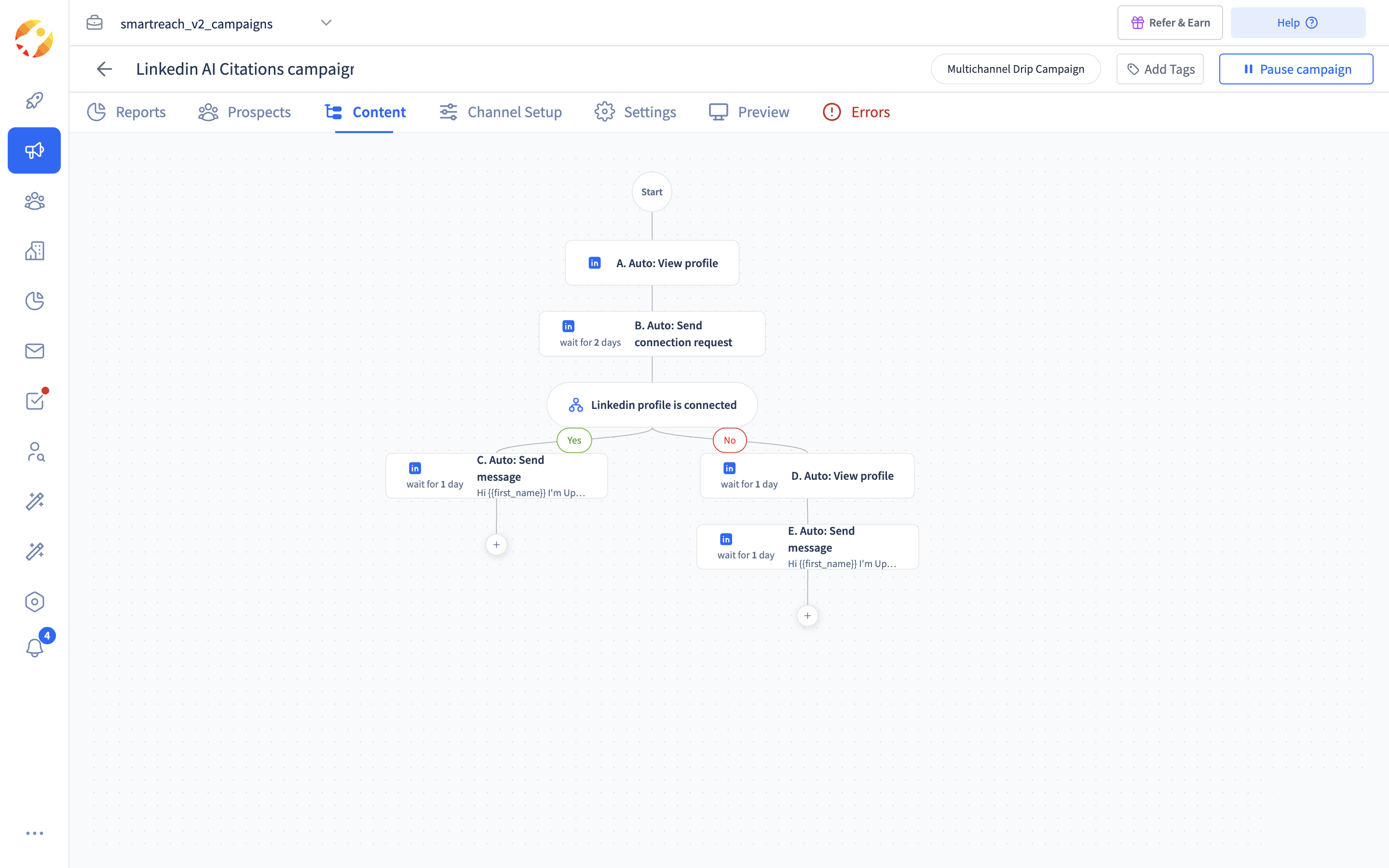 A SmartReach.io sequence that branches on whether the prospect accepted the LinkedIn connection request.
It also works as a sales engagement platform for teams that want one place to run omnichannel sales outreach, and the setup steps are in the HubSpot sync guide.
Core capabilities
- Four channels in one cadence. Email, LinkedIn, calls and WhatsApp, with one reply-pause rule across all of them.
- Deliverability protection. Email validation, spam tests, inbox rotation (Inbox Rotation) and warmup, so volume doesn't burn your domain.
- Prospect CRM. Advanced filters, a live activity feed, custom fields, duplicate handling and reply-type tags for millions of prospects.
- Lead Finder. Find and verify contacts inside SmartReach.io, then drop them straight into a sequence.
- Two-way CRM sync. Native sync with HubSpot, Salesforce, Pipedrive and Zoho CRM.
Pros
- No per-seat pricing, so a growing team doesn't add a seat cost for every new rep.
- LinkedIn and WhatsApp steps that HubSpot sequences don't have.
- Keeps HubSpot as the CRM, so there's no data migration.
- 14-day free trial.
Cons
- It isn't a full CRM. Teams that want deal forecasting and marketing automation still need HubSpot or another CRM behind it.
- Calling and LinkedIn steps sit on the Sales Engagement plans, not the Email Outreach plans.
- There's no free plan, only the trial.
Pricing
SmartReach.io sells two plan families. Email Outreach costs $29, $89, $199 and $499 per month across Basic, Plus, Pro and Scale. Sales Engagement, which adds calling, LinkedIn and WhatsApp, costs $39, $99, $249 and $599 per month.
2. Salesforce Sales Cloud
Quick facts
- From
- $25/user/mo
- Free trial
- Free Suite
- Best for
- large or complex sales teams that need deep customization, forecasting and AI agents
Salesforce is HubSpot's biggest competitor and the default choice for enterprises. Sales Cloud covers leads, accounts, opportunities, forecasting and reporting, and its AppExchange marketplace has an integration for nearly anything.
The 2025 and 2026 releases moved Salesforce toward AI agents. The top Max edition includes Agentforce for Sales, and Agentforce can be added to Core and above from $125 per user per month.
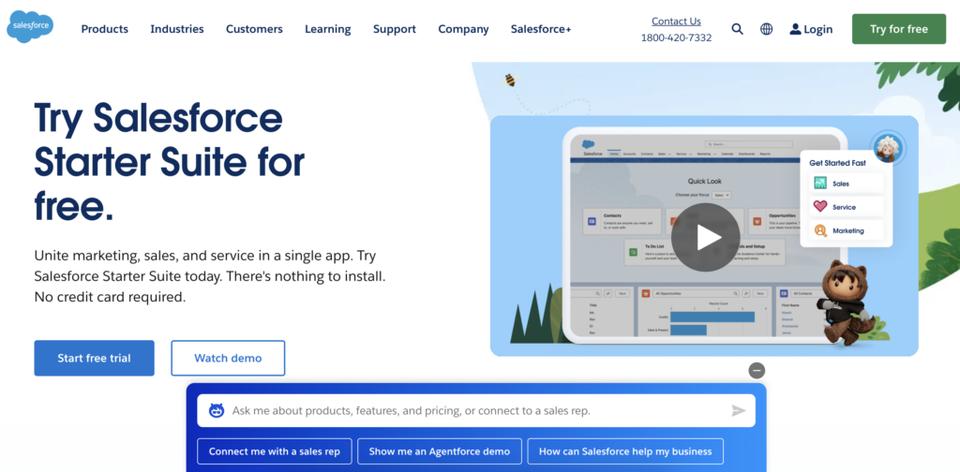 Salesforce Sales Cloud, the enterprise alternative to HubSpot.
Pros
- Almost unlimited customization and the biggest app marketplace.
- Strong forecasting and reporting for large sales floors.
- A Free Suite and a $25 Starter Suite for small teams.
Cons
- Pro Suite is $100 per user per month, and Core, Advanced and Max run $195, $395 and $550, all billed annually.
- It usually needs an admin or a consultant to set up well.
Pricing. Free Suite $0, Starter Suite $25, Pro Suite $100, Core $195, Advanced $395 and Max $550 per user per month, from the Salesforce pricing page in November 2026.
3. Zoho CRM
Quick facts
- From
- $14/user/mo (annual)
- Free trial
- Free for 3 users
- Best for
- budget-conscious teams that want a complete CRM for the lowest seat price
Zoho CRM is the best-value full CRM on this list. It covers pipelines, workflows, territory management and analytics, and it connects to the rest of the Zoho suite for teams that also need email, help desk or finance tools.
Zoho now lists AI agents from the Standard tier up, and Ultimate adds QuickML for custom models. The free edition is free forever for 3 users with no credit card.
Pros
- Very low seat prices, and the Zoho suite at a discount.
- Deep customization for the price.
Cons
- The interface feels busier than HubSpot's.
- Zoho's own US pricing page didn't show paid tier prices when we checked, so confirm the quote.
Pricing. Standard from about $14, Professional $23, Enterprise $40 and Ultimate $52 per user per month billed annually, according to recent third-party listings. Monthly billing costs more.
4. Pipedrive
Quick facts
- From
- $14/seat/mo (annual)
- Free trial
- 14 days, no card
- Best for
- small sales teams that want a visual pipeline they can run without training
Pipedrive is the simplest CRM here. Deals move across a drag-and-drop pipeline, and reps get going in an afternoon. Its plans are now called Lite, Growth, Premium and Ultimate.
The 2026 pitch is AI. Pipedrive says every plan works with Claude, ChatGPT and other assistants through MCP, and it adds meeting intelligence and AI report building. Its automations can also run automated enterprise workflows such as assigning leads and creating follow-up tasks.
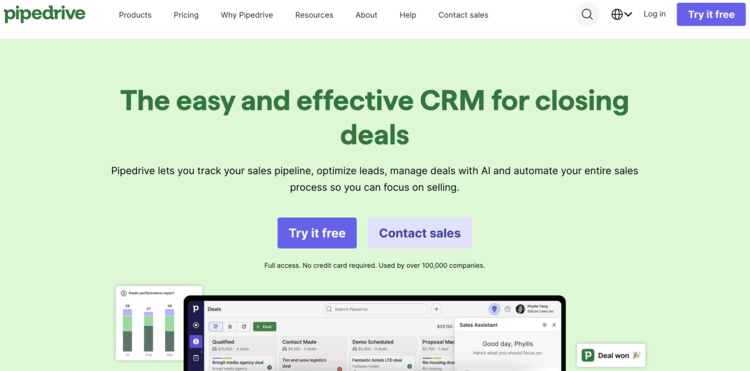 Pipedrive's visual pipeline is its main draw.
Pros
- The lowest learning curve of any CRM on this list.
- A 14-day trial with no card.
Cons
- Prices vary by region, and the higher tiers climb quickly.
- Marketing automation is an add-on, not built in.
Pricing. Lite starts at about $14 per seat per month billed annually. Growth, Premium and Ultimate cost more, and Pipedrive saves up to 26% on annual billing.
5. Salesmate
Quick facts
- From
- $23/user/mo
- Free trial
- 15 days
- Best for
- teams that want a full CRM with a built-in phone and an AI assistant
Salesmate is a full sales CRM with pipelines, sequences, built-in calling and texting, and an AI assistant called Sandy AI on the Pro plan and up. Every plan includes AI agent credits.
It's the closest like-for-like HubSpot Sales Hub replacement for a phone-heavy team.
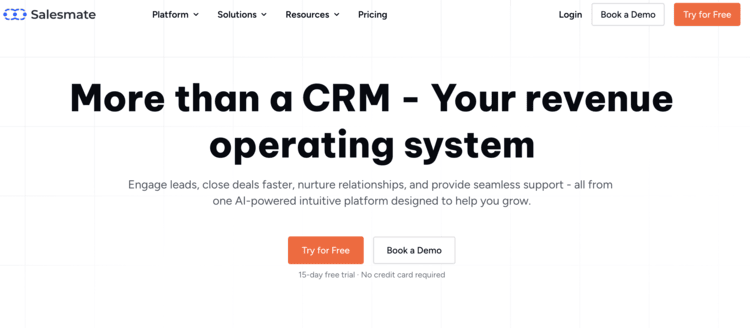 Salesmate puts calling and sequences inside the CRM.
Pros
- Calling and texting built into the CRM.
- Lower seat prices than HubSpot Professional.
Cons
- Enterprise onboarding starts at $1,999.
- Sandy AI isn't on the Basic plan.
Pricing. Basic $23, Pro $39 and Business $63 per user per month billed monthly, with up to 20% off annually.
6. Freshsales
Quick facts
- From
- $9/user/mo (annual)
- Free trial
- 21 days
- Best for
- small teams that want AI lead scoring and a built-in phone on a tight budget
Freshsales, the CRM from Freshworks, has the lowest paid entry price on this list. It includes contact scoring with Freddy AI, a built-in phone and email, and visual deal pipelines.
It suits teams that already use Freshdesk, because the two share customer data.
Pros
- The cheapest paid seat here.
- The longest free trial on this list.
Cons
- The free plan was reportedly removed in 2026, so check before you plan around it.
- Reporting is thinner than HubSpot's.
Pricing. Growth about $9, Pro $39 and Enterprise $59 per user per month billed annually, according to G2 and recent third-party listings.
7. Copper
Quick facts
- From
- $23/seat/mo (annual)
- Free trial
- Free trial, no card
- Best for
- teams that run their whole day inside Gmail and Google Workspace
Copper is the CRM for Google Workspace teams. It lives inside Gmail, pulls contacts and emails in automatically, and keeps records up to date without manual entry. Newer AI features write and rewrite email templates.
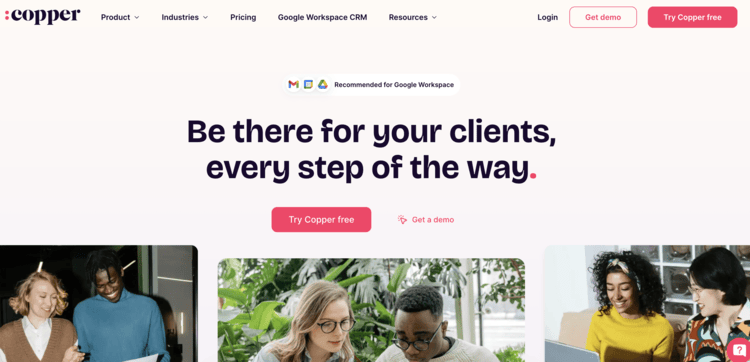 Copper works from inside Gmail.
Pros
- The best Gmail and Google Calendar fit of any CRM here.
- Very little data entry.
Cons
- It's a weaker choice for Microsoft 365 teams.
- Automation sits on the higher tiers.
Pricing. Basic $23, Professional $59 and Business $99 per seat per month billed annually, or $29, $69 and $134 billed monthly.
8. Insightly
Quick facts
- From
- $29/user/mo (annual)
- Free trial
- 14 days, no card
- Best for
- teams that sell and then deliver projects for the same customers
Insightly combines a CRM with project management, so a deal can turn into a delivery project without leaving the tool. It integrates with Microsoft, Google, Mailchimp and Zapier, and AI Copilot is on the Professional and Enterprise plans.
Reps at events can add contacts quickly with a QR code business card and the mobile app's card scanner.
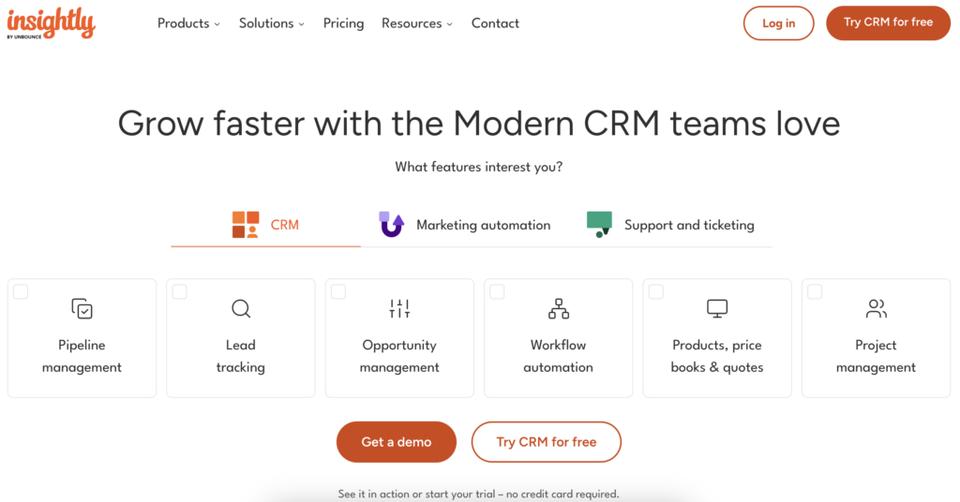 Insightly links deals to delivery projects.
Pros
- CRM and project delivery in one place.
- Clear per-user pricing with no onboarding fee listed.
Cons
- Monthly billing prices aren't published.
- AI Copilot isn't on the entry plan.
Pricing. Plus $29, Professional $49 and Enterprise $99 per user per month billed annually.
9. Sugar Sell (SugarAI)
Quick facts
- From
- $68/user/mo (annual)
- Free trial
- Demo
- Best for
- manufacturers and distributors that sell from ERP and order history
SugarCRM rebranded as SugarAI in 2026, and Sugar Sell is its sales CRM. Its strength is Sugar Predict, which reads ERP and order data to flag customers likely to churn or reorder.
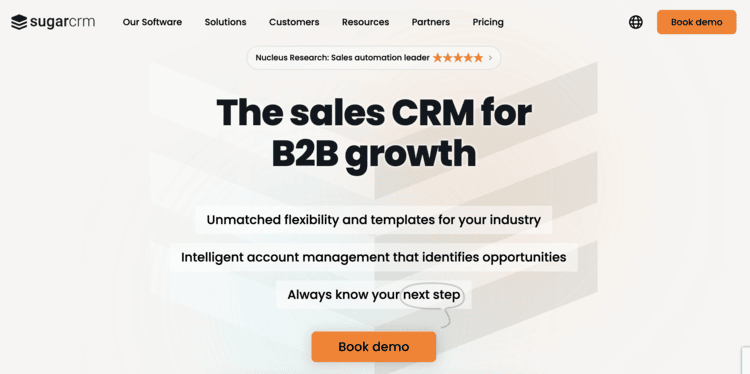 Sugar Sell, now part of SugarAI.
Pros
- Strong account management for repeat-order businesses.
- Can be deployed in the cloud or on your own servers.
Cons
- Pricier than most CRMs on this list.
- No self-serve trial, you book a demo.
Pricing. Standard+ $68, Advanced+ $98 and Premier+ $155 per user per month billed annually.
10. Nimble
Quick facts
- From
- $29.90/seat/mo (annual)
- Free trial
- Free trial, no card
- Best for
- founders, consultants and small teams who sell through relationships
Nimble is a lightweight CRM that builds contact records from email, calendars and social profiles. Its browser extension, Nimble Prospector, adds people from LinkedIn and websites in a click, and its "Stay in touch" reminders keep relationships from going cold.
New in 2026 are AI Sequences and a Nimble MCP server that works with Claude and ChatGPT.
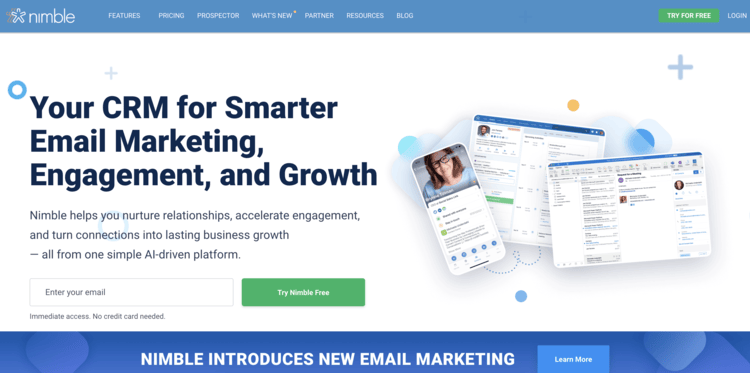 Nimble builds contact records from email and social profiles.
Pros
- One simple plan with 25,000 contacts.
- Very little setup.
Cons
- Too light for a structured sales team with managers and forecasts.
- Reporting is basic.
Pricing. One plan at $29.90 per seat per month billed annually.
11. Creatio
Quick facts
- From
- Quote-based
- Free trial
- Demo
- Best for
- operations-heavy teams that want to build custom sales processes without code
Creatio is a no-code platform with CRM apps for sales, marketing and service on top. Teams build their own workflows, approvals and data models visually, which makes it a fit for regulated industries with unusual processes.
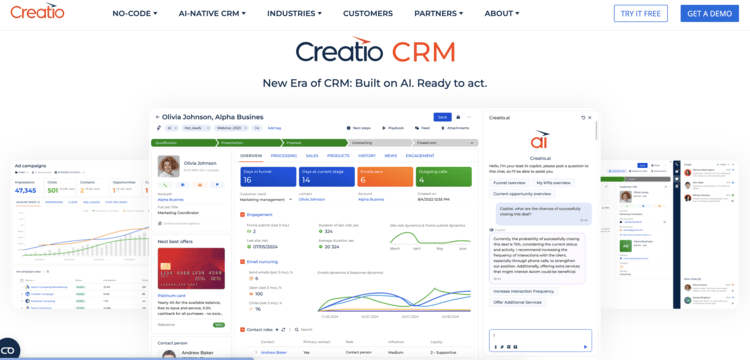 Creatio lets teams design their own sales process without code.
Pros
- Very flexible process automation.
- AI credits included at the organization level.
Cons
- Growth and Enterprise plans need at least 5 users.
- Per-user prices aren't shown on the page, so you need a quote.
Pricing. Quote-based, with a 5-user minimum on Growth and Enterprise. Organization AI credits run from 200 a month to 10,000 on Unlimited.
12. Pipeliner CRM
Quick facts
- From
- $85/user/mo (annual)
- Free trial
- 14 days
- Best for
- mid-size and large sales teams that manage by visual pipeline
Pipeliner CRM, whose pricing now sits on the Coevera site, is built for sales managers. Pipelines, account maps and org charts are visual, and its Voyager AI is included, with a more advanced version as an add-on.
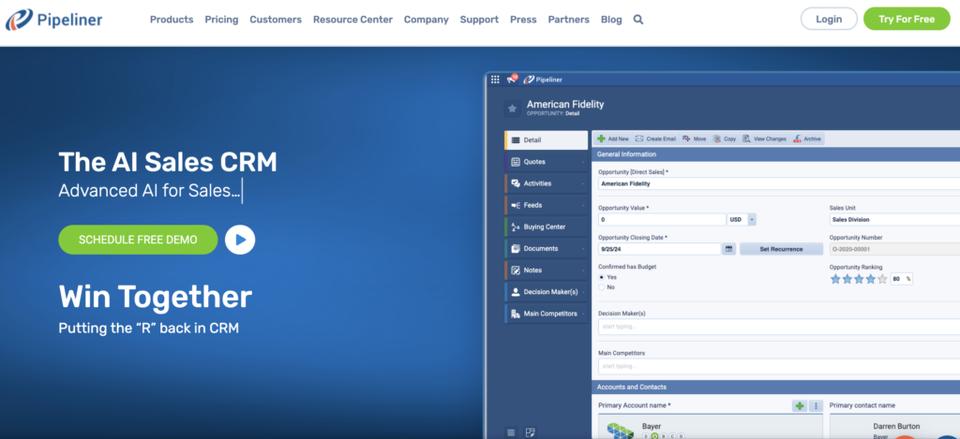 Pipeliner CRM is built around visual pipelines and account maps.
Pros
- Strong visual tools for sales managers.
- AI included in the base price.
Cons
- A 15-user minimum rules out small teams.
- High seat prices.
Pricing. Business $85, Enterprise $115 and Unlimited $150 per user per month billed annually, with a 15-user minimum.
13. BIGContacts
Quick facts
- From
- Free, then per 1,000 contacts
- Free trial
- Free plan (100 contacts), 15-day trial
- Best for
- small businesses that want contacts, email marketing and a pipeline in one simple CRM
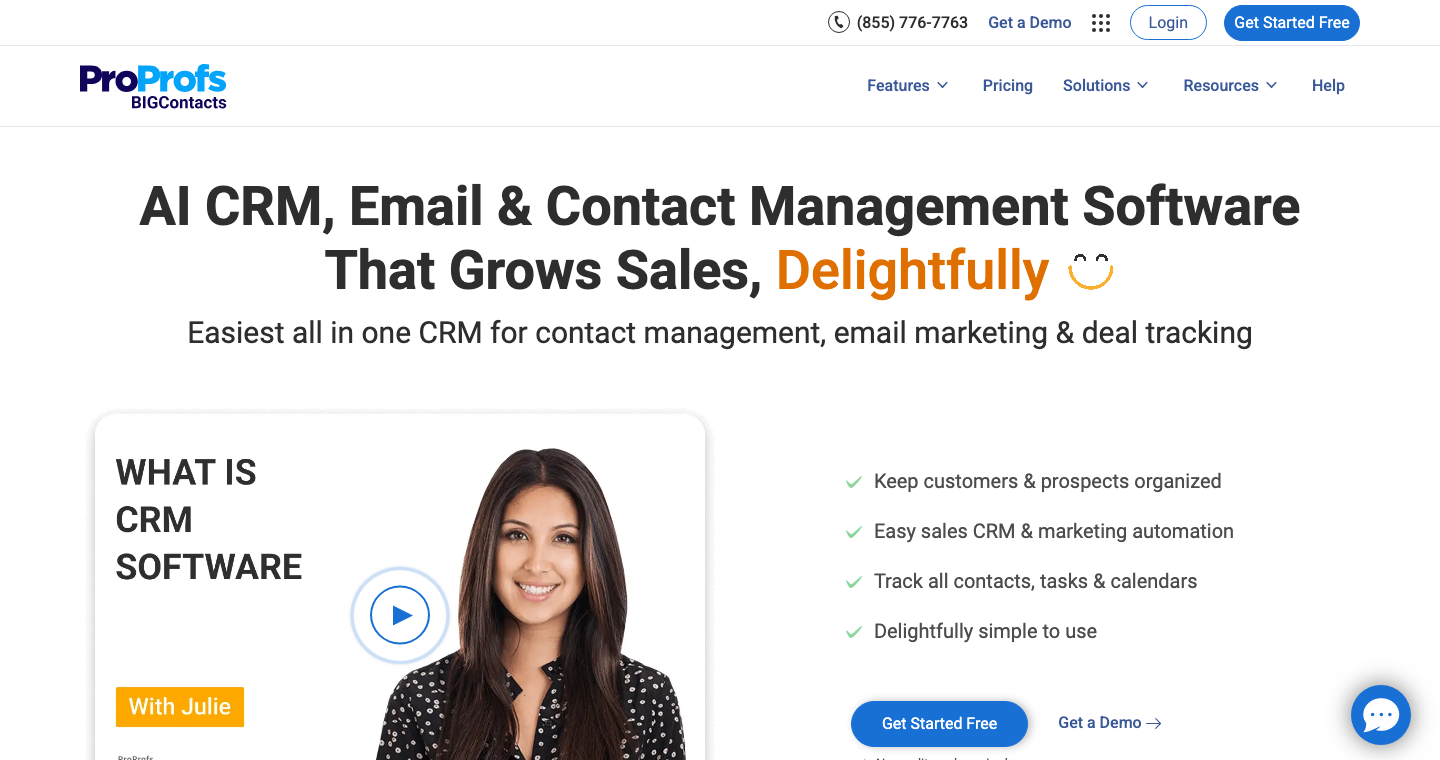
BIGContacts is a CRM for small and medium-sized businesses that want to manage contacts, sales pipelines and email marketing in one place. It keeps emails, calls, meetings, notes, tasks and files in each contact profile, and AI Search finds records through plain-language questions.
Its AI Marketing Campaign Designer drafts email campaigns from a goal and audience, and the AI Pipeline Tracker flags deals that have stalled.
Pros
- Free forever for 1 user and 100 contacts.
- Unlimited users on paid plans.
- Contacts, email marketing and pipeline in one tool.
Cons
- Pricing grows with contact count, so large databases cost more.
- Built for small businesses, not enterprise sales teams.
Pricing. A free plan for 100 contacts, then paid plans priced per 1,000 contacts with unlimited users. The Business plan listed $19.99 per month per 1,000 contacts billed annually, with a promotional $9.99, when we checked in November 2026.
How do you choose the right HubSpot competitor?
Start with one question. Are you replacing HubSpot, or replacing what HubSpot costs you for outreach?
- You need a different CRM. Pick Salesforce for scale, Zoho CRM or Freshsales for price, Pipedrive for simplicity, Copper for Google Workspace, or Sugar Sell for repeat-order businesses.
- Your reps mostly run sequences. Keep HubSpot as the record and add SmartReach.io, which syncs two-way and runs email, LinkedIn, calls and WhatsApp in one sequence without per-seat pricing.
- You're a small business. BIGContacts, Nimble and Zoho CRM's free edition get you started for little or nothing.
Then check the cost for your real team size. Seat minimums (5 on Creatio, 15 on Pipeliner) and onboarding fees change the math more than the headline price. Measure the switch too, with sales analytics software that tracks reply and conversion rates before and after.
I'll admit the honest answer for many teams is "don't switch." If HubSpot's marketing tools carry your inbound pipeline, ripping it out costs more than the seats. A migration is also real work. If you do move CRMs, you can hire a vetted HubSpot developer through Toptal to plan the data export and rebuild your workflows.
Moving outreach off HubSpot without leaving HubSpot
You don't have to pick between HubSpot and a cheaper tool. SmartReach.io connects to HubSpot through a native two-way integration. Contacts and activity sync both ways, so reps work their sequences in SmartReach.io while managers keep reporting in HubSpot.
If your leads are coming in but not turning into customers, these strategies to increase lead conversions pair well with a tighter outreach sequence.
Final thoughts on HubSpot competitors
HubSpot is still a strong all-in-one CRM, and for many marketing-led teams it's the right choice. The tools above win when HubSpot's per-seat pricing, onboarding fees or email-first sequences get in the way.
Here's my opinion. Most outbound teams don't need a new CRM. They need cheaper, wider outreach that writes back to the CRM they already have. If that's you, keep HubSpot and run your sequences on SmartReach.io for 14 days, free.
Start your free SmartReach.io trial
HubSpot competitors FAQs
What is the best alternative to HubSpot?
It depends on what you're replacing. Salesforce Sales Cloud is the strongest full CRM replacement for large teams, and Zoho CRM is the best value. If the problem is HubSpot's outreach cost, SmartReach.io is the pick. It's a cold email software that runs email, LinkedIn, calls and WhatsApp in one sequence and syncs two-way with HubSpot, from $29 per month.
Who is HubSpot's biggest competitor?
Salesforce is HubSpot's biggest competitor. Salesforce wins on enterprise customization and AI agents, with Sales Cloud running from $25 to $550 per user per month. HubSpot wins on ease of use. For outbound teams, SmartReach.io competes with HubSpot's sequences rather than its CRM, from $29 per month, while HubSpot stays the record.
Is there a cheaper alternative to HubSpot Sales Hub?
Yes. Zoho CRM starts at $14 per user per month billed annually and is free for up to 3 users. Freshsales starts at $9 per user per month. SmartReach.io has no per-seat pricing, so its $99 per month Sales Engagement Plus plan covers a whole team, against $500 per month for five HubSpot Professional seats.
Can I keep HubSpot CRM and use another tool for outreach?
Yes, and many outbound teams do. SmartReach.io syncs two-way with HubSpot, so contacts, activities and replies stay in the HubSpot record while sequences run in SmartReach.io. Its Sales Engagement plans add LinkedIn steps, a built-in dialer and WhatsApp to email, starting at $39 per month with a 14-day free trial.
Why do companies switch away from HubSpot?
Cost is the usual reason. HubSpot charges per seat, Sales Hub Professional costs $100 per sales seat per month with a $1,500 onboarding fee, and AI agents draw on credits. Teams that mainly need outbound often keep HubSpot as the CRM and add SmartReach.io, which prices by active prospects with no per-seat pricing.
Which HubSpot alternative is best for small businesses?
Pipedrive and Zoho CRM suit most small businesses. Pipedrive is the easiest to learn and has a 14-day trial, and Zoho CRM is free for 3 users. BIGContacts is free for 100 contacts. If the small team's job is outbound, SmartReach.io starts at $29 per month with unlimited users on every plan above Basic.
Does HubSpot have a free plan?
Yes. HubSpot's free edition covers up to 2 users with no credit card, and Sales Hub Starter lists at $20 per seat per month. SmartReach.io has no free plan but offers a 14-day free trial, and it works alongside HubSpot's free CRM through its two-way HubSpot integration, so a team can test outreach without migrating data.
Stop juggling tools
Book more meetings on every channel
Join 5,000+ teams running multichannel outreach from one sequence, with deliverability built in.