12 Best Meeting Scheduling Tools and How to Use Them

On this page
You send a meeting request. They reply with two times that don't work for you. You suggest a third. Nobody answers for two days, and by then the prospect has gone cold.
A meeting scheduling tool kills that loop. You share one link, the other person picks a slot that's actually free on your calendar, and the invite, video link and reminders go out on their own.
The hard part in 2026 isn't finding one. It's picking the right one, because the market has split. Some tools are free booking pages, some are routing engines priced for enterprise demand teams, and some live inside the outreach tool that books the meeting in the first place.
This guide compares 12 of them on pricing pulled from each vendor's live pricing page in October 2026, then covers how to set yours up so it actually gets used.
What is a meeting scheduling tool?
A meeting scheduling tool is software that publishes your real calendar availability as a booking link, so another person can pick a free slot without any back-and-forth email. Once they book, it adds the event to both calendars, attaches a video link and sends reminders.
Most tools handle the same core scenarios.
- One-on-one meetings with clients, prospects or colleagues
- Group meetings, where the tool finds a slot that works for every host
- Round robin meetings, where bookings rotate across a team
- Recurring meetings, webinars, workshops and training sessions
- Interviews, consultations and paid appointments
They also take care of the things that cause missed meetings, such as time zones, buffer time between calls, daily meeting caps and minimum notice periods.
How does a meeting scheduling tool work?
Every scheduler follows the same five steps, whether it's free or costs $1,000 a month.
- Create an event type. Set the topic, duration, mode of communication (phone, Zoom, Teams, Google Meet or in person) and any intake questions you want answered before the call.
- Set your availability. Pick working hours, time zone, buffers between meetings, and how far ahead people can book.
- Share the link. Send it in an email, embed it on your website, or add it to your email signature or LinkedIn profile.
- The attendee picks a slot. They see only times that are free on your connected calendars, shown in their own time zone.
- The tool confirms and reminds. The event lands on both calendars with a video link, and reminders go out before the meeting.
Here's how Subha, the author of this guide, put a scheduling link on a LinkedIn profile so prospects can book a call without asking.
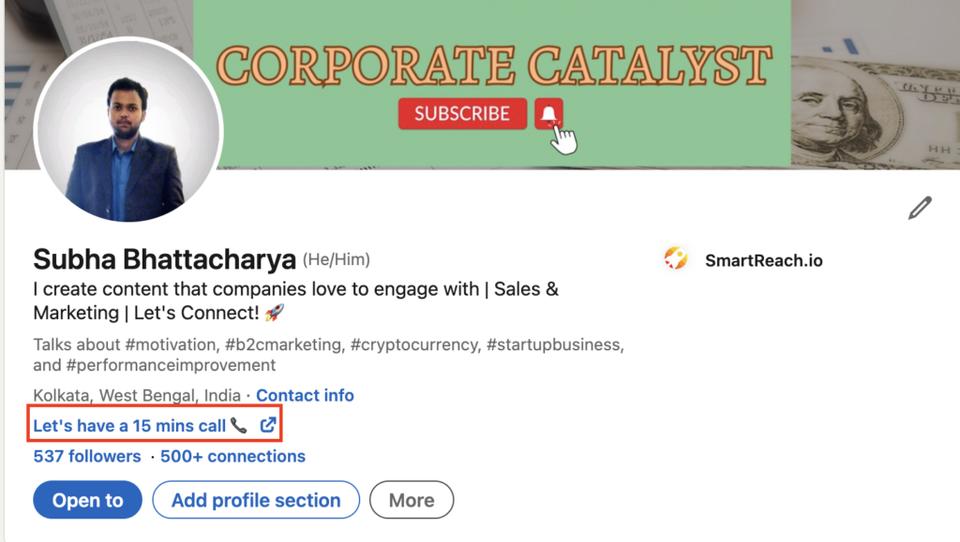
A booking link in the LinkedIn profile turns a profile visit into a meeting without a single email.
Why use a meeting scheduling tool?
The main reason is time. A meeting that takes four emails to confirm costs both sides a day or more of waiting, and every extra day before a sales call lowers the odds it happens at all.
- It saves hours a week. No more "does Tuesday work?" threads, and no double bookings, because the tool only offers slots that are actually free.
- It cuts no-shows. Automatic reminders and a calendar invite with the video link built in mean fewer people forget or join the wrong call.
- It removes time zone errors. Attendees see slots in their own time zone, which matters the moment you sell across regions or work with an offshore team.
- It makes booking easy for buyers. A prospect who can book in two clicks while they're interested is far more likely to show up than one who has to wait for your reply.
The 12 best meeting scheduling tools compared
SmartReach.io is the one tool on this list built into an outreach sequence. Its Meeting Scheduler is included on every plan from $29 per month, and a booking pauses the prospect's email, LinkedIn, calls and WhatsApp steps automatically. The other 11 are standalone or CRM schedulers.
Here's how the 12 tools stack up on the details that decide a purchase. Prices are the lowest paid tier from each vendor's pricing page in October 2026. Scroll sideways on mobile to see every column.
| Tool | Best for | Free plan | Paid from | Round robin | CRM sync | Free trial |
|---|---|---|---|---|---|---|
| SmartReach.io Meeting Scheduler | Outbound sales teams | No, included on every paid plan | $29/mo, no per-seat pricing | Yes, every plan | HubSpot, Salesforce, Pipedrive, Zoho | 14 days |
| Calendly | All-round standalone scheduling | Yes, 1 event type | $10/seat/mo, billed annually | Teams plan, $16/seat/mo | Salesforce and HubSpot on Teams | 14 days of Teams |
| HubSpot Meetings | HubSpot CRM users | Yes, 1 personal page | Sales Hub Starter, $20/seat/mo | Sales Hub Starter and up | HubSpot, native | Free tools |
| Cal.com | Free plan depth, developers | Yes, 1 user, unlimited event types | $12/user/mo | Teams plan | HubSpot and Salesforce, even on free | 14 days |
| Chili Piper | Routing inbound demo requests | No | $1,250/mo for 15 seats, annual only | Yes | Salesforce and HubSpot | Demo only |
| OnceHub | Mid-priced routing | Yes, 1 booking link | $10/seat/mo, billed annually | Route plan, $19/seat/mo | Salesforce and HubSpot | 14 days |
| Google Calendar appointment schedules | Google users | Yes, 1 booking page | Included in Workspace Business Standard and up | No | No | 14 days of Workspace |
| Microsoft Bookings | Microsoft 365 teams | No | Included in Business Basic, $7/user/mo | Shared booking pages | Dynamics via Microsoft | Varies by plan |
| Zoho Bookings | Zoho CRM users | Yes, 1 user | $6/user/mo, billed annually | Yes, 4 rotation rules | Zoho CRM and Bigin | Not stated |
| Doodle | Group polls | Yes, with ads | $11/user/mo, billed annually | No | Via integrations | Not stated |
| Acuity Scheduling | Paid client sessions | No | $16/mo, billed annually | Multiple calendars | Via Zapier | 7 days |
| SimplyBook.me | Service businesses | Yes, 50 bookings/mo | €11.90/mo, billed annually | Multiple providers | Via integrations | 14 days |
The best meeting scheduling tools, reviewed
Each review covers quick facts, what the tool does well, honest pros and cons, and who should pick it. SmartReach.io comes first because its scheduler is included at no extra cost on every plan from $29 per month, inside the same tool that sends the outreach.
1. SmartReach.io Meeting Scheduler
Quick facts
- G2
- 4.6/5 ★
- Capterra
- 4.7/5 ★
- From
- $29/mo
- Free trial
- 14 days
- Best for
- outbound sales teams that book meetings from email, LinkedIn, calls and WhatsApp sequences
SmartReach.io Meeting Scheduler ships inside SmartReach.io, a cold email software that adds LinkedIn, calls and WhatsApp to the email sequence on its Sales Engagement plans. The scheduler is included on every plan at no extra cost, from Email Outreach Basic at $29 per month, and SmartReach.io is rated 4.6 on G2 from 60 reviews as of October 2026.
The point of having the scheduler inside the outreach tool is what happens after someone books. The prospect's sequence pauses automatically, so they never get a "just following up" email the morning after they agreed to a call, and the lead status updates in your CRM without anyone touching it.
It also works as a sales engagement platform for teams that want calls, LinkedIn steps and WhatsApp in the same cadence as email.
Core capabilities
- Booking links per scenario. Each link carries its own availability, duration, location and calendar, so a discovery call and a demo can follow different rules.
- Branded meeting links. Your company name in the URL looks credible in a cold email and is easy to remember.
- Calendar sync. Connect Google Calendar, Outlook and Apple Calendar, and only free slots are offered, so you're never double booked.
- Auto-pause on booking. A prospect who books a meeting drops out of the sequence automatically.
- Team scheduling. Round robin spreads meetings evenly across reps, and collective availability finds a slot when everyone is free.
- Limits that protect your day. Daily and weekly caps, buffers on either side of a meeting, and minimum notice periods.
- CRM sync. Lead status updates in HubSpot, Salesforce, Pipedrive or Zoho after every meeting.
- Security. GDPR compliance, two-factor authentication, and encryption in transit and at rest.
Pros
- Included on every SmartReach.io plan, so there's no separate scheduler bill.
- Booking a meeting pauses the prospect's sequence on its own.
- No per-seat pricing. Plans scale by active prospects, with unlimited users above Basic.
- Lead status syncs to the four most common sales CRMs.
Cons
- Not sold on its own, so it only makes sense if you also run outreach.
- No payments or intake for paid client sessions, which Acuity and SimplyBook.me handle better.
- No free plan, only a 14-day free trial.
Pricing of SmartReach.io
The scheduler comes with every plan. No per-seat pricing applies. Plans scale by active prospects, and every plan above Basic includes unlimited users and unlimited sending email accounts.
| Plan | Price (monthly) | Active prospects | What you get | Best for |
|---|---|---|---|---|
| Email Outreach Basic | $29/mo | 1,000 | Email, 1 user, 10 warmup accounts | Solo reps booking from cold email |
| Email Outreach Plus | $89/mo | 50,000 | Email, unlimited users, inbox rotation | Scaling email teams |
| Sales Engagement Basic | $39/mo | 1,000 | Email plus 1 calling seat and 1 LinkedIn seat | Solo multichannel reps |
| Sales Engagement Plus | $99/mo | 50,000 | All channels, 3 calling and 3 LinkedIn seats | Small multichannel teams |
See the full plan list for the Pro and Scale tiers.
2. Calendly
Quick facts
- G2
- 4.7/5 ★
- From
- $10/seat/mo
- Free trial
- 14 days of Teams
- Best for
- anyone who wants a polished standalone booking page that every attendee already recognizes
Calendly is the scheduler most people have already clicked, which is its quiet advantage. Attendees know how the page works, so there's no friction at the moment of booking.
The free plan covers one event type, one connected calendar and one-on-one meetings. Standard adds unlimited event types and multiple calendars. Round robin, lead routing and Salesforce sync arrive on the Teams plan, and Notetaker, its AI recap add-on, records and summarizes calls.
Pros
- The most familiar booking page on the market.
- Payments through Stripe and PayPal.
- Strong integrations with Zoom, Teams, Google Meet, Salesforce and HubSpot.
Cons
- The free plan is very limited, with a single event type.
- Round robin and CRM sync need the Teams plan.
- Per-seat pricing adds up quickly for a larger team.
Pricing. Free plan available. Standard is $10 per seat per month billed annually, and Teams is $16 per seat per month billed annually. Enterprise is custom.
For a deeper look at every option here, see our list of Calendly alternatives.
3. HubSpot Meetings
Quick facts
- G2
- 4.4/5 (Sales Hub) ★
- From
- Free, then $20/seat/mo
- Free trial
- Free tools
- Best for
- teams that already keep contacts and deals in HubSpot CRM
HubSpot Meetings is the scheduler inside HubSpot's CRM. Every booking creates or updates the contact record and logs the meeting against it, so sales and marketing see the same history.
The free version gives you one personal scheduling page with HubSpot branding. Group meetings and round robin pages need Sales Hub or Service Hub Starter, and Professional raises the limit to 1,000 links.
Pros
- Bookings land straight on the CRM record, with no sync to set up.
- Free to start alongside HubSpot's free CRM.
- Round robin from the Starter tier.
Cons
- Free pages carry HubSpot branding.
- Inbound routing from forms is less flexible than Chili Piper's.
- Professional is $90 per seat per month billed annually, plus a $1,500 onboarding fee.
Pricing. Free with HubSpot's free tools for up to two users. Sales Hub Starter is $20 per seat per month, and Professional is $90 per seat per month billed annually.
4. Cal.com
Quick facts
- G2
- 4.6/5 ★
- From
- $12/user/mo
- Free trial
- 14 days
- Best for
- solo users who want the most complete free plan, and teams that want an open source scheduler
Cal.com is the open source scheduler, and it has the most generous free plan on this list. One user gets unlimited event types, payments, and HubSpot or Salesforce sync without paying anything.
Teams adds round robin and routing forms. Because the code is open, engineering teams can self-host it or build booking into their own product.
Pros
- Free plan with unlimited event types and CRM sync.
- Open source and self-hostable for full control of data.
- Routing forms and round robin on Teams.
Cons
- Setup takes longer than Calendly, especially for routing.
- Self-hosting needs engineering time to maintain.
Pricing. Free for one user. Teams starts at $12 per user per month, and annual billing saves 25%.
5. Chili Piper
Quick facts
- G2
- 4.6/5 ★
- From
- $1,250/mo, annual
- Free trial
- Demo only
- Best for
- B2B demand teams routing inbound demo requests to the right rep the moment a form is submitted
Chili Piper is built for one job, which is turning an inbound form fill into a booked meeting before the lead leaves the page. It qualifies the lead, routes it to the right rep using Salesforce data, and shows that rep's calendar instantly.
It's the strongest routing engine here, and it's priced for that. The Routing and Scheduling plan is annual only and covers 15 seats.
Pros
- Instant booking straight from web forms.
- Routing on Salesforce objects such as account owner and territory.
- Fast handoff from SDR to AE.
Cons
- Enterprise pricing with annual-only contracts.
- No free plan or self-serve trial.
Pricing. Routing and Scheduling is $1,250 per month billed annually ($15,000 per year) for 15 seats, plus $45 per extra seat. Its standalone calendar product, ChiliCal, is $12 per user per month with a 200-seat minimum.
6. OnceHub
Quick facts
- G2
- 4.4/5 ★
- From
- $10/seat/mo, annual
- Free trial
- 14 days
- Best for
- teams that want routing forms and round robin without Chili Piper's enterprise contract
OnceHub, formerly ScheduleOnce, sits between Calendly and Chili Piper. It handles booking pages, routing forms that qualify leads before they book, and chatbots that route visitors with AI on its top tier.
Pros
- Routing forms and round robin at a mid-market price.
- Salesforce and HubSpot sync, plus Stripe payments.
- Free plan for one user.
Cons
- Phone numbers and the security add-on cost extra.
- The interface takes longer to learn than Calendly's.
Pricing. Free for one user, one calendar and one booking link. Schedule is $10 per seat per month billed annually ($12 monthly), and Route is $19 per seat per month billed annually ($23 monthly).
7. Google Calendar appointment schedules
Quick facts
- From
- Free
- Free trial
- 14 days of Workspace
- Best for
- individuals and Google Workspace teams who want a free booking page inside the calendar they already use
Appointment schedules are built into Google Calendar, so there's nothing new to install. Personal accounts get one booking page with email reminders that checks several calendars for conflicts.
Premium features (multiple booking pages, payments, email verification and up to 20 co-hosts) need Workspace Business Standard or higher. Business Starter doesn't include them.
Pros
- Free and already in the calendar most people use.
- Google Meet links added automatically.
Cons
- No round robin or routing.
- Premium features need a higher Workspace tier.
Pricing. Free for personal accounts. Premium booking features come with Workspace Business Standard and above.
8. Microsoft Bookings
Quick facts
- G2
- 3.8/5 ★
- From
- Included from $7/user/mo
- Free trial
- Varies by plan
- Best for
- teams already paying for Microsoft 365 that want booking inside Outlook and Teams
Microsoft Bookings comes with most Microsoft 365 business plans, from Business Basic through Enterprise. It offers personal and shared booking pages, adds Teams meeting links automatically, and sends email and SMS reminders.
Pros
- No extra cost if you already pay for Microsoft 365.
- Teams links and Outlook calendar sync built in.
Cons
- The lowest G2 rating on this list.
- Limited customization outside the Microsoft stack.
Pricing. Included in Microsoft 365 Business Basic, which rose from $6 to $7 per user per month on July 1, 2026, and in Business Standard, Business Premium and the Enterprise plans.
9. Zoho Bookings
Quick facts
- G2
- 4.1/5 ★
- From
- $6/user/mo, annual
- Best for
- small businesses already using Zoho CRM or Bigin
Zoho Bookings handles one-on-one and group appointments, online or in person, paid or free. Round robin comes with four rotation rules, and its tightest fit is with the rest of the Zoho suite.
Pros
- Free plan for one user.
- Native sync with Zoho CRM and Bigin on Premium.
- Low per-user price.
Cons
- Customization of booking pages is limited.
- CRM sync and payments sit on the Premium tier.
Pricing. Free for one user. Basic starts at $6 per user per month billed annually, and Premium at $9 per user per month billed annually.
10. Doodle
Quick facts
- G2
- 4.4/5 ★
- From
- $11/user/mo, annual
- Best for
- finding one time that suits a large group, through a poll
Doodle's group poll is still the fastest way to find a time for ten busy people. Everyone votes on proposed slots and the most popular one wins. It also offers booking pages and sign-up sheets.
Pros
- The best group polling on this list.
- Sign-up sheets for events and office hours.
Cons
- The free plan shows ads and allows one poll and one booking page.
- Light on sales features like routing and CRM sync.
Pricing. Free plan available. Pro is $11 per user per month billed annually ($15 monthly), and Team is $16 per user per month billed annually, with a two-user minimum.
11. Acuity Scheduling
Quick facts
- G2
- 4.6/5 ★
- From
- $16/mo, annual
- Free trial
- 7 days
- Best for
- coaches, consultants and clinics who charge for sessions
Acuity Scheduling, owned by Squarespace, is built for selling time. It takes payment at booking through Stripe, Square, PayPal or Venmo, supports packages, memberships and intake forms, and can send invoices and receipts. The Premium plan adds an AI booking assistant and a HIPAA business associate agreement.
Pros
- The best payment options on this list.
- Intake forms, packages and memberships.
- Flat pricing per plan, not per user.
Cons
- No free plan.
- Plans are capped by the number of calendars.
Pricing. Starter is $16 per month billed annually ($20 monthly) for one calendar. Higher plans add calendars, up to 36 on Premium.
12. SimplyBook.me
Quick facts
- G2
- 4.4/5 ★
- From
- €11.90/mo, annual
- Free trial
- 14 days
- Best for
- service businesses that want a full booking website, not just a link
SimplyBook.me gives service businesses a booking website with payments, vouchers, discounts and support for more than 24 languages. Bookings can come from your site, social pages and partner platforms.
Pros
- A full booking website out of the box.
- Free plan with 50 bookings a month.
- Wide language support.
Cons
- Setup and configuration take time.
- Many features are paid add-ons on top of the plan.
Pricing. Free for 50 bookings per month and one provider. Basic is €11.90 per month billed annually (€13.90 monthly) for 100 bookings and five providers. Prices show in your local currency.
5 best practices for using a meeting scheduling tool
A scheduler only saves time if people actually book through it. These five habits make the difference.
1. Set your availability rules first
Set working hours, time zone and buffers before you share a single link. Fifteen minutes between calls stops back-to-back meetings from running into each other, and a minimum notice period stops someone booking you ten minutes from now. Update your availability whenever your week changes.
2. Create a separate event type for each purpose
A 15-minute intro call, a 45-minute demo and a group onboarding session need different lengths, locations and questions. Give each its own event type, and use round robin event types when meetings should rotate across a team.
3. Ask only the questions you need
Add two or three intake questions that help you prepare, such as company size or the problem they want solved. Every extra field lowers the number of people who finish booking. This matters most on discovery calls, where one good answer shapes the whole conversation.
4. Put the link where people already are
Sales reps get the most from the link in their email signature and inside outreach emails. Take Amy, a senior SDR running her own outreach. She puts a 15-minute intro link in her signature and in the second email of each sequence, so an interested prospect can book on the spot instead of waiting for her reply.
Larger companies running webinars or events should embed it on the website. Then automate the reminder, using the scheduler's own reminders or dedicated appointment reminder software, so booked meetings actually happen.
5. Connect it to your calendar and your CRM
Sync every calendar you use, so nobody can book a slot that's already taken, and connect your video tool so links are added automatically. For sales teams, a scheduler that updates the CRM after each meeting, such as HubSpot Meetings or SmartReach.io Meeting Scheduler, saves the manual logging that reps tend to skip.
How to choose the right meeting scheduling tool
Start with where your meetings come from, then work through these five factors in order.
- Features. List what you actually need. For sales, that usually means CRM sync to update lead status, calendar support for Google, Outlook and Apple, round robin for teams, and an integration with Zapier or your sales outreach tool.
- Real cost for your team. Multiply the per-user price by your headcount, then add the tier you'd need for round robin or CRM sync. That number, not the entry price, is the one to compare. Annual billing usually saves 15% to 25% if you're confident in the tool.
- Support. Check how you can reach the vendor (chat, email or phone) and how quickly they answer. Test it during the trial with a real question.
- Reviews. Read the recent one-star and two-star reviews on G2 and Capterra, not just the average. They show the problems you'll actually hit.
- Security. A scheduler reads your calendar and collects attendee data. Look for GDPR compliance, single sign-on and two-factor authentication, encryption in transit and at rest, and an independent security report where the vendor offers one.
So which meeting scheduling tool should you pick?
For outbound sales teams, SmartReach.io Meeting Scheduler is the pick, because it's included on every plan from $29 per month and stops follow-ups across email, LinkedIn, calls and WhatsApp the moment a prospect books. For everyone else, there's a clear best fit for each situation.
- Outbound sales teams. SmartReach.io Meeting Scheduler, because it's included with the outreach tool and stops follow-ups the moment someone books.
- A familiar standalone booking page. Calendly.
- HubSpot CRM users. HubSpot Meetings.
- The best free plan. Cal.com.
- Inbound demo routing at scale. Chili Piper, or OnceHub on a smaller budget.
- Google or Microsoft shops. Google Calendar appointment schedules or Microsoft Bookings.
- Zoho users. Zoho Bookings.
- Group meetings. Doodle.
- Paid sessions and service businesses. Acuity Scheduling or SimplyBook.me.
If your meetings come from cold outreach, the scheduler belongs in the same place as the sequence. SmartReach.io includes its Meeting Scheduler on every plan, so a booked call pauses the prospect's email, LinkedIn, calls and WhatsApp steps automatically and updates your CRM. Read more on how to book more meetings with a sales engagement platform, or get the wording right with these meeting request email templates.
Meeting scheduling tools FAQs
What is the best meeting scheduling tool in 2026?
It depends on where your meetings come from. For outbound sales, SmartReach.io is the best pick because its meeting scheduler is included on every plan and books calls straight from email, LinkedIn, calls and WhatsApp sequences, from $29 per month. Calendly is the safest general choice for a standalone booking page, and Chili Piper leads for routing inbound demo requests at enterprise scale.
What is the best free meeting scheduling tool?
Cal.com's free plan is the most complete on this list in 2026, with unlimited event types, payments and HubSpot or Salesforce sync for one user. Calendly, OnceHub, Zoho Bookings, Doodle and HubSpot Meetings also have free tiers, each capped at one booking page or event type. SmartReach.io has no free plan, but its scheduler is included on every paid plan and comes with a 14-day free trial.
Which meeting scheduler is best for sales teams?
SmartReach.io suits outbound teams because a booked meeting automatically pauses that prospect's sequence, and the lead status syncs to HubSpot, Salesforce, Pipedrive or Zoho. The same sequence runs email, LinkedIn, calls and WhatsApp, with no per-seat pricing, from $29 per month. For inbound teams routing demo requests from web forms, Chili Piper and OnceHub are the stronger fit.
Does SmartReach.io include a meeting scheduler?
Yes. SmartReach.io, a cold email software, includes its Meeting Scheduler on every plan at no extra cost, starting with Email Outreach Basic at $29 per month. You can create booking links with their own availability, duration and location, sync Google, Outlook and Apple calendars, spread meetings across a team with round robin, and drop the link into any email step of a sequence.
What is the best time to schedule a meeting?
Mid-morning, roughly 10 a.m. to 11 a.m. in the attendee's time zone, is a common default because it misses the start-of-day inbox rush and the pre-lunch slump. Better still, let the attendee pick. A scheduler that shows slots in the visitor's own time zone, such as SmartReach.io, Calendly or Cal.com, removes the time zone math behind a lot of missed meetings.
Is Jira a scheduling tool?
No. Jira is a project and issue tracking tool from Atlassian. It plans work across sprints and timelines, but it can't publish a booking page or check calendar availability. For meetings, pair it with a dedicated scheduler such as Calendly or Microsoft Bookings, or SmartReach.io when the meetings come from sales outreach, where the scheduler is included on every plan from $29 per month.
Stop juggling tools
Book more meetings on every channel
Join 5,000+ teams running multichannel outreach from one sequence, with deliverability built in.