Google, Yahoo & Microsoft Email Sender Requirements | What They Mean for Cold Email

On this page
When Google and Yahoo announced their bulk sender requirements in late 2023, plenty of cold emailers treated them as a rumor to wait out. Nobody is waiting anymore. The rules took effect in February 2024, Microsoft matched them for consumer Outlook addresses in May 2025, and Gmail began rejecting unauthenticated mail outright in late 2025.
What started as a policy for newsletter blasters is now the baseline for anyone who sends email at volume, cold outreach included.
This guide covers what each provider requires, what actually applies to B2B cold email, and the checklist that keeps your campaigns compliant.
SmartReach.io, the cold email software this blog belongs to, runs multichannel outreach across email, LinkedIn, calls and WhatsApp, with its Sales Engagement plans built for teams that live inside these deliverability rules every day. The compliance features below come from that vantage point.
What Google and Yahoo require
Google published its email sender guidelines with three pillars, and Yahoo mirrored them almost clause for clause. Enforcement began in February 2024 and tightened through 2025.
The 5,000 email a day threshold
A common misreading first. The 5,000 figure is not a sending limit. It is the threshold at which a domain counts as a bulk sender and the full requirements kick in. It counts mail sent to personal accounts on that provider's network, so addresses ending in @gmail.com or @googlemail.com for Google and @yahoo.com for Yahoo.
For cold email there is an important nuance. B2B outreach goes to business domains hosted on Google Workspace or Microsoft 365, and those recipients sit outside the formal bulk sender definition. That is not a free pass. The same authentication and reputation signals decide whether a Workspace mailbox trusts you. Treat the requirements as universal and you will never be caught out.
Authentication with SPF, DKIM and DMARC
Bulk senders must pass all three checks, and every sender should.
- SPF and DKIM configured on the sending domain
- A DMARC policy of at least p=none, with the From header aligned to the SPF or DKIM domain
- Valid forward and reverse DNS (PTR records) for sending IPs
- TLS for message transmission
Here is what changed in practice. Before 2024, failing these checks cost you some deliverability. Since Gmail's enforcement ramp-up in late 2025, unauthenticated mail is routed to spam or refused entirely. Authentication moved from best practice to entry ticket.
If you need to set this up, our walkthrough on authenticating SPF, DKIM and DMARC covers the records step by step, and the free email authentication checker shows you where a domain stands right now. If the DMARC record is the one you are missing, the free DMARC record generator builds the p=none policy these rules ask for, with the From alignment set correctly.
The 0.3% spam complaint threshold
Google wants your spam complaint rate under 0.1% and never touching 0.3%. That is a maximum of 3 annoyed recipients per 1,000 delivered emails before the whole domain feels it.
Two details matter for cold emailers. Complaints are measured through Gmail's feedback loop on personal accounts, so business recipients marking you as spam are not counted in this specific metric. And the rate is domain-wide, so one careless campaign can poison deliverability for every team sharing the domain.
The free spam complaint rate calculator from SmartReach.io works the figure out against both numbers, and tells you whether the campaign was even large enough to express a rate under either. At small volumes a single complaint can put you over 0.30% on paper without meaning anything.
One-click unsubscribe
Bulk messages must carry RFC 8058 one-click unsubscribe headers, and opt-outs must be honored within 2 days. Recipients who can leave easily do not press the spam button, which protects the complaint rate above.
What Microsoft added in May 2025
Microsoft applied the same authentication bar to its consumer network on May 5, 2025. Senders of 5,000 or more emails a day to @outlook.com, @hotmail.com and @live.com addresses must pass SPF, DKIM and DMARC (p=none minimum, aligned), use valid From and Reply-To addresses, and include one-click unsubscribe. Microsoft's announcement is explicit about the consequence. Non-compliant bulk mail is rejected with the error 550 5.7.515 access denied.
With that move, all three major mailbox providers enforce the same core standard. There is no provider left to route around.
What this means for cold email in 2026
The policies were written for marketing blasts to consumer inboxes, but they reshaped cold outreach anyway.
Send B2B mail to business addresses only. Personal Gmail, Yahoo and Outlook addresses are where the bulk sender thresholds and complaint feedback loops live. A clean B2B list keeps you outside the strictest enforcement zone and performs better anyway.
Volume discipline beats volume. Keeping each mailbox under 40 emails a day and spreading campaigns across 5 to 7 warmed inboxes per domain protects sender reputation far better than pushing one address to its limits. Never send cold outreach from your primary company domain. Run it from secondary domains so a reputation problem never touches your main one.
Retire spray and pray. Complaint thresholds punish irrelevant mail directly. Tight targeting from your ICP and real personalization are now deliverability tactics, not just conversion tactics.
Diversify the channel mix. Email is a means to an end. Sequences that add LinkedIn touches, calls or WhatsApp alongside email depend less on any single provider's filters, and multichannel sequences consistently out-reply email-only ones in SmartReach.io's platform data.
The compliance checklist
Run through this before your next campaign.
- SPF, DKIM and DMARC published and passing for every sending domain, From header aligned
- Valid PTR records and TLS on sending infrastructure
- One-click unsubscribe on, opt-outs processed within 2 days
- Prospect lists verified before sending, undeliverable and long-unengaged addresses purged
- Spam complaint rate monitored and held under 0.1%
- Daily volume per mailbox capped, campaigns spread across warmed inboxes and secondary domains
- Content checked for spam triggers, broken merge tags and risky formatting before launch
How SmartReach.io helps you adhere
Deliverability is the part of cold email that SmartReach.io automates hardest, and each requirement above maps to a feature.
Authentication checks on every inbox. When you connect sending accounts, SmartReach.io verifies SPF, DKIM and DMARC records and its free spam test reports flag any authentication issue with steps to fix it, no IT admin required.
One-click unsubscribe built in. Campaigns carry a compliant unsubscribe mechanism, and you can edit the link text to match your voice. It takes two toggles.
- Open the campaign and go to Channel Setup
- Select Unsubscribe Text/Link
- Turn on Include an unsubscribe option in emails
- Turn on Add prospect who unsubscribe to Do Not Contact category, so the same person is never emailed from another campaign
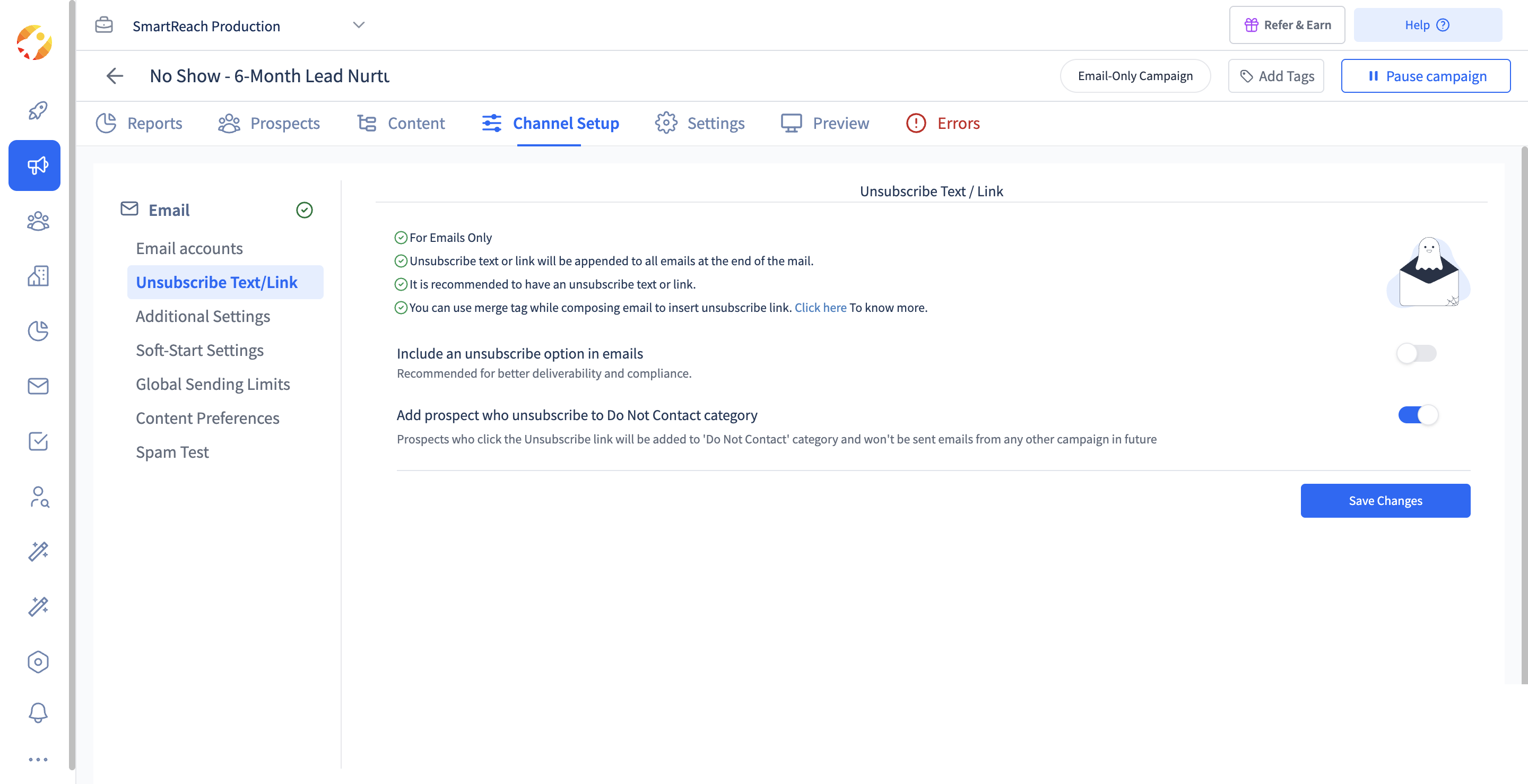 Unsubscribe Text/Link in a SmartReach.io campaign. The one-click requirement and the suppression list, from one screen.
Inbox rotation for safe volume. A single campaign can send from multiple email accounts across multiple domains, with a daily cap per address, so no mailbox drifts into risky territory while total volume stays where your pipeline needs it.
Warmup for every domain. SmartReach.io includes free access to WarmupHero so your active and backup domains stay warm, and a domain that goes bad never stalls the pipeline.
Verification before sending. Prospect emails are verified ahead of send, so invalid addresses never bounce against your reputation, and the content checker scores spam probability, broken merge tags and risky HTML before a campaign goes live.
Blacklist monitoring. SmartReach.io regularly checks popular global IP blacklists and notifies you if a sending IP appears on one, so corrective action happens before deliverability craters.
You can test the whole deliverability stack on the 14-day free trial with up to 200 prospects.
The evolution, not the end
The sender requirements did not end cold email. They ended careless cold email. Authentication, verified lists, easy opt-outs and honest volume were always what separated senders who reach the inbox from senders who reach the spam folder. The providers simply made the separation enforceable.
Adapt to that and the rules work in your favor, because every spammer they filter out makes room for outreach that respects the recipient.
Frequently asked questions
What are the email sender requirements from Google, Yahoo and Microsoft?
Senders of 5,000 or more emails a day must authenticate with SPF, DKIM and DMARC, offer one-click unsubscribe, and keep spam complaints under 0.3%. Google and Yahoo began enforcing this in February 2024, and Microsoft applied the same authentication bar to consumer Outlook addresses in May 2025. SmartReach.io runs authentication and spam checks on every connected inbox so cold email campaigns meet these requirements.
Do the bulk sender rules apply to B2B cold email?
The 5,000 a day thresholds count mail sent to personal mailboxes such as @gmail.com, @yahoo.com and @outlook.com, not business domains. B2B cold email lands on Google Workspace and Microsoft 365 mailboxes, which sit outside the formal bulk sender definition. In practice every mailbox provider now uses the same signals, so treat SPF, DKIM, DMARC and low complaint rates as mandatory either way.
What happens if my emails fail SPF, DKIM or DMARC in 2026?
Unauthenticated mail is now filtered or refused outright. Gmail stepped up enforcement in late 2025 and routes unauthenticated mail to spam or rejects it, and Microsoft rejects non-compliant bulk mail to consumer Outlook addresses with the 550 5.7.515 access denied error. A failed authentication check today means the email usually never reaches the inbox at all.
What spam complaint rate do Google and Yahoo allow?
Google asks senders to stay under a 0.1% spam complaint rate and never reach 0.3%. At 3 complaints per 1,000 delivered emails you risk bulk mail being sent to spam or blocked across the domain. Verified lists, tight targeting and easy one-click unsubscribe keep the rate down, and SmartReach.io tracks complaint signals per inbox so you can pause a domain before it crosses the line.
How does SmartReach.io help with the sender requirements?
SmartReach.io is a cold email software that checks SPF, DKIM and DMARC on every connected email account, adds one-click unsubscribe to campaigns, verifies prospect emails before sending, rotates sending across inboxes to keep volume per account safe, and monitors popular IP blacklists. The 14-day free trial includes these deliverability checks on up to 200 prospects.
Stop juggling tools
Book more meetings on every channel
Join 5,000+ teams running multichannel outreach from one sequence, with deliverability built in.