Best Email Verification Tools & Services for List Cleaning

On this page
Your bounce rate is the first thing a mailbox provider judges you on. Cross about 3% and Google and Microsoft stop giving you the benefit of the doubt, and the damage lands on the domain, not the campaign.
So you go looking for an email verification tool, and every roundup hands you the same nine logos with the same feature bullets and a headline price that turns out to be annual, or a minimum, or for a volume you'll never buy.
This one works differently. Every price below came off the vendor's live pricing page in September 2026, with monthly billing selected where there was a toggle. Where a number moved since the last version of this article, it says so. 👇🏼
TL;DR: the 8 best email verification tools at a glance
The 8 best email verification tools compared
Scroll the table sideways to see all columns →
| Tool | Best for | Entry price | Free credits | Standout feature |
|---|---|---|---|---|
| SmartReach.io | Cold email teams | $29/mo, verification free | 14-day trial, no card | Email, LinkedIn, calls, WhatsApp in one sequence |
| DeBounce | Budget bulk cleaning | $10 per 5,000 | 100 credits | Credits never expire |
| ZeroBounce | Enrichment + validation | $39 pay as you go | 100 credits/mo | Inbox placement and blacklist tests |
| Maileroo | Developers and startups | Pay as you go | 250 credits/mo | REST API with a real free allowance |
| Bouncer | High volume, GDPR | $8 per 1,000 | 100 credits | Data auto-deleted, credits never expire |
| Emailable | Speed on a one-off list | $38 per 5,000 | 250 credits | 250,000 addresses in about 7 minutes |
| NeverBounce | List scoring | $0.008 per email | No | Per-address deliverability score |
| Mailfloss | Automated ESP cleaning | $29/mo for 10,000 | 500/mo free tier | Typo fixing and daily auto-sync |
Quick pick by situation
- Running cold email campaigns: SmartReach.io. The check is already in the send.
- Cleaning a list once, on a budget: DeBounce at $10 for 5,000.
- 100,000 addresses or more: Bouncer, where the rate falls to $0.002.
- Cleaning an ESP list on a schedule: Mailfloss.
How does email verification actually work?
Email verification runs four checks against an address, in order, and stops as soon as one fails. Understanding the order matters, because it explains why some addresses come back "unknown" rather than valid or invalid, and why no tool can honestly promise 100%.
- Syntax check. Does the address follow the format rules? This catches typos and malformed entries instantly, at no cost to anyone.
- Domain check. Does the domain exist and resolve in DNS? A dead domain means a dead address.
- MX record check. Does the domain publish mail servers? A domain with no MX records can't receive mail at all.
- SMTP check. The verifier opens a conversation with the receiving mail server and asks whether the mailbox exists, without delivering anything.
Two results sit outside that clean pass or fail. A catch-all domain accepts mail for every address at the domain, so the SMTP check can't tell you whether one specific mailbox is real. And greylisting makes a server defer an unknown sender temporarily, which reads as inconclusive. Good tools label both honestly. Tools that quietly bucket catch-alls as "valid" are how people end up with a 6% bounce rate on a list that scored 99%.
The four types of email verification service
Not every tool on this list does the same job, and the type you need depends on where the bad addresses are entering your list.
1. Single email checkers
Free or cheap tools that verify one address at a time, usually in a browser. Useful for spot checks before an important send.
2. Bulk email verification tools
Upload a CSV, get a scored file back. This is the category most of this article covers. DeBounce, Bouncer, Emailable and NeverBounce all live here.
3. Real-time verification APIs
These sit on your signup form or CRM workflow and reject a bad address at the point of entry, which is the cheapest place to catch one. ZeroBounce, Bouncer and Maileroo all publish APIs for this.
4. Verification built into the sending tool
The check runs as part of the campaign rather than as a separate step. There's no export, no upload and no reimport. This is how SmartReach.io handles it, and it's covered first below.
The 8 best email verification tools reviewed
1. SmartReach.io: best for teams already sending cold email
Quick facts
- G2
- 4.6/5 ★
- Capterra
- 4.7/5 ★
- From
- $29/mo, verification included
- Free trial
- 14 days, no card
- Best for
- Sales teams who'd rather the verification step disappeared into the campaign than became a second subscription and a CSV round trip.
SmartReach.io is a cold email software that verifies every prospect address before the first email sends, and its Sales Engagement plans run email, LinkedIn, calls and WhatsApp from the same sequence. Verification isn't a credit pack you top up. It runs on every plan, on every campaign, at no extra cost.
That's a different shape of product from the other seven here, so it's worth being precise about the trade.
Everything else on this list is a cleaner. You export a list, upload it, wait, download a scored file, reimport the survivors, then send. Do that weekly and it's a standing chore, and the gap between the clean and the send is where addresses go stale again.
SmartReach.io closes that gap by running the check at send time. The syntax, domain, MX and SMTP checks fire against each prospect before their first email leaves, and anything that fails is held back rather than burned against your domain reputation.
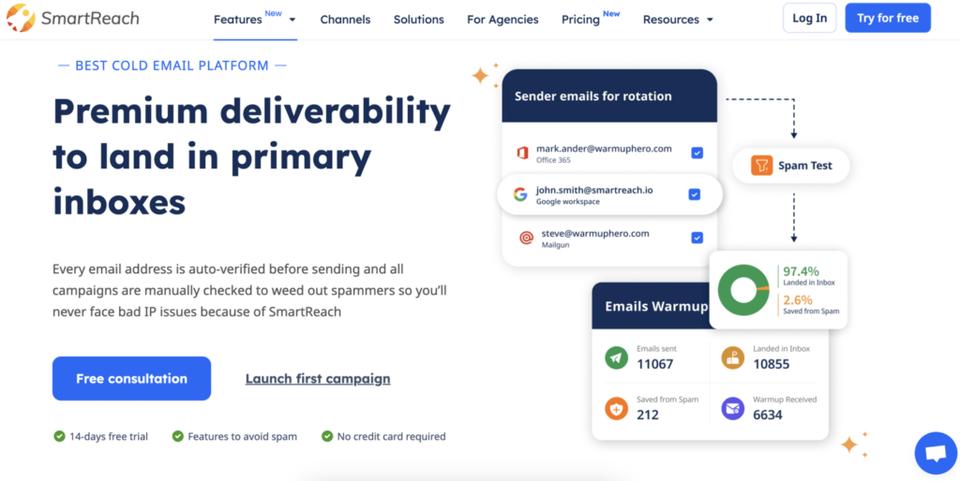 Verification is one part of the deliverability picture in SmartReach.io. Bounce rate, sender reputation and inbox placement sit on the same screen.
What you get beyond the verification itself
- Pre-send validation on every campaign. Syntax, domain, MX and SMTP checks on each prospect, with no credits to buy and no volume cap.
- A built-in prospect database. Lead Finder holds 300M+ contacts across 50M+ companies, so you can build the list and validate it in the same tool.
- Deliverability tooling around the send. Email warmup, spam testing, inbox placement checks and domain health monitoring, which is the half of the job verification doesn't cover.
- Inbox rotation. Sends spread across your connected mailboxes rather than hammering one, with a limit of 200 emails a day per account and roughly 40 recommended.
- Multichannel steps. On Sales Engagement plans a sequence can mix email, LinkedIn, calls through the built-in dialer, and WhatsApp, with a reply on any channel pausing the rest.
- Two-way CRM sync. HubSpot, Salesforce, Pipedrive and Zoho.
Pros
- Verification is unlimited and free on every plan, with no credit packs.
- No export, upload, download and reimport loop before each campaign.
- Rated 4.6/5 on G2 from 60 reviews and 4.7/5 on Capterra from 27 reviews.
- No per-seat pricing. Plans scale by active prospects, and every plan above Basic includes unlimited users and unlimited sending email accounts.
- 14-day free trial with no card, covering 200 prospects.
Cons
- It isn't a standalone verifier. There's no bulk upload-and-score mode for a list you don't intend to send from here.
- No verification API to call from your own signup form. Use Bouncer or ZeroBounce for that.
- If all you need is to clean one bought list once, a $10 DeBounce credit pack is the cheaper answer.
How much does SmartReach.io cost?
| Plan | Monthly | Verification | Channels |
|---|---|---|---|
| Email Outreach Basic | $29/mo | Included | |
| Email Outreach Plus | $89/mo | Included | |
| Email Outreach Pro | $199/mo | Included | |
| Email Outreach Scale | $499/mo | Included | |
| Sales Engagement Basic | $39/mo | Included | Email, LinkedIn, calls, WhatsApp |
| Sales Engagement Plus | $99/mo | Included | Email, LinkedIn, calls, WhatsApp |
| Sales Engagement Pro | $249/mo | Included | Email, LinkedIn, calls, WhatsApp |
| Sales Engagement Scale | $599/mo | Included | Email, LinkedIn, calls, WhatsApp |
Up next: DeBounce ↓
2. DeBounce: best budget bulk cleaner
Quick facts
- G2
- 4.5/5 ★
- Capterra
- 4.7/5 ★
- From
- $10 per 5,000 verifications
- Free trial
- 100 free credits, no card
- Best for
- SMBs and agencies cleaning lists occasionally who want the lowest credible price per address without a subscription.
DeBounce is the cheapest credible bulk verifier on this list, at $10 for 5,000 verifications with credits that never expire. There's no monthly plan, no minimum commitment and no upfront fee. You buy credits when you need them and they sit there until you do.
The company backs its results with a published 97.5% deliverability guarantee, which is more specific than most of this category manages. Duplicate addresses are deduplicated free, so you're not paying twice for the same contact in two exports.
One thing to note if you're returning to this article. DeBounce moved from debounce.io to debounce.com. Old bookmarks still redirect, but the domain in your API config is worth checking.
Speed is reasonable rather than category-leading. Roughly 10,000 addresses in 10 minutes, and 100,000 in under two hours.
Pros
- Lowest entry price here at $10 for 5,000, and credits never expire.
- 100 free credits on signup with no card, which is enough for a real accuracy test.
- Published 97.5% deliverability guarantee rather than a vague accuracy claim.
- Disposable address detection, catch-all identification and greylisting detection all included.
- API access is included at every volume rather than gated behind a tier.
Cons
- Thinner integration list than ZeroBounce or Mailfloss, with no native CRM connectors.
- CSV is the practical upload format, so odd exports need reshaping first.
- Support isn't 24/7, which matters if you're cleaning a list at 2am before a morning send.
- Reporting is basic next to NeverBounce's scoring.
How much does DeBounce cost?
| Verifications | Price | Verifications | Price |
|---|---|---|---|
| 5,000 | $10 | 200,000 | $140 |
| 10,000 | $15 | 500,000 | $300 |
| 25,000 | $30 | 1,000,000 | $500 |
| 50,000 | $50 | 2,000,000 | $800 |
| 100,000 | $90 | 5,000,000 | $1,500 |
Up next: ZeroBounce ↓
3. ZeroBounce: best for validation plus deliverability tooling
Quick facts
- G2
- 4.6/5 ★
- Capterra
- 4.7/5 ★
- From
- $39 pay as you go, or $99/mo
- Free trial
- 100 free credits a month
- Best for
- Marketing teams who want validation, data enrichment, inbox placement testing and blacklist monitoring on one bill.
ZeroBounce is the broadest product in this category, pairing validation with enrichment, inbox placement tests and blacklist monitoring, and it claims 99.6% validation accuracy. It's the one to pick when verification is part of a wider deliverability practice rather than a standalone chore.
Its pricing changed, and the change is significant. Earlier versions of this article quoted $18 a month for 2,000 addresses. That entry point is gone. Pay as you go now starts at a $39 minimum for 2,000 addresses, and the ZeroBounce ONE subscription starts at $99 a month with a 10,000-credit minimum. Annual billing saves 20%, and subscription credits roll over and don't expire.
The free plan is genuinely useful for evaluation. 100 validation credits a month that refill, plus one inbox placement test, one email server test, one blacklist monitor and 10 email finder searches.
Worth knowing on the billing side. "Unknown" results and duplicate removals are free, so you're only charged for addresses the tool can actually rule on. The email finder costs 20 credits per successful query, which adds up faster than people expect.
Pros
- Claimed 99.6% validation accuracy, stated openly on the pricing page.
- Enrichment adds name, gender and geolocation to valid addresses.
- Inbox placement tests, blacklist monitoring and server tests alongside validation.
- Integrates with Mailchimp, Constant Contact, Drip and more, plus Zapier.
- Unknown results and duplicates aren't billed, and subscription credits roll over.
Cons
- The cheapest real entry point is now $39, well above DeBounce's $10.
- The $99 subscription has a 10,000-credit minimum, so light users overpay.
- More setup than a plain bulk cleaner, and reviewers consistently say so.
- Email finder searches burn 20 credits each.
How much does ZeroBounce cost?
| Option | Price | Notes |
|---|---|---|
| Free | $0 | 100 credits/mo, refills, no rollover |
| Pay as you go | From $39 for 2,000 addresses | Minimum purchase |
| ZeroBounce ONE | From $99/mo | 10,000-credit minimum, 20% off annually |
Up next: Maileroo ↓
4. Maileroo: best free allowance for developers
Quick facts
- G2
- Not listed
- Capterra
- Not listed
- From
- Pay as you go, no monthly fee
- Free trial
- 250 free verifications a month
- Best for
- Developers and early-stage startups wiring address checks into a signup form or product without committing to a subscription.
Maileroo is an API-first verification service with a standing free allowance of 250 verifications a month and no monthly fee on paid usage. It's the pick when verification is something your application does rather than something a marketer does.
The product is primarily a transactional email platform with verification alongside it, which cuts both ways. If you already send transactional mail through Maileroo, adding verification is one API key rather than a new vendor. If you don't, you're buying into a smaller company than the rest of this list.
Verification covers the usual checks plus disposable address detection and role-based filtering, and the API is a straightforward REST endpoint.
A correction on our earlier numbers. Previous versions of this article listed a 5,000-verification free tier for Maileroo. The current published allowance is 250 a month, and paid verification is priced through a calculator rather than a fixed public ladder, so check it against your own volume before you commit.
Pros
- 250 free verifications every month, which is a real recurring allowance rather than a one-off.
- Clean REST API that drops into a signup form or CRM workflow quickly.
- No monthly fee. Paid usage is genuinely pay as you go.
- Disposable address detection and role-based filtering included.
- Sits alongside transactional sending if you need both from one vendor.
Cons
- No G2 or Capterra presence, so there's no independent review base to check.
- Verification pricing isn't published as a fixed table, which makes budgeting harder.
- No published accuracy figure.
- Smallest vendor here, which matters for a long-term dependency.
Up next: Bouncer ↓
5. Bouncer: best for high volume and GDPR-sensitive teams
Quick facts
- G2
- 4.8/5 ★
- Capterra
- 4.9/5 ★
- From
- $8 per 1,000, falling to $0.002
- Free trial
- 100 free credits, no card
- Best for
- Enterprises and EU teams who need volume pricing, documented GDPR handling and credits that don't expire underneath them.
Bouncer is the volume play, with pay-as-you-go pricing that falls from $0.008 per email at 1,000 addresses to $0.002 at a million, and it's the strongest-rated tool in this roundup at 4.8 on G2. Credits never expire and no card is needed to start.
It's also the one EU teams tend to land on. Data handling is documented, GDPR compliance is a first-class part of the pitch rather than a footnote, and the automatic data deletion window means a cleaned list doesn't sit on someone else's servers indefinitely.
The verification itself combines syntax checks, MX analysis and SMTP connections, with a "Bouncer Guarantee" on results. Notably, Bouncer doesn't publish a headline accuracy percentage on its pricing page, which is either refreshingly honest or frustrating depending on how you feel about round numbers.
Pros
- Best volume economics here. $2,000 for a million addresses, at $0.002 each.
- Highest ratings in this roundup at 4.8 on G2 and 4.9 on Capterra.
- 100 free credits with no card, and credits never expire.
- Real-time, bulk and API modes all available on the same account.
- Documented GDPR handling with automatic data deletion.
Cons
- No published accuracy percentage to hold them to.
- More expensive than DeBounce at small volumes. $35 for 5,000 against DeBounce's $10.
- Reporting is basic, and there's no phone support.
- Advanced features carry a learning curve that the interface doesn't smooth over.
How much does Bouncer cost?
| Credits | Price | Per email |
|---|---|---|
| 1,000 | $8 | $0.008 |
| 5,000 | $35 | $0.007 |
| 10,000 | $60 | $0.006 |
| 50,000 | $250 | $0.005 |
| 100,000 | $400 | $0.004 |
| 250,000 | $750 | $0.003 |
| 500,000 | $1,250 | $0.0025 |
| 1,000,000 | $2,000 | $0.002 |
Up next: Emailable ↓
6. Emailable: best for speed on a large one-off list
Quick facts
- G2
- 4.8/5 ★
- Capterra
- 4.7/5 ★
- From
- $38 per 5,000, or $32.30 on subscription
- Free trial
- 250 free credits
- Best for
- Growth teams with a big list and a deadline, who need the file back in minutes rather than tomorrow morning.
Emailable is the fastest tool here, clearing 10,000 addresses in under three minutes and 250,000 in about seven. If you've ever started a bulk clean at 5pm and come back the next morning to find it still running, that number is the reason to look at this one.
Pricing is pay as you go with a subscription discount of roughly 15%. 5,000 credits cost $38 outright or $32.30 a month on a plan. Credits never expire either way, one credit covers one verification across bulk, API, widget and single checks, and there are no contracts.
The deliverability extras are priced separately in credits rather than bundled. An inbox report costs 100 credits and a blacklist check costs 5, which is fair but worth factoring in.
Pros
- Fastest processing in this roundup by a wide margin.
- 250 free credits on signup, more than most of this list.
- Credits never expire and one credit covers any verification method.
- 4.8 on G2, matching Bouncer at the top of the category.
- No contracts or commitments, with a 15% subscription discount if you want one.
Cons
- More expensive than DeBounce or Bouncer at the same volume. $38 against $10 and $35 for 5,000.
- Deliverability extras cost credits on top rather than being included.
- Reporting is thinner than NeverBounce's scoring.
- Above a million credits you're into a sales conversation for a quote.
Up next: NeverBounce ↓
7. NeverBounce: best for scoring a list rather than splitting it
Quick facts
- G2
- 4.3/5 ★
- Capterra
- 4.4/5 ★
- From
- $0.008 per email, down to $0.003
- Free trial
- No free credits
- Best for
- Email marketers who want a per-address confidence score so they can segment a list instead of just deleting half of it.
NeverBounce returns a deliverability score for every address, not just a valid or invalid verdict, which lets you segment a list rather than binary-delete it. That's the real reason to choose it over a cheaper cleaner.
The practical use is straightforward. High-confidence addresses go into the main send, borderline ones go into a smaller warm-up send you can afford to bounce, and the rest get suppressed. For an ecommerce list where half the file is two years old, that's a better outcome than deleting everything questionable.
It also surfaces generic role addresses like info@ and sales@ specifically, which rarely engage and disproportionately generate complaints.
Pricing runs from $0.008 per email up to 10,000, $0.005 up to 100,000 and $0.003 at a million. There's a monthly Sync plan from around $10 for automated list maintenance, and a Growth subscription at $49 a month covering 10,000 verifications. Above 250,000 a month it's custom pricing.
Pros
- Per-address deliverability scoring, which no other tool here matches.
- Flags generic role addresses explicitly so you can decide rather than guess.
- Usage-based credits with no monthly minimum or setup fee on pay as you go.
- Automated list maintenance via the Sync plan from about $10/mo.
- Real-time, bulk and API modes, with GDPR compliance documented.
Cons
- No free credits, so there's no way to test the accuracy before paying.
- Lowest ratings in this roundup at 4.3 on G2.
- More expensive than Bouncer at every comparable tier.
- Reporting beyond the score itself is thin.
How much does NeverBounce cost?
| Volume | Price per email |
|---|---|
| Up to 10,000 | $0.008 |
| Up to 100,000 | $0.005 |
| Up to 250,000 | $0.004 |
| Up to 1,000,000 | $0.003 |
Up next: Mailfloss ↓
8. Mailfloss: best for automated cleaning of an ESP list
Quick facts
- G2
- 4.0/5 ★
- Capterra
- 4.9/5 ★
- From
- $29/mo for 10,000 credits
- Free trial
- 7 days, plus a 500/mo free tier
- Best for
- Email marketers who want their Mailchimp or Klaviyo list cleaned on a schedule without anyone remembering to do it.
Mailfloss connects to your email service provider and cleans the list on a schedule, so nobody has to remember to export a CSV. It's the only tool here built around automation rather than around the verification itself.
Its standout feature is typo fixing. Instead of deleting gmial.com, it corrects it to gmail.com and keeps the subscriber. On a consumer list with self-serve signups, that recovers more addresses than you'd expect.
Its pricing moved since our last update, mostly in your favour. Lite is $29 a month for 10,000 credits, Business is $59 for 25,000, and Pro is $209 for 125,000. The old Pro price was $250, so the top tier got cheaper. Annual billing saves 17%, and there's now a free-forever tier of 500 verifications a month.
Pros
- Automatic daily cleaning synced back to your ESP, with no manual export.
- Typo fixing recovers valid subscribers instead of deleting them.
- Free-forever tier of 500 verifications a month.
- Prepaid credits available as a one-time purchase, and they never expire.
- 7-day trial with no card up front.
Cons
- Lite connects one email platform only. Multi-platform needs the $59 Business tier.
- Per-credit cost is high next to DeBounce or Bouncer at the same volume.
- 4.0 on G2 is the weakest score in this roundup.
- No published accuracy figure, and reporting is limited.
How much does Mailfloss cost?
| Plan | Monthly | Credits/mo | Platforms connected |
|---|---|---|---|
| Free | $0 | 500 | 1 |
| Lite | $29/mo | 10,000 | 1 |
| Business | $59/mo | 25,000 | 10 |
| Pro | $209/mo | 125,000 | Unlimited |
How to choose the right email verification service
Four questions, in this order. The first one usually settles it.
Is verification a step in your sending, or a separate job?
If you're running cold email campaigns, the check belongs inside the sending tool. A standalone verifier means an export, an upload, a wait, a download and a reimport before every campaign, and the list ages in the gap. SmartReach.io runs the check at send time on every plan from $29 a month.
If you're cleaning a CRM export, a bought list or an old ecommerce database once, a standalone tool is the right answer and you can stop reading here. DeBounce at $10 for 5,000 is the cheapest credible one.
What good looks like: nobody on your team owns a recurring calendar reminder to clean the list.
What's your real monthly volume?
The per-address rate swings more than the brand names do.
- Under 10,000 a month. DeBounce at $10 per 5,000 is the value pick. Emailable at $38 if speed matters more than cost.
- 10,000 to 100,000. Bouncer at $0.006 to $0.004, or NeverBounce at $0.005 if you want scoring.
- Over 100,000. Bouncer, where the rate falls to $0.002 at a million. Nothing else here gets close.
What good looks like: you priced your own list, not the vendor's example tier.
Do you need an API, or a file?
Real-time API checks catch bad addresses at the point of entry, which is the cheapest place to catch one. ZeroBounce, Bouncer and Maileroo all publish APIs. If all you ever do is clean a CSV, don't pay for an integration you won't wire up.
What good looks like: bad addresses stop entering the list, rather than being removed from it later.
Can you test the accuracy before you pay?
Build a control list of 100 addresses where you already know the answer. Live mailboxes, confirmed bounces, a catch-all domain, a disposable address. Run it through the free credits and score it yourself.
DeBounce, Bouncer and ZeroBounce all give 100 free credits, and Emailable gives 250. NeverBounce gives none, which is the single biggest mark against it.
What good looks like: you've seen the tool get a catch-all right before you spend anything.
Best email verification tool by use case
Running cold email campaigns
Pick SmartReach.io. Verification runs before every send at no extra cost, so there's no second subscription and no CSV round trip. Plans from $29 a month, and the Sales Engagement tiers from $39 add LinkedIn, calls and WhatsApp steps to the same sequence.
Cleaning a bought list once
Pick DeBounce. $10 for 5,000 verifications, credits that never expire and 100 free to test with first. A 97.5% deliverability guarantee is more than most of this category commits to in writing.
An ecommerce database of 50,000+
Pick NeverBounce or Bouncer. Both land at $250 for 50,000 addresses, so pick on output. NeverBounce scores each address so you can segment an ageing list instead of deleting half of it. Bouncer pulls ahead above 100,000, where its rate keeps falling to $0.002.
An agency running many client lists
Pick Bouncer. Volume pricing down to $0.002, credits that never expire across clients, documented GDPR handling and automatic data deletion, which is the part client legal teams ask about.
A Mailchimp or Klaviyo list on autopilot
Pick Mailfloss. It syncs to the ESP and cleans daily without anyone touching a CSV, and typo fixing recovers subscribers that other tools would delete. $29 a month for 10,000 credits.
Verification inside your own product
Pick Maileroo or ZeroBounce. Maileroo gives 250 free verifications a month on a plain REST API. ZeroBounce costs more but adds enrichment, inbox placement testing and blacklist monitoring on the same key.
How to use an email verification tool properly
The tool is the easy part. What you do either side of it decides whether it helps.
Before you verify
- Deduplicate first. You pay per address at most vendors, and DeBounce, Bouncer and Emailable won't charge you for duplicates, but not everyone is that generous.
- Split personal from business addresses. They behave differently under SMTP checks, and catch-all results cluster heavily on business domains.
- Decide your threshold in advance. Write down what you'll do with catch-alls and unknowns before you see the file, so the number doesn't talk you into sending to them.
During verification
- Read past valid and invalid. Catch-all, disposable, role-based and unknown are separate categories and each deserves a separate decision.
- Don't delete blindly. Suppress questionable addresses rather than deleting them, so you don't re-import the same bad data from a CRM export next quarter.
- Check what the tool actually tested. A vendor that doesn't tell you whether it ran an SMTP check is telling you something.
After verification
- Suppress, don't just remove. A suppression list stops a bad address walking back in through the next import.
- Watch bounce rate and complaints for two weeks. That's your real accuracy measurement, not the vendor's percentage.
- Re-verify on a schedule. B2B lists decay at roughly 2% a month as people change jobs. A list cleaned six months ago isn't clean.
So which email verification tool should you pick?
Honest answer, it depends on whether verification is a chore or a step.
If you're cleaning a list once, buy DeBounce credits and move on. $10 for 5,000, credits that never expire, and the lowest real cost per address on this list. Nothing about that decision deserves more than five minutes.
If you're cleaning hundreds of thousands of addresses regularly, Bouncer wins on economics and on the GDPR paperwork your client's legal team will ask for. If you need the file back fast, Emailable. If you need a score rather than a verdict, NeverBounce.
If you're running cold email, I'd pick SmartReach.io, and yes, I work here, so weigh that accordingly. Three reasons that hold up anyway.
- The check is already in the send. No export, no upload, no reimport, and no list ageing in the gap between clean and campaign.
- It costs nothing extra. Verification is unlimited on every plan from $29 a month, against $10 to $250 a clean elsewhere.
- The rest of the deliverability job is in the same tool. Warmup, inbox rotation, spam testing and domain health, which is the half of the problem verification doesn't solve.
Where it loses. There's no bulk upload-and-score mode and no verification API, so if what you need is a cleaner for lists you're sending from somewhere else, buy DeBounce or Bouncer and don't think twice.
Try SmartReach.io free for 14 days, no card required.
Email verification tool FAQs
Which email verification tool is best?
It depends on where verification sits in your workflow. DeBounce is the cheapest credible bulk cleaner at $10 for 5,000 verifications. Bouncer and Emailable are the picks for high volume. SmartReach.io is the pick when you're running cold email, because it's a cold email software that verifies every prospect address before the first send at no extra cost, on plans from $29 a month.
How can I verify an email address?
Run it through syntax, domain, MX record and SMTP checks. A tool does all four in one pass. Upload a CSV to DeBounce, Bouncer or ZeroBounce for bulk cleaning, or let an outreach platform do it inline. SmartReach.io validates addresses automatically before a campaign sends, so invalid contacts never reach a mailbox.
What is an email validation tool?
An email validation tool checks whether an address is real, active and able to receive mail. It verifies DNS and MX records, opens an SMTP conversation with the receiving server, and flags disposable addresses, role accounts and spam traps. DeBounce, Bouncer and ZeroBounce are the common bulk options. SmartReach.io runs the same checks inside its cold email campaigns.
How do you test an email verification tool's accuracy?
Build a control list of 100 addresses you already know the answer for. Include live mailboxes, addresses you've confirmed bounced, a catch-all domain and a disposable address. Run it through the tool's free credits, then score the results. DeBounce, Bouncer and ZeroBounce all give 100 free credits, which is enough for a real test.
Is ZeroBounce free?
Not really. ZeroBounce has a free plan with 100 validation credits a month, which refill but don't roll over. Beyond that you buy credits. Pay as you go starts at $39 for 2,000 addresses, and the ZeroBounce ONE subscription starts at $99 a month for 10,000 credits. The old $18 entry price is gone.
Can you automate email verification?
Yes, in two ways. Bulk tools like Bouncer, Emailable and ZeroBounce publish APIs you can call from a signup form or a CRM workflow. Or you skip the integration work and use a platform that verifies inline. SmartReach.io checks every prospect address before the first email goes out, on every plan, with no credits to buy.
How do you verify an email address manually?
Check the format first, then confirm the domain resolves in DNS, then look up its MX records with a tool like MXToolbox. Advanced users can open a telnet session and run SMTP commands against the mail server. It works for one address. For a list of 5,000 it's not realistic, which is why verification tools exist.
Do you still need a separate email verification tool for cold email?
Often not. A standalone verifier makes sense for a bought list, an old CRM export or an ecommerce database you're cleaning once. For ongoing outbound, the check belongs in the sending tool. SmartReach.io is a cold email software that verifies addresses before each send, so there's no second subscription and no export-clean-reimport loop.
Stop juggling tools
Book more meetings on every channel
Join 5,000+ teams running multichannel outreach from one sequence, with deliverability built in.