Saleshandy vs Apollo | Flat Fee vs Per Seat

On this page
Put the two pricing pages side by side and Saleshandy looks about a third the price of Apollo. Open a calculator and that gap either disappears or triples, depending on one thing nobody puts in the comparison table.
That thing is what the meter counts. Saleshandy bills a workspace and hands you a monthly credit allowance. Apollo bills every seat and then meters the actual work through a single pool.
So a solo founder and a five-person SDR team can read the same two pages and reach opposite conclusions, correctly.
This comparison starts with the invoice at three team sizes, then works backwards into the credits, the channels, the data and the deliverability.
SmartReach.io shows up as the third column throughout, because on most of these questions it's the better alternative to whichever one just won. It's a cold email software whose Sales Engagement plans run email, LinkedIn, calls and WhatsApp as steps in one sequence, metered by active prospects rather than by headcount.
TL;DR on Saleshandy vs Apollo
How I compared them
Every figure below was read off Saleshandy's and Apollo's own pages on 4 September 2026, with the billing toggle flipped to monthly where one exists. No number here came from another comparison post.
That matters more than usual in this matchup. Both vendors default their pricing pages to the annual rate, and both have moved their plans in 2026.
Saleshandy folded its separate Lead Finder subscription into the main plans and made lead credits monthly. Apollo is still migrating older accounts onto its unified credit system, which is why some Apollo users won't see the features listed on the pricing page.
Six things decide this comparison, and they're the six sections that follow.
- What each plan actually bills for, priced at 1, 5 and 10 users
- What a credit buys, because both meter data and one of them meters calling from the same pool
- Which channels run without a human, which is not what either homepage implies
- How the sequences branch, and what the branches can read
- Whose lead data holds up, past the headline count
- Which one lands more email, including the mailbox arithmetic
Where a section has a winner, there's a short note on the better alternative to that winner. That's not a throwaway. On four of these six questions the honest answer is a third product, and pretending otherwise would waste your time.
What are they actually for?
They're not competing for the same job. Saleshandy is built to send at volume from a lot of mailboxes. Apollo is built to tell you who to send to.
Both have grown into the other's territory, which is why they now land on the same shortlists. The overlap is real and shallow.
Every price in the table below is the monthly list price on monthly billing, because that's the number you actually pay in month one.
| At the time of writing | Saleshandy | Apollo | SmartReach.io |
|---|---|---|---|
| Built around | Sending at volume | B2B data and pipeline | Multichannel sequences |
| Entry paid plan | $41/mo per workspace | $65/seat/mo | $29/mo |
| Mid plan | $99/mo per workspace | $99/seat/mo | $89 email, $99 multichannel |
| Top published plan | $189/mo per workspace | $149/seat/mo, annual only, 3-seat min | $499 email, $599 multichannel |
| Billed by | Workspace | Seat | Active prospects |
| Users included | 1, then 10, then unlimited | Per seat, always | Unlimited from Plus up |
| What the meter counts | Active prospects and emails sent | One credit pool for data and dialling | Active prospects, concurrent |
| Email accounts | Unlimited on every plan | Unlimited Gmail and Microsoft from Professional | Unlimited from Plus up |
| Lead database | 852M+ contacts, 42M+ companies | 240M+ contacts, 30M+ companies | 300M+ contacts, 50M+ companies |
| Search filters | 40+ on Starter, 70+ above | 65+ | Filtered search in Lead Finder |
| Lead credits | 1,500 to 8,000 a month, included | Drawn from the seat's credit pool | Included by tier |
| Phone reveal cost | 6 credits | 8 credits | Included by tier |
| Email verification | 500 to 5,000 credits, one-time | From the credit pool | Free on every plan |
| Email warmup | Included, unlimited | Yes, from Basic | WarmupHero, scales by tier |
| Inbox rotation | Yes, 10 to 1,000 accounts | Yes | Yes, from Plus |
| ESP matching | No | No | Yes, from Plus |
| Buy domains and mailboxes | Yes, from $2.99 per mailbox | Yes, from Basic | Yes, from Plus |
| Channels | Email and calls, plus LinkedIn and WhatsApp as tasks | Email and calls, plus manual LinkedIn tasks | Email, LinkedIn, calls, WhatsApp |
| Automated LinkedIn | No | No, removed January 2026 | Yes, $29 per LinkedIn account, Plus and up |
| Dialer | Separate subscription, $29 to $69/mo, power dialer coming soon | Metered from credits, $119 add-on for power and parallel dialing | Power dialer and calling seats on Sales Engagement plans |
| Built-in CRM | Yes, basic pipeline | Yes, with deal management | Syncs to HubSpot, Salesforce, Pipedrive, Zoho |
| Free trial | 7 days, no card | 14 days, 100 credits, plus a free plan | 14 days, 200 prospects, no card |
| G2 rating | 4.6/5, 773 reviews | 4.7/5, 9,690 reviews | 4.6/5, and 4.7 on Capterra |
One caveat before you screenshot that table. Confirm both on your own signup screen rather than trusting any comparison post, this one included, because these plans have moved twice this year.
What do they cost?
Run the same three team sizes through both pricing pages and the answer flips halfway through. All figures below are annual-billing rates unless flagged, because that's what both vendors quote.
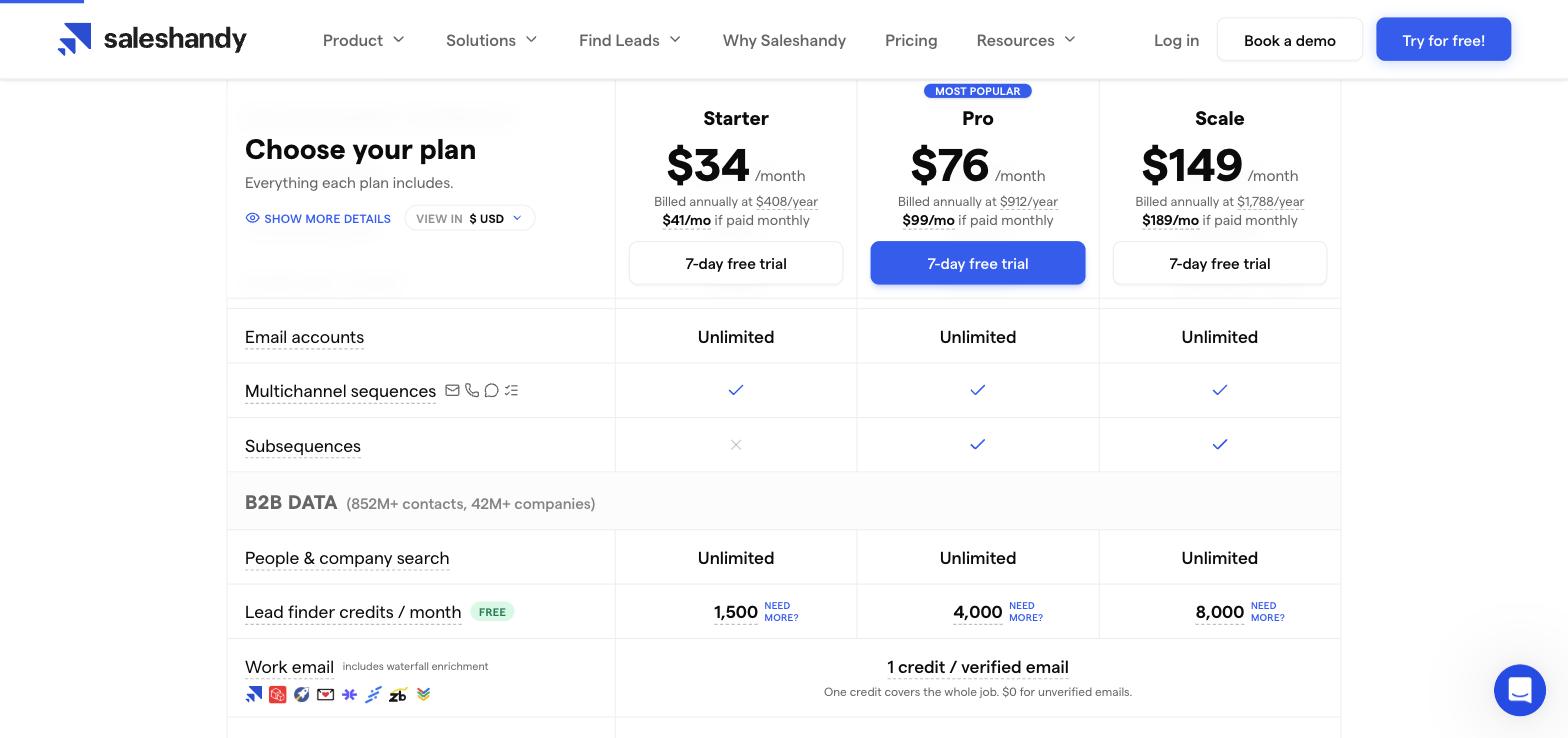
Saleshandy prices the workspace, not the person. The row that matters most is further down the page, where Users reads 1, then 10, then Unlimited.
One person
- Saleshandy Starter, $34/mo (or $41 monthly). 2,000 active prospects, 6,000 emails, unlimited email accounts, 1,500 lead credits a month. No Subsequences, and it's a single user.
- Apollo Basic, $49/seat/mo (or $65 monthly). 30,000 credits a year granted upfront, warmup, waterfall enrichment, CRM integrations, domain and mailbox buying.
- SmartReach.io, $29/mo for Email Outreach Basic or $39/mo for Sales Engagement Basic, which adds LinkedIn, calling and WhatsApp steps.
At one seat Apollo's $49 is the best-shaped $49 in this comparison. Nothing else gives a solo operator a real database, a sequencer and a CRM on one bill, and it's the only one of the three with a free plan to test first.
Be honest about Saleshandy's $34 too. It's the cheapest way in, and it's deliberately thin. Conditional branching starts at Pro.
The better alternative at one seat is SmartReach.io Sales Engagement Basic at $39 a month, but only if you need more than email. It's the cheapest way to get LinkedIn steps, a calling seat and WhatsApp tasks into the same cadence, and it's $10 less than Apollo Basic before Apollo's credits run out.
Read the Basic tier carefully though. It's one user, one calling seat and one manual LinkedIn seat, and full LinkedIn automation is a Plus-tier add-on. If automated LinkedIn is the reason you're switching, Plus at $99 is the honest entry point.
Five people, email plus calling
This is where the two models stop resembling each other.
- Saleshandy Pro, $76/mo flat, covering 10 users, 30,000 active prospects and 100,000 emails. Add Dialer Pro at $55/mo for $131/mo total.
- Apollo Professional, 5 × $79 = $395/mo. Add the Advanced Dialer at $119 per team for $514/mo.
- SmartReach.io Sales Engagement Plus, $99/mo flat for unlimited users, 50,000 active prospects, with calling seats on the plan.
That's a $383 monthly gap between Saleshandy and Apollo for a team running the same two channels. The gap is headcount, and it grows with every hire.
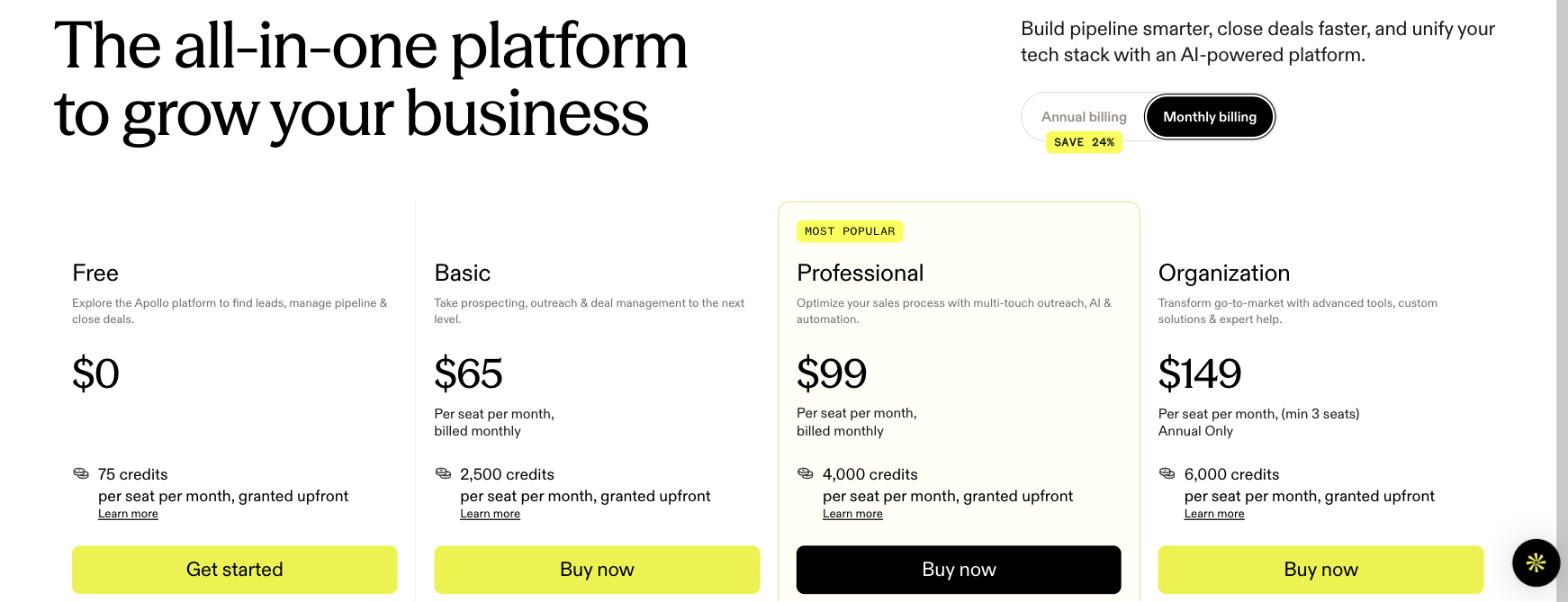
Apollo's page defaults to annual. Flip the toggle to monthly and Basic moves from $49 to $65, Professional from $79 to $99, and Organization turns out to be annual only with a three-seat minimum.
The trade-off, in the same breath. That $514 buys a genuine database, intent data and a CRM that some teams run instead of paying for HubSpot seats. If you're already paying per rep for a CRM elsewhere, Apollo's number is doing double duty and the gap narrows fast.
The better alternative to Apollo at five people is SmartReach.io Sales Engagement Plus. It's $99 a month flat against Apollo's $395, it adds LinkedIn as an automated step rather than a task, and adding the sixth rep doesn't move the invoice. What you give up is Apollo's intent data and its CRM.
Ten people
- Saleshandy Scale, $149/mo flat. Unlimited users, unlimited active prospects, 200,000 emails, 8,000 lead credits a month. With Dialer Pro, $204/mo.
- Apollo Professional, 10 × $79 = $790/mo, or $909/mo with the dialer add-on. On monthly billing that's $1,139.
- SmartReach.io Sales Engagement Pro, $249/mo flat for unlimited users and 100,000 active prospects.
Two costs sit outside all three plan prices. Saleshandy bills phone numbers separately at $3.81 per number per quarter in the US and Canada and $10.32 in India, and mailboxes from $2.99 each per month with a $14 annual domain fee.
What annual billing changes
Committing annually moves every number down, so it doesn't change who wins. It does change how much a wrong choice costs you.
| Annual billing | Effective monthly | Saving vs monthly |
|---|---|---|
| Saleshandy Starter | $34/mo per workspace | ~17% |
| Saleshandy Pro | $76/mo per workspace | ~23% |
| Saleshandy Scale | $149/mo per workspace | ~21% |
| Apollo Basic | $49/seat/mo | ~24% |
| Apollo Professional | $79/seat/mo | ~20% |
| Apollo Organization | $119/seat/mo | Annual only |
| SmartReach.io Email Outreach Plus | $79/mo | ~11% |
| SmartReach.io Sales Engagement Plus | $89/mo | ~10% |
One trap worth flagging on Apollo. Cancellations take effect at the end of the current term and mid-term downgrades aren't refunded, so an annual commit is genuinely a year.
What does a credit actually buy?
Here's the section that decides more Apollo invoices than the seat count does. Apollo runs one pool for everything, and dialling draws on it.
Apollo's single pool
The published rates are 1 credit per email reveal, 8 per phone number, 1 to 8 per enrichment, 1 per AI research run, and 2 credits per minute on the US dialer.
Professional grants 48,000 credits per seat a year, which is 4,000 a month. Put a real SDR month against that and the pool looks smaller than it reads.
| Apollo Professional, one seat, one month | Credits |
|---|---|
| 4,000 credit allowance | 4,000 |
| 1,500 dial minutes at 2 credits each | −3,000 |
| 200 phone reveals at 8 credits each | −1,600 |
| 600 email reveals at 1 credit each | −600 |
| Remaining | −1,200, so you're buying overage |
That's not an extreme month. It's one rep dialling about 70 minutes a working day and revealing ten phone numbers.
Saleshandy's split meters
Saleshandy splits the meters instead, which is the more forgiving design.
Lead finder credits refresh monthly at 1,500, 4,000 or 8,000, at 1 credit per verified email and 6 per phone number, with nothing charged when a reveal returns no result.
Calling draws on a separate dialer allowance of 1,000 or 2,500 credits a month, so prospecting and dialling never compete for the same budget.
Two things to check before you sign. Saleshandy's email verification and AI credits are one-time grants, not monthly, so heavy verification pushes you into $19 and $10 credit packs.
And Saleshandy doesn't publish its credits-per-call rate on the dialer page, so ask support for that number before you build a forecast on it.
The alternative that doesn't meter this at all
Saleshandy wins this section, and SmartReach.io is the better alternative to it. SmartReach.io includes email verification free on every plan rather than as a one-time credit grant, and lead credits come with the tier rather than as a separate wallet.
The reason that matters is behavioural. A metered verification budget quietly teaches a team to send to unverified addresses at the end of the month, which is the fastest way to push a bounce rate somewhere you can't recover from.
Which channels are really automated?
Both homepages say multichannel. Neither runs LinkedIn on its own today, and that's the most important sentence in this post.
Apollo removed automated LinkedIn actions in January 2026. Its sales engagement page now describes sequences as emails, calls and automated tasks, and LinkedIn work is a task a rep completes in LinkedIn and marks done.
Saleshandy's sequence builder shows five step types, email, call, LinkedIn, WhatsApp and custom task, and its homepage promises that if a prospect doesn't reply "it automatically tries another channel". The mechanics behind LinkedIn and WhatsApp are task steps rather than sends, which is why "Tasker" is one of its five hero pillars.
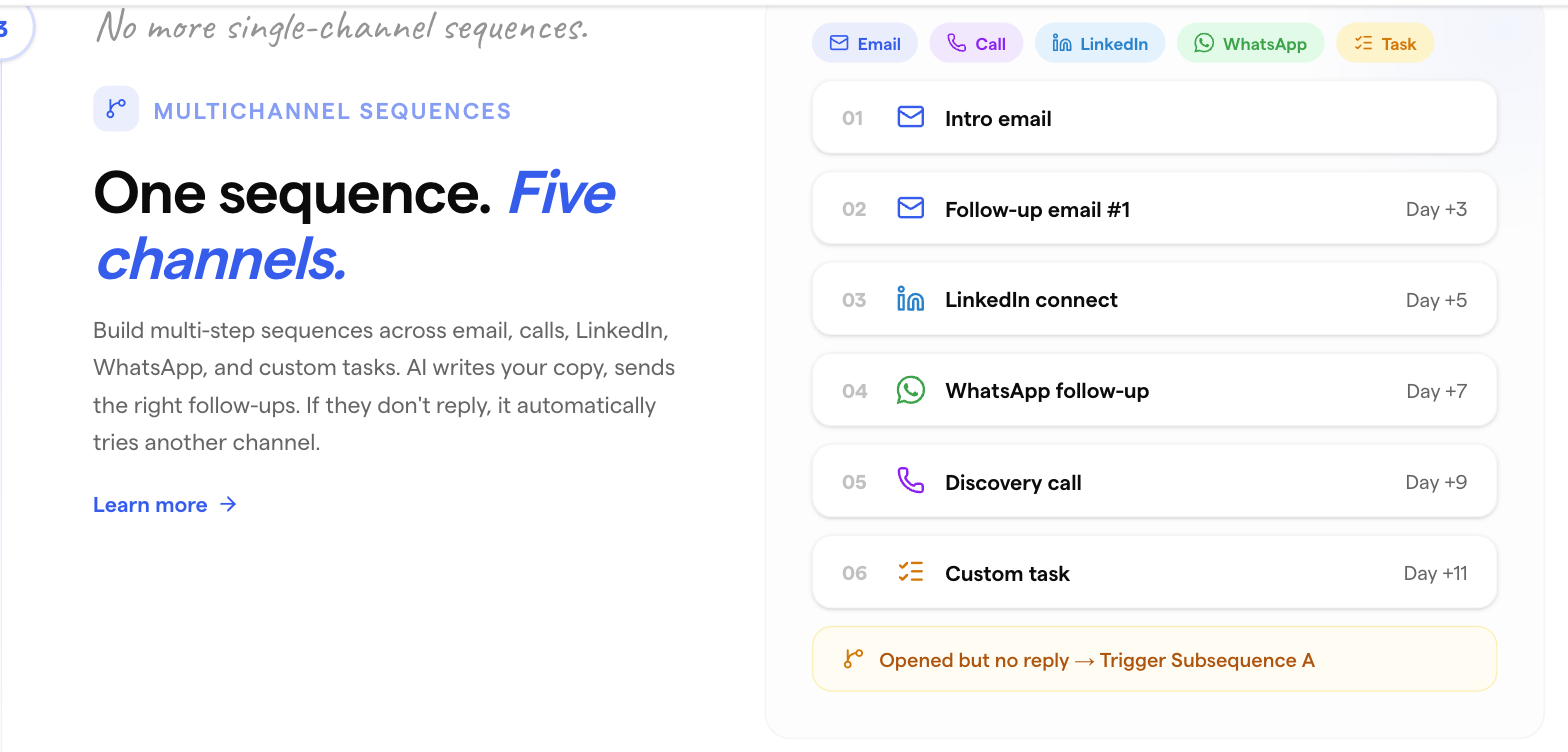
Saleshandy's sequence puts five channels on one timeline. Email is the part that sends by itself, and the LinkedIn, WhatsApp and call steps land in a rep's task queue. Test that on the 7-day trial before you plan around it.
So the honest reading is that both tools automate email, both queue everything else, and any comparison telling you one is "fully multichannel" hasn't opened the product.
This is the clearest case for the alternative in the whole comparison. SmartReach.io runs email, LinkedIn steps, calls through the built-in dialer and WhatsApp inside a single sequence, with full LinkedIn automation as an add-on at $29 a month per connected LinkedIn account, from the Plus tier up.
With the add-on on, a SmartReach.io LinkedIn step is a real send. Profile views, connection requests, messages and InMails execute from the sequence, and a reply on any channel pauses the rest of the cadence for that prospect.
Without it, every plan still runs LinkedIn in co-pilot mode, which is the same task queue both rivals give you. So the fair comparison is Plus at $99 a month plus $29 per LinkedIn account against a task queue neither rival lets you upgrade out of.
The limits, stated in the same breath. SmartReach.io doesn't do SMS, and its WhatsApp steps are manual, so the automated pair is email and LinkedIn. That's still one more automated channel than either rival ships.
How do the sequences branch?
Saleshandy, on the two-way comparison. Apollo's sequences are strong at scale and thin on conditional logic.
Saleshandy's Subsequences arrive at Pro. You set trigger conditions such as opens, clicks, tags or replies, combine them, add a delay, and matching prospects move into a separate follow-up flow. It applies to prospects already in a sequence, not just new ones.
Apollo leans on A/Z testing from Professional and on its Workflow Engine for routing, rather than on branches inside the sequence itself. For a data-led team that's usually enough. For a team designing a real cadence it isn't.
Here's the cadence most outbound teams actually want, and it's a useful thing to build on a trial.
- Day 1. View the LinkedIn profile. No message, just the view, so your name appears in their notifications before anything lands in the inbox.
- Day 2. First email. Short, one ask, no attachment.
- Day 4. LinkedIn connection request with a one-line note.
- Day 7. Follow-up email on the same thread.
- Day 10. If the request was accepted, a LinkedIn message. If it wasn't, a call task instead.
- Day 14. Third email, different angle.
- Day 18. Final call attempt, then move them to nurture.
On Saleshandy, steps 1, 3 and 5 are tasks a human clears. On Apollo, the same three are tasks plus a Chrome extension queue. On SmartReach.io they're sequence steps that execute.
One warning that applies to all three. Don't build important branches on email opens any more.
Apple's Mail Privacy Protection pre-fetches images, so a large share of your opens are a proxy server rather than a person. Branch on replies, on clicks and on LinkedIn acceptance, which are still real signals.
The better alternative to Saleshandy on sequence logic is SmartReach.io, because its branches read across channels rather than within one. A step can check whether an email bounced and route the prospect to LinkedIn, or check whether a phone number exists on the record and route to a call task when it doesn't.
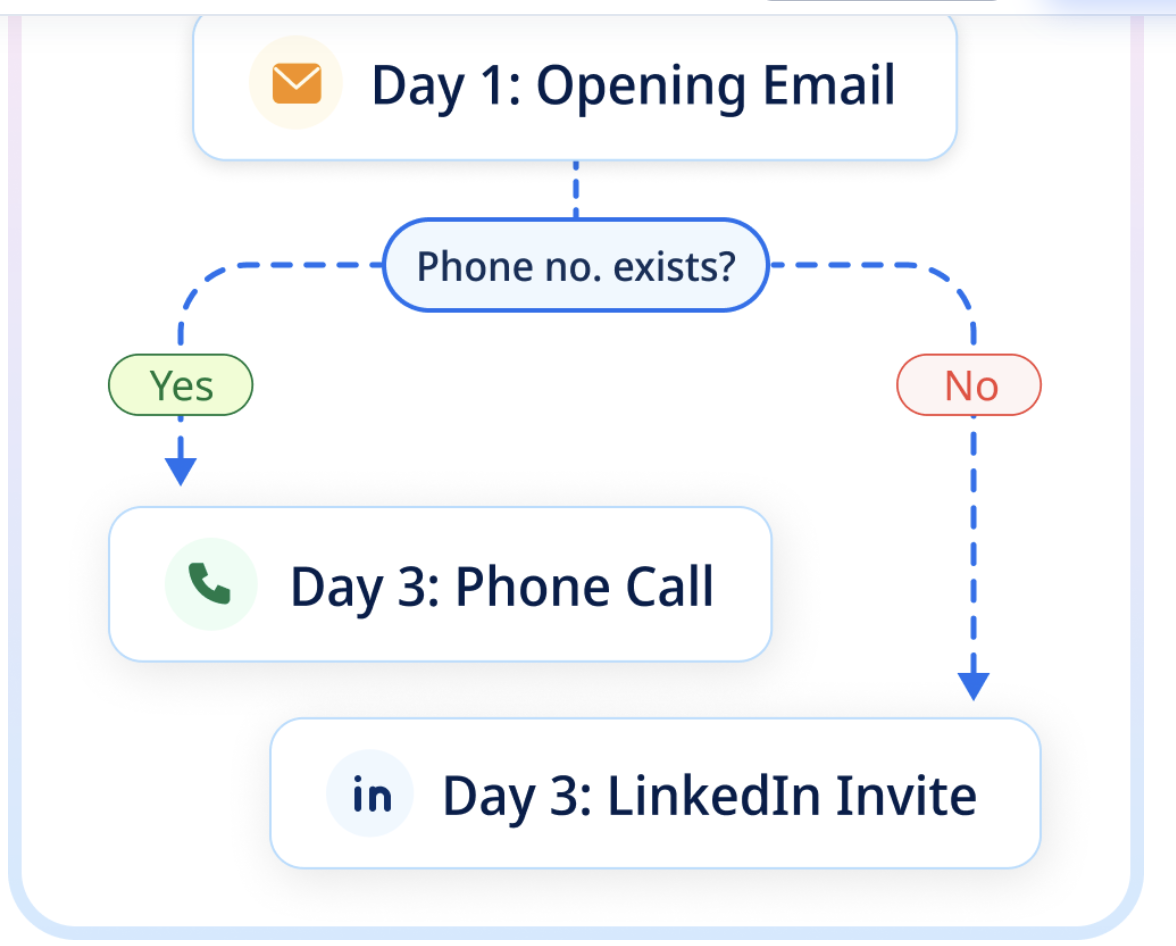
The branch is the point. A prospect with a phone number on the record routes to a call, and one without routes to LinkedIn, inside the same sequence rather than in a second tool. Multichannel drip campaigns like this one start at the Plus tier.
Whose data is better?
Apollo, and it isn't close, despite advertising the smaller number.
Saleshandy claims 852M+ contacts across 42M+ companies. Apollo self-reports 240M+ contacts and 30M+ companies. On headline count Saleshandy wins by more than three to one.
Count is close to the least useful metric here. What decides a list is how precisely you can cut it and how fresh the records are.
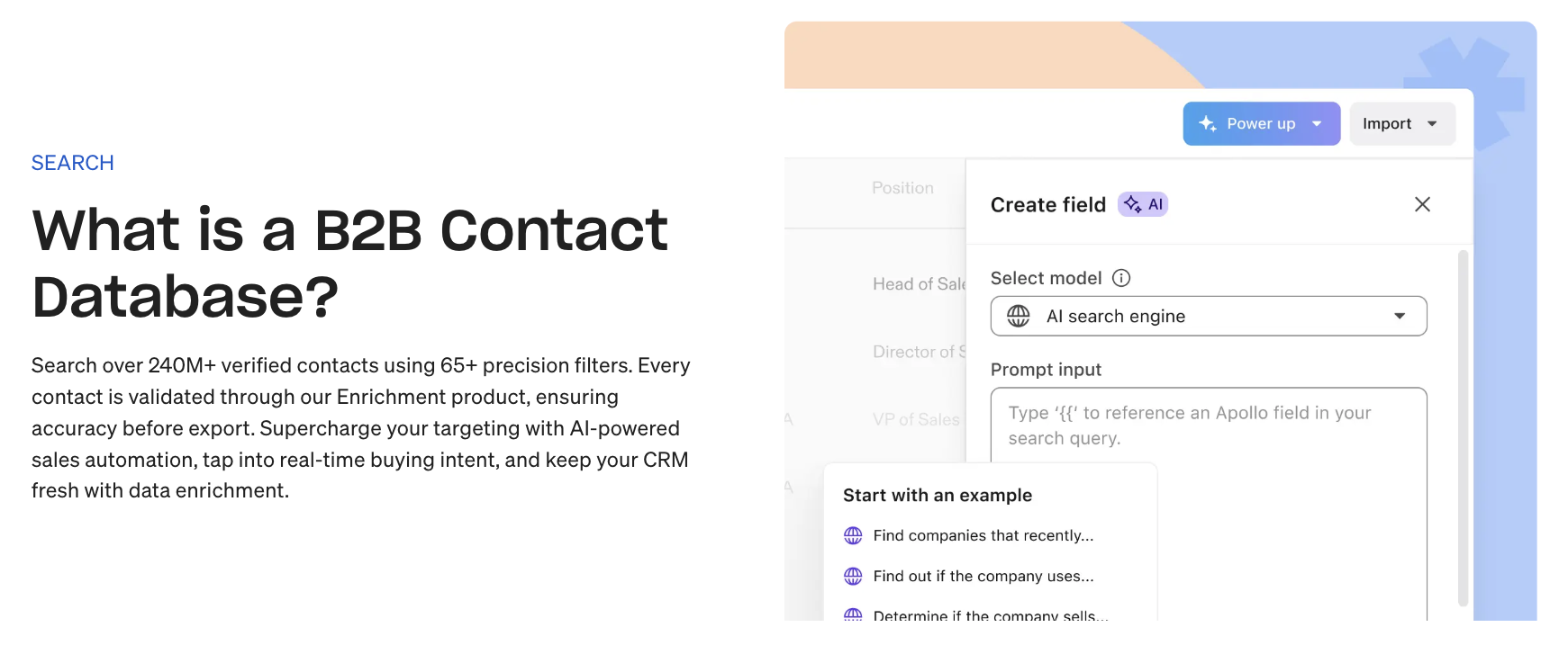
Apollo's 65+ filters, intent topics, job-change tracking and AI field creation are what the per-seat price is actually buying. Saleshandy's 70+ filters cover the firmographic basics without the intent layer.
Saleshandy's database is an aggregation, and its own page says so. Reveals run a real-time waterfall across nine named third-party vendors, verified at the moment you reveal, with no charge when nothing is found.
That's a good commercial deal and a weaker moat. The numbers have also moved a lot, from 700M contacts and 60M companies in 2025 marketing to 852M and 42M now, which is what recomputed aggregator totals look like rather than an audited corpus.
Apollo's weak spot is accuracy against its own marketing. Its page claims 98% email accuracy, while "inaccurate data" is the most frequent complaint theme across its 9,690 G2 reviews, and the community habit of re-verifying Apollo exports with a second tool exists for a reason.
The better alternative to Apollo here depends on what breaks first. If you need intent topics and 65+ filters, nothing in this comparison replaces Apollo, and that's worth saying plainly.
If what you actually need is a clean list that reaches an inbox, SmartReach.io is the stronger buy. Its B2B lead finder holds 300M+ contacts and 50M+ companies, and every plan verifies email addresses free rather than charging credits for it, which is the step that decides bounce rate.
Which one lands more email?
Saleshandy, for most teams, and mostly because of what it does with mailboxes rather than what it does with warmup.
Every Saleshandy plan connects unlimited email accounts and includes unlimited warmup. Sender rotation spreads a campaign across 10 accounts on Starter, 100 on Pro and 1,000 on Scale.
Apollo has a Deliverability Suite and email warmup from Basic, and it sells domains and mailboxes in-product too. The catch is the mailbox ceiling. Unlimited Gmail and Microsoft mailboxes arrive at Professional, which is $79 per seat rather than $49.
Both let you buy pre-configured infrastructure. Saleshandy's runs $2.99 to $3.99 per mailbox a month with SPF, DKIM and DMARC set up for you, capped at 5 mailboxes per domain.
The mailbox arithmetic
Do this before you pick a tier, because it decides the plan more often than the feature list does.
At a safe 40 emails a day per mailbox across about 22 sending days, one mailbox carries roughly 880 emails a month.
| Monthly send target | Mailboxes needed | Domains needed |
|---|---|---|
| 6,000 (Saleshandy Starter cap) | ~7 | 2 |
| 20,000 | ~23 | 5 |
| 100,000 (Saleshandy Pro cap) | ~114 | 23 |
| 200,000 (Saleshandy Scale cap) | ~228 | 46 |
Two readings fall out of that table. Saleshandy's Starter cap is comfortably inside its 10-account rotation, and its Pro cap needs more mailboxes than most teams have any intention of buying.
Also, at $2.99 a mailbox, 23 mailboxes is $69 a month on top of the plan, which is most of a second subscription.
Neither tool sells ESP matching, which pairs a sending inbox to the recipient's mail provider so a Google mailbox talks to a Google inbox. It's one of the few deliverability levers that isn't just warmup by another name.
Whatever you pick, the rules you're sending under are Google's, not the vendor's. Google's sender guidelines put the spam complaint threshold at 0.3% and require SPF, DKIM and DMARC for bulk senders, and no warmup tool overrides that.
The better alternative to Saleshandy on deliverability is SmartReach.io, because it's the only one of the three that pairs inbox rotation with ESP matching, from the Plus tier. It also runs blacklist monitoring that auto-pauses an affected inbox, and verifies every address free rather than metering it.
Who wins on calling?
SmartReach.io, for most outbound teams, because it's the only one of the three that includes a power dialer in the plan price rather than behind an add-on or a second subscription.
Apollo includes a US dialer on every paid plan and meters it at 2 credits a minute. Power dialing, parallel dialing, international numbers and local presence live in the Advanced Dialer add-on at $119 per team a month.
Call recordings with AI insights are capped at 150 minutes on Basic, 4,000 on Professional and 8,000 on Organization.
Saleshandy's dialer is a separate subscription at $23 or $55 a month on annual billing. It ships auto-recording, transcription, AI call summaries, voicemail drops with per-template callback rates, local presence and number rotation.
Three limits worth knowing before you commit. Numbers are available in the US, Canada and India only, India numbers dial Indian numbers only after a business verification, and Power Dialer, Parallel Dialer and the mobile app are all still listed as coming soon.
SmartReach.io puts a power dialer and calling seats on the Sales Engagement plans from $39 a month, so a rep works a prospect list without switching apps and the queue keeps moving when nobody answers. It also ships live listen, whisper and barge coaching, which neither rival lists anywhere.
That makes the calling comparison a straight three-way ranking. SmartReach.io has power dialing and coaching in the plan. Apollo has power and parallel dialing behind a $119 per team add-on, with no coaching. Saleshandy has neither, and lists both as coming soon.
The honest gap is parallel and predictive dialing. If your motion is 200+ dials per rep per day, Apollo's add-on is the only one of the three that answers it, and a dedicated outbound dialer beside any of them is worth pricing.
Does either one replace your CRM?
Apollo can, for a lot of smaller teams. Saleshandy can, barely.
Apollo ships opportunities and pipeline boards, meeting scheduling, inbound lead routing, call recording with conversation intelligence, and analytics. Companies under about twenty people do run Apollo instead of a separate CRM seat, and that materially changes the price comparison above.
Saleshandy's CRM is a kanban and list pipeline with notes, stages and click-to-call from the prospect card, currently free on the plan. It's fine as a deal tracker and thin as a system of record.
SmartReach.io takes the third position deliberately. It syncs into HubSpot, Salesforce, Pipedrive and Zoho and keeps the CRM where your revenue team already works, which is the right call for the large majority of teams who already own one.
So the alternative logic here inverts. If you have no CRM and want one bundled, Apollo is the buy. If you already run HubSpot or Salesforce, a second half-CRM is a liability rather than a feature, and SmartReach.io's sync is the cleaner answer.
Which one suits an agency?
Saleshandy, and the deciding factor is a licence clause rather than a feature.
Apollo's standard plans are licensed for internal business use. Using them to power external products, share data with customers or resell Apollo data needs a separate agreement with custom pricing, which its own pricing FAQ states plainly.
That makes Apollo structurally awkward for a lead-gen agency, before you reach the fact that per-seat credit pools don't stack neatly across clients.
Saleshandy sells unlimited clients from one dashboard with dedicated sending infrastructure per client and no per-client fee. Whitelabel and SSO now sit on its Enterprise tier, which is a change from earlier in 2026 when whitelabel arrived at Scale.
The better alternative for a smaller agency is SmartReach.io, which gives client dashboards from the Plus tier with no per-client fee and no enterprise conversation, on plans that carry no per-seat pricing as the client roster grows.
Count them before you buy. Plus includes 1 client dashboard, Pro includes 3 and Scale includes 10, so a 6-client agency is on Scale or on the quote-based Agency plan rather than on Plus.
If whitelabel under your own domain is non-negotiable, Saleshandy Enterprise is the one to price. The wider market is covered in the Saleshandy alternatives roundup.
Should you just run both?
A lot of teams do, and it's worth pricing honestly, because the stack is the real competitor to both products.
The stack is Apollo for the list and Saleshandy for the sending. Apollo Basic at $49 per seat covers the data, and Saleshandy Pro at $76 covers volume across unlimited mailboxes.
The version of this that works is a small Apollo seat count for research plus a flat sending platform underneath. The version that doesn't is buying Apollo seats for every rep so they can each export lists.
What breaks when you switch?
Less than you fear on the data side, more than you expect on the reputation side.
Sequences, templates and contact lists rebuild in an afternoon through CSV export and import. Both tools export cleanly.
What doesn't move is domain and mailbox reputation, warmup history and engagement data. All of it restarts on the new platform, regardless of what a migration guide promises.
Work through these five in order.
- Move suppression and unsubscribe lists first, and check them by hand. The fastest way to burn a fresh domain is emailing someone who already opted out.
- Keep both tools running for two weeks. Don't cut over on a Friday and hope.
- Move one domain at a time, and watch inbox placement on the new platform before you point everything at it.
- Rebuild warmup before volume. New mailboxes on a new platform need the ramp again, whatever their history elsewhere.
- Time an Apollo exit to your renewal date. Cancellations take effect at the end of the term and mid-term downgrades aren't refunded.
Budget two weeks for that, not two days. Any vendor marketing a one-click migration is describing how it moves your data, not how it moves your sender reputation, and the second one decides whether your first month works.
So which one should you buy?
Choose Saleshandy if
Sending is the bottleneck and the list is already solved. You want unlimited email accounts, rotation and warmup on a flat workspace fee that doesn't move when you hire. You're five or more people and everyone needs access. Or you run client campaigns and need unlimited clients without a per-client charge.
The lowest headline number at ten people. Plan the test carefully, because the trial is only 7 days.
Choose Apollo if
You don't know who to email yet. You want 65+ filters, intent topics, job-change tracking and waterfall enrichment behind the same login as your sequences, and you'd rather run one platform than a CRM plus an outreach tool. You dial at volume and want parallel dialing.
The best per-seat value at one or two seats, and the most expensive shape at ten.
Choose SmartReach.io if
Email alone has stopped working on your segment and you need LinkedIn running as an automated step rather than a task in a third tool. Your headcount grows faster than your prospect volume. You want ESP matching and inbox rotation paired, verification included rather than metered, and calling seats on the plan.
The best alternative to both for teams past the single-channel stage who'd rather run one system than reconcile three.
Saleshandy
Quick facts
- G2
- 4.6/5 ★
- From
- $34/mo per workspace on annual billing, $41 monthly
- Free trial
- 7-day free trial, no card
- Best for
- Teams that know exactly who to email and need volume, mailboxes and rotation on a flat fee.
Pros
- Unlimited email accounts and unlimited warmup on every plan
- Flat workspace pricing, 10 users on Pro and unlimited on Scale
- Lead finder credits refresh monthly, and unverified reveals are free
- Domains and mailboxes from $2.99, with SPF, DKIM and DMARC configured
- Unlimited active prospects on the Scale plan
Cons
- LinkedIn and WhatsApp are task steps, not automated sends
- The dialer is a second subscription, and numbers are extra
- Verification and AI credits are one-time grants, not monthly
- Conditional Subsequences start at Pro, not Starter
- 7-day trial, and whitelabel now sits on the Enterprise tier
Apollo
Quick facts
- G2
- 4.7/5 ★
- From
- $49/seat/mo on annual billing, $65 monthly
- Free trial
- 14-day trial with 100 credits, plus a free plan
- Best for
- Teams whose bottleneck is knowing who to contact, and small companies consolidating CRM and outreach.
Pros
- The deepest B2B data here, with 65+ filters and intent topics
- A genuine CRM with pipeline, meetings and deal management
- Power and parallel dialing through the Advanced Dialer add-on
- Domain and mailbox purchasing plus warmup from the Basic tier
- A free plan that's usable for evaluating the data
Cons
- Per seat at every tier, so the bill tracks headcount
- One credit pool for data and dialling, at 8 credits a phone number
- Automated LinkedIn actions were removed in January 2026
- Standard plans are licensed for internal use only, which blocks agencies
- Data accuracy is the most consistent complaint in its reviews
SmartReach.io
Quick facts
- G2
- 4.6/5 ★
- Capterra
- 4.7 ★
- From
- $29/mo email outreach, $39/mo multichannel
- Free trial
- 14-day free trial, 200 prospects, no card
- Best for
- Teams running email, LinkedIn, calls and WhatsApp in one sequence without paying per user.
Pros
- Email, LinkedIn, calls and WhatsApp in one branching sequence
- No per-seat pricing, with unlimited users from the Plus tier up
- ESP matching, which neither rival sells at any price
- Free email verification on every plan rather than metered credits
- Blacklist monitoring that auto-pauses an affected inbox
- Calling seats on the plan, with live listen, whisper and barge coaching
Cons
- No whitelabel, and no free plan, only the 14-day trial
- LinkedIn automation is a $29 per-account add-on from Plus, not on Basic
- Lead Finder, inbox rotation and ESP matching all start at Plus
- WhatsApp steps are manual, and there's no SMS channel
- No parallel or predictive dialer, so 200+ dials a day needs a specialist tool
The short version. Saleshandy wins this matchup on cost at almost every team shape above one person, and wins it decisively at ten.
Apollo wins on data, on the CRM and on dialling at volume, and it's the better buy for one or two people who need all three on one bill.
And on the question both of them answer badly, whether a channel other than email will run without a human, the answer is neither. That's the gap SmartReach.io was built for, and it's why it belongs on the same shortlist.
Want the deeper look at either one? There's a full Apollo.io review, a head-to-head on Saleshandy vs SmartReach.io, and Instantly vs Saleshandy for the version of this question where prospect metering decides it. Lemlist vs Apollo prices the same Apollo tiers against a personalization-first rival, and the Apollo alternatives roundup covers the rest of the field.
For more on Saleshandy specifically, the Saleshandy review prices every tier, Mailshake versus Saleshandy is the per-seat comparison, and Saleshandy versus Smartlead is the closest like-for-like on price.
Questions people actually ask
Is Saleshandy or Apollo better for cold email?
Saleshandy, if sending is the job. It gives unlimited email accounts on every plan, sender rotation, warmup and a flat workspace fee, so the bill doesn't move when the team grows. Apollo is the better buy when you don't yet know who to email, because 240M+ contacts, 65+ filters and intent data sit behind the same login as the sequencer.
What is the best alternative to Saleshandy and Apollo?
SmartReach.io, for teams that need more than one channel to actually run on its own. SmartReach.io is a cold email software that sends email, LinkedIn steps, calls and WhatsApp from one branching sequence, with no per-seat pricing and unlimited users on every plan above Basic. Sales Engagement plans start at $39 a month with a 14-day free trial covering 200 prospects and no card.
How much do Saleshandy and Apollo cost per month?
On monthly billing Saleshandy runs $41, $99 and $189 for the whole workspace. Apollo runs $65 and $99 per seat, and its Organization tier is annual only at $119 per seat with a three-seat minimum. Saleshandy's advertised $34, $76 and $149 are annual rates, and Apollo's advertised $49, $79 and $119 are too.
Does Apollo charge per user?
Yes, at every paid tier. Apollo Basic is $49 per seat a month on annual billing and Professional is $79, so a five-person team pays five times the headline number. Saleshandy charges one workspace fee and includes 1 user on Starter, 10 on Pro and unlimited on Scale. SmartReach.io has no per-seat pricing at all and includes unlimited users from the Plus tier up, which is why it's the cheaper alternative to Apollo past about three people.
Do Saleshandy or Apollo automate LinkedIn?
Neither runs LinkedIn on its own today. Apollo removed automated LinkedIn actions in January 2026, so connection requests and messages are manual tasks a rep completes in LinkedIn. Saleshandy puts LinkedIn and WhatsApp in the sequence builder as task steps rather than sends. SmartReach.io is the alternative that does automate it, at $29 a month per connected LinkedIn account.
How many credits does an Apollo phone number cost?
Eight. Apollo runs one credit pool for everything, at 1 credit per email reveal, 8 per phone number, 1 to 8 per enrichment, 1 per AI research run and 2 credits per minute on the US dialer. Professional grants 4,000 credits per seat a month, so 1,500 dial minutes alone consumes 3,000 of them before a single contact is revealed.
Does Saleshandy include a lead database in the plan?
Yes, and the credits refresh monthly. Saleshandy grants 1,500 lead finder credits a month on Starter, 4,000 on Pro and 8,000 on Scale against a claimed 852M+ contacts and 42M+ companies, at 1 credit per verified email and 6 per phone number, with no charge for an unverified result. Email verification and AI credits are one-time grants, not monthly.
Which is better for an agency, Saleshandy or Apollo?
Saleshandy, on the terms alone. Apollo's standard plans are licensed for internal business use, and powering external products, sharing data with clients or reselling it needs a separate agreement. Saleshandy sells unlimited clients from one dashboard and puts whitelabel and SSO on its Enterprise tier. SmartReach.io is the middle option, with client dashboards from the Plus tier and no per-client fee, though Plus includes 1 dashboard, Pro 3 and Scale 10.
Which one has the better dialer?
SmartReach.io, for most teams, because its power dialer and calling seats are in the plan from $39 a month with live listen, whisper and barge coaching. Apollo's Advanced Dialer add-on at $119 per team a month adds parallel dialing and international numbers on top of power dialing. Saleshandy's dialer is a separate $23 to $55 subscription with numbers in the US, Canada and India only, and its power dialer is still listed as coming soon.
Can I run Saleshandy and Apollo together?
Plenty of teams do, using Apollo for the list and Saleshandy for the sending. At five people that stack costs about $321 a month on annual billing, Apollo Basic for five seats plus one Saleshandy Pro workspace, which is over three times SmartReach.io Sales Engagement Plus at $99 a month for unlimited users. The two-tool stack buys you Apollo's filters and intent data, and it costs you two logins, two bills and a CSV in the middle.
Stop juggling tools
Book more meetings on every channel
Join 5,000+ teams running multichannel outreach from one sequence, with deliverability built in.