Mailshake vs Saleshandy | Per Seat or Flat, Priced Out

On this page
Two tools, one straight question. Does the bill go up when you hire, or does it not?
That is what Mailshake vs Saleshandy comes down to once the feature lists stop competing for your attention. Mailshake charges for every person who logs in. Saleshandy charges for how many prospects you are working, and stops counting heads above its entry plan.
At one user the difference is a rounding error. At five it pays a contractor. Everything else in this comparison matters, but nothing else changes the number by 150%.
Mailshake vs Saleshandy at a glance
Both tools send sequenced cold email with automated follow-ups, a unified inbox, A/B testing and CRM sync. Below that shared floor they are built on different assumptions about who is sending.
| Mailshake | Saleshandy | SmartReach.io | |
|---|---|---|---|
| Billing unit | Per user | Flat, by active prospects | Flat, by active prospects |
| Entry price, monthly | $29 per user | $41 | $29 |
| Mid plan, monthly | $49 per user | $99 | $89 |
| Top published plan | $99 per user | $189 | $199 |
| Users included | 1 per licence | 1, then 10, then unlimited | 1 on Basic, unlimited from Plus |
| Email accounts | 1, 2 then 10 | Unlimited on every plan | Unlimited from Basic |
| Emails a month | 1,500, then unlimited | 6,000 / 100,000 / 200,000 | 10,000 on Basic, then unlimited |
| Warmup | Included, unlimited | Included, free | Included, 10 then 25 accounts |
| Inbox rotation | Not published | Yes, every plan | From Email Outreach Plus |
| ESP matching | No | No | Yes, from Plus |
| Lead database | $19 a month add-on | Included, 852M+ contacts | Included, 300M+ contacts |
| Calling | Power dialer on top plan | None | Calling seats from $39 |
| Manual task | Manual task | Automated in-sequence | |
| Free trial | None | 7 days | 14 days, no card |
Two rows in that table decide most purchases. The billing unit, and the email account cap.
Pricing, and what a team of five really pays
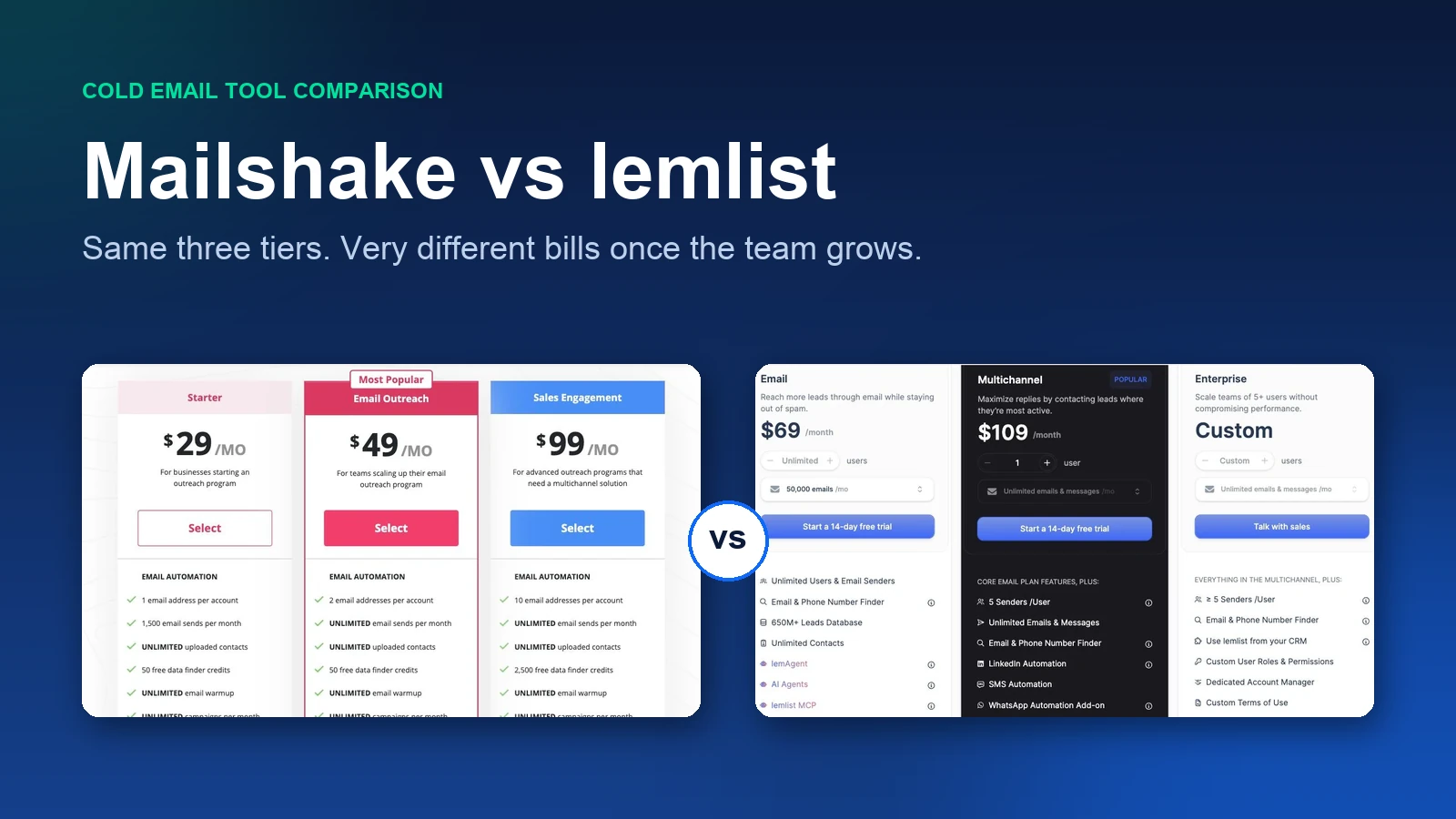
Mailshake publishes three plans. Starter at $29 per user, Email Outreach at $49 per user, and Sales Engagement at $99 per user, all monthly. Annual billing takes those to $25, $45 and $85.
Saleshandy publishes Starter at $41, Pro at $99 and Scale at $189 a month, with annual rates of $34, $76 and $149.
Read as single numbers, Mailshake looks cheaper at every tier. That reading survives exactly one hire.
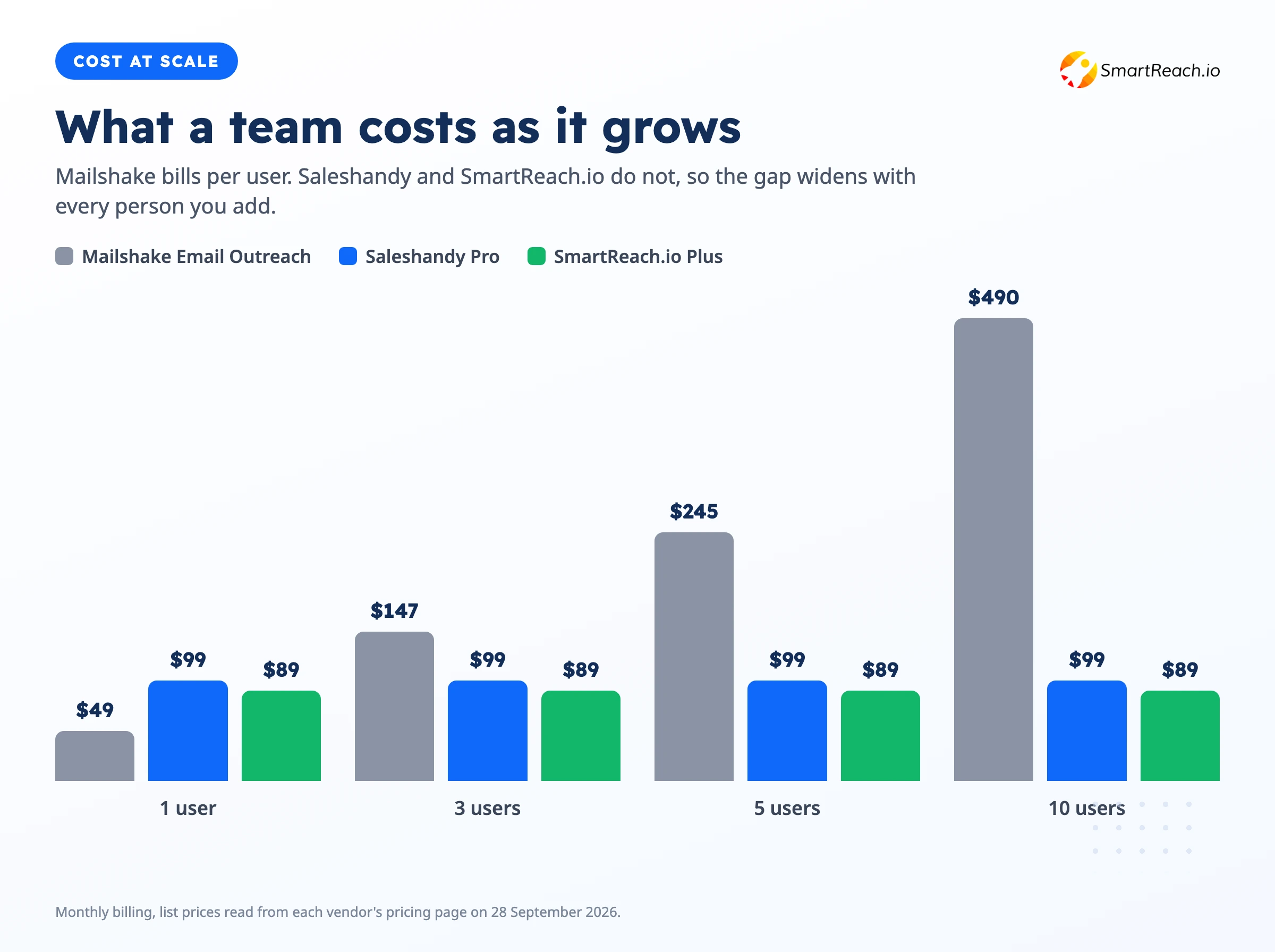
Mailshake Email Outreach at $49 per user against two flat plans. The gap is $0 at one user and $391 at ten.
Work the arithmetic at the tier most small teams actually buy. Mailshake Email Outreach at $49 per user costs $49, $147, $245 and $490 at one, three, five and ten users. Saleshandy Pro is $99 whatever you do, up to ten users. SmartReach.io Email Outreach Plus is $89 with no user cap at all.
So the honest answer to which is cheaper has a threshold in it. Below two users, Mailshake. At two, they are within a few dollars. Above two, Saleshandy, by a margin that grows every month and never comes back.
There is one more thing in the pricing worth naming, because both vendors do it and it changes the number you remember. Both pricing pages open on annual billing. Mailshake shows $25 with $29 struck through. Saleshandy shows $34 with "$41/mo if paid monthly" underneath in smaller type. If you are budgeting monthly, neither headline number is yours.
Sending accounts, the limit that decides cold email
Here is the row that matters more than price for anyone actually doing cold outreach, and it is the one most comparisons skip.
Cold email volume is spread across many mailboxes on purpose. Sender reputation attaches to the domain and the mailbox, so a hundred emails a day from one inbox is a deliverability problem, while the same hundred split across five inboxes is routine. SmartReach.io recommends about 40 emails a day per inbox, across 5 to 7 mailboxes per domain.
That makes the email account cap a volume cap in disguise.
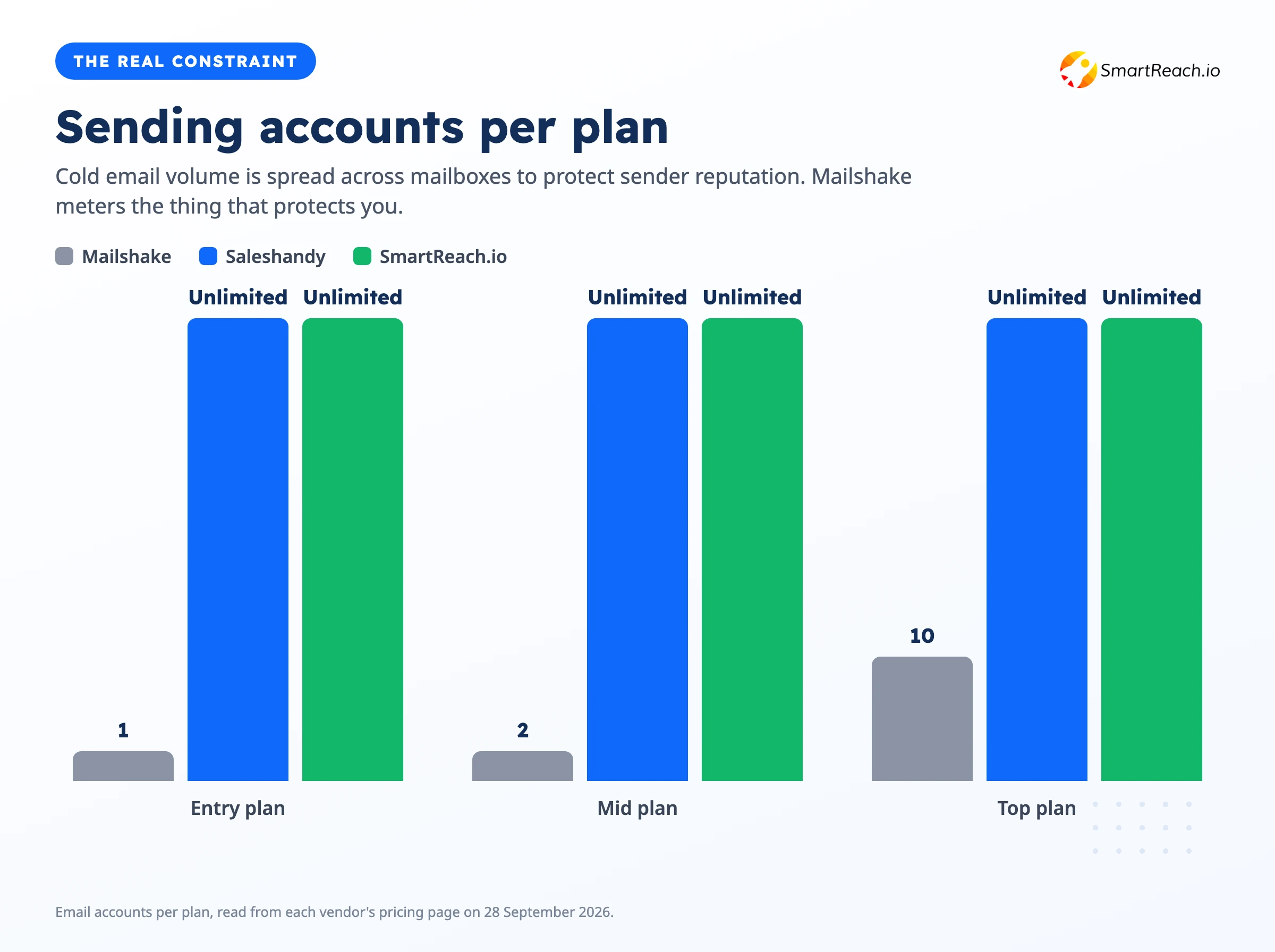
Mailshake meters the thing that protects your domain. Saleshandy and SmartReach.io do not.
Mailshake gives one email address per account on Starter, two on Email Outreach and ten on Sales Engagement. Saleshandy gives unlimited sending accounts on all three plans, and says so in the first row of its pricing table.
Put real numbers on it. At the recommended 40 a day, a single Mailshake Starter mailbox supports roughly 1,200 emails a month, which lines up with the 1,500 send cap on that plan. Two mailboxes on Email Outreach support about 2,400. Getting to 10,000 a month safely needs eight or nine mailboxes, which on Mailshake means the $99 Sales Engagement plan, per user.
On Saleshandy the same 10,000 emails sit inside the $41 Starter plan for mailbox purposes, though the plan's own 6,000 email ceiling becomes the binding limit instead. On Pro at $99 you get both unlimited mailboxes and 100,000 emails.
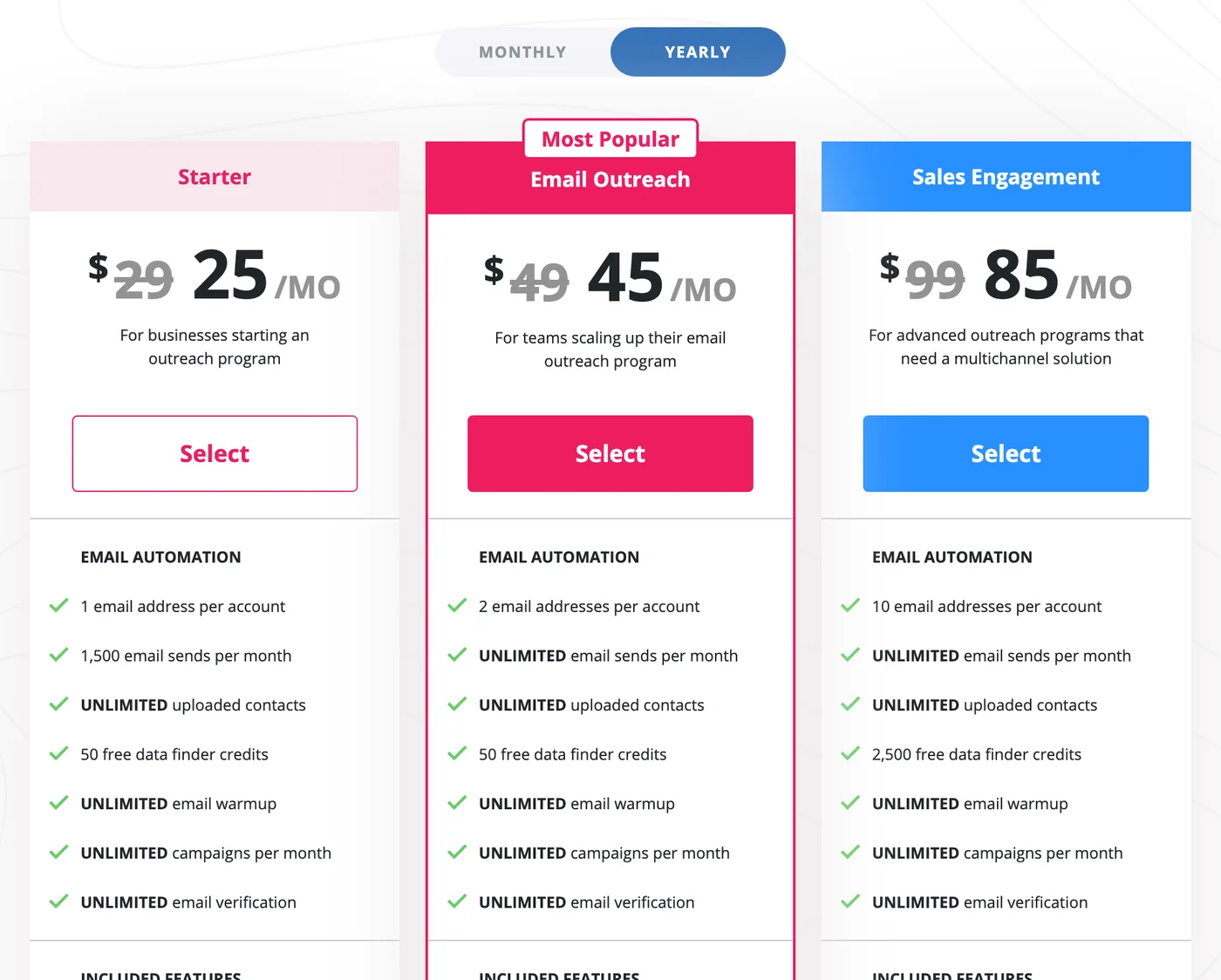
Mailshake's pricing page, captured 28 September 2026. The yearly toggle is preselected, and the email address cap sits in the first feature row of each plan.
Deliverability tooling, side by side
Both include warmup at no extra cost, which is now table stakes rather than a differentiator. Mailshake advertises unlimited email warmup on all three plans. Saleshandy includes free warmup and adds sender rotation across your unlimited mailboxes.
Sender rotation is the meaningful gap. It spreads a campaign's sends across every connected mailbox automatically, so no single inbox carries the whole load. Mailshake does not publish a rotation feature, which is consistent with a product that gives you one or two mailboxes to rotate between.
Neither tool does ESP matching, where sends are timed and routed based on the recipient's mailbox provider, and neither publishes blacklist monitoring that pauses a campaign when a domain gets listed. Those are the two deliverability features that separate a sequencer from sending infrastructure, and both of these tools stop short of them.
Saleshandy also sells the mailboxes. Google, Microsoft 365 and Azure inboxes from $2.99 to $3.99 each a month with DNS records configured automatically, and domains at $14 a year. Mailshake sells Ready to Use Mailboxes at $12 a month, which is three to four times the price for the same job.
Calling, LinkedIn and the multichannel question
This is where Mailshake earns its top plan and where both tools overstate what they do.
Mailshake Sales Engagement at $99 per user includes five phone numbers, a power dialer and unlimited dialer minutes to North American numbers. That is a genuine dialer, not a click-to-call link, and for a team that works the phone as hard as the inbox it is worth the seat price on its own. Saleshandy has nothing comparable.
LinkedIn is where both fall down, and they fall down identically. Both put a LinkedIn step in the sequence builder. Neither performs the action. The step becomes a task on a rep's list, and the rep opens LinkedIn and does it by hand, or the work is handed to a separate tool at a separate price.
Saleshandy's pricing page names four channels under a "multichannel sequences" row that is ticked on every plan. The icons next to it are email, phone, chat and task. Read that carefully and the claim is accurate, because a task is a step. It is just not automation.
Lead data, and what a credit is worth
Mailshake sells Data Finder as an add-on at $19 a month, with 50 free credits on Starter and Email Outreach and 2,500 on Sales Engagement. So on the two cheaper plans, prospect data is a second subscription.
Saleshandy bundles Lead Finder into every plan it sells, at 1,500 credits a month on Starter, 4,000 on Pro and 8,000 on Scale, drawn from a database it publishes as 852M+ contacts and 42M+ companies.
That contact count is larger than most tools in this category claim, and it deserves a caveat rather than a dismissal. Raw record counts across B2B data vendors are not comparable, because vendors count differently and nobody audits them. What is comparable is the unit price. Saleshandy Pro works out near 2.5 cents per revealed contact. Mailshake's add-on at $19 for a credit pack is harder to price per record because the pack size is not published on the pricing page.
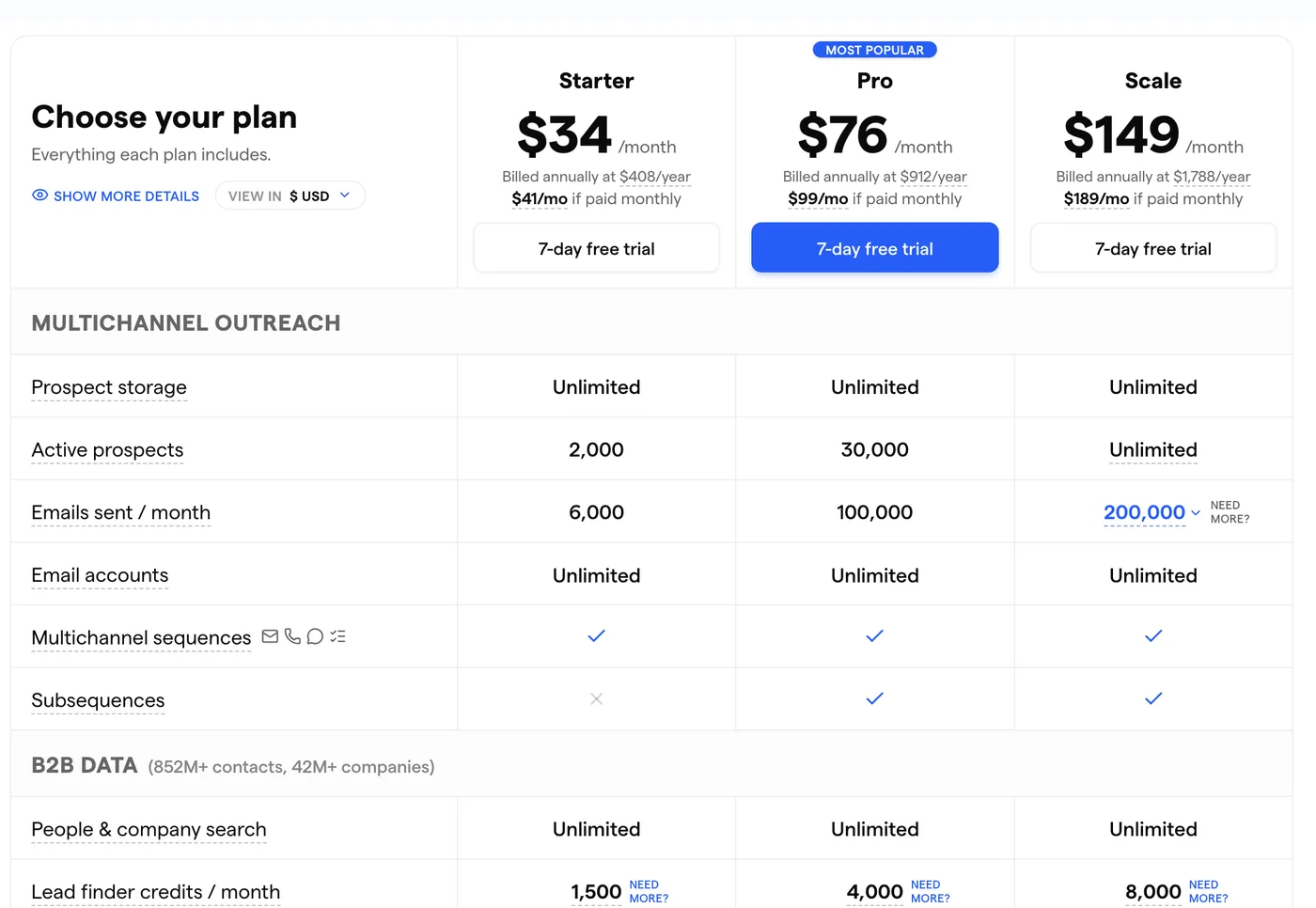
Saleshandy's pricing page, captured 28 September 2026. Unlimited email accounts on every plan, and the B2B data row publishing 852M+ contacts.
Where Mailshake and Saleshandy both fall short
Most comparisons stop at picking a winner. The more useful question for a lot of readers is what neither one solves, because that is what sends people back to a shortlist six months later.
Neither automates LinkedIn. Both will schedule a LinkedIn step and then ask a human to perform it. If LinkedIn is a real channel for you rather than a box to tick, both tools are a partial answer.
Neither does ESP matching or blacklist monitoring. Warmup and rotation are the first layer of deliverability. Knowing that a recipient is on Google Workspace rather than Microsoft 365 and routing accordingly is the second, and neither tool publishes it.
Both meter something you will hit. Mailshake meters people and mailboxes. Saleshandy meters emails, including 200,000 a month on its top plan. Whichever you pick, plan for the ceiling rather than being surprised by it.
Neither gives you long enough to test properly. Mailshake has no free trial at all. Saleshandy has seven days, which is shorter than a warmup cycle, so you cannot evaluate the thing that actually determines whether cold email works before you pay.
Which one should you buy
Solo founder, email only, under 1,500 sends a month
Mailshake Starter at $29 is the cheapest way in, and one mailbox is enough at that volume. Watch the send cap rather than the price. There is no trial, so you are paying to find out.
Two to ten senders, email led
Saleshandy Pro at $99 flat. Ten users, unlimited mailboxes, 100,000 emails and 4,000 lead credits on one bill. This is the case Saleshandy was built for and the one where Mailshake's per-user model works against you hardest.
A team that lives on the phone
Mailshake Sales Engagement at $99 per user. The power dialer with unlimited North American minutes has no equivalent in Saleshandy, and if half your pipeline comes from dials, that is worth the seat cost.
LinkedIn is a real channel, not a task list
Neither of these. Look at tools that execute the LinkedIn step rather than assign it, which is the single biggest functional gap both share.
Switching without burning your domains
If you are moving between them, the sequences are the easy part and the mailboxes are not.
Sequence copy does not transfer. You rebuild it, which is a morning of work and a decent excuse to cut the two steps nobody ever replied to. Prospects move as a CSV export and import.
The part that needs care is sender reputation. A mailbox that suddenly starts sending through a different platform looks different to Google and Microsoft, and a mailbox that has been paused during a migration looks colder than it did. Ramp a moved mailbox back up rather than resuming at full volume, and keep the daily rate near 40 per inbox while it settles.
Run both tools in parallel for two weeks if you can. It costs one extra month of the cheaper plan and it is far less expensive than discovering your domain reputation moved with you.
If neither fits, the usual reason is that both cap something you did not expect to be capped. Mailshake caps people and mailboxes. Saleshandy caps emails. The Saleshandy alternatives roundup compares ten tools on exactly that basis, the Saleshandy review goes through its plans and limits in full, and there are head-to-heads against Smartlead, Dripify and Apollo, the last one on the same per-seat versus flat question.
Is Mailshake or Saleshandy cheaper?
Saleshandy, from the second user onward. Mailshake Email Outreach is $49 per user a month, so five people cost $245, while Saleshandy Pro is $99 flat and covers ten. At a single user Mailshake is cheaper at $49 against $99. SmartReach.io Email Outreach Plus is $89 flat with unlimited users and 50,000 active prospects.
How many email accounts do Mailshake and Saleshandy allow?
Mailshake allows 1 on Starter, 2 on Email Outreach and 10 on Sales Engagement, counted per user. Saleshandy allows unlimited sending accounts on all three of its plans. That matters because cold email volume is spread across mailboxes to protect sender reputation. SmartReach.io also allows unlimited sending accounts, and recommends about 40 emails a day per inbox.
How long do you get to test Mailshake and Saleshandy?
Not long enough on either one. Mailshake sells no free trial at all and leans on a 30-day money-back guarantee instead, so you pay before sending a single test campaign. Saleshandy gives 7 days, which is shorter than an email warmup cycle. SmartReach.io gives 14 days across 200 prospects with no credit card.
Which is better for a solo sender, Mailshake or Saleshandy?
Mailshake Starter at $29 a month is the cheaper entry, but it allows one mailbox and 1,500 sends a month, which caps a real cold email programme quickly. Saleshandy Starter at $41 allows unlimited mailboxes and 6,000 emails. SmartReach.io Email Outreach Basic is $29 a month with unlimited sending accounts and 10,000 emails.
Does Mailshake include a power dialer?
Yes, on Sales Engagement at $99 per user a month, which includes 5 phone numbers, a power dialer and unlimited dialer minutes to North American numbers. Saleshandy has no dialer of its own. SmartReach.io includes calling seats on its Sales Engagement plans from $39 a month, with live listen, whisper and barge coaching.
Do Mailshake and Saleshandy both do multichannel outreach?
Only partly, and in opposite ways. Mailshake automates email and adds real calling on its top plan, with LinkedIn as a manual task. Saleshandy markets four channels but automates email alone. SmartReach.io runs email, LinkedIn, calls and WhatsApp, and automates the LinkedIn steps inside the same conditional sequence for $29 a month per connected account.
Which has the better lead database?
Saleshandy, on raw size and on price. It publishes 852M+ contacts and 42M+ companies with 1,500 to 8,000 credits granted monthly. Mailshake sells Data Finder as a $19 a month add-on with 50 free credits on two of three plans. SmartReach.io includes lead finder credits monthly across 300M+ contacts and 50M+ companies.
Can I move a campaign from Mailshake to Saleshandy?
Sequences do not transfer between them, so copy is rebuilt by hand and prospects move as a CSV. The part that needs care is sender reputation, because a mailbox that changes sending platform looks different to mailbox providers. SmartReach.io recommends ramping a moved mailbox back to about 40 emails a day across 5 to 7 mailboxes per domain.
Stop juggling tools
Book more meetings on every channel
Join 5,000+ teams running multichannel outreach from one sequence, with deliverability built in.