10 Best Apollo Alternatives, Ranked by What You're Replacing

On this page
Most people don't start shopping for an Apollo alternative because they hate Apollo. They start because of a number that stopped making sense.
Maybe it's the bounce rate, which was 4% in spring and is 19% now, on a list built the same way both times. Maybe it's the invoice, which grew 40% last year while your prospect volume stayed flat, because you hired three people and Apollo charges by the head. Maybe it's the 19th of the month, when the credits ran out again and the phone lookups stopped, because a mobile number costs eight credits and an email costs one and nothing rolls over.
Any one of those sends you to Google. And Google hands back the same twelve listicles, all recommending databases, because everyone writing them assumes an Apollo alternative means a different place to get contacts.
That assumption is where the money gets wasted. Apollo isn't one product. It's a contact database and a sending platform sold on one invoice, and those two halves fail for completely different reasons and get replaced by completely different tools. Migrate the wrong half and you'll spend three weeks and a setup fee fixing something that was working fine.
So before the list, the question worth answering: which half of Apollo actually broke?
TL;DR: the 10 best Apollo alternatives
At-a-glance: every Apollo alternative compared
Every price below is the monthly list price on monthly billing, at the time of writing, so the columns are actually comparable. Annual discounts are noted in each tool's own section rather than mixed in here.
| Tool | G2 | Starting price (model) | Best for | Contact database | Deliverability suite | Multichannel | Free tier / trial | Verdict |
|---|---|---|---|---|---|---|---|---|
| Apollo.io (baseline) | 4.7 ★ | $60/user/mo | Database-led outbound | ✓ (large) | Partial, no warmup pool | ✓ (email, calls, LinkedIn tasks) | Free plan | The thing you're replacing |
| 1. SmartReach.io | 4.6 ★ | $29/mo (by prospects) | Multichannel teams off per-seat | ✓ (300M+ / 50M+) | ✓ (warmup, rotation, ESP match, blacklist) | ✓ (email, LinkedIn, calls, WhatsApp) | 14-day, no card | Best for the sending half |
| 2. Clay | 4.9 ★ | $185/mo (flat + credits) | RevOps and enrichment | ✓ (waterfall, many sources) | – | – | Free plan | Best enrichment, full stop |
| 3. Cognism | 4.6 ★ | Quote only (annual) | Non-NA phone-verified data | ✓ (phone-verified) | – | – | Demo only | Best data outside the US |
| 4. Instantly.ai | 4.8 ★ | $47/mo (flat) | Email-only volume | Add-on subscription | ✓ (unlimited warmup) | – (email; calls/SMS in separate CRM) | Free trial | Best entry-tier sending |
| 5. Smartlead | 4.5 ★ | $39/mo (flat) | Agencies, client inboxes | SmartProspect, $59 add-on below $174 | ✓ (unlimited warmup) | Calls on $174+ plans, no native LinkedIn | 14-day | Cheapest serious sender |
| 6. ZoomInfo | 4.5 ★ | Quote only (annual) | Enterprise depth | ✓ (deepest in NA) | – | Partial | Demo only | Deepest database |
| 7. lemlist | 4.6 ★ | $69/mo (per workspace) | Personalisation, bundled data | ✓ (650M+) | Partial | ✓ (email, LinkedIn, calls) | 14-day | Best bundled sender |
| 8. Salesloft | 4.5 ★ | Quote only | Enterprise, CRM-anchored | – | Partial | ✓ (email, calls, SMS) | Demo only | Enterprise only |
| 9. Lusha | 4.3 ★ | Free, paid from ~$50/mo | Quick lookups | ✓ | – | – | Free plan | Best free data tier |
| 10. Snov.io | 4.6 ★ | $39/mo (credits) | Small budgets | ✓ (finder) | Partial | ✓ (email drip) | Free plan | Cheapest both-halves |
| Hunter.io | 4.4 ★ | ~$49/mo | Email finding, verification | ✓ (email only, no phone) | – | – | Free plan | Verification specialist |
| UpLead | 4.7 ★ | $99/mo | Accuracy guarantee | ✓ (95% guarantee) | – | – | 7-day, 5 credits | Small but clean |
| Seamless.AI | 4.2 ★ | $147/mo (annual) | Real-time search | ✓ | – | – | Free, 50 credits | Volume over precision |
| Reply.io | 4.6 ★ | $49/user/mo | AI-led cadences | ✓ | Partial | ✓ (email, call, social) | Free trial | Per-seat, adds up fast |
| Amplemarket | 4.7 ★ | $600/mo (annual, 2 users) | Funded teams wanting one vendor | ✓ | ✓ | ✓ | Demo only | All-in-one, priced like it |
| Lead411 | 4.5 ★ | $49/mo | Intent data on a budget | ✓ (with intent) | – | Basic cadences | Free trial | Intent without the enterprise bill |
Why teams leave Apollo
Apollo isn't a bad product. It's a genuinely impressive one, and the free plan is the most generous on this page. But four complaints recur often enough that they're worth naming precisely, because each one points at a different replacement.
The data degrades by geography. Reported US contact accuracy sits around 88%, which is fine. Outside North America it drops to roughly 60-73% at the time of writing, and bounce rates on exported lists commonly land in the 15-25% range. The mechanism matters more than the number: the database isn't re-verified in real time and doesn't fall back to a second provider when it misses. A contact that was valid in spring can be stale by summer, and you find out by burning your domain reputation on it.
Credits expire, and the maths is uneven. Phone lookups cost eight credits against one for an email, allowances reset monthly with no rollover, and extra credits run around $0.20 each with a minimum purchase. A rep making 25 calls a day can clear a month's mobile allowance inside a working week. The published seat price is real; it's just not the final number.
The warmup pool is gone. Apollo shut it down in 2024 and replaced it with Inbox Ramp Up, which paces sending volume upward on a schedule. Pacing helps. It isn't the same thing as a warmup network that generates positive engagement to build reputation, and for teams whose core problem is inbox placement, that's the gap that actually hurts. Google and Microsoft both tightened bulk sender requirements over the same period, and Google's published guidelines for bulk senders now put hard numbers on spam-complaint thresholds that a paced-but-cold domain will struggle to stay under.
Per-seat pricing punishes the thing you want to do. Hiring. Your prospect volume and your headcount are different variables, and Apollo bills the second one.
Two situations, both common, both pointing in opposite directions:
A five-person team selling into DACH and the Nordics has a data problem. The sequencer is fine. Replies are fine when the address is right. The address is often not right. Moving the sending half would change nothing, and the fix is a data vendor with verified non-US coverage.
A twelve-person team selling into US mid-market has the opposite problem. The data is good enough. But half the sequences land in Promotions, the shared inbox is a spreadsheet, LinkedIn happens in a separate tool, and the bill grew 40% last year purely from hiring. Swapping the database would change nothing.
Same product, same complaint on the surface, completely different answers.
The 10 best Apollo alternatives: full reviews
1. SmartReach.io: Best for multichannel teams leaving the per-seat bill
Quick facts
- G2
- 4.6/5 ★
- From
- $29/mo, priced by active prospects
- Free trial
- 14-day free trial, no card
- Best for
- Teams replacing Apollo's sending half who want four channels in one cadence without paying per head.
Full disclosure before anything else: this is our product, so read the placement knowing that. We've put the honest limitations in their own block below rather than burying them in the cons list, and there are three dimensions further down this page where we'd tell you to buy something else.
SmartReach.io is a cold email software with multichannel outreach capabilities via channels like email, LinkedIn, calls and WhatsApp. It also works as a sales engagement platform that runs all of those channels in one conditional sequence, priced by active prospects rather than by seat. The reason it leads an Apollo-alternatives list isn't feature count. It's that the two things Apollo stopped doing well, deliverability tooling and cost control as you hire, are the two things the pricing model and the sending stack are built around.
The pricing model is the part worth understanding first, because it's structural rather than promotional. Apollo, Reply, Salesloft and lemlist's Multichannel plan all bill per user, so the cost of adding a rep is a licence fee whether or not that rep increases your sending volume. SmartReach.io bills against active prospects contacted in a month, and from the Plus tier upward the user count is unlimited. A three-person team and a thirty-person team pay the same $89 as long as they're working the same list. That inverts the usual growth penalty, and it's the single biggest reason teams migrate off a per-seat tool.
The second piece is the deliverability stack, which matters more since Apollo retired its warmup pool. Warmup, inbox rotation, ESP matching, soft start, blacklist monitoring and unlimited email validation all ship inside the plan rather than as add-ons or separate vendors. The validation piece is the direct answer to the bounce problem that sends people looking in the first place: every prospect gets an SMTP check before send, free, on every tier, so a stale record gets caught before it touches your domain rather than after it's already cost you reputation.
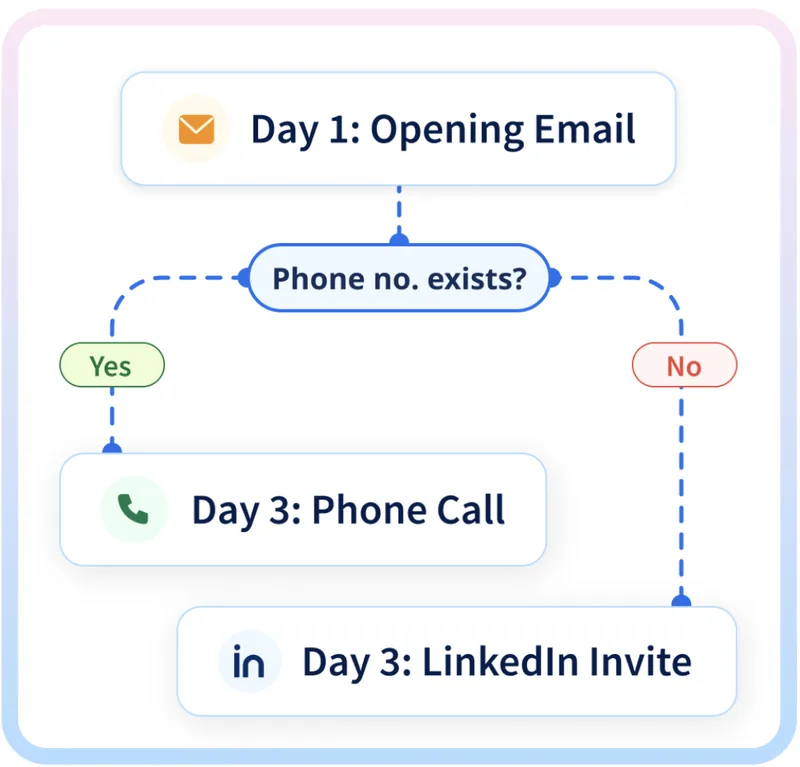 The branch is the point. One cadence checks whether a phone number exists and routes each prospect to a call or a LinkedIn invite, rather than blasting the same channel at everyone.
Core capabilities
- Four channels in one cadence. Email, LinkedIn, calls and WhatsApp, branching through conditional multichannel drips on what each prospect actually does. A reply on any channel pauses the whole sequence, so nobody follows up with someone who already said yes.
- A real deliverability stack. Email warmup, inbox rotation, ESP matching, soft start, blacklist monitoring and free unlimited email validation on every tier. These are normally three separate vendors.
- Mailbox and domain supply. Buy secondary domains and email accounts inside the platform, authenticated on creation. Azure gets you a domain plus 50 mailboxes for $35 a month, against $6 per mailbox at Google or Microsoft.
- A shared inbox. The shared inbox is on every plan, not gated behind a mid tier.
- Built-in B2B lead finder. 300M+ contacts across 50M+ companies, drawn against a credit allowance.
- Agency structure. Client dashboards, sub-accounts, role permissions and leaderboards, with lead generation tooling for agencies built around client separation.
Pros
- Genuinely multichannel, not email with a LinkedIn checkbox bolted on.
- Unlimited users and unlimited sending accounts from the Plus tier up, so hiring doesn't move the bill.
- Deliverability tooling that's usually three subscriptions is bundled in.
- Free unlimited email validation on every tier, which is the direct answer to Apollo's bounce problem.
- Mailboxes and authenticated domains purchasable in-platform at well below list.
Cons
- The Lead Finder is real but it isn't Apollo's database. It runs on a credit allowance, not an all-you-can-search model.
- Basic is a single user and caps at 1,000 prospects, so the useful entry point for a team is really the $89 Plus tier.
- The breadth takes a couple of hours to learn. It's not the fastest tool on this page to get running.
How much does SmartReach.io cost?
| Plan | Monthly | Prospects | Users | Warmup accounts | Key inclusions |
|---|---|---|---|---|---|
| Email Outreach Basic | $29/mo | 1,000 | 1 | 10 | Sequences, free email validation, shared inbox |
| Email Outreach Plus | $89/mo | 50,000 | Unlimited | 25 | + inbox rotation, ESP matching, AI automations, 1 client dashboard |
| Email Outreach Pro | $199/mo | 100,000 | Unlimited | 75 | + 3 client dashboards, priority support |
| Email Outreach Scale | $499/mo | 500,000 | Unlimited | Unlimited | + 10 client dashboards |
| Sales Engagement Basic | $39/mo | 1,000 | 1 | 10 | + 1 calling seat, 1 LinkedIn manual seat |
| Sales Engagement Plus | $99/mo | 50,000 | Unlimited | 25 | + 3 calling seats, 3 LinkedIn manual seats, full multichannel |
| Sales Engagement Pro | $249/mo | 100,000 | Unlimited | 75 | + 10 calling seats, 10 LinkedIn manual seats |
| Sales Engagement Scale | $599/mo | 500,000 | Unlimited | Unlimited | + 100 calling seats |
Annual billing runs about 11% below monthly: Email Outreach Plus is $948 a year against $1,068 paid monthly. LinkedIn automation is a $29 per month per account add-on on top.
Hidden costs: none of the deliverability tools are add-ons. Warmup, rotation, ESP matching, blacklist monitoring and email validation are in the plan.
Cost at scale (10 users, 50K prospects, monthly billing): $89/mo on Email Outreach Plus, or $99/mo on Sales Engagement Plus if you need calling and LinkedIn.
Up next: Clay ↓
2. Clay: Best for enrichment-led outbound and RevOps
Quick facts
- G2
- 4.9/5 ★
- From
- $185/mo flat, plus credits
- Free trial
- Free plan, 100 data credits
- Best for
- RevOps and growth teams who treat outbound as a data pipeline before it's a sending pipeline.
Clay is the strongest answer on this page to Apollo's data half, and it isn't close. Instead of querying one database, Clay runs waterfall enrichment: it asks provider one for an email, and if that misses it asks provider two, then three, across dozens of sources, and you only spend a credit when something comes back. That single design choice fixes the exact failure mode Apollo users complain about, which is a single-source database that returns nothing useful and charges you for the privilege.
It also does things Apollo simply can't. You can enrich from a website, score a list with an AI prompt, pull signals from job boards, and build a genuinely custom ICP filter rather than picking from a fixed dropdown.
The mental model that makes Clay click is a spreadsheet where every column can run code. A row starts as a company name. One column finds the domain, the next pulls the headcount, the next scrapes the careers page, the next runs an AI prompt asking whether the job postings suggest they're building an outbound team, and the last writes a personalised opening line from everything above. That's a research process a junior SDR would spend a week on, running on a few thousand rows while you're asleep.
Two practical notes on the money. Clay repriced in March 2026, replacing the old Starter, Explorer and Pro tiers with Launch and Growth, and the new entry point is higher: $185 a month against the legacy $149. And since that change you draw from two separate pools, Data Credits for marketplace enrichments and Actions for workflow operations, which makes forecasting spend harder than a single balance would. Heavy AI columns burn Actions quickly, so model a real list before committing to a tier.
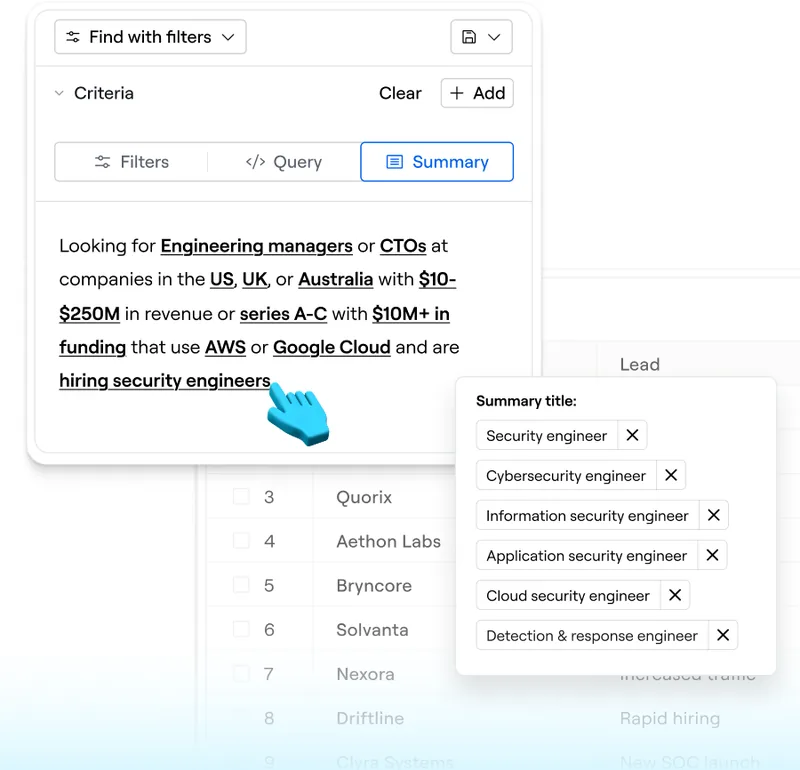 This is the difference in one screen. You describe the ICP in a sentence rather than assembling it from dropdowns.
Core capabilities
- Waterfall enrichment across a large marketplace of data providers, pay-on-success.
- AI research columns that run a prompt per row against live web data.
- Unlimited seats on every plan, which is unusual in the data category.
- Deep integrations into sequencers and CRMs, since Clay is deliberately not a sender.
Pros
- The strongest enrichment on this page. Nothing else here matches the hit rate.
- Pay-on-success credits mean misses don't cost you.
- Unlimited seats on every tier.
- Replaces several point tools at once if you're technical enough to build it.
Cons
- Steep learning curve. This is a tool for someone who enjoys building systems.
- It doesn't send. You still need a sequencer, so it's never a complete Apollo replacement on its own.
- It repriced in March 2026 and got more expensive. The old $149 Starter tier is legacy-only now.
- Two separate credit pools (Data Credits and Actions) make forecasting spend harder than it should be.
How much does Clay cost?
At the time of writing, on monthly billing: Free at $0 with 100 data credits and 500 actions, Launch at $185/mo with 2,500 data credits and 15,000 actions, Growth at $495/mo with 6,000 data credits and 40,000 actions, and Enterprise on a custom quote. Annual billing brings Launch to about $167/mo and Growth to about $446/mo. Legacy Starter, Explorer and Pro plans at $149, $349 and $800 remain for existing customers only.
Hidden costs: credit consumption is the real variable. Heavy AI research columns burn actions quickly.
Verdict: if the database is the job, Clay is the better buy and we'd say so to your face. SmartReach.io's Lead Finder is a bundled convenience, not an enrichment engine, and pretending otherwise would waste your time.
Up next: Cognism ↓
3. Cognism: Best for phone-verified data outside North America
Quick facts
- G2
- 4.6/5 ★
- From
- Quote only, annual contract
- Free trial
- Demo only
- Best for
- Teams selling into Europe or APAC whose Apollo bounce rate is a geography problem, not a tooling problem.
If your Apollo complaint is "the data's fine in the US and useless everywhere else," Cognism is the specific fix. It's built around human-verified mobile numbers and a compliance posture aimed at European buyers, with notification against do-not-call lists across several countries. Where Apollo's international accuracy drops into the 60s, Cognism's non-US coverage is the product rather than an afterthought.
The mechanism behind the accuracy claim is worth understanding, because it's the thing you're paying for. Cognism runs a human verification step on mobile numbers rather than inferring them from patterns, which is slow and expensive and is exactly why the connect rates hold up where inferred data collapses. On the compliance side it screens against do-not-call registries across several European markets and notifies contacts where local law requires it. That combination is what gets a European procurement or legal team to sign off, and it's a genuinely different posture from a US-first database that treats GDPR as a checkbox.
Some contracts also come with unrestricted view licensing, which removes per-record credit limits entirely. If your team's real problem is that people ration lookups because credits are scarce, that structural change can matter more than the data quality itself.
The trade is straightforward and steep: there's no self-serve tier, no monthly billing, and no way to try it without talking to sales.
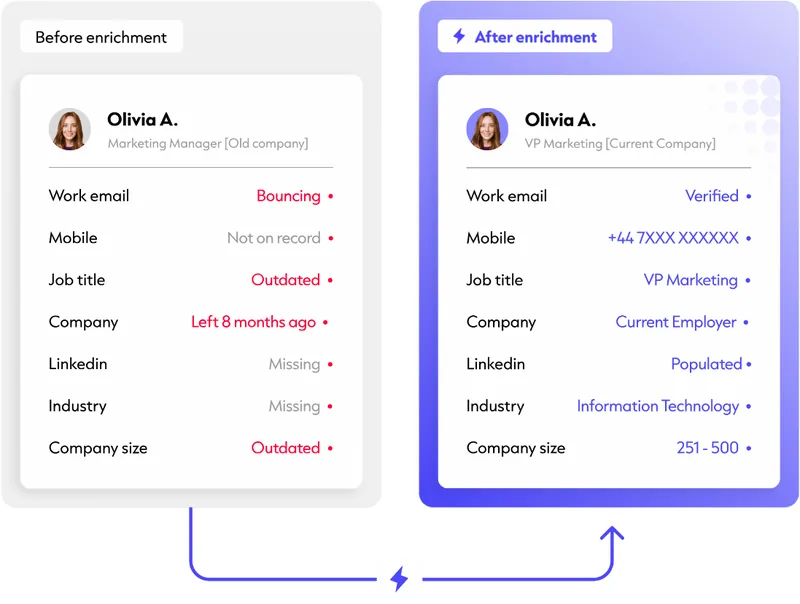 Cognism's own illustration of the problem it sells against. The left column is what a stale database hands your sequencer, and every red line there is a bounce or a wasted send.
Core capabilities
- Phone-verified mobile numbers, verified by humans rather than inferred.
- GDPR-focused compliance, with DNC screening across multiple European markets.
- Intent data through a Bombora partnership on higher tiers.
- Unrestricted-view licensing on some contracts, which removes the credit-anxiety problem entirely.
Pros
- The best non-US data quality in this comparison.
- Human-verified mobiles materially lift connect rates over inferred numbers.
- Compliance posture that survives a European procurement review.
- Some contracts drop per-record credit limits altogether.
Cons
- No public pricing, no self-serve, no monthly billing. Annual contracts only, one-year minimum.
- Expensive. Reported platform fees commonly run $15,000-$25,000 a year plus per-user licensing.
- It's a data vendor. You still need a sequencer.
- North American depth trails ZoomInfo.
How much does Cognism cost?
Cognism doesn't publish pricing and quotes every deal. At the time of writing, reported figures put the platform fee in the $15,000-$25,000 per year range plus roughly $1,500-$2,500 per user per year, with benchmark datasets showing SMB contracts near $29,000 a year. Annual contracts only, with no month-to-month option.
Verdict: Cognism wins non-US data outright. No tool on this page, ours included, competes with it on verified European mobile coverage.
Up next: Instantly.ai ↓
4. Instantly.ai: Best for email-only volume at scale
Quick facts
- G2
- 4.8/5 ★
- From
- $47/mo flat, unlimited mailboxes
- Free trial
- Free trial, then paid plans
- Best for
- Email-only teams and agencies running large mailbox pools on a tight subscription budget.
Instantly's pitch is unlimited sending accounts and unlimited warmup on every tier, including the $47 entry plan, and that offer is genuinely the best entry-tier deal in cold email. If your Apollo problem is that you want to run thirty mailboxes and Apollo's per-seat model makes that absurd, Instantly solves it for less than the price of one Apollo Professional seat.
The unlimited-mailbox model deserves unpacking because it changes how you run campaigns. Instead of pushing volume through three inboxes and watching them degrade, you spread the same volume across thirty, keep each one well under the thresholds Google and Microsoft enforce, and rotate between them automatically. Every one of those mailboxes gets warmup at no extra cost, on every tier. For a solo operator or a small agency, that's the difference between a sustainable sending operation and burning a domain a quarter.
Its Outreach plans don't do anything beyond email. There's no LinkedIn at all, and calling and SMS live in Instantly's separate CRM. And the lead database that makes it look like an Apollo replacement is a separate subscription on its own price ladder, so the $47 headline isn't what a team without its own lists actually pays. Lead credits start at $9 a month, but a working 1,500 to 2,000 credits costs $47 to $77, and at that level the real entry price about doubles. The same unbundling applies to CRM, inbox placement testing and website visitor tracking, each sold separately. Worth checking too: the Unibox shared inbox is gated to the $97 Hypergrowth tier, so a team of three on Growth coordinates replies by hand.
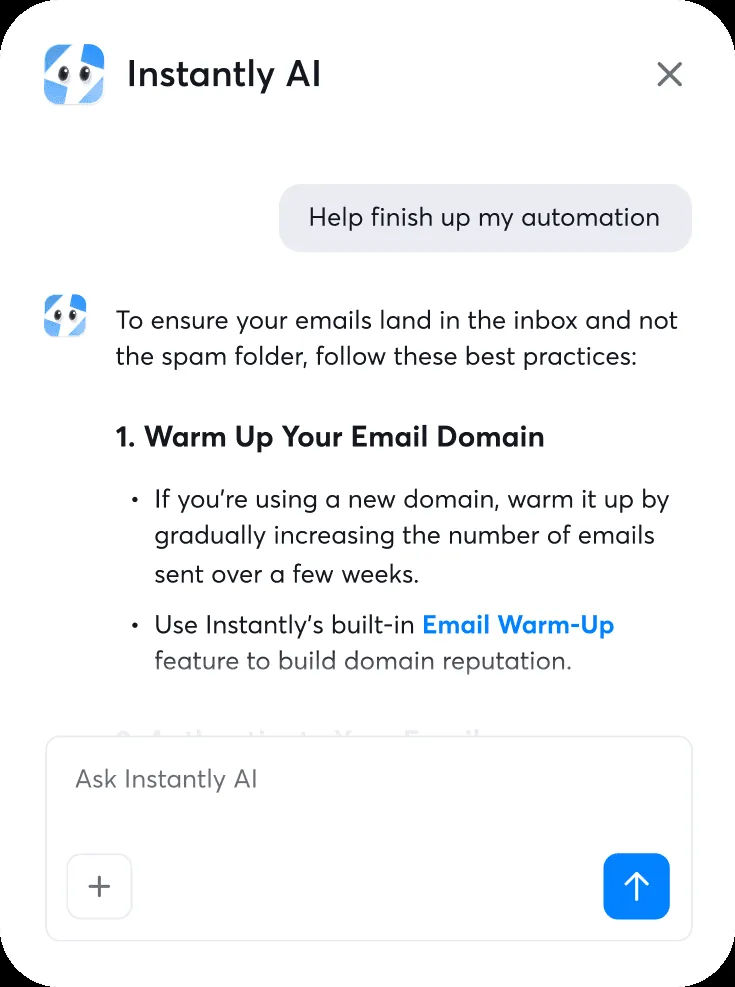 Warmup is the first thing Instantly's own assistant reaches for. It's the feature Apollo retired in 2024, and it's on every Instantly tier including the $47 one.
Core capabilities
- Unlimited email accounts and unlimited warmup on every paid tier.
- Inbox rotation across the mailbox pool.
- Unibox shared inbox, gated to the $97 Hypergrowth tier and above.
- A separate lead database of 450M+ contacts, sold as its own subscription from $9 a month.
Pros
- Unlimited mailboxes and warmup at $47 is unmatched at that price.
- Simple to run. You can be sending the same day.
- Strong deliverability reputation among high-volume senders.
Cons
- Outreach plans are email only. No LinkedIn or WhatsApp, and calling and SMS need its separate CRM.
- The lead database is a separate subscription, so the real entry price roughly doubles for teams without lists.
- The shared inbox is gated at $97, so a team of three on Growth coordinates replies by hand.
- Contact caps on Growth are low at 1,000, which pushes serious users up a tier fast.
How much does Instantly.ai cost?
At the time of writing, on monthly billing: Growth at $47/mo with 1,000 contacts and 5,000 sends, Hypergrowth at $97/mo with 25,000 contacts and 125,000 sends, and Light Speed at $358/mo with 100,000 contacts and 500,000 sends. Lead credits (from $9 a month), the CRM, inbox placement testing and website visitor tracking are separate subscriptions. Annual billing is discounted.
Verdict: Instantly wins entry-tier sending outright. Nothing else gives you unlimited warmup at $47, and if email is your only channel that's the sharpest deal here.
Up next: Smartlead ↓
5. Smartlead: Best for agencies running client inboxes
Quick facts
- G2
- 4.5/5 ★
- From
- $39/mo flat, unlimited email accounts
- Free trial
- 14-day free trial
- Best for
- Agencies and lead-gen shops that want raw sending infrastructure with client sub-accounts.
Smartlead is the cheapest serious sending infrastructure on this page, and it's built for people running email on behalf of other people. Unlimited email accounts and unlimited warmup come on every plan including the $39 Basic tier, and the agency tiers add white-label client portals so your customers log into something with your name on it.
What Smartlead optimises for is inbox placement at volume, and the architecture shows it. Every plan carries unlimited email accounts and unlimited warmup, so the usual scaling move (spread sending across thirty or fifty mailboxes on several authenticated domains, keep each one well under the daily thresholds) doesn't cost extra. A master inbox consolidates replies across the whole pool, which is the difference between a manageable operation and forty browser tabs. The agency tiers add white-label client portals, so your customers log into something carrying your branding rather than Smartlead's.
The gap is equally clear. Smartlead does have a database, SmartProspect, which Smartlead says covers 300M+ verified profiles, but on Base and Pro it is a $59 a month add-on capped at 2,000 or 30,000 verified emails, so as an Apollo replacement it only covers the data half properly from the $174 Smart plan up. It's also email-first: calling arrives only on the $174 Smart plan, and there is no LinkedIn step. And the Basic tier's 2,000 leads and 6,000 sends a month sound generous until you run the arithmetic on a real campaign, which pushes most serious users to Pro at $94 fairly quickly.
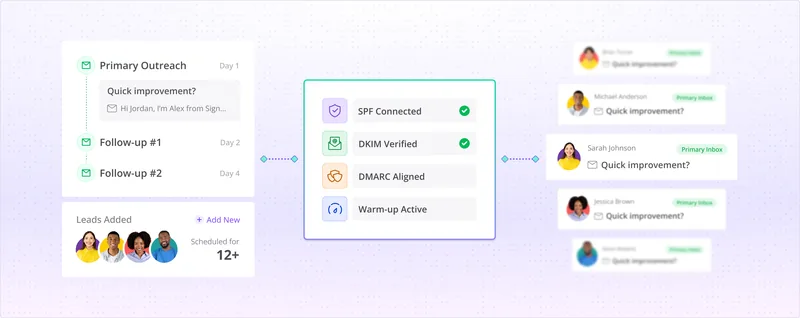 Smartlead's own diagram of what it sells: authentication and warmup treated as the product, not a settings page. This is the layer Apollo thinned out when it retired the warmup pool.
Core capabilities
- Unlimited email accounts and warmup on every tier.
- Master inbox consolidating replies across all connected mailboxes.
- White-label client portals on the Unlimited tiers.
- Global block list, webhooks and API from the Pro tier up.
Pros
- $39 entry with unlimited mailboxes and warmup is excellent value.
- Purpose-built for agency workflows and client separation.
- Strong, well-documented API for teams that want to automate around it.
Cons
- No contact database whatsoever. You bring your own lists.
- Email only.
- Basic caps at 2,000 leads and 6,000 sends a month, which is tight.
- The UI is functional rather than polished.
How much does Smartlead cost?
At the time of writing, on monthly billing: Basic at $39/mo with 2,000 leads and 6,000 sends, Pro at $94/mo with 30,000 leads, Unlimited Smart at $174/mo, and Unlimited Prime at $379/mo. Annual billing runs roughly 17% below monthly. Every tier includes unlimited email accounts and warmup.
Verdict: for pure email infrastructure at the lowest price, Smartlead is the pick. It replaces Apollo's sending half and nothing else.
Up next: ZoomInfo ↓
6. ZoomInfo: Best for enterprise database depth
Quick facts
- G2
- 4.5/5 ★
- From
- Quote only, annual contract
- Free trial
- Demo only
- Best for
- Enterprise revenue orgs that need the deepest North American firmographic and technographic data available.
ZoomInfo is what Apollo is trying to be. It's the deepest B2B database in North America, with firmographic, technographic and intent layers that Apollo's coverage doesn't reach, plus org charts and a scoop feed that surfaces buying triggers. If your complaint about Apollo is that the data isn't deep enough rather than that it's too expensive, this is the upgrade.
The depth is genuinely different in kind, not just degree. Beyond contacts and companies you get technographics (what software a company already runs), funding and hiring signals, org charts that map who reports to whom, and a scoop feed of buying triggers sourced from ZoomInfo's research team. For a team whose ICP is defined by something structural, a company running a particular tech stack or a department that just got budget, those attributes are the entire job and Apollo's filters won't get you there.
It's also the most expensive option on this page by a wide margin, sold on annual contracts with auto-renewal, and the procurement process is a project in itself. Several buyers describe the renewal terms as harder to exit than to enter, so read the notice period before you sign rather than after.
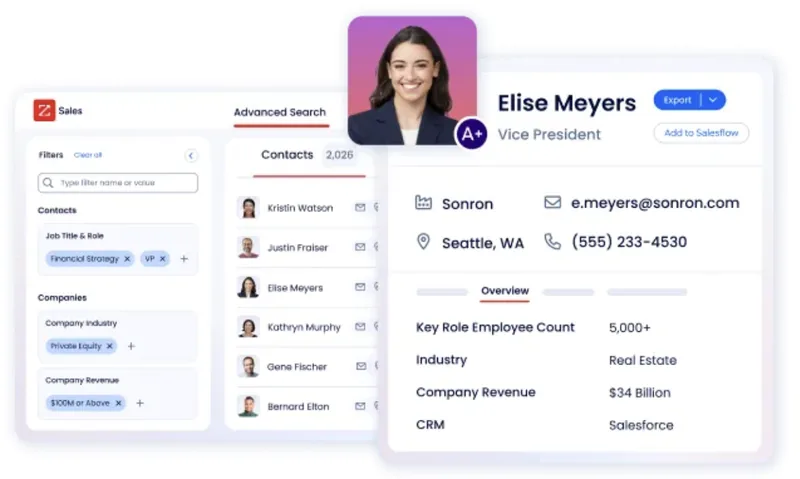 The right-hand panel is what the money buys. Employee count, industry, revenue and CRM attached to a single record, which is the firmographic depth Apollo's filters don't reach.
Core capabilities
- The deepest NA contact and company data in the category.
- Intent signals and website visitor identification.
- Org charts and reporting-structure mapping.
- Deep CRM and workflow integrations built for large ops teams.
Pros
- Unmatched depth and firmographic breadth in North America.
- Intent and scoop data that genuinely surfaces timing.
- Enterprise-grade integrations and admin controls.
Cons
- Very expensive. Verified contracts commonly start near $15,000 a year and the median lands around $32,000.
- Annual contracts with auto-renewal, which several buyers describe as hard to exit.
- Non-US coverage trails Cognism.
- The sales engagement layer is thin compared to a dedicated sequencer.
How much does ZoomInfo cost?
No public pricing. At the time of writing, reported figures put Professional-tier contracts near $14,995 a year, mid-market teams at $25,000-$35,000, and a median across verified purchases around $31,875 a year. Every paid plan is an annual contract with auto-renewal.
Verdict: ZoomInfo wins raw database depth outright. If budget isn't the constraint and coverage is, it beats Apollo and everything else here.
Up next: lemlist ↓
7. lemlist: Best for personalisation-led outreach
Quick facts
- G2
- 4.6/5 ★
- From
- $69/mo per workspace, unlimited users
- Free trial
- 14-day free trial
- Best for
- Teams that want a large bundled lead database plus image and video personalisation in the sequencer.
lemlist repriced in 2026, and most comparison posts haven't caught up. The Email plan is now $69 a month for the whole workspace with unlimited users and unlimited email senders, not per head. That inverts the old received wisdom that lemlist punished growing teams: an eight-person email-only team now pays one flat fee.
It also bundles a 650M+ lead database, which makes it one of the few tools here that credibly replaces both halves of Apollo in a single subscription. The catch is that the per-seat model didn't disappear, it moved: Multichannel is $109 per user per month, so ten reps who need LinkedIn and calling land at $1,090 rather than $69.
The personalisation depth is what lemlist has always been known for and it still holds up. Custom images with a prospect's logo or website dropped into them, personalised video thumbnails, dynamic landing pages, and liquid-syntax conditional blocks that change the body copy based on a field value. If your reply rate depends on the prospect believing the email was written for them specifically, nothing else in this comparison gets as close. The credit model sits alongside the plan rather than inside it: rechargeable packs at 1 credit for $0.01, where a verified email costs 5 credits and a phone number 20, so budget for the credits separately from the subscription.
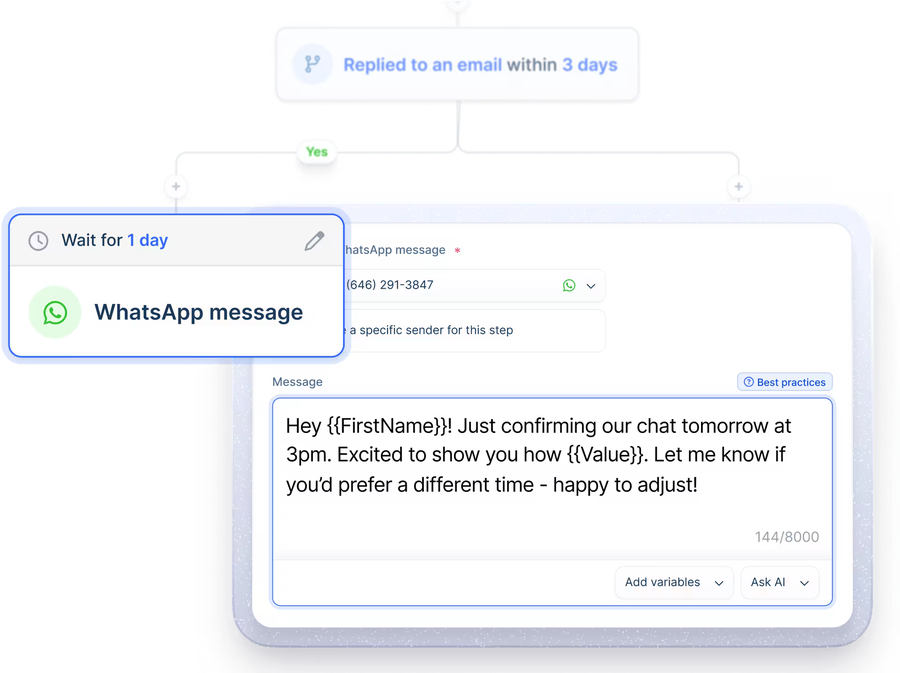 A reply condition branching into a WhatsApp step, with merge variables in the body. This is the multichannel half that costs $109 per seat rather than the $69 workspace fee.
Core capabilities
- Image and video personalisation per prospect, still the category leader.
- A 650M+ lead database with rechargeable credits at 1 credit for $0.01.
- Multichannel sequences across email, LinkedIn and calling on the Multichannel tier.
- Unified inbox included on all plans, including the $69 Email plan.
Pros
- $69 flat for unlimited users on email-only is strong value for a growing team.
- The largest bundled database of any sender on this page.
- Personalisation depth nothing else here matches.
- Unified inbox on every tier, not gated.
Cons
- Multichannel is still $109 per user per month, so ten seats is $1,090.
- The Email plan caps at 50,000 sends a month.
- Credits are a separate purchase from the plan, so the headline isn't the total.
- Deliverability tooling is thinner than Instantly, Smartlead or SmartReach.io.
How much does lemlist cost?
At the time of writing, on monthly billing: Email at $69/mo per workspace with unlimited users and senders, 50,000 sends and unlimited contacts. Multichannel at $109/user/mo with five sending addresses each and unlimited sends. Enterprise is custom from five seats. Credits are bought separately as rechargeable packs at 1 credit for $0.01, where a verified email costs 5 credits and a phone number 20. Annual billing is discounted.
Verdict: for one subscription covering data and sending, lemlist's Email plan is the best-value bundle here. Above email-only, per-seat pricing reasserts itself hard.
Up next: Salesloft ↓
8. Salesloft: Best for enterprise CRM-anchored engagement
Quick facts
- G2
- 4.5/5 ★
- From
- Quote only
- Free trial
- Demo only
- Best for
- Large revenue orgs with a Salesforce-anchored stack and a dedicated ops team to run it.
Salesloft is a sales engagement platform for organisations that have outgrown the idea of buying software self-serve. Cadences, conversation intelligence, forecasting and deal management sit in one workflow anchored to the CRM, with the governance and reporting a 100-rep org needs. Against Apollo it's a straight upgrade on process maturity and a straight downgrade on speed and price.
It ships no contact database, so it replaces exactly half of Apollo, and only the half that a large team was probably already unhappy with for different reasons.
What you're actually buying is governance and coaching rather than sending horsepower. Rhythm prioritises each rep's day into a ranked action list, Conversations records and transcribes calls so managers can coach against real dialogue, and Deals ties the activity to weighted pipeline and forecast. For a VP running thirty reps who needs to know why the number will or won't land, that's a different product category from a cold email tool, and comparing them on price per mailbox misses the point entirely.
The flip side is that it's heavy. Salesloft needs an ops owner to configure and maintain it, and without one it consistently underdelivers against its cost. The deliverability tooling is also thin in the way senders mean: no warmup network, no inbox rotation, no validation. Salesloft assumes your data and domains are somebody else's problem, which for its target buyer they usually are.
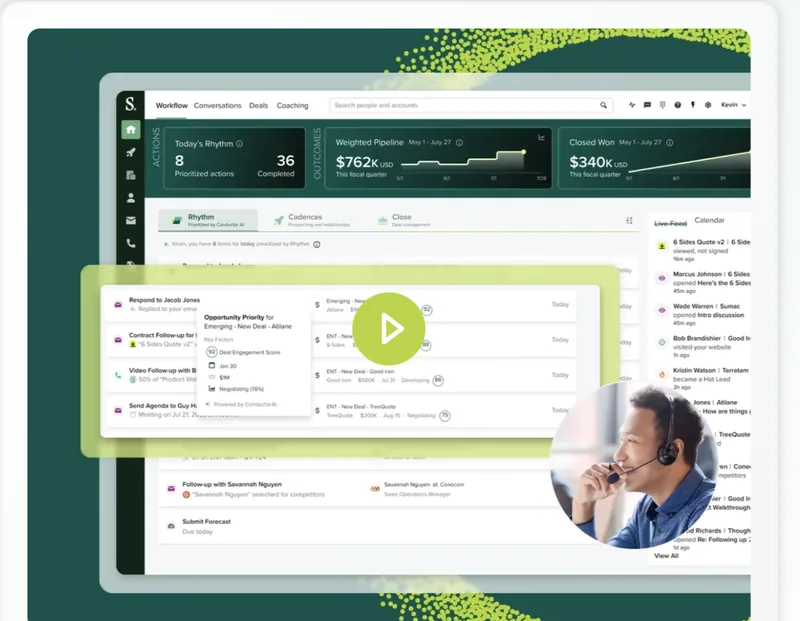 Prioritised actions on the left, weighted pipeline and closed-won across the top. Salesloft sells management visibility, which is a different purchase from inbox placement.
Core capabilities
- Cadence management with heavy admin controls and templating governance.
- Conversation intelligence, call recording and coaching workflows.
- Deal and forecast management alongside the engagement layer.
- Deep Salesforce integration, which is the actual reason most buyers choose it.
Pros
- Mature, well-governed platform built for large orgs.
- Conversation intelligence and coaching are genuinely strong.
- The Salesforce integration is the deepest in this comparison.
Cons
- Quote only, annual contracts, enterprise procurement cycle.
- No contact database at all.
- Deliverability tooling is thin. No warmup, no rotation in the sense senders mean it.
- Heavy. It needs an ops owner, and without one it underdelivers badly.
How much does Salesloft cost?
No public pricing, quote only, annual contracts. Expect enterprise-tier commitments and a procurement process measured in weeks.
Verdict: right answer for a 100-rep Salesforce org, wrong answer for almost everyone reading an Apollo-alternatives post.
Up next: Lusha ↓
9. Lusha: Best for cheap lookups and a real free tier
Quick facts
- G2
- 4.3/5 ★
- From
- Free plan, paid from about $50/mo
- Free trial
- Free plan, 40 credits a month
- Best for
- Individual reps and small teams who need occasional verified contact lookups, not a full database.
Lusha is the lightest-weight data tool here, and that's the point. A browser extension, a clean UI, a free tier that actually does something, and per-credit pricing that doesn't require a procurement conversation. For a rep who needs twenty good phone numbers a week rather than a list of five thousand, it's a better fit than anything enterprise-tier.
Worth noting for context: we recommend Lusha as an enrichment partner to plug into SmartReach.io rather than treating it as a competitor, so read this entry as a genuine recommendation rather than a grudging one.
The workflow is where it earns its place. You're on a LinkedIn profile or a company site, you click the extension, and you get a verified email and often a direct dial without leaving the page. There's also a bulk side (list building, CRM enrichment that fills missing fields on records you already own), but the extension is what people actually renew for. An email costs one credit and a verified mobile costs five, which makes the spend easy to reason about compared with Apollo's eight-to-one ratio and monthly expiry.
The limits are real and you'll hit them fast. Credit allowances are small, so this doesn't scale to building a 20,000-row list. Database depth trails Apollo and is nowhere near ZoomInfo. And published pricing varies noticeably across sources and regions, more than any other tool on this page, so treat any figure you read (including ours) as indicative and confirm on their current page before buying.
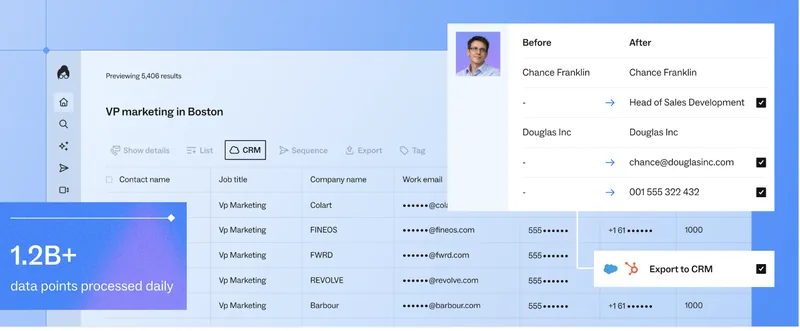 A search, an enrichment fill, and a push to the CRM. Lusha is deliberately narrow, and for occasional lookups that narrowness is the feature.
Core capabilities
- Browser extension for LinkedIn and company sites.
- Free tier with 40 credits a month on one seat.
- Credit model where an email costs one credit and a verified mobile costs five.
- CRM integrations into the usual suspects.
Pros
- Genuinely useful free tier, no card required.
- Fastest tool here to get value from. Install, click, done.
- Clean per-credit pricing with no annual commitment.
Cons
- Small credit allowances. It doesn't scale to list-building.
- Database depth trails Apollo, let alone ZoomInfo.
- Published pricing varies noticeably by source and region, so confirm before you buy.
- No sending capability at all.
How much does Lusha cost?
At the time of writing, a free plan at $0 with 40 credits a month on one seat, with paid self-serve tiers starting around $50 a month and scaling by credit slider. Published figures differ meaningfully across sources and regions, so treat the number as indicative and check the current page before committing.
Verdict: best free data tier here, and the right pick if your need is occasional rather than systematic.
Up next: Snov.io ↓
10. Snov.io: Best for sourcing and sending on one small budget
Quick facts
- G2
- 4.6/5 ★
- From
- $39/mo, credit-based
- Free trial
- Free plan available
- Best for
- Small teams and founders who need finding and sending in one tool at the lowest possible combined price.
Snov.io is the cheapest tool here that credibly does both halves. An email finder, a verifier, a drip campaign builder and basic warmup, all on one credit-based subscription starting at $39 a month. For a founder-led sales motion or a two-person team, that combination at that price is hard to argue with.
The workflow holds together better than the price suggests. You search or upload a list, the verifier scrubs it, the drip builder sequences it across email and LinkedIn steps, and a light CRM tracks what came back, all in one login with one credit balance. For a founder doing their own outbound before there's a sales team to hire for, that's often the whole stack, and the Chrome extensions for finding contacts on LinkedIn and company sites cover the manual prospecting in between.
The trade is that it's mid-tier at everything rather than strong at anything. The database is smaller than Apollo's, the deliverability tooling is thinner than Smartlead's, and the sequencer is less capable than lemlist's. Credit-based pricing also hides the real cost: the $39 headline is the subscription, not the spend, and heavy search and verification months climb well past it. Support quality draws mixed reviews, which matters more when the tool is your whole stack rather than one component of it.
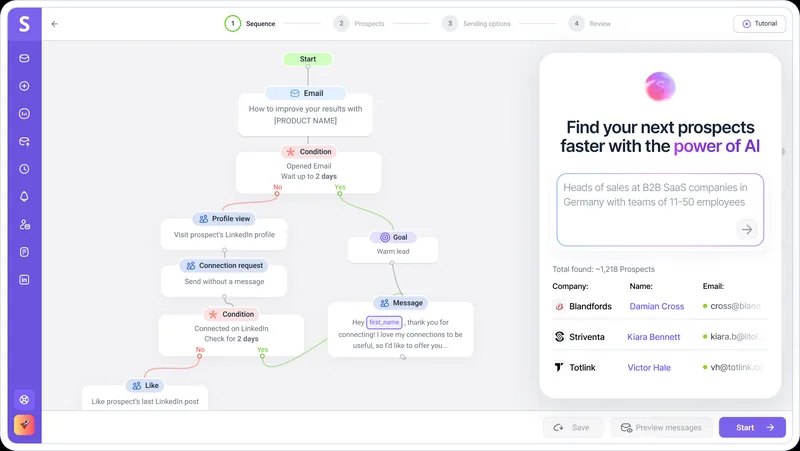 Both halves of Apollo on one screen: a branching sequence on the left, AI prospect search returning names and emails on the right. That's the whole argument for Snov.io at $39.
Core capabilities
- Email finder and verifier with bulk list processing.
- Drip campaigns with basic conditional logic.
- Basic warmup and a light deliverability layer.
- A simple CRM for pipeline tracking, which small teams often find sufficient.
Pros
- Both halves of Apollo for $39 a month.
- Free plan for testing.
- Genuinely easy to learn.
Cons
- Credit-based pricing means the effective cost climbs with usage in ways the headline hides.
- Database is smaller and less accurate than the dedicated data vendors here.
- Deliverability tooling is basic.
- Support quality gets mixed reviews.
How much does Snov.io cost?
At the time of writing, a free plan plus paid tiers starting at $39/mo on a credit model, scaling by credit volume. Annual billing is discounted.
Verdict: the cheapest way to replace both halves of Apollo at once, with the compromises that price implies.
Up next: the bonus round ↓
Bonus: more Apollo alternatives worth knowing
These didn't make the ten, either because they solve a narrower slice of the problem or because their pricing puts them outside what most teams leaving Apollo are looking for. Each one is still the right answer for somebody, so they're worth a look before you commit.
Hunter.io: Best for verifying a list before it burns your domain
Quick facts
- G2
- 4.4/5 ★
- From
- About $49/mo on monthly billing
- Free trial
- Free plan, 25 searches a month
- Best for
- Teams whose specific problem is bounce rate, and who want finding and verification done properly rather than bundled badly.
Hunter does one thing and does it properly: finding and verifying work email addresses. No phone numbers, no sequencer worth the name, no intent data. In a category where every vendor claims to do everything, that narrowness is the reason to buy it.
If your Apollo complaint is specifically the bounce rate, Hunter is the cheapest targeted fix on this page. Domain Search returns every known address at a company with a confidence score and the public sources each one was found in, which is unusually transparent. Email Verifier runs SMTP, MX and catch-all checks and tells you which test failed rather than just returning a red cross. Discover, its newer company-search layer, filters by location, industry, size and keyword and shows how many known emails sit behind each company before you spend anything.
The honest limit is that Hunter is a data-hygiene tool, not a prospecting platform. There's no phone data at all, so if your motion involves dialling, this replaces none of what Apollo gave you.
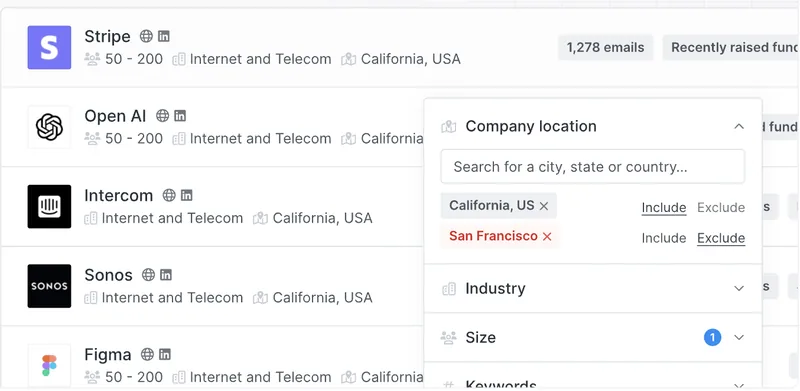 Note the "1,278 emails" badge against Stripe. Hunter shows you the coverage behind a company before you spend a credit, which is the opposite of Apollo's model.
Core capabilities
- Domain Search returning every known address at a company with confidence scores and cited sources.
- Email Verifier with SMTP, MX and catch-all checks, reported per test.
- Discover, a company search filtered by location, industry, size and keyword.
- Bulk processing and API for cleaning lists at volume.
Pros
- The most transparent verification in this comparison. You see why an address passed or failed.
- Genuinely useful free tier at 25 searches a month.
- Cheap and narrow, which makes it easy to bolt onto whatever else you run.
- Confidence scores and source citations let you make your own risk call per record.
Cons
- No phone numbers at all.
- The sequencing feature exists but isn't a reason to buy.
- Published prices are annual-billing figures, so the monthly number is meaningfully higher.
- Credit allowances are small relative to a real list-building operation.
How much does Hunter.io cost?
At the time of writing, published tiers are Free at $0 for 25 searches a month, Starter at $34/mo, Growth at $104/mo and Business at $244/mo, but those are all annual-billing figures. Paying monthly runs roughly 30% higher, so budget about $49 a month for Starter on monthly billing.
Verdict: the cheapest targeted fix for a bounce problem, and it replaces none of Apollo's sending half.
Up next: UpLead ↓
UpLead: Best for buyers who want an accuracy guarantee in writing
Quick facts
- G2
- 4.7/5 ★
- From
- $99/mo
- Free trial
- 7-day trial, 5 credits
- Best for
- Teams who'd rather pay more per record for data that's verified at the moment of export than cheap records that bounce.
UpLead's differentiator is contractual rather than technical: it guarantees 95% accuracy and credits you back for any record that misses. Where Apollo serves a record from a database and leaves you to discover it's stale, UpLead verifies at the point of export and puts money behind the result.
That structural difference is the entire pitch, and for a certain buyer it's decisive. If your problem is that nobody trusts the list any more, a vendor absorbing the cost of its own bad records changes the conversation internally. The platform around it is competent rather than remarkable: search across 50+ attributes including technographics, real-time verification on export, competitor intelligence, and the usual CRM integrations.
What you're trading is volume. Essentials gives you 170 credits a month for $99, which is a small number if you're used to Apollo's allowances, and extra credits at $0.60 each add up fast. This is a precision instrument, not a list-building machine, and using it like one gets expensive quickly.
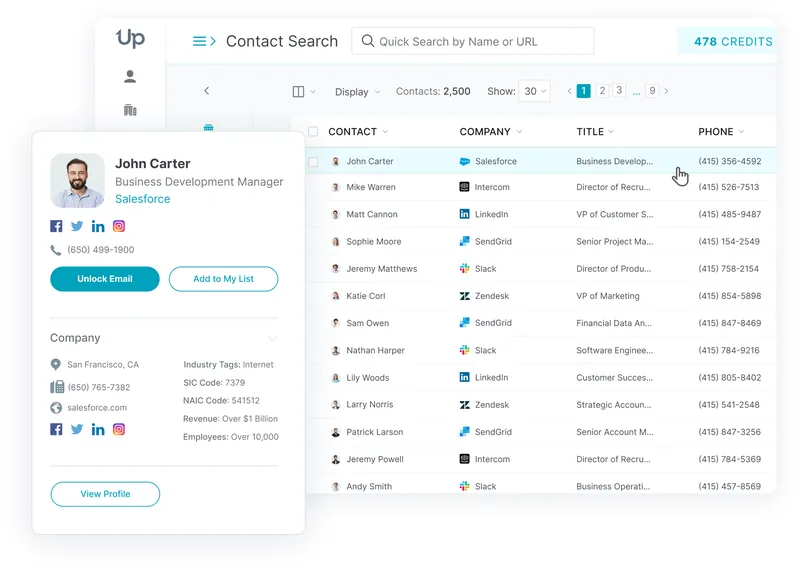 The credit counter top right and the Unlock Email button are the model in one screen. You spend deliberately, per record, and the record is verified when you spend.
Core capabilities
- 95% accuracy guarantee with credits refunded on bad records.
- Real-time verification at the moment of export rather than at database-build time.
- 50+ search attributes including technographic filters.
- Competitor intelligence and CRM integrations on the usual platforms.
Pros
- The accuracy guarantee is contractual, not marketing copy.
- Verification happens on export, which is the moment that actually matters.
- Clean, quick interface with a shallow learning curve.
- Technographic filters are genuinely useful for a tech-defined ICP.
Cons
- Small credit allowances. 170 a month on Essentials goes quickly.
- Extra credits at $0.60 each make overages expensive.
- Single user on both self-serve tiers.
- No sending capability, so it replaces exactly half of Apollo.
How much does UpLead cost?
At the time of writing, on monthly billing: Essentials at $99/mo with 170 credits and one user, Plus at $199/mo with 400 credits, and Professional on a custom quote, annual billing only. Extra credits run $0.60 each. The trial is 7 days and 5 credits.
Verdict: the right pick when trust in the data matters more than the volume of it.
Up next: Seamless.AI ↓
Seamless.AI: Best for volume when you'll clean the list yourself
Quick facts
- G2
- 4.2/5 ★
- From
- $147/mo, billed annually
- Free trial
- Free plan, up to 50 credits
- Best for
- Teams that want the widest possible net and have the process to scrub what comes back.
Seamless takes the opposite approach to UpLead: rather than serving a curated database, it searches the live web at query time and assembles a record from whatever it finds. Public data, private data, news and SEC filings, search engines, email validation and phone research all feed one real-time engine, which is how it gets to 1.6B+ emails and 448M+ phone numbers.
In principle that's the right answer to the staleness problem, because nothing sits in a table going out of date. In practice reviews are consistently split: praise for volume and coverage, criticism for accuracy on the records it returns. You'll find contacts nobody else surfaces, and you'll also find records that don't survive verification. If you have a scrubbing step in your process, that trade can work. If you send straight from export, it will hurt.
Two things to know before you engage. The sales process draws frequent complaints in public reviews, more than any other vendor on this page, so go in knowing what you want. And Basic pricing is quoted on annual billing, so there's no cheap month-to-month way to test it beyond the free tier.
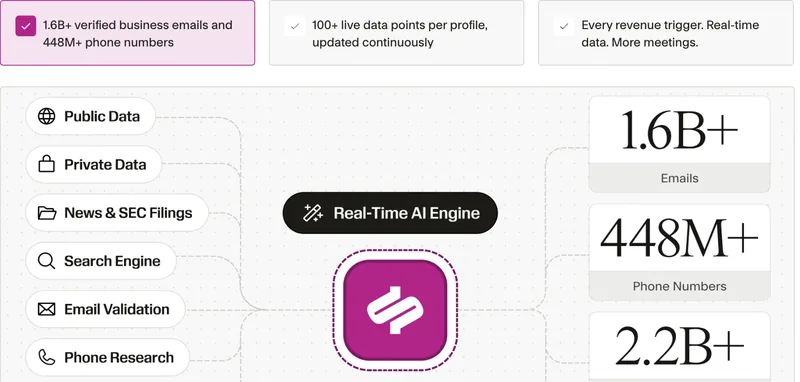 Seamless's own diagram of the model: assemble the record at query time from many sources rather than serve it from a table. The upside is coverage, the downside is variance.
Core capabilities
- Real-time search that builds records at query time rather than serving cached rows.
- 1.6B+ emails and 448M+ phone numbers across the engine's combined sources.
- Buyer intent and job-change signals in the data layer.
- Chrome extension and CRM integrations for in-workflow lookups.
Pros
- Coverage is genuinely wide. It surfaces contacts other databases miss.
- Real-time assembly avoids the stale-table problem by design.
- Free tier lets you test the data before committing.
- Intent and job-change signals included rather than sold separately.
Cons
- Accuracy is the recurring complaint. Budget for a verification step.
- The sales process draws more criticism than any other vendor here.
- Basic is quoted on annual billing, so month-to-month testing isn't really on offer.
- Credit allowances on the entry tier are modest for the price.
How much does Seamless.AI cost?
At the time of writing, a free plan with up to 50 credits, and Basic at $147/mo billed annually. Higher tiers are quoted. There's no widely published month-to-month equivalent, which is worth factoring into any comparison against the flat monthly tools on this page.
Verdict: widest net here, and the one most dependent on you having a cleaning step.
Up next: Reply.io ↓
Reply.io: Best for AI-led cadences if per-seat pricing isn't the problem
Quick facts
- G2
- 4.6/5 ★
- From
- $49/mo email-only
- Free trial
- Free trial
- Best for
- Teams that want AI-generated multichannel sequences and aren't leaving Apollo because of the per-seat bill.
Reply is a genuinely capable multichannel sequencer with one of the stronger AI layers in the category, and it repeats the exact pricing structure most people are leaving Apollo to escape.
The product is good. Sequences branch across email, calls, LinkedIn, WhatsApp and SMS, adapting on replies and actions rather than running a fixed script. Its Jason AI SDR tier drafts sequences, handles replies and books meetings with progressively less supervision. A built-in database of roughly a billion contacts, powered by Generect, means it can credibly cover both halves of Apollo in one subscription.
The problem is arithmetic. At the time of writing it's $49 a month for email only, $89 per user for multichannel, and $139 per user for the AI SDR tier, landing nearer $187 per user once LinkedIn and calling are switched on. If you're shopping because Apollo's per-seat bill grew faster than your pipeline, Reply hands you the same structure with a different logo on it. If you're shopping because you want better AI and the seat cost was never the issue, it's a strong pick.
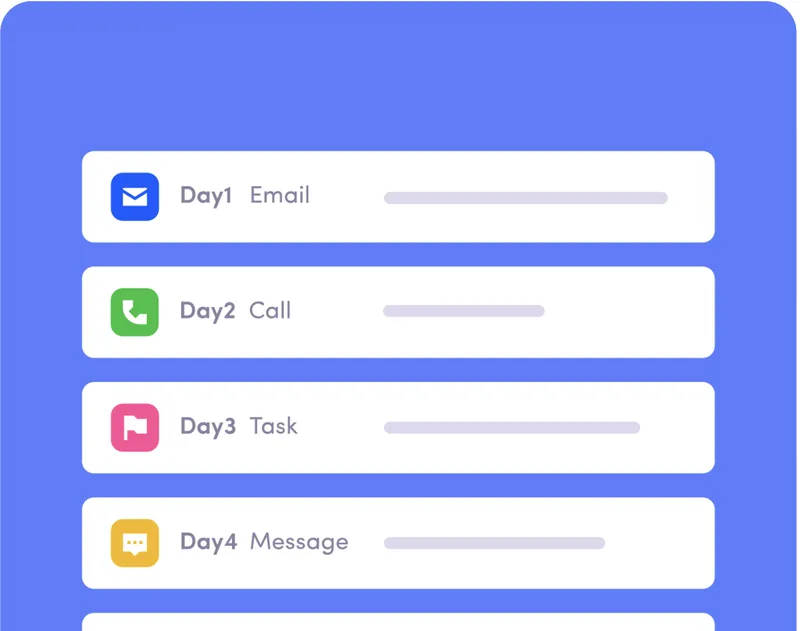 Email, call, task and message in one cadence. The capability is real; the per-user price for it is what sends Apollo refugees elsewhere.
Core capabilities
- Multichannel conditional sequences across email, calls, LinkedIn, WhatsApp and SMS.
- Jason AI SDR for drafting sequences, handling replies and booking meetings.
- A built-in database of roughly 1B contacts with intent signals.
- LinkedIn prospecting and contact enrichment inside the same workflow.
Pros
- One of the strongest AI layers in the category, not a bolted-on wrapper.
- True multichannel with conditional branching, not task reminders.
- Bundled database means it can replace both halves in one subscription.
- Email-only entry at $49 is reasonable for a solo sender.
Cons
- Per-seat pricing on everything above email-only, which is the problem most readers are here to solve.
- Real multichannel cost lands near $187 per user once channels are enabled.
- The tier structure is confusing, with capability split across three price points.
- Deliverability tooling is thinner than the dedicated senders here.
How much does Reply.io cost?
At the time of writing, on monthly billing: $49/mo for email only, $89 per user per month for multichannel, and $139 per user per month for the AI SDR tier, with the practical figure closer to $187 per user once LinkedIn and calling are enabled. Ten seats on true multichannel is roughly $1,870 a month, against $940 for ten Apollo Professional seats.
Verdict: better product than Apollo on AI and channels, worse answer if the seat bill is why you're leaving.
Up next: Amplemarket ↓
Amplemarket: Best for funded teams consolidating onto one vendor
Quick facts
- G2
- 4.7/5 ★
- From
- $600/mo, annual only, includes 2 users
- Free trial
- Demo only
- Best for
- Well-funded teams that want data, sending, AI and signals from one vendor and will pay a premium not to assemble it.
Amplemarket is the most complete single-vendor answer on this page, and it's priced like it. Data, multichannel sending, deliverability tooling, buying signals and an AI copilot arrive as one product rather than as integrations you maintain.
Its Duo copilot is the part that justifies the positioning. Rather than presenting a list and leaving prioritisation to the rep, it surfaces a ranked action queue built from signals: a prospect changed jobs, a past closed-lost account reopened, someone engaged with a competitor on G2, a previous evaluator resurfaced at a new company. Each item arrives with the reasoning attached and a recommended sequence already drafted. The company also publishes migration stories from Apollo, Outreach and ZoomInfo, which tells you precisely who it's built to displace.
The price is the filter. The Startup plan is $600 a month on an annual term including two users, with no monthly option at all. That's $300 per user before you add anyone, which lands above Apollo Organization on monthly billing. For a funded team where an ops hire costs more than the software, consolidation can be worth it. For a team counting subscription costs, it won't be.
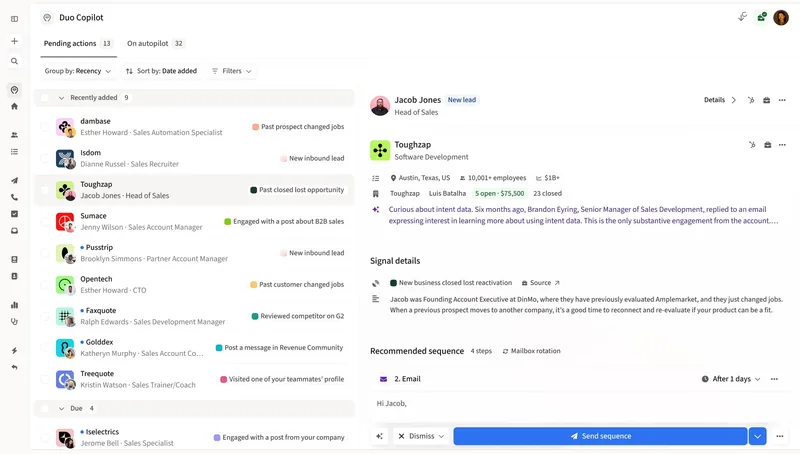 A ranked action queue where every item carries its reason. This is the layer you're paying the premium for, and it's the thing a data tool plus a sender doesn't give you.
Core capabilities
- Duo copilot producing a ranked, reasoned action queue rather than a contact list.
- Buying and job-change signals feeding prioritisation automatically.
- Multichannel sequences with mailbox rotation and deliverability tooling built in.
- Native data covering both halves without a second subscription.
Pros
- The most complete single-vendor replacement for Apollo on this page.
- Signal-driven prioritisation is genuinely differentiated, not a rebranded filter.
- Deliverability tooling and mailbox rotation included rather than bolted on.
- Strong data quality, with public migration stories off Apollo and ZoomInfo.
Cons
- Expensive. $600 a month minimum, which is above Apollo Organization per user.
- Annual contracts only. No monthly option to test with.
- Demo-gated, so you can't evaluate it without a sales conversation.
- Overkill for small teams, and priced to make that clear.
How much does Amplemarket cost?
At the time of writing, the Startup plan is $600 a month on an annual term, including two users, which works out to $300 per user before you scale. There is no month-to-month option, and higher tiers are quoted.
Verdict: the best consolidation play here, for the small set of teams whose constraint is ops time rather than budget.
Up next: Lead411 ↓
Lead411: Best for buying-intent signals on a small budget
Quick facts
- G2
- 4.5/5 ★
- From
- $49/mo
- Free trial
- Free trial, 50 leads
- Best for
- Small teams that want intent data and unlimited exports without signing an enterprise contract.
Lead411 sells the thing that's normally gated behind a ZoomInfo contract: Bombora-sourced buying intent, starting at $49 a month. For a small team that wants to know which accounts are researching your category right now, that price point is unusual enough to be worth a look on its own.
The rest of the product is a competent B2B database with verified emails and direct dials, growth intent triggers (funding rounds, hiring surges, IPO filings), and a Chrome extension for lookups in the flow of work. The pitch it leans on hardest against Apollo is structural: no credit limits and no export caps on the plans that advertise it, which directly targets the "credits ran out on the 19th" complaint. If credit anxiety is what's driving you off Apollo, that framing is aimed squarely at you.
Coverage is the trade. The database is thinner than Apollo's and nowhere near ZoomInfo's, international data is weak, and some plans carry a minimum commitment rather than true month-to-month. It's a narrow, well-priced product rather than a broad one.
Core capabilities
- Bombora-sourced buying intent at a price point normally reserved for enterprise contracts.
- Growth intent triggers on funding, hiring and corporate events.
- Verified emails and direct dials with published accuracy claims.
- Unlimited exports on the plans that advertise it, with no per-record credit ceiling.
Pros
- Intent data at $49 a month is genuinely unusual in this category.
- No credit limits or export caps on the advertised plans, which is the direct counter to Apollo's model.
- Growth triggers surface timing that a static database can't.
- Free trial available without a sales conversation.
Cons
- Database coverage is materially thinner than Apollo's.
- International data is weak. This is a North America tool.
- Some plans carry a minimum commitment rather than true month-to-month.
- The sending features are basic and won't replace a real sequencer.
How much does Lead411 cost?
At the time of writing, the entry Spark plan starts at $49/mo, with Basic tiers around $99 per user per month and a minimum commitment on some plans. A free trial covering 50 leads is available without talking to sales.
Verdict: the cheapest way to buy intent data, with the coverage limits that price implies.
The two-tool tax
Here's the part most Apollo-alternatives posts skip. If you split Apollo into two tools, you pay two bills. Nobody argues with that. What almost nobody checks is whether two bills actually cost more than the one you're leaving.
For a ten-person team, on monthly billing, at the time of writing, they usually don't.
The real two-tool tax isn't money. It's coordination. Two subscriptions means two renewal dates, two support queues, two places where reply data lives, and a recurring argument about which tool touched which prospect. If you're a two-person team, that overhead is trivial. If you're running fifteen reps across three territories, it's a part-time job.
Which is the actual decision: pay more for one vendor, or pay less and own the integration. Both are defensible. Only one of them is usually presented to you.
Three strategies, twelve dimensions
There are only three ways out of this, and each one has a representative tool. Keep both halves on one invoice and live with the trade-offs (Apollo). Replace the sending half, accept a lighter database, and stop paying by the head (SmartReach.io). Or replace the data half with something far stronger and pair it with a sender of your choosing (Clay).
Here's how the three land across every dimension below, before the detail:
| Dimension | Apollo | SmartReach.io | Clay |
|---|---|---|---|
| Data and prospecting | Strong | Light | Strongest |
| Accuracy outside North America | Weak | Light | Strongest |
| Deliverability and warmup | Weak since 2024 | Strongest | Not applicable |
| Inbox rotation and ESP matching | None | Strongest | Not applicable |
| Secondary domains and mailboxes | Bring your own | Strongest | Not applicable |
| Unified shared inbox | Good | Strongest | None |
| Multichannel | Partial | Strongest | Not applicable |
| Automation and sequences | Adequate | Strongest | Strongest pre-send |
| Ease of use | Strongest | Moderate | Hardest |
| Integrations and CRM | Own CRM | Strong | Widest |
| Team and agency features | Per-seat | Strongest | Unlimited seats |
| Pricing value | Weakest at scale | Strongest per user | Strongest per record |
Twelve rows, three tools, and nobody sweeps. Now the detail.
Data and prospecting
Apollo ships a large database with search filters good enough that prospecting feels closer to Sales Navigator than to a sequencer. Clay doesn't own a database at all, it waterfalls across dozens of providers, which produces a higher hit rate at a per-record cost. SmartReach.io includes 300M+ contacts across 50M+ companies on a credit allowance, which is a convenience rather than a prospecting engine.
Verdict: Clay for hit rate, Apollo for browsing and volume, SmartReach.io a distant third.
Data accuracy by geography
Apollo is roughly 88% accurate on US contacts and drops to about 60-73% internationally. Clay's waterfall design routes around single-provider gaps, which is exactly why it holds up better outside North America. Neither is Cognism, but between these three it isn't close.
Verdict: Clay, and it's the single strongest argument for the split-stack approach.
Deliverability and warmup
Apollo retired its warmup pool in 2024 and replaced it with volume pacing. Clay doesn't send, so it has no position here. SmartReach.io ships warmup, inbox rotation, ESP matching, soft start, blacklist monitoring and free unlimited validation on every tier. With Microsoft's outbound spam thresholds and Google's bulk sender rules both tightening, pacing alone is a thin defence.
Verdict: SmartReach.io outright. This is the clearest gap on the page.
Inbox rotation and ESP matching
Apollo has no meaningful rotation layer. Clay, again, doesn't send. SmartReach.io rotates across the mailbox pool and matches sending ESP to recipient ESP, which measurably improves placement on large sends.
Verdict: SmartReach.io outright, by default as much as by merit.
Secondary domains and mailboxes
Apollo expects you to arrive with mailboxes. SmartReach.io sells authenticated domains and mailboxes in-platform, with Azure at $35 a month for a domain plus 50 mailboxes against $6 per mailbox at Google or Microsoft. At fifty mailboxes that's $35 against $300.
Verdict: SmartReach.io, and the saving is larger than the subscription difference.
Unified shared inbox
Apollo has a workable unified inbox. SmartReach.io includes the shared inbox on every plan including the $29 tier. Clay has none.
Verdict: SmartReach.io narrowly, on not gating it behind a tier.
Multichannel
Apollo covers email, calls and LinkedIn tasks, where "tasks" means reminders rather than automation. SmartReach.io runs four channels in one conditional sequence with reply-pause working across all of them. Clay integrates with senders rather than sending.
Verdict: SmartReach.io outright.
Automation and sequences
Apollo's sequencer is solid and unremarkable. SmartReach.io branches on 12 condition types, including email opens, unanswered calls and LinkedIn connection status. Clay isn't a sequencer but its AI research columns do things neither of the others can approach.
Verdict: SmartReach.io on sequencing, Clay on pre-send logic. Apollo third on both.
Ease of use
Apollo is the easiest of the three to get running, and that's a real advantage. SmartReach.io takes a couple of hours to learn properly. Clay takes days and rewards people who enjoy building systems.
Verdict: Apollo outright. Breadth costs ramp time and we're not going to pretend otherwise.
Integrations and CRM
All three cover the major CRMs. Apollo's native CRM is more complete than most people expect. SmartReach.io offers two-way sync with field mapping across HubSpot, Salesforce, Pipedrive and Zoho, plus 8,000+ apps through Zapier. Clay's integration surface is the widest of the three by a distance.
Verdict: Clay on breadth, Apollo on having a usable CRM of its own.
Team and agency features
Apollo's team features are per-seat by construction. SmartReach.io runs unlimited users from Plus up with client dashboards at 1, 3 and 10 by tier. Clay gives unlimited seats on every plan, which for a data tool is generous.
Verdict: SmartReach.io for agencies, Clay for unlimited-seat data access, Apollo last.
Pricing value
Ten seats of Apollo Professional is $940 a month. Clay Launch plus a sender is $282. SmartReach.io Plus is $89. The caveat, stated plainly: SmartReach.io caps at 50,000 prospects on that plan and its database is materially thinner than Apollo's.
Verdict: SmartReach.io on cost per user, Apollo on cost per contact record. Pick the metric that matches your bottleneck.
How to choose an Apollo alternative: a 6-step framework
1. Work out which half you're replacing
Pull your last quarter's numbers. If bounce rate is above 8% and your replies are fine when the address is good, it's a data problem. If bounce rate is low and replies are poor, it's a deliverability or messaging problem. Fixing the wrong half is the most common expensive mistake in this category.
2. Price it per user, not per plan
Take every candidate's monthly list price and divide by your actual headcount, then re-run it at the headcount you'll have in twelve months. Per-seat tools that look cheap at three people are brutal at fifteen. Flat tools look expensive at one person and cheap at ten. Your hiring plan is a pricing input.
3. Check the credit model before the feature list
Ask three questions: do credits roll over, what does a phone number cost against an email, and what happens when a lookup returns nothing. Apollo's answers (no, eight against one, you're charged anyway) are the reason the published seat price and the invoice diverge. Clay's pay-on-success model and SmartReach.io's free unlimited validation are structurally different answers to the same question.
4. Test data accuracy in your actual territory
Vendor accuracy claims are averages, and averages hide geography. Export 200 contacts in the region you actually sell into, run them through an independent verifier, and count. A tool that's 88% accurate in the US and 62% in Germany is a great tool and a terrible fit if you sell in Germany.
5. Check whether warmup is real or just pacing
There's a meaningful difference between a warmup network that generates positive engagement signals and a scheduler that raises your daily send cap over three weeks. Both get called warmup. Only one builds sender reputation. Ask which one you're buying, because Apollo's 2024 change swapped the first for the second.
6. Pressure-test the exit before you sign
Annual contracts with auto-renewal are standard among the data vendors here, and several buyers describe the exit as harder than the entry. Before committing, confirm the notice period, whether you can export enriched records, and whether your data survives cancellation. A tool you can leave in thirty days is worth a premium over one you can't.
Best Apollo alternative by use case
You're leaving over cost and headcount
Your data's acceptable, your bill grows every time you hire, and deliverability is drifting. SmartReach.io Email Outreach Plus at $89 a month covers unlimited users and 50,000 prospects with the full deliverability stack. Add Sales Engagement Plus at $99 if you need calling and LinkedIn. Ten seats of Apollo Professional is $940, so the saving is about 90%, and the cap you accept is 50,000 prospects and a credit-limited Lead Finder.
You're leaving over data quality
Bounce rates are high and it's worst outside North America. Cognism if Europe or APAC is the market and you can sign an annual contract. Clay at $185 a month if you want waterfall enrichment, pay-on-success credits and no contract. Pair either with a sender: Instantly at $47 or Smartlead at $39 keeps the combined bill well under a ten-seat Apollo plan.
You just want one cheaper bill
Small team, both halves needed, budget is the constraint. Snov.io at $39 a month does finding and sending on one credit-based plan. lemlist's Email plan at $69 does it better with a 650M+ database and unlimited users, if email is your only channel. Neither matches Apollo's database depth, and at this price nothing will.
So, which Apollo alternative is yours?
There isn't one best Apollo alternative, and any list that names one is selling you something. There's a best answer to "which half is failing me," and the honest version of that answer sends different readers to different tools.
If the database is the job, Clay at $185 or Cognism on a quote beat us and we'd say so to your face. If Europe is your market, Cognism isn't a close call. If email is your only channel and price is the constraint, Instantly at $47 with unlimited warmup or Smartlead at $39 will serve you better than paying for channels you won't use. And if you value getting running this afternoon over everything else, Apollo's own free plan is genuinely good and staying put is a defensible answer.
SmartReach.io at $89 wins a narrower, more specific case: a team that's growing, sending across more than one channel, watching deliverability slip while the per-seat bill climbs. Four channels in one cadence, warmup and rotation and validation included rather than sold separately, and a flat fee that ignores headcount. Against ten Apollo Professional seats that's $89 versus $940, and the cap you accept in exchange is 50,000 prospects a month and a credit-limited Lead Finder instead of Apollo's database.
Five tools, five different readers, and only one of them is us.
Apollo alternatives FAQs
Why are people switching away from Apollo.io?
Three reasons come up repeatedly. Data accuracy drops sharply outside North America, where reported contact accuracy falls to roughly 60-73% against about 88% for US contacts. Credits expire monthly with no rollover, so unused allowance is money burned. And Apollo shut down its warmup pool in 2024, replacing it with volume pacing, which means the platform no longer builds sender reputation the way a dedicated sending tool does. Per-seat pricing on top of that makes growing teams the worst-case customer.
Is there a free alternative to Apollo.io?
Yes, several, though the free tiers are small. Clay's free plan gives 100 data credits and 500 actions a month, Lusha's free plan gives 40 credits a month on one seat, Seamless.AI offers up to 50 credits, and Hunter.io's free plan covers 25 searches a month. All are useful for testing and none are enough to run outbound on. Apollo's own free plan remains one of the more generous in the category, which is a genuine point in its favour.
Which Apollo alternative has the best data quality?
Cognism, if your market includes Europe or APAC. Its phone-verified mobile data and GDPR-focused compliance posture are the strongest in this list, and it's the clearest upgrade over Apollo for teams whose accuracy problems are geographic. ZoomInfo wins on raw depth and firmographic breadth in North America. Both are quote-only with annual contracts, so neither is a like-for-like swap for an Apollo seat.
What's the cheapest Apollo alternative?
It depends which half you are replacing, and on headcount. For sending, Smartlead Basic at $39 a month and Instantly Growth at $47 are the lowest flat entry points; SmartReach.io Email Outreach Basic starts at $29. For data, the free tiers from Clay, Lusha and Hunter cost nothing but will not sustain a campaign. The bigger saving usually comes from leaving per-seat pricing entirely.
Can I use two Apollo alternatives together?
Yes, and for many teams it is the better answer, because splitting Apollo into a data tool plus a sending tool often costs less than Apollo itself. Clay Launch at $185 a month plus Instantly Hypergrowth at $97 is $282 flat for ten people, against $940 for ten Apollo Professional seats. The cost is coordination: two subscriptions and reply data in two places.
What's the difference between a prospecting tool and a sales engagement platform?
A prospecting tool finds and enriches contacts. It answers who to email. A sales engagement platform runs the outreach: sequences, follow-ups, deliverability tooling, reply detection and multichannel coordination. It answers how to reach them. Apollo does both in one bill, which is exactly why replacing it is confusing. Tools like Clay, Cognism and ZoomInfo replace the first half. Tools like SmartReach.io, Instantly and Smartlead replace the second.
Does Apollo still offer email warmup?
Not in the sense most people mean. Apollo shut its warmup pool in 2024 and replaced it with Inbox Ramp Up, which paces sending volume upward over time. Pacing is useful, but it is not a warmup network generating positive engagement signals to build reputation. If warmup is why you are shopping, that gap is the sharpest argument for moving the sending half elsewhere.
How much does Apollo actually cost per user per month?
On monthly billing Apollo runs $60 per user for Basic, $94 for Professional and $149 for Organization, with a free tier at $0. Annual billing drops those to $49, $79 and $119. The published number is rarely the final one: credits expire monthly and a phone lookup costs eight credits against one for an email, so active teams commonly land between $150 and $400 per user.
Stop juggling tools
Book more meetings on every channel
Join 5,000+ teams running multichannel outreach from one sequence, with deliverability built in.