Saleshandy Review | What the Plans Actually Meter

On this page
Most cold email tools sell a story about growth. Saleshandy sells a flat invoice and unlimited mailboxes, which is a duller pitch and a more honest one.
This Saleshandy review is about what that flat invoice actually buys, because the pricing page is clearer than most and still leaves three things buried that decide whether the tool fits.
It is one of the few platforms in this category that does not charge per seat, does not cap how many sending accounts you connect, and includes a B2B database rather than selling it back to you as a second subscription. So the interesting question is not whether it works. It does. The question is what it counts instead, because every tool in this category meters something.
Quick facts
- G2
- 4.6 ★
- From
- $41/mo
- Free trial
- 7 days
- Best for
- Flat-rate cold email across many mailboxes
What Saleshandy actually is
A cold email sequencing platform built around high-volume sending. Sequences with automated follow-ups, conditional branching through Subsequences, A/B testing, a unified inbox, sender rotation across unlimited mailboxes, free warmup and deliverability monitoring.
Alongside it sits Lead Finder, a B2B contact database with credits granted monthly rather than sold separately, and an email infrastructure service that provisions Google, Microsoft 365 and Azure mailboxes from $2.99 each with DNS configured automatically.
The design philosophy is consistent. Remove the things that normally meter cold email, then meter one thing instead.
What the plans actually meter
Three plans, published clearly, and the numbers underneath them are where the decisions live.
| Plan | Monthly | Annual | Active prospects | Emails a month | Users | Lead credits |
|---|---|---|---|---|---|---|
| Starter | $41 | $34 | 2,000 | 6,000 | 1 | 1,500 |
| Pro | $99 | $76 | 30,000 | 100,000 | 10 | 4,000 |
| Scale | $189 | $149 | Unlimited | 200,000 | Unlimited | 8,000 |
Sending accounts are unlimited on all three, and prospect storage is unlimited on all three. Everything in the table above is a ceiling.
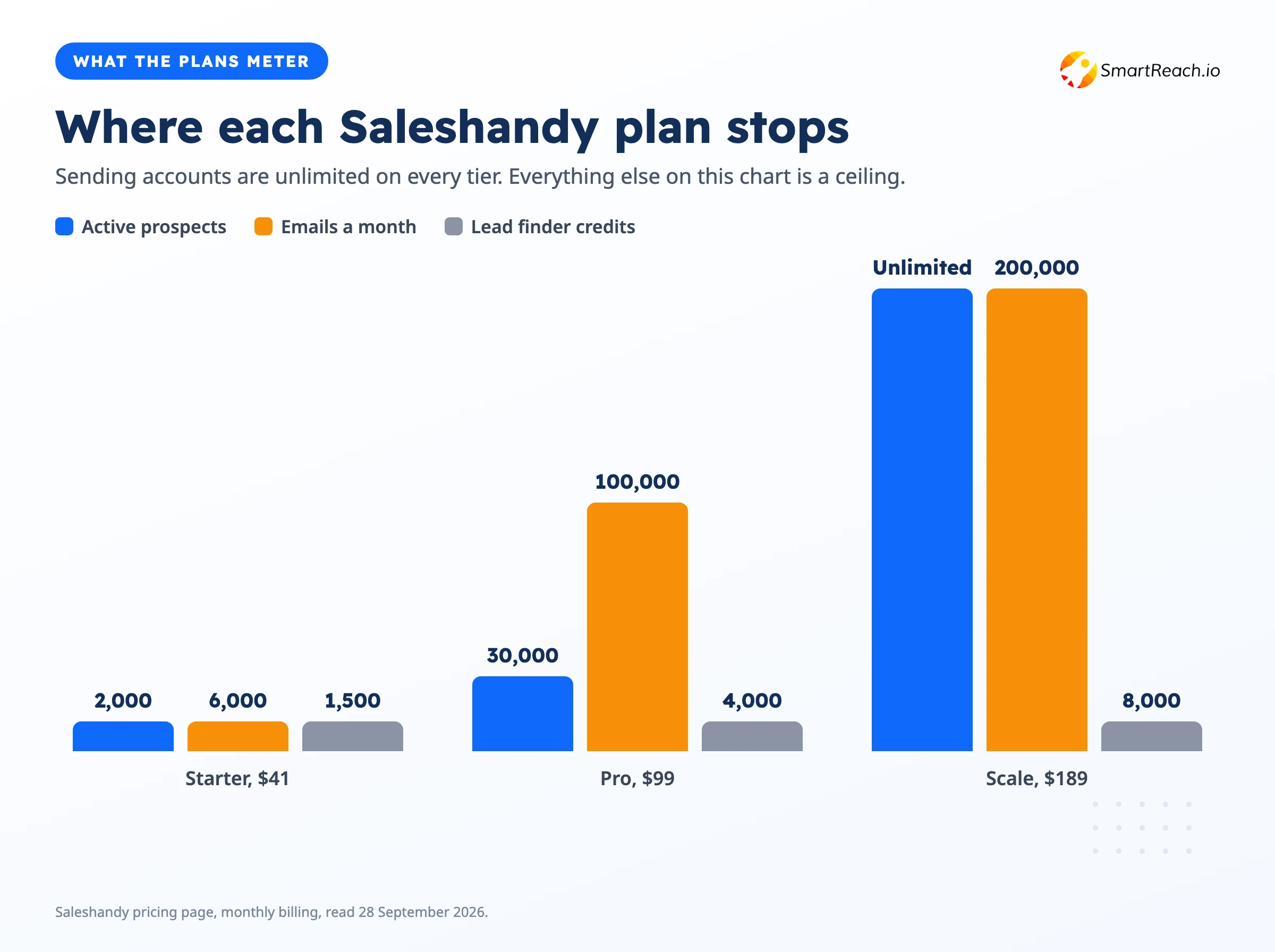
Three meters, three different growth curves. The emails row is the one that stops a campaign mid-month.
Two things in that table deserve more attention than they usually get.
Every plan meters emails, including Scale. Unlimited prospects, capped sends. At 200,000 a month that is generous, and it is still a ceiling, which surprises teams who read unlimited on the prospect row and assumed it applied throughout. There is a "need more?" link beside the number, so the cap is negotiable, which also means it is real.
Subsequences are not on Starter. The conditional branching that makes sequences worth building is a Pro feature. Starter runs linear follow-ups only, which is a meaningful product difference rather than a volume limit, and the pricing page marks it with a small cross that is easy to miss.
Where the flat pricing benefit actually starts
Saleshandy's reputation rests on flat pricing, and the reputation is deserved. The detail people repeat is slightly wrong.
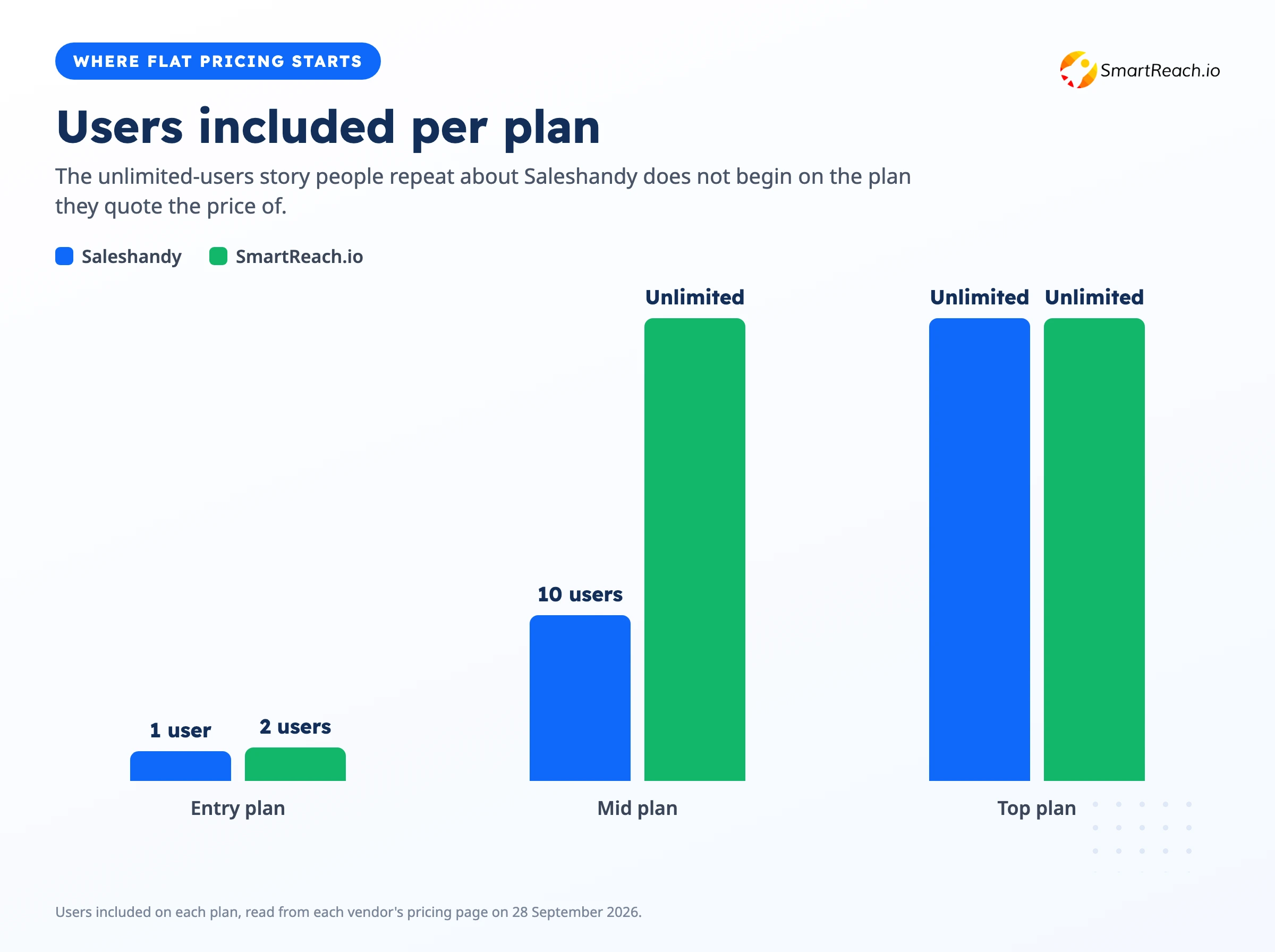
Starter is a single user. The unlimited-users story starts two plans later.
Starter at $41 covers one user. So for a solo sender, Saleshandy is a flat $41 plan competing against plenty of flat $29 to $39 plans, and the advantage everyone praises has not kicked in yet.
At Pro it does, and decisively. Ten users for $99 flat is the cheapest way to put a small team on one platform in this category, and it is why Saleshandy wins almost every comparison against a per-seat tool from the second hire onward.
At Scale, unlimited users for $189 is mainly an agency purchase, and it is where white-label arrives with no per-client charge.
The practical advice is to skip Starter unless you are genuinely solo and genuinely under 6,000 emails a month. Most teams that buy Starter upgrade within a quarter, and the upgrade is not a small step.
Deliverability and the mailbox economics
This is the strongest part of the product and the least discussed.
Free warmup on every plan, including Starter. Sender rotation across unlimited mailboxes, which spreads a campaign's volume automatically so no single inbox carries it all. That combination is the reason the unlimited sending accounts row matters, because unlimited mailboxes with no rotation would just be unlimited mailboxes sitting idle.
Then the provisioning. Google, Microsoft 365 and Azure mailboxes at $2.99 to $3.99 each a month, domains at $14 a year, DNS records written automatically. Setting up a ten-mailbox sending estate manually is an afternoon of DNS records and a source of quiet errors. At roughly $35 a month for the mailboxes plus a couple of domains, buying it is close to free next to the time.
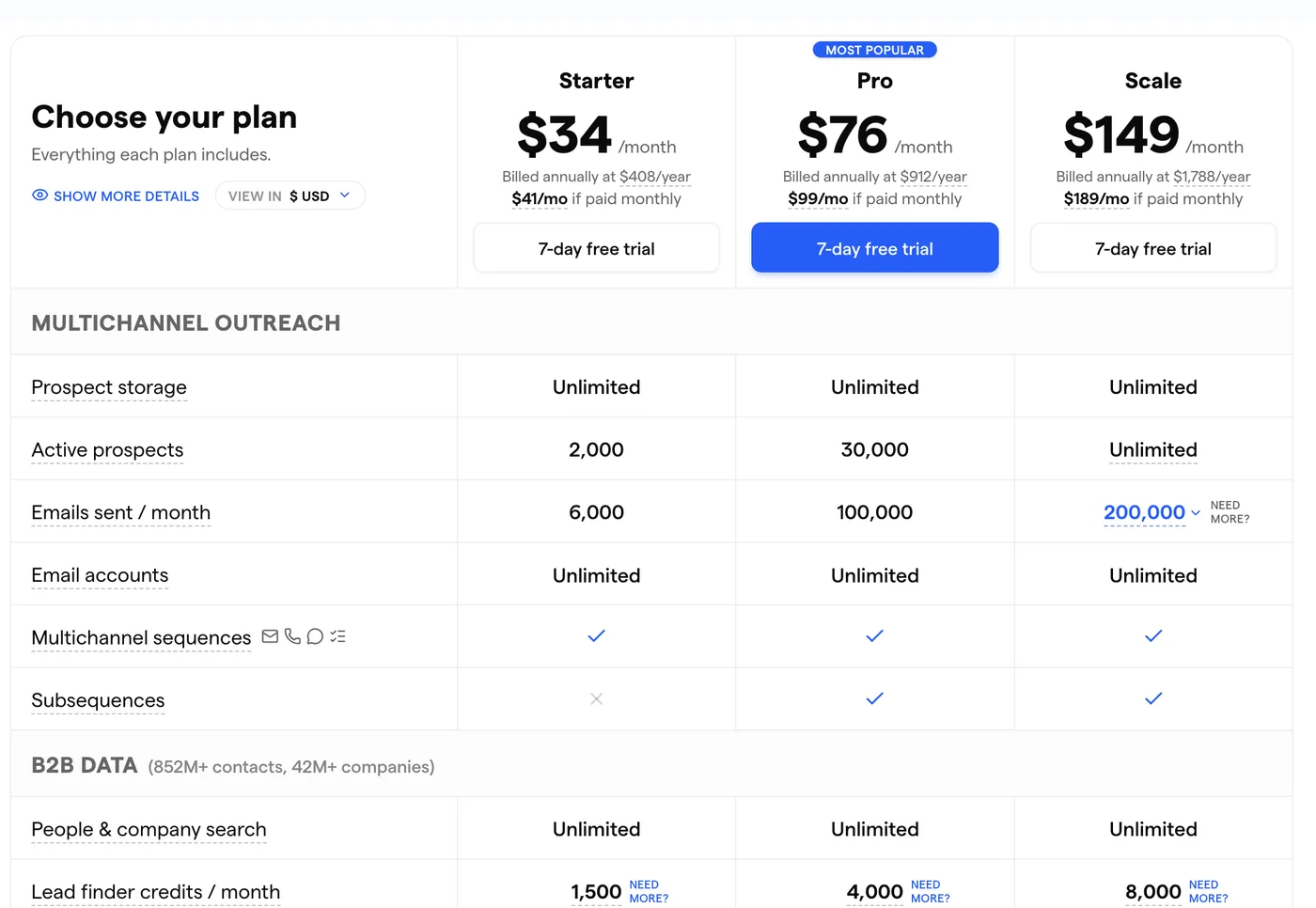
Saleshandy's pricing page, captured 28 September 2026. Note the annual figure in large type with the monthly price beneath it.
What is missing is the layer above. There is no ESP matching, where sends are routed and timed based on whether the recipient sits on Google Workspace or Microsoft 365, and no published blacklist monitoring that pauses a campaign automatically when a sending domain gets listed. Saleshandy gives you the first layer of deliverability properly and stops there.
The Lead Finder, and what 852M means
Saleshandy publishes 852M+ contacts and 42M+ companies, with credits granted monthly rather than sold as a pack. One credit reveals a verified email. Starter carries 1,500 a month, Pro 4,000, Scale 8,000.
At Pro that is around 2.5 cents per revealed contact, on a bill you were already paying. Compare that to a dedicated data vendor at 11 to 13 cents a credit and the bundling looks like the better part of the deal.
Now the caveat. Record counts in B2B data are self-reported and nobody audits them, so 852M is a claim rather than a measurement, and it tells you nothing about coverage in your specific segment. Dedicated vendors also go considerably deeper on filters, intent signals and phone numbers, none of which Saleshandy offers.
Use the trial for one thing above all others. Pull fifty contacts in your actual target segment and count the bounces. That number is worth more than any published figure on either side.
The multichannel claim needs qualifying
Saleshandy's marketing names four channels. In the product, only email is automated.
A LinkedIn step inside a Saleshandy sequence is a task that appears on a rep's list for them to do by hand, or it is handed to a separate LinkedIn tool. WhatsApp is the same. Calling exists as a dialer without power dialing or live coaching.
That is not dishonest exactly, because the steps do exist in the sequence builder, and the pricing page even shows the four icons next to a "multichannel sequences" row ticked on every plan. But multichannel implies the tool does the reaching, and for three of the four channels it does not.
What reviewers actually say
Saleshandy holds roughly 4.6 out of 5 on G2 across about 770 reviews, which is a large and credible base. A 4.6 across several hundred reviews tells you far more than a 4.9 across twenty.
Praise clusters on value for money, the unlimited mailbox policy and responsive early-stage support.
Criticism clusters in three places. Campaign bugs that appear mid-send, including sequences stalling and variables rendering wrong. Support that reportedly slows as accounts get larger. And the seven-day trial, which reviewers repeatedly describe as too short to test a sending tool properly, since warmup alone takes longer than that.
That last complaint is worth taking seriously rather than filing as impatience. Cold email succeeds or fails on deliverability, deliverability depends on warmed mailboxes, and warmup takes two to three weeks. A seven-day trial cannot show you the thing you most need to see.
Where Saleshandy falls short
Pros
Unlimited sending accounts on every plan, which is the constraint that actually matters for cold email.
Flat pricing from Pro upward, at ten users for $99 and unlimited for $189.
Lead Finder bundled, with credits granted monthly rather than as a one-off block.
Cheap mailbox provisioning at $2.99 to $3.99 with automatic DNS.
Free warmup and sender rotation on every tier, Starter included.
Cons
Emails metered on every tier, including 200,000 on Scale.
Starter is one user and has no Subsequences, so the pricing story really starts at $99.
LinkedIn is a task, not automation, despite four channels on the homepage.
Seven-day trial, shorter than a warmup cycle.
No ESP matching or blacklist monitoring, so deliverability stops at the first layer.
The four gaps worth planning around before you buy.
The send ceiling. Know which number binds first for you, prospects or emails. For most teams at Pro it is the emails, and it arrives sooner than the prospect count suggests.
LinkedIn. If LinkedIn is a real channel rather than a box to tick, budget for a second tool or pick a platform that executes the step.
The trial. Seven days will not tell you what you need. Plan a paid first month as the real evaluation and keep the list small while you watch deliverability.
Support at scale. The complaint pattern is specific to larger accounts. If you are buying Scale, ask about response times in writing before you sign.
Who should buy Saleshandy
Two to ten senders, email led
Pro at $99 is the case the product was designed for. Ten users, unlimited mailboxes, 100,000 emails and 4,000 lead credits on one bill.
An agency with several clients
Scale at $189 with white-label included and no per-client charge. Compare that against tools charging per client workspace and count your clients first.
A solo sender under 6,000 emails
Starter at $41 works, but check what else $41 buys. No Subsequences and one user is a thin plan next to flat competitors at $29 to $39.
Above 200,000 emails a month
Not Saleshandy, or not Saleshandy alone. Its top plan stops there, and you will be negotiating rather than buying off the page.
The verdict
Saleshandy is a well-built tool with an honest pricing model and one piece of marketing that overreaches.
The flat rate is real, the unlimited mailboxes are real, and the bundled database saves a subscription. For a small team doing email-led outbound at moderate volume, it is among the easier recommendations in this category, and the deliverability basics being free rather than an upsell is genuinely unusual.
Go in knowing three things. The flat-pricing benefit starts at $99 rather than $41, every plan caps your monthly sends, and the LinkedIn on the homepage is a task list rather than automation. None of those is disqualifying. All three are easier to accept before you pay than after.
If you are still shortlisting, the Saleshandy alternatives roundup compares ten options on the same basis, and there are head-to-heads against Mailshake, Smartlead, Dripify, Lusha and Apollo.
Is Saleshandy worth it in 2026?
For flat-rate cold email at moderate volume, yes. Saleshandy gives unlimited sending accounts on every plan, free warmup and ten users on Pro at $99 a month. It suits teams under about 100,000 emails a month. SmartReach.io Email Outreach Plus is $89 with 50,000 prospects and no monthly send ceiling.
Which Saleshandy plan is right for a small team?
Pro at $99 a month, in almost every case. Starter at $41 covers a single user and 6,000 emails, so a team of two already outgrows it, while Scale at $189 only matters above 100,000 emails a month. SmartReach.io Email Outreach starts at $29 a month and carries unlimited users from $89 on its Plus plan.
Does Saleshandy limit how many emails you can send?
Yes, on every plan it sells. Starter allows 6,000 emails a month, Pro allows 100,000 and Scale allows 200,000, so even the top tier carries a ceiling despite offering unlimited prospects. SmartReach.io meters only its Basic plan, at 10,000 emails a month, and removes the monthly send limit on every plan above that one.
Does Saleshandy really do multichannel outreach?
Partly. Saleshandy markets email, LinkedIn, calls and WhatsApp, but only the email steps are automated. A LinkedIn step is a manual task a rep completes, or a hand-off to another tool you pay for separately. SmartReach.io automates LinkedIn inside the same conditional sequence as email, at $29 a month per connected LinkedIn account.
How good is the Saleshandy Lead Finder?
Useful rather than exceptional, and its real value is that it comes bundled. Every plan carries credits, at 1,500 a month on Starter, 4,000 on Pro and 8,000 on Scale, drawn from a published 852M+ contacts. Dedicated data vendors go deeper. SmartReach.io similarly includes credits monthly, from 300M+ contacts and 50M+ companies.
What do Saleshandy reviewers complain about most?
Three themes recur across its roughly 770 G2 reviews. Campaign bugs that surface mid-send, personalization variables that render wrong, and a support experience reviewers say slows down at higher volumes. The seven-day trial also draws criticism as too short. SmartReach.io offers a 14-day free trial covering 200 prospects, with no credit card.
How much do Saleshandy mailboxes cost?
Mailboxes run $2.99 to $3.99 each a month depending on billing term, with domains at $14 a year, and DNS records are configured automatically. That is among the cheapest provisioning in the category. SmartReach.io sells Google and Microsoft 365 mailboxes at $4 a month each with domains at $5, or an Azure bundle at $35 for 50 mailboxes.
Is there a Saleshandy free trial?
Seven days on every plan, which several reviewers call too short. The problem is structural rather than stingy, because an email warmup cycle takes longer than a week, so you cannot evaluate deliverability before paying. SmartReach.io offers 14 days across 200 prospects with no credit card, which covers a warmup cycle and real replies.
Stop juggling tools
Book more meetings on every channel
Join 5,000+ teams running multichannel outreach from one sequence, with deliverability built in.