Lemlist vs HeyReach | Multichannel or LinkedIn First?

On this page
Two tools that land on the same shortlist most weeks, and only one of them sends an email.
Lemlist runs email, LinkedIn, calls, SMS and WhatsApp out of one sequence. HeyReach runs LinkedIn, across a lot of accounts at once, and hands everything else to software you buy separately.
So the useful question isn't which is better. It's whether your bottleneck is channel coverage or LinkedIn volume, because those two problems have different answers.
There's a third shape worth pricing before you commit to either. SmartReach.io is a cold email software whose Sales Engagement plans run email, LinkedIn, calls and WhatsApp as steps inside one sequence, with LinkedIn billed per connected account rather than per head.
Every price below came off each vendor's own pricing page in September 2026, on monthly billing. Annual rates get quoted against monthly ones constantly, and that's where most comparisons quietly go wrong.
TL;DR
What do they each do?
Different jobs, and the shortlist mixes them up because both words in "LinkedIn outreach" appear on both websites.
Lemlist is a sequencer. It takes a list of people and works them across email, LinkedIn, calls, SMS and WhatsApp until somebody replies or the sequence runs out.
HeyReach is a LinkedIn machine. It connects many LinkedIn accounts, rotates sending between them, and runs invites, messages, profile visits and InMails at a volume one account could never reach.
SmartReach.io sits across both jobs. It's a cold email software that sends email natively, adds LinkedIn, calls and WhatsApp as steps in the same sequence on its Sales Engagement plans, and includes a B2B lead finder covering 300M+ contacts and 50M+ companies, so the list and the sending live in one product.
Here's the ten-second test. Count the LinkedIn accounts you plan to send from, then count the products you're willing to pay for.
One or two accounts and a need for email in the same campaign points at Lemlist. Twenty-five accounts, a client roster, whitelabel branding, and email already handled somewhere else points at HeyReach.
Anything in between, which is most teams, is where the one-product answer starts winning on both the bill and the admin.
Amy, a senior SDR working her own patch, has one LinkedIn account and a reply-rate problem. Stan in RevOps has fourteen accounts, two subscriptions and a reporting problem.
Those aren't the same purchase, and neither of the first two tools solves the other one's version of it well.
Which one is cheaper?
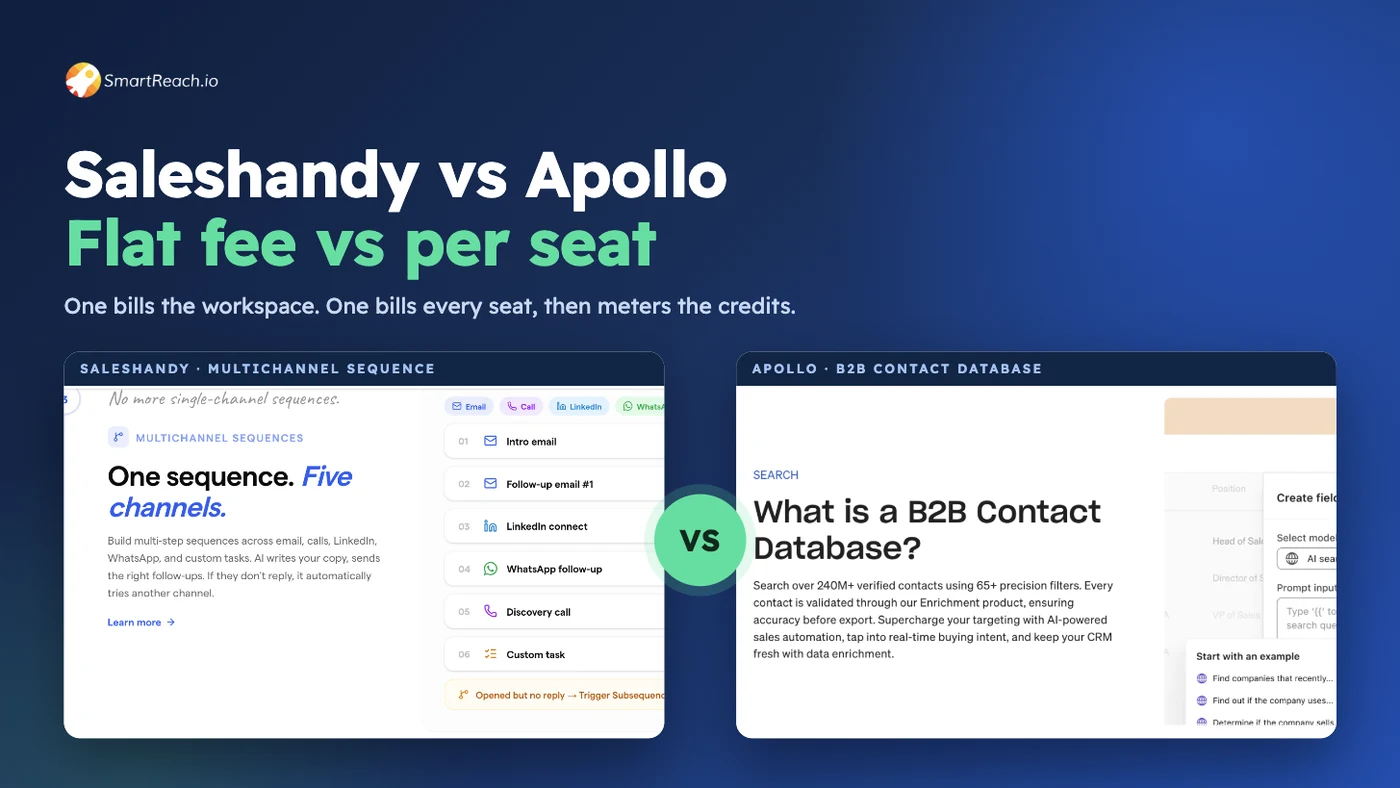
Neither, until you say what you're counting. Lemlist bills people, HeyReach bills LinkedIn accounts, and the answer flips depending on which number is bigger.
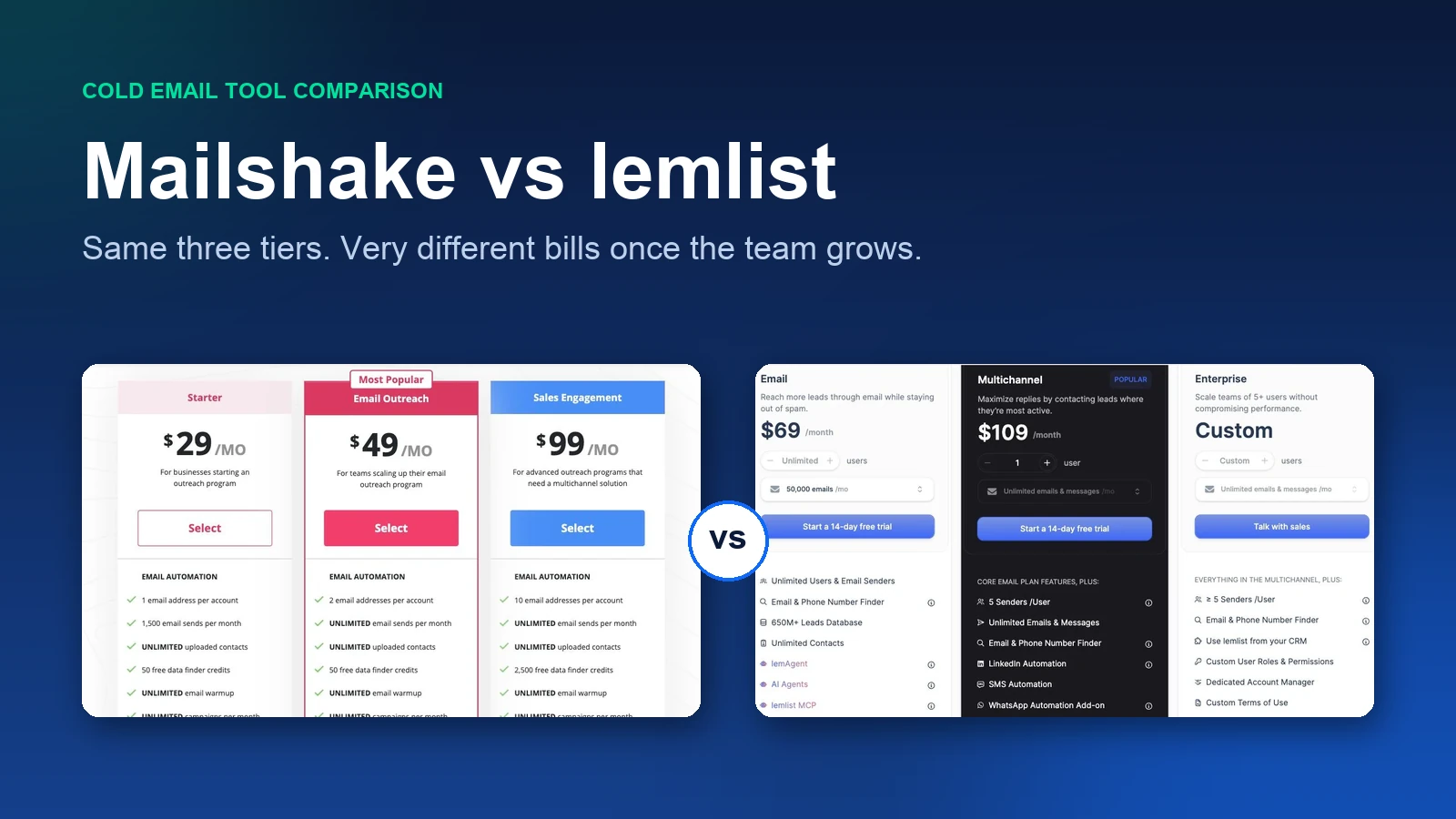
Lemlist's Email plan is $69 a month flat for unlimited users with a 50,000 email monthly cap. Multichannel, the plan that actually adds LinkedIn and calls, is $109 per user a month.
HeyReach's Growth plan is $79 a month per sender, and a sender is a connected LinkedIn account. Teammates, VAs and clients cost nothing at all.
SmartReach.io prices on a third axis again. Plans scale by active prospects rather than by people or accounts, Sales Engagement Plus is $99 a month for 50,000 active prospects, and LinkedIn automation is a $29 add-on per connected LinkedIn account.
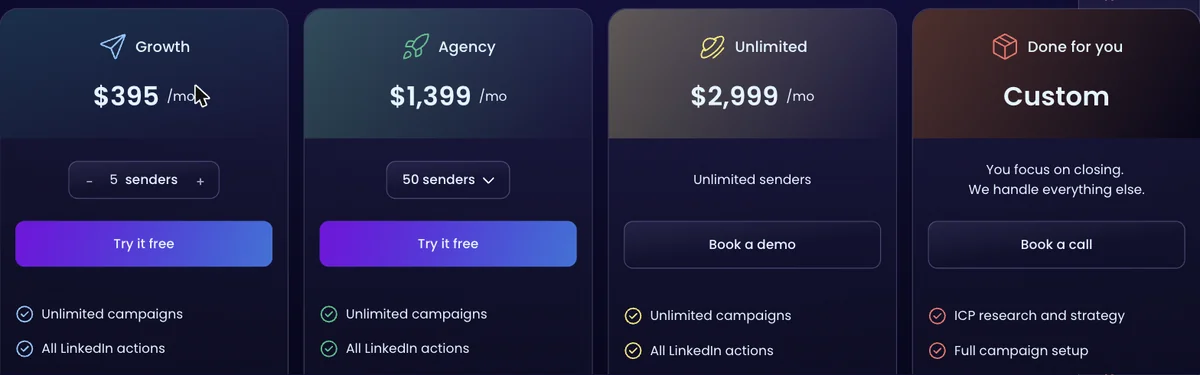
HeyReach's Growth price is linear, so five LinkedIn senders is five times $79. The Agency bundle exists because that line gets steep fast.
Every figure below is the monthly list price on monthly billing, read off each vendor's pricing page in September 2026.
| Factor | Lemlist | HeyReach | SmartReach.io |
|---|---|---|---|
| What it is | Multichannel outreach sequencer | LinkedIn automation for many sender accounts | Cold email software with a built-in lead finder |
| Entry paid tier | $69 flat, Email | $79 per sender, Growth | $29 flat, Email Outreach Basic |
| Multichannel tier | $109 per user, Multichannel | Not applicable, LinkedIn only | $99 flat, Sales Engagement Plus |
| What the meter counts | Users on Multichannel, emails on Email | Connected LinkedIn accounts | Active prospects, concurrent |
| Users included | Unlimited on Email, per user on Multichannel | Unlimited users on every plan | Unlimited from Plus up |
| Channels | Email, LinkedIn, calls, SMS, WhatsApp add-on | LinkedIn only, email via integrations | Email, LinkedIn, calls, WhatsApp |
| Email sending | Native, with warm-up and inbox rotation | None, hands off to Instantly, Smartlead or EmailBison | Native, with inbox rotation and deliverability protection |
| Second tool needed | No | Yes, an email sender from $47 | No |
| Lead data | 650M contact database, all plans | 100 enrichment credits per sender on Growth | 300M+ contacts and 50M+ companies, included |
| Reply management | Unified Inbox, all channels | Unified inbox, LinkedIn only | Shared inbox across all four channels, role-based access |
| Agency bundle | None, Enterprise is quote-based | $999 for 25 senders, $1,399 for 50 | Not sold as a bundle, unlimited users above Basic |
| Whitelabel | No | Included on Agency and Unlimited | No |
| Annual rate | $55 and $87, about 20 percent off | About 20 percent off, 10 percent quarterly | Up to 40 percent off list |
| Free trial | 14 days, full Multichannel, no card | 14 days, 3 LinkedIn accounts, no card | 14-day free trial, 200 prospects, no card |
Two rows decide more purchases than the rest combined. What the meter counts, and second tool needed.
A four-person team sharing four LinkedIn accounts pays Lemlist $436 a month. HeyReach charges $316 for the accounts and then needs an email sender on top.
A two-person agency running twenty client LinkedIn accounts pays Lemlist $218 for two users and gets two LinkedIn accounts, which doesn't do the job at all. HeyReach charges $999 and does.
The models aren't better or worse than each other in the abstract. They're aimed at different shapes of team, and the only way to know which shape you are is to price the whole motion rather than one line item.
What does the whole stack cost?
This is the section most comparisons skip, and it's the one that changes the answer.
A price per tool isn't a budget. A budget is every product you need before a prospect can receive an email and a LinkedIn message from the same campaign.
On that basis the three options aren't one product each. They're one, two and one.
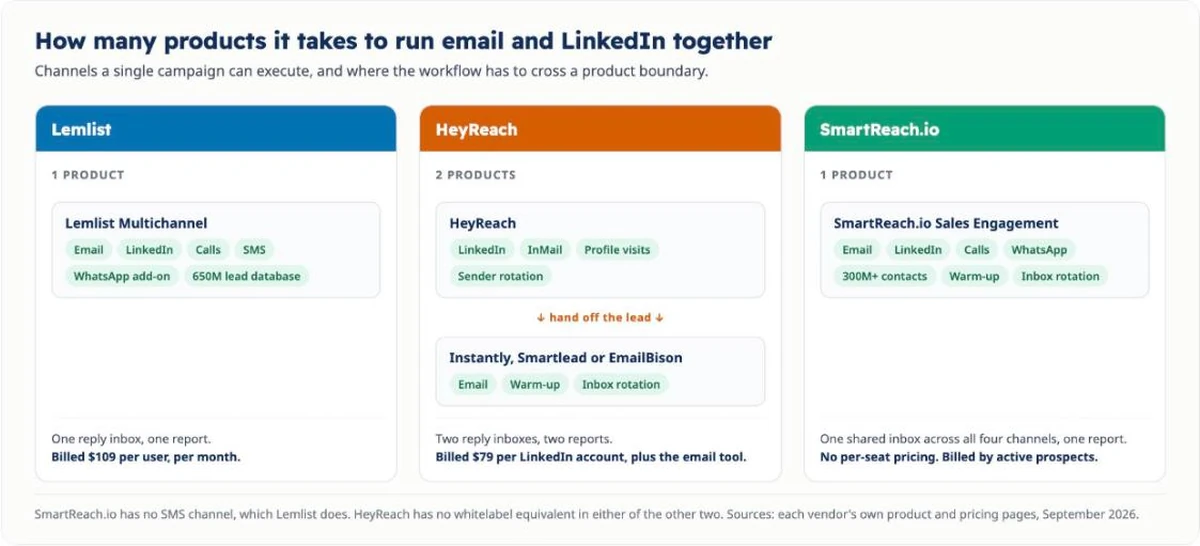
HeyReach's column has an extra box in it. That box is a second subscription, a second reply inbox and a second report, and it doesn't appear on any pricing page.
Price the second box honestly, because this is where stack comparisons usually cheat. Instantly, the sender HeyReach integrates with most visibly, is $47 a month on Growth and $97 on Hypergrowth.
The $47 tier caps you at 1,000 uploaded contacts and 5,000 emails a month. That's a solo operator's allowance, not a team's, so five people running real volume are on the $97 plan.
Mailboxes and domains sit on top of both numbers, for every option here, so they cancel out of the comparison. What doesn't cancel out is the subscription itself, and the fact that somebody has to administer it.
There's a softer cost in that second box too. Two vendors means two renewal dates, two support queues, two places a campaign can silently stop, and two sets of API credentials for whoever wires the CRM up.
None of that shows up on a pricing page, and all of it shows up in the third month.
Worth saying plainly, because it cuts the other way as well. If your team already runs Instantly or Smartlead happily, that box is paid for and administered, and bolting HeyReach onto it is a genuinely cheap way to add LinkedIn volume.
The second subscription is only a real cost when you're buying it fresh. The question is whether you're adding a tool to a stack that works, or building the stack from nothing.
Now run the same three team shapes through all three options, with every product counted, at the plan a team that size would genuinely buy.
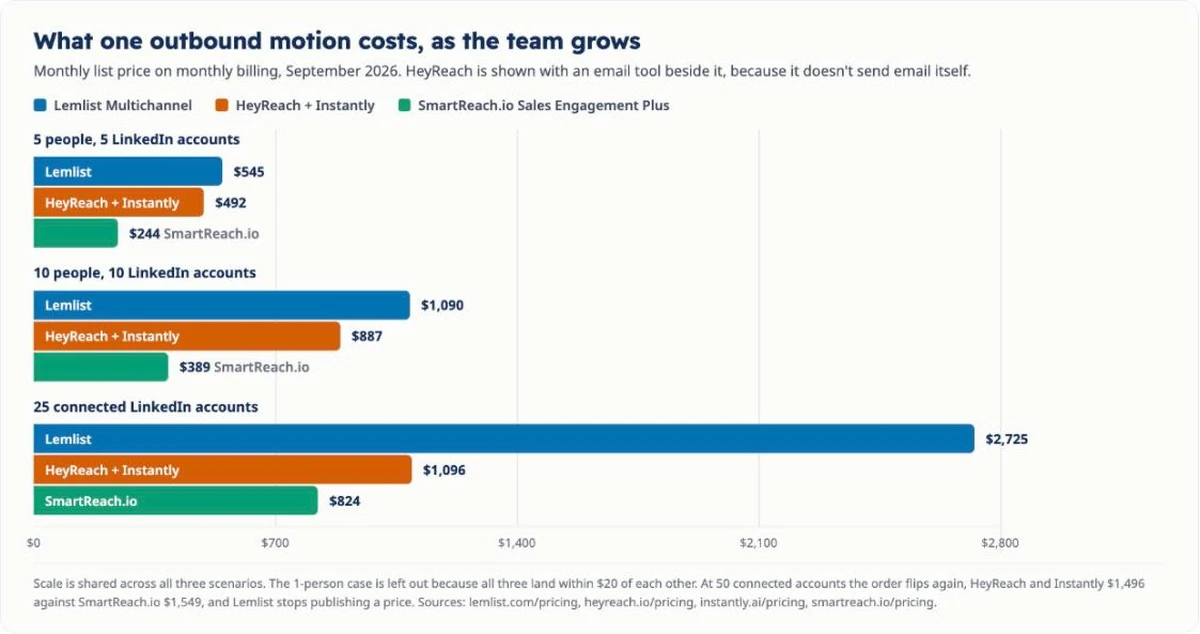
At five people the gap is about $250 a month. At twenty-five connected accounts it's still SmartReach.io in front, and Lemlist has become the expensive option rather than the cheap one.
The pattern holds across the middle of the market. Five people, ten people, twenty-five accounts, and the one-product option is the cheapest of the three each time.
That isn't because the others are badly priced. It's because per-user pricing compounds with headcount, and a two-tool stack pays two vendors for one motion.
Two honest exceptions sit at either end of that range, and both matter.
At one person with one LinkedIn account, Lemlist is $109, HeyReach with Instantly Growth is $126, and SmartReach.io is $128. Nobody should switch tools over $19 a month.
At fifty connected accounts, HeyReach and Instantly come to $1,496 against SmartReach.io's $1,549, because a flat bundle eventually beats a per-account add-on. Lemlist stops publishing a price at that scale entirely.
Who sends the email?
Lemlist and SmartReach.io. HeyReach doesn't send email at all, and this is the single most misread thing about it.
HeyReach's marketing says multichannel outreach, and the feature is real. What it does is find verified emails and push those leads into Instantly, Smartlead or EmailBison through native integrations.
Look at what the step menu offers. Connection request, find email, send InMail, view profile, then "add to Instantly" and "add to Smartlead".
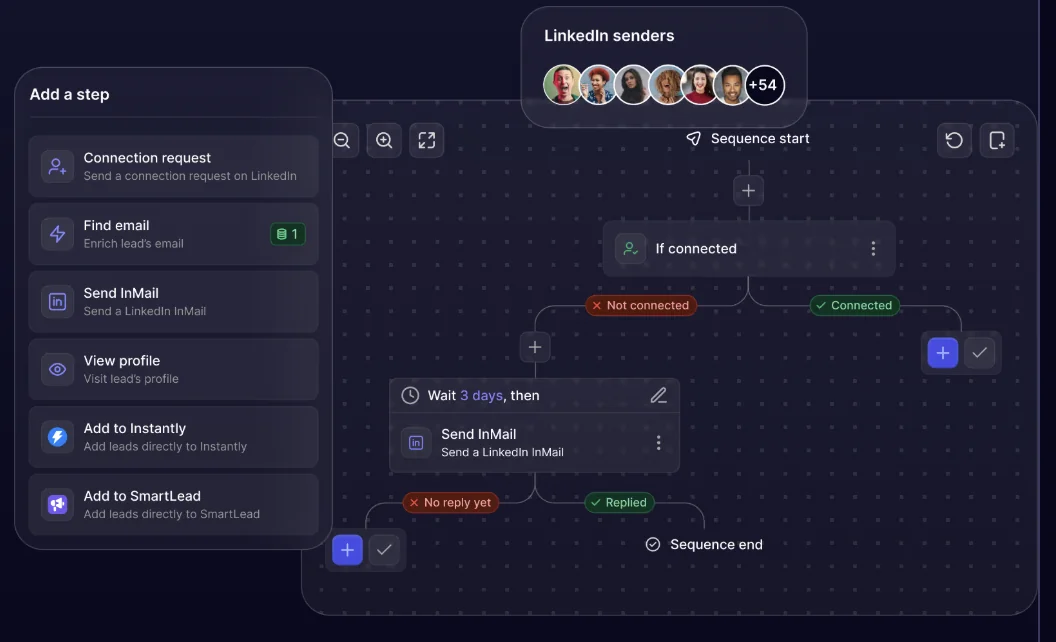
The last two steps in HeyReach's menu are handoffs, not sends. Email leaves the product at that point and the sequence logic goes with it.
Those last two entries aren't send steps, they're exits. Once a lead crosses into the email tool, the branching, the timing and the reporting live over there.
Lemlist keeps all of it inside. Sequences branch on conditions, personalization runs on Liquid syntax with dynamic images and custom landing pages, and lemwarm ships on every plan including the $69 tier.
The unglamorous parts are there too. Inbox rotation, rotating IPs, custom tracking domains, DNS setup tests, sending limit management, deliverability alerts, and in-app domain and mailbox purchase.
SmartReach.io sends natively as well, with published limits rather than vague ones. It supports up to 200 emails a day per connected email account and recommends staying nearer 40 a day, spread across several mailboxes and domains, which is the safe end of current bulk-sender guidance.
Its deliverability protection covers inbox rotation across connected accounts, spam testing, inbox placement checks and domain health, and every plan above Basic includes unlimited sending email accounts, so adding mailboxes to spread volume doesn't move the invoice.
None of the three fixes the part that actually decides inbox placement. Since 2024, Google and Yahoo have required bulk senders to authenticate with SPF, DKIM and DMARC, offer one-click unsubscribe, and keep spam complaints under 0.3 percent.
Aim for 0.1 percent, and read Google's sender guidelines before the first campaign rather than after the reply rate collapses.
Which one does LinkedIn better?
HeyReach, once you're past two or three accounts. Lemlist or SmartReach.io, if LinkedIn is one channel in a wider sequence.
Lemlist's LinkedIn step list is genuinely deep. Profile visits, follows, invites, text messages and voice messages, all as sequence steps rather than manual tasks a rep has to remember.
The branching is what makes it worth having. A campaign can send a connection request, wait two days, and split on whether the invite was accepted.
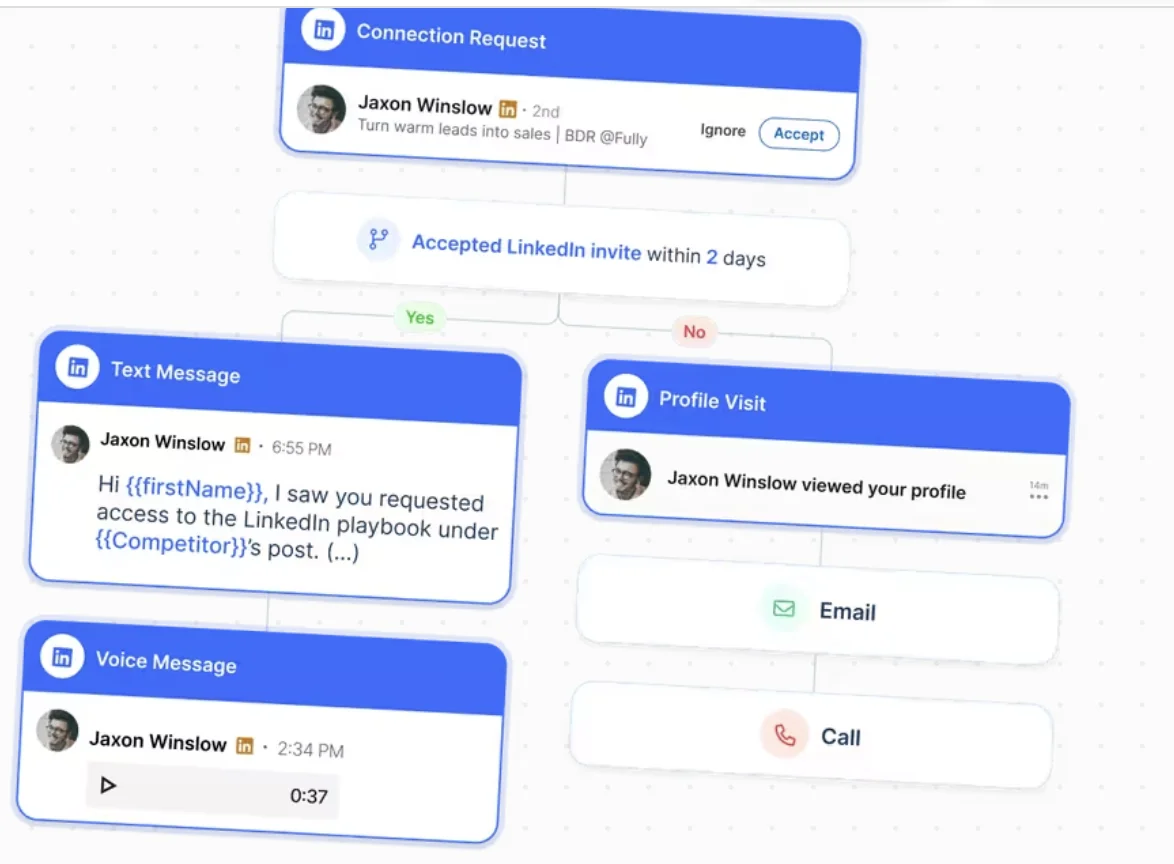
Accepted invites get a LinkedIn message and a voice note. Everyone else drops to a profile visit, an email and a call, in the same campaign.
That right-hand branch is the thing HeyReach structurally can't do. When a LinkedIn invite goes unanswered, HeyReach's fallback is another LinkedIn action or an exit to a different product.
HeyReach's advantage sits somewhere else entirely, in the multi-account layer. Connect fourteen LinkedIn accounts, and it rotates sending across them, keeps one inbox for every LinkedIn reply, and lets a colleague answer on someone else's behalf.
It also tracks more of the surface. Post likes and InMail sit alongside visits, invites and messages in its reporting, where Lemlist's LinkedIn analytics stay closer to visits, invites and messages.
Here's the correction worth making, because competitor pages seed the opposite. SmartReach.io runs a real four-channel sequence, not email with a LinkedIn task bolted on.
A single SmartReach.io sequence can send an email, wait for a reply, view a LinkedIn profile, send a connection request, place a call through the built-in dialer, and send a WhatsApp message, branching on what the prospect actually did. Replies from all four channels land in one shared inbox with role-based access for members, admins and owners. LinkedIn automation is $29 per connected LinkedIn account, and calling seats are included on Sales Engagement plans rather than sold per person.
SmartReach.io doesn't do SMS. That's the honest limit against Lemlist, which does.
Where do the replies land?
In one inbox, two inboxes, or one inbox that only covers one channel. This is the difference that shows up in week three rather than on the pricing page.
Lemlist has a Unified Inbox from its entry tier, covering every channel it sends on. One place to answer email, LinkedIn and SMS, which is the thing that makes a five-channel campaign survivable.
HeyReach has a unified inbox too, and it's good at what it covers. Every LinkedIn account in one view, no logging in and out, voice notes from the desktop, and replying on behalf of a colleague.
But it covers LinkedIn only. The email half of the motion answers in Instantly or Smartlead, which means a prospect who replies to the email and then accepts the invite has produced two conversations in two products, with nothing joining them.
SmartReach.io puts all four channels in one shared inbox with role-based access for members, admins and owners, which is the part that matters once more than two people work the same list.
Ask the question that actually predicts the pain. When a prospect replies, how many places does somebody have to look, and does the person who owns that account know it happened?
One place, for Lemlist and SmartReach.io. Two, for HeyReach plus a sender, and that's before anybody tries to build a single report across both.
For Amy working alone, two inboxes is an annoyance. For Stan coordinating six reps across fourteen accounts, it's the reason a warm reply sits unanswered for three days.
Who finds the leads?
Lemlist and SmartReach.io ship a database. HeyReach ships credits and expects you to bring the list.
Lemlist's is the biggest number on paper, a 650 million contact database included on every plan, with an email and phone finder, unlimited LinkedIn enrichment and account-based prospecting.
The catch is the meter underneath. Enrichment runs on credits at $0.01 each, a verified email costs 5 credits and a phone number costs 20, so 2,000 verified emails is $100 on top of the plan.
Intent signals cost more again. A website visit is 20 credits, hiring and job-change signals start at 100, a funding event is 100, and LinkedIn engagement signals start at 400.
HeyReach gives Growth plans 100 enrichment credits per sender and assumes the list arrives from somewhere else, usually Sales Navigator, Clay or RB2B. That's a reasonable design for its audience, and it's why HeyReach shows up in so many Clay-centred stacks.
It does mean a third line item for teams without a data source already. Clay's entry paid tier is $185 a month, which is more than the HeyReach senders it feeds.
SmartReach.io includes its B2B lead finder in the plan, covering 300M+ contacts and 50M+ companies, with no separate credit meter for lookups and no export step between finding a prospect and sequencing them.
That's less flexible than Clay's orchestration and less granular than Lemlist's per-credit rates. It's also a single number you can put in a budget, which is the trade most teams actually want.
One caveat worth saying out loud. Bundled databases all look better in a demo than on your ICP.
Take 200 real accounts in your niche, run them through each tool on the trial, and count verified emails and direct dials. That number is the only one that matters, and it's rarely the one on the marketing page.
Will your account get restricted?
Every tool here carries the same risk, and no vendor page on any side says this plainly enough.
LinkedIn's user agreement prohibits using software to access the service or extract data. Every automation tool in this category operates against that, and account restrictions are enforced against the account, not the vendor.
The ceiling is real too. LinkedIn caps most accounts at roughly 100 invitations a week, and its own invitation limit page explains that withdrawing invites doesn't lift the restriction.
Work that through. Twenty-five HeyReach senders works out at roughly 2,500 invitations a week, and that's a hard number no plan on any of these tools can raise.
Buying more senders is the only lever. Which, conveniently for HeyReach's pricing model, is also the thing you pay for.
The three take different approaches to the plumbing underneath. HeyReach gives every sender a dedicated residential proxy on the Growth plan, and asks you to bring your own proxies on Agency and Unlimited.
Lemlist runs LinkedIn actions through a Chrome extension driving your logged-in session, so actions fire only while the browser is open. An overnight campaign doesn't run overnight, and a rep who shuts their laptop pauses the sequence.
SmartReach.io runs LinkedIn as a step inside the server-side sequence, billed per connected LinkedIn account, which means the cadence keeps its timing when a laptop closes. It doesn't remove LinkedIn's weekly cap, and nothing does.
The guardrails matter more than the tool choice here.
- Warm a new LinkedIn account for two to three weeks before automating anything on it.
- Sit well under the weekly invitation cap rather than at it.
- Spread actions across the working day instead of firing them in one block.
- Keep profile views and messages in a human ratio. An account that views 200 profiles and sends 200 requests in a day reads as a bot.
- Never point automation at an account you can't afford to lose.
Which one suits an agency?
HeyReach, past roughly twenty-five client accounts. Below that it's a real contest, and the whitelabel question usually settles it.
The Agency plan is $999 a month for 25 senders or $1,399 for 50, with one whitelabel branding included, done-for-you onboarding and a dedicated Slack channel. The Unlimited plan is $2,999 for unlimited senders.
Do the per-account arithmetic. Twenty-five senders on Agency works out near $40 each, and fifty senders lands under $28.
The crossover is worth knowing before you buy. Growth beats Agency until about twelve senders, and past thirteen accounts you're paying more on Growth than the $999 bundle costs.
Unlimited users is the underrated half of it. Onboard the whole agency, every VA and every client, at no extra cost, which changes how a team actually uses the tool.
Lemlist has no equivalent. There's no whitelabel, no client workspace model, and Multichannel bills every head, so a five-person agency is at $545 before a single client account gets connected.
SmartReach.io sits between the two, and where it lands depends on one question. Ten client LinkedIn accounts is $99 plus $290, so $389 a month with email, calls and WhatsApp included, against HeyReach's $790 plus a sender for LinkedIn alone.
Past twenty-five accounts the arithmetic turns. HeyReach's bundle stops charging per account and SmartReach.io's add-on doesn't, and if your clients need your branding on the dashboard, SmartReach.io doesn't offer that at all.
So the honest split is by size and by whitelabel. Under fifteen client accounts and running email as well, SmartReach.io is usually the cheaper single product. Over twenty-five accounts on LinkedIn alone with reseller branding, HeyReach is built for exactly that and the others aren't.
Our HeyReach alternatives roundup covers what else sits in that specific lane.
What breaks at ten people?
The three pricing models finally show their teeth, and they break in different directions.
Take a team where every person runs their own LinkedIn account, which is the normal shape. Here's what each model does as the team grows, with the email tool counted where one is needed.
| Team size | Lemlist Multichannel | HeyReach Growth plus Instantly | SmartReach.io Sales Engagement Plus |
|---|---|---|---|
| 1 person | $109 a month | $79 plus $47, so $126 | $99 plus $29 LinkedIn, so $128 |
| 5 people | $545 a month | $395 plus $97, so $492 | $99 plus $145 LinkedIn, so $244 |
| 10 people | $1,090 a month | $790 plus $97, so $887 | $99 plus $290 LinkedIn, so $389 |
| 25 accounts | $2,725 a month | $999 plus $97, so $1,096 | $99 plus $725 LinkedIn, so $824 |
| 50 accounts | Enterprise quote | $1,399 plus $97, so $1,496 | $99 plus $1,450 LinkedIn, so $1,549 |
Read the first and last rows honestly, because they're the two that don't go SmartReach.io's way.
At one person the three are within $19 of each other, which is noise. At fifty accounts the flat bundle wins and the per-account add-on loses by $53.
Everything between those two rows is where almost every reader actually sits, and there the gap is $250 to $700 a month.
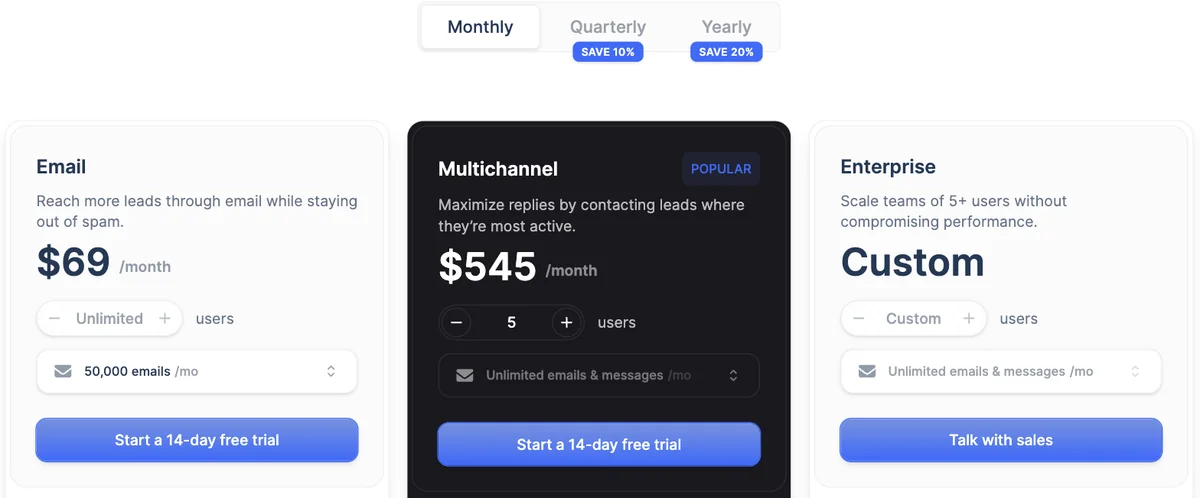
The word under Lemlist's $69 Email price is unlimited users. Switch to Multichannel and the same box counts heads, which is where $545 for five people comes from.
Lemlist's is the model teams complain about later. The Email plan says unlimited users, and the Multichannel plan, the one with the channels people actually bought it for, bills everyone.
There's a second-order effect nobody prices in. When multichannel costs $109 a head, teams quietly stop giving it to everyone.
Two SDRs get the good plan, four get the cheap one, and the multichannel motion you bought never runs across the team. That's the same structure we picked apart in Lemlist vs Clay.
SmartReach.io answers it by not counting people at all. Plans scale by active prospects, every plan above Basic includes unlimited users and unlimited sending email accounts, and LinkedIn is a $29 add-on per connected account.
Sales Engagement starts at $39 a month, Plus is $99 for 50,000 active prospects, and hiring the eleventh rep doesn't move the base invoice. The eleventh LinkedIn account does, which is the honest shape of that model.
Which one is faster to set up?
HeyReach, comfortably, because it does one thing. The other two ask for a first week rather than a first hour, and for different reasons.
Connect a LinkedIn account, import leads from Sales Navigator or Clay, drag a few steps into a sequence, launch. Sönke Venjacob, founder at Platinum Agency, calls it "the most reliable LinkedIn automation tool available" in a testimonial on HeyReach's own site.
There's not much surface area to learn because the product does one thing. That's a design decision, not a gap, and it's genuinely the right call for its audience.
Lemlist asks more of you, in proportion to what it covers. Connecting mailboxes, running DNS and deliverability checks, warming domains and building branching logic across five channels is a first-week project.
The depth is mostly in the personalization layer. Liquid syntax, dynamic images and custom landing pages take a while to master, but nothing blocks you from sending while you learn.
SmartReach.io lands in the same range as Lemlist on day one, because any tool that sends email has to do the mailbox and domain work first. Where it saves time is later, in what you don't have to set up twice.
One integration to a CRM instead of two. One suppression list instead of two. One report that already knows a prospect got an email on Monday and a connection request on Thursday.
The practical question is who owns the tool day to day. If it's the SDRs themselves between calls, weight simplicity heavily and pay attention to how many products they'll have open.
If it's an ops person who's excited about it, the depth starts earning its keep in about a month, and the thing they'll thank you for is having one system to administer rather than two.
Should you run both?
Usually not, and this is where Lemlist and HeyReach differ from most vs pairings.
They overlap on LinkedIn, which is the expensive channel in both products. Paying Lemlist $109 a user for LinkedIn automation you then run in HeyReach is money set on fire.
The stack that actually gets built is HeyReach plus an email sender. HeyReach for LinkedIn at volume, Instantly or Smartlead for the inbox, and a shared CRM or spreadsheet holding the two together.
Budget it properly before you commit. Ten senders on HeyReach is $790, Instantly Hypergrowth adds $97, and mailboxes and domains sit on top of that.
The seam is the part people underestimate. Two tools means two reply inboxes, two reporting views, and no single answer to "what happened to this prospect".
For a five-person team that seam costs more in coordination than either subscription costs in cash. For a fifty-account agency it's just how the work gets done, and it's fine.
The reason SmartReach.io keeps appearing in this comparison isn't that it beats either tool at that tool's specialty. It's that for the team in the middle, running email and LinkedIn across five to twenty-five accounts, it removes the seam and the second bill at the same time.
If you're already running Instantly or Smartlead and happy with it, adding HeyReach is the cheapest way to get serious LinkedIn volume. Our notes on multichannel outreach tools cover the other combinations.
What breaks when you switch?
Campaigns move in an afternoon. Sender reputation and LinkedIn account history don't move at all, and that asymmetry is the whole risk.
This matters more than usual here, because moving between these three isn't a like-for-like migration. You're often changing how many products the motion runs in, not just which vendor sends it.
Here's the order that avoids the expensive mistakes.
- Move suppression and unsubscribe lists first. Emailing someone who already opted out is the fastest way to burn a fresh domain, and in most jurisdictions it's a compliance problem rather than a deliverability one.
- Export contacts and rebuild sequences by hand. Don't trust an importer to carry branching logic across. Rebuilding takes an afternoon and you'll find steps you don't need any more.
- Connect and warm mailboxes before the first real send. Warm-up history doesn't transfer. A mailbox well seasoned on the old tool starts cold on the new one.
- Leave LinkedIn accounts alone for a fortnight. Moving a connected account between automation tools and immediately resuming volume is the pattern that draws a restriction. Ramp back up slowly.
- Run one small campaign, 200 to 300 prospects, while the old subscription is still live. Compare bounce rate and reply rate against a similar list on the old tool. This is the only real test.
- Cancel last. Cancelling first and then finding a deliverability problem with no fallback makes for a bad month.
Budget two weeks for that, not two days.
There's a switch-specific trap when you consolidate two tools into one. The reporting looks worse before it looks better, because a single product counts a prospect once where two products each counted them separately.
Consolidating onto SmartReach.io has one sequencing detail worth planning around. Its LinkedIn add-on is billed per connected account, so connect the accounts in the same week you move the sequences rather than months apart, and the $29 per account starts earning against the tool it replaced instead of running alongside it.
Any vendor marketing a one-click migration is describing how they move your data, not how they move your sender reputation. The second one decides whether your first month works.
So which one should you buy?
Lemlist
Quick facts
- G2
- 4.7 ★
- From
- $69/month flat for email
- Free trial
- 14 days, full Multichannel, no card
- Best for
- Small teams of one to three people that want email, LinkedIn, calls, SMS and WhatsApp branching inside one campaign
What it is. A multichannel sequencer with deep personalization tooling and a 650 million contact database attached.
Key features. Email, LinkedIn, calls and SMS in one branching sequence, WhatsApp as an add-on. Liquid syntax, dynamic images and custom landing pages. lemwarm, inbox rotation and a Deliverability Hub on every plan. Unified Inbox from the entry tier. AI reply-intent and out-of-office detection.
Pros
- Five channels from one campaign, with real conditional branching
- The only one of the three with SMS as a native step
- Email plan covers unlimited users on one flat $69 fee
- lemwarm, inbox rotation and deliverability reporting on every tier
- 650M contact database and phone finder on all plans
- Native Clay, Zapier, Make and n8n integrations
Cons
- Multichannel is per user and compounds hard past three people
- Ten people on Multichannel is $1,090 a month, the highest bill here
- Hard 50,000 email monthly cap on the flat Email plan
- Only five sending addresses per user on Multichannel
- LinkedIn actions run through a Chrome extension, so the browser has to stay open
- No whitelabel or client workspace model for agencies
HeyReach
Quick facts
- G2
- 4.7 ★
- From
- $79/month per LinkedIn sender
- Free trial
- 14 days, 3 LinkedIn accounts, no card
- Best for
- Agencies running twenty-five or more client LinkedIn accounts with whitelabel branding, where email already lives in another tool
What it is. LinkedIn automation built around sender accounts rather than users, with rotation, a unified LinkedIn inbox and whitelabel for agencies.
Key features. Unlimited LinkedIn senders with automatic rotation. All LinkedIn actions including invites, messages, InMail, profile visits and post engagement. Unified inbox across accounts with reply-on-behalf-of. Native Instantly, Smartlead and EmailBison handoffs. HubSpot sync, API, webhooks, MCP server and CLI. Whitelabel on Agency and Unlimited.
Pros
- Charges per LinkedIn sender, never per user, with unlimited teammates and clients
- Agency bundle at $999 for 25 senders is the cheapest per-account rate here
- Cheapest total stack at fifty accounts, at $1,496 with an email tool
- Whitelabel branding included from the Agency plan up
- Dedicated residential proxy per sender on the Growth plan
- Tracks post likes and InMail alongside visits, invites and messages
Cons
- LinkedIn is the only channel, with no native email, calls or WhatsApp
- Email means a second subscription, from $47 a month, and a second reply inbox
- No conditional fallback to another channel when an invite goes unanswered
- Agency and Unlimited plans require you to bring your own proxies
- Growth is poor value between about thirteen and twenty-five senders
- Only 100 enrichment credits per sender, so the list comes from elsewhere
SmartReach.io
Quick facts
- G2
- 4.6 ★
- Capterra
- 4.7 ★
- From
- $29/month flat
- Free trial
- 14-day free trial, 200 prospects, no card
- Best for
- Teams of three to twenty-five running email and LinkedIn together who want one product, one reply inbox and no per-seat pricing
What it is. A cold email software with a built-in B2B lead finder and multichannel sequences, priced by active prospects rather than by headcount.
Key features. 300M+ contacts and 50M+ companies in the lead finder. Email, LinkedIn, calls and WhatsApp as steps in one conditional sequence. Built-in dialer reaching 200+ countries. Inbox rotation and deliverability protection. Shared inbox across all four channels with role-based access. CRM sync to HubSpot, Salesforce, Pipedrive and Zoho.
Pros
- Cheapest total stack from five people to twenty-five accounts, by $250 to $700 a month
- One product for email and LinkedIn, so one reply inbox and one report
- No per-seat pricing, with unlimited users above Basic
- Unlimited sending email accounts above Basic, so spreading volume is free
- Lead finder included in the plan, with no separate credit meter for lookups
- Rated 4.6 on G2 and 4.7 on Capterra as of September 2026, with 5,000+ customers
Cons
- No SMS channel, unlike Lemlist
- No whitelabel or agency reseller packaging
- At one person it's $19 a month more than Lemlist, which is not a reason to move
- Smaller review base than either rival
- No free tier, only a 14-day trial
SmartReach.io is rated 4.6 on G2 from 60 reviews and 4.7 on Capterra from 27 reviews as of September 2026, with 5,000+ customers and 99.99% uptime. That's a smaller review base than either rival here, so the 14-day free trial covering 200 prospects with no card is a faster way to judge it than any star rating.
The honest summary of Lemlist vs HeyReach is that the price tags aren't comparable, and the shortlists shouldn't overlap as often as they do.
HeyReach wins if you're counting LinkedIn accounts into the dozens. Lemlist wins if you're one to three people who need SMS in the mix.
For everyone in between, which is most teams reading this, the cheapest working motion isn't either of them. It's the one that doesn't need a second subscription to send an email. Compare the plans and pricing or start a 14-day free trial covering 200 prospects, no card needed.
Questions people actually ask
Is Lemlist or HeyReach cheaper?
It depends on whether you count people or LinkedIn accounts. Lemlist Multichannel is $109 per user a month, so five people cost $545. HeyReach Growth is $79 per LinkedIn sender, so five accounts cost $395, plus an email tool from $47. SmartReach.io Sales Engagement Plus covers the same five people at $99 plus $29 per connected LinkedIn account, so $244.
Does HeyReach send cold email?
Not itself. HeyReach finds verified emails and pushes leads into Instantly, Smartlead or EmailBison through native integrations, which is what its multichannel feature means. The sending, warm-up and inbox rotation live in that second tool. SmartReach.io sends email natively alongside LinkedIn, calls and WhatsApp, so one product covers the same motion.
Can Lemlist replace HeyReach for LinkedIn?
For a small team, yes. Lemlist automates profile visits, follows, invites, text messages and voice messages as sequence steps on its Multichannel plan. What it doesn't do is run dozens of sender accounts from one dashboard with rotation and whitelabel, which is the specific job HeyReach was built for.
Which one is better for an agency?
HeyReach, past roughly 25 client LinkedIn accounts, where its $999 Agency bundle includes whitelabel branding and unlimited teammates. Below that, SmartReach.io usually costs less and covers email too, at $99 a month plus $29 per connected LinkedIn account, with no per-seat pricing and unlimited users above Basic.
Does HeyReach charge per user?
No. HeyReach charges per LinkedIn sender, which is a connected LinkedIn account, and lets you invite unlimited teammates, VAs and clients for free. Lemlist bills $109 per user on Multichannel. SmartReach.io also avoids per-seat pricing, scaling by active prospects with unlimited users on every plan above Basic.
How many LinkedIn invites can each account send?
Around 100 a week on most accounts, which is LinkedIn's limit rather than a tool setting. Twenty-five HeyReach senders works out at roughly 2,500 invitations a week, and no plan on either tool raises that ceiling. Buying more senders is the only way to raise LinkedIn volume safely.
Do teams run Lemlist and HeyReach together?
Rarely, because they overlap on LinkedIn. The common HeyReach stack pairs it with an email sender like Instantly or Smartlead instead. SmartReach.io covers the same ground in one product, running email, LinkedIn, calls and WhatsApp in a single sequence with plans from $29 a month and no per-seat pricing.
Which is safer for a LinkedIn account?
Both carry the same underlying risk, since LinkedIn's user agreement prohibits automation software regardless of vendor. HeyReach ships a dedicated residential proxy per sender on Growth and asks for your own on Agency. Warming a new account for two to three weeks and staying under the weekly cap matters more than the tool you pick.
Stop juggling tools
Book more meetings on every channel
Join 5,000+ teams running multichannel outreach from one sequence, with deliverability built in.