Lemlist vs Clay | Which One Do You Actually Need?

On this page
Two tools, two very different bills, and a comparison that gets made every week in Slack channels that should probably be asking a different question.
Lemlist is a sequencer. Clay is a data platform. For most of the last three years, comparing them made about as much sense as comparing a mailing list to a printing press.
Then Clay shipped a cold email sequencer of its own, and the line got blurry enough to be worth drawing properly.
So this is Lemlist vs Clay on the terms that actually decide it. What each one is for, what each one really costs once the meters start running, and where the overlap now sits.
SmartReach.io belongs in the conversation as a third shape. It's a cold email software that keeps the finding and the sending in one product, and its Sales Engagement plans put LinkedIn, calls and WhatsApp beside email as steps in the same cadence.
Every price here was read off both vendors' own pricing pages in September 2026, on monthly billing, because annual rates quoted against monthly rates are how most comparison posts get the gap wrong.
TL;DR
Are these even the same tool?
No, and pretending otherwise is how teams end up buying the wrong one.
Clay is infrastructure. You point it at a source, it enriches every row through a waterfall of providers, runs AI research on the ones that matter, scores them, and pushes the survivors somewhere useful.
Lemlist is execution. It takes a list of people and works them, across email, LinkedIn, calls, SMS and WhatsApp, until somebody replies or the sequence runs out.
Here's the test that sorts it in about ten seconds. Look at your last campaign and ask why it underperformed.
If the list was wrong, the titles were stale and half the emails bounced, that's a Clay problem. If the list was fine and nobody answered, that's a Lemlist problem.
Amy, a senior SDR running her own patch, usually has the second problem. Stan in RevOps almost always has the first.
The two failures don't even look alike in the numbers. A data problem shows up as bounce rate, as bad personalization tokens, and as replies that say "wrong person".
An execution problem shows up as a clean send with a flat reply rate. Same 2,000 emails, completely different fix.
The confusion is recent and it's Clay's doing. Clay Sequencer sends cold email now, which means the two products finally overlap on one channel out of five.
That overlap is real, and later in this post it gets its own section. It just isn't the whole comparison, and treating it that way is how teams pay $185 a month for a sequencer they could have had for $69.
What does each one cost?
Very differently, and the difference isn't the headline number.
Lemlist prices by plan and, above the entry tier, by person. Clay prices by plan and then by consumption, through two separate meters that most buyers underestimate on day one.
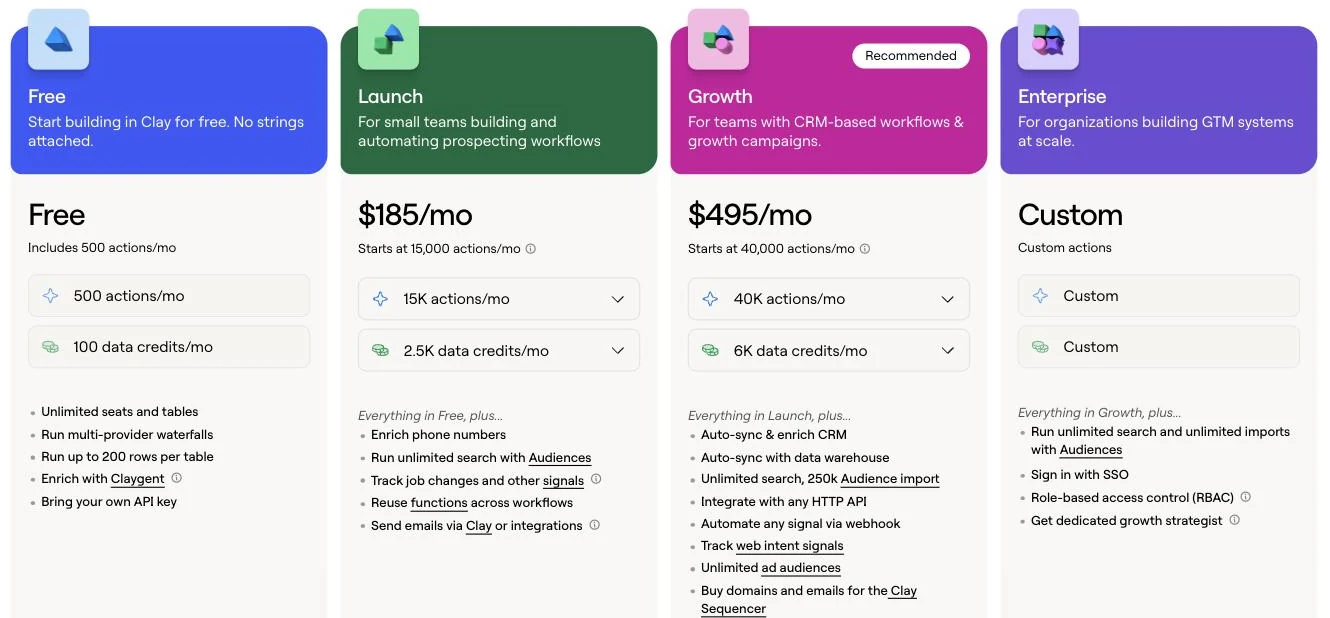
Clay runs two meters per plan. The dropdowns under each price are the real pricing page, because that's where the number you'll actually pay gets set.
Every figure below is the monthly list price on monthly billing, read off both vendors' pricing pages in September 2026.
| Factor | Lemlist | Clay | SmartReach.io |
|---|---|---|---|
| What it is | Multichannel outreach sequencer | GTM data and orchestration platform | Cold email software with a built-in lead finder |
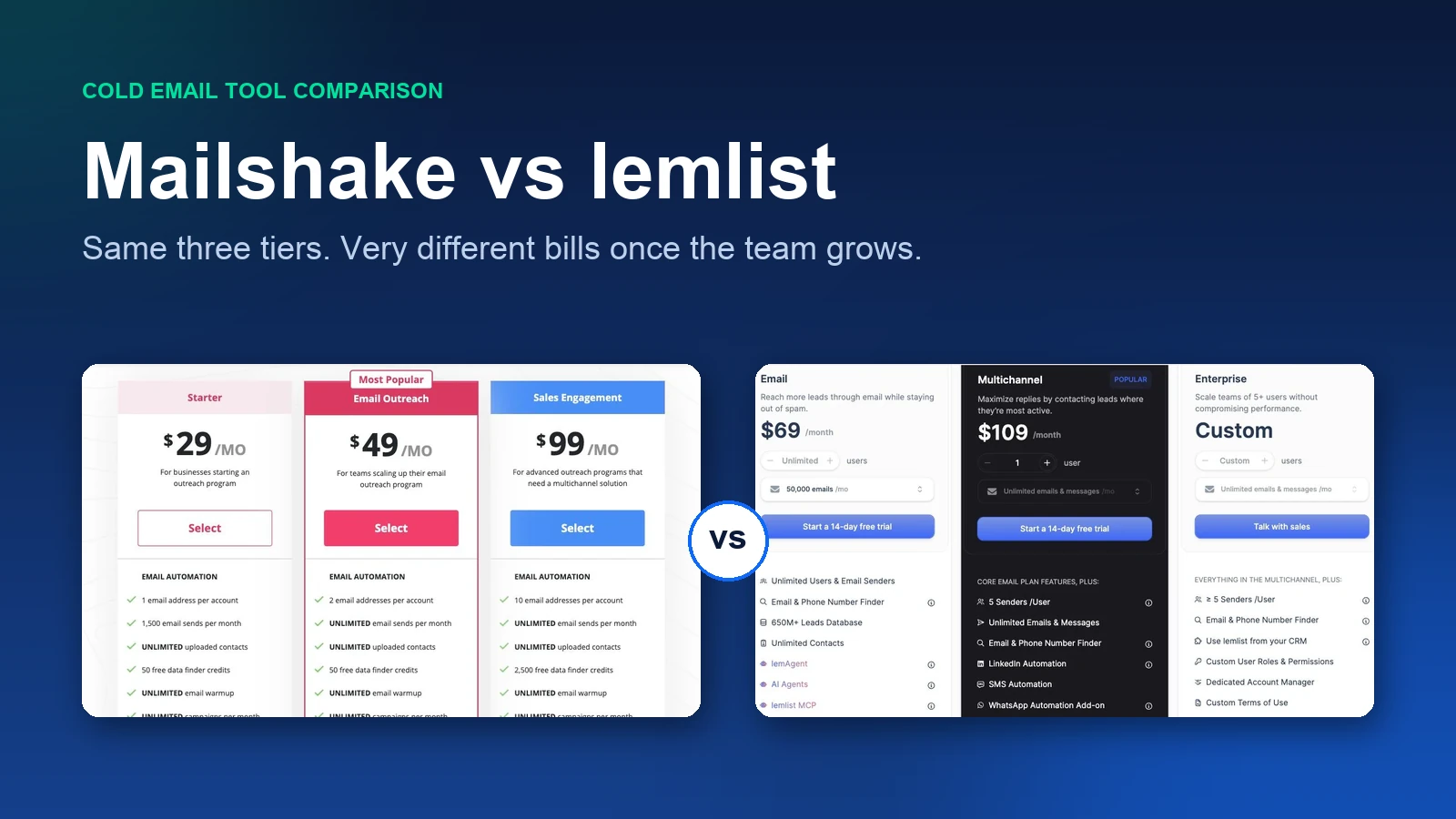
| Entry paid tier | $69 flat, Email | $185, Launch | $29 flat, Email Outreach Basic |
| Mid tier | $109 per user, Multichannel | $495, Growth | $99 flat, Sales Engagement Plus |
| Annual rate | $55 and $87, about 20 percent off | $167 and $446, about 10 percent off | Up to 40 percent off list |
| Free tier | None, 14-day trial only | Yes, 500 Actions and 100 Data Credits a month | None, 14-day free trial |
| Users included | Unlimited on Email, per user on Multichannel | Unlimited seats on every plan | Unlimited from Plus up |
| What the meter counts | Emails sent on Email, unlimited on Multichannel | Data Credits and Actions | Active prospects, concurrent |
| Channels | Email, LinkedIn, calls, SMS, WhatsApp add-on | Email only, via Clay Sequencer | Email, LinkedIn, calls, WhatsApp |
| Lead data | 650M contact database, all plans | Waterfall across 150+ data partners | 300M+ contacts, 50M+ companies |
| Enrichment billing | Credits, 5 per verified email, 20 per phone | Data Credits from $0.05 each | Included with the plan |
| Sending mailboxes | 5 senders per user on Multichannel | Bought in-product, billed in credits | Unlimited sending email accounts above Basic |
| Deliverability | lemwarm, inbox rotation, Deliverability Hub | In-product inboxes and domains, auto-warming | Inbox rotation and deliverability protection |
| Compliance | GDPR, SSO on Enterprise | SOC 2 Type II, GDPR, CCPA, ISO 27001 | GDPR, 2FA, encryption in transit and at rest |
| Free trial | 14 days, full Multichannel, no card | Free plan, no trial needed | 14-day free trial, 200 prospects, no card |
Two rows decide most purchases. Users included and what the meter counts.
Lemlist's Email plan is unusually generous on people and unusually strict on volume. Unlimited users, one flat $69, and a hard 50,000 emails a month ceiling.
Clay inverts it. Unlimited seats on every plan including the free one, and a bill that moves with how much data you pull and how much work the platform does on your behalf.
That second model is harder to forecast, and it's the single most common complaint about Clay from finance rather than from users.
Clay's free tier deserves a mention because nothing else here has one. 500 Actions and 100 Data Credits a month, unlimited seats, waterfall enrichment and Claygent, capped at 200 rows per table.
That's enough to learn the product properly before spending anything, which is rare in this category. It's also enough to run a genuine bake-off against your own ICP rather than against a vendor's demo list.
One structural detail worth knowing before you commit a year. Clay's Enterprise tier requires an annual commitment, while Launch and Growth are available month to month.
Lemlist runs the opposite way. Monthly, quarterly at about 10 percent off, and yearly at about 20 percent off, on every self-serve tier.
What do the credits actually buy?
This is the part that decides whether either quote survives contact with a real campaign.
Lemlist's credits are simple arithmetic. One credit is $0.01, a verified email costs 5 credits and a phone number costs 20, so $10 buys roughly 200 verified emails or 50 phone numbers.
Buying-intent signals are the expensive line. A website visit is 20 credits, hiring and job-change signals start at 100, a funding event is 100, and LinkedIn engagement signals start at 400.
Work that through for a month of real prospecting. Two thousand verified emails is 10,000 credits, so $100 on top of the plan.
Add 300 phone numbers at 20 credits each and you're at 16,000 credits, or $160. That's more than double the $69 Email plan, and it's the number nobody quotes in a comparison table.
Clay's model is two meters instead of one, which is more honest and harder to predict.
Data Credits buy the data itself, starting at $0.05 each and getting cheaper at volume, because Clay negotiates with its 150+ partners and passes the rate down. Actions buy the platform work, at under a cent each.
Launch includes 2,500 Data Credits a month. At the entry rate that's $125 of data bundled into a $185 plan, which reframes the price a little.
Three details in Clay's model genuinely favour the buyer, and they're worth knowing.
- A miss is free. If an enrichment returns no result, you're charged neither Data Credits nor Actions.
- Your own keys skip the data meter. Bring your own API key for a provider and you spend one Action, no Data Credits.
- Data Credits roll over. On Launch and Growth, unused credits bank up to twice your monthly allowance. Actions don't roll over and reset every cycle.
The one to watch is AI. About 80 percent of Clay's models cost a fixed number of Data Credits per task.
Token-heavy models are billed on actual consumption at cost with no markup, shown as a tilde estimate in the column. Clay's own figure is that 75 percent of runs land under the estimate, which means a quarter of them don't.
SmartReach.io sidesteps the meter entirely on the data side. The lead finder and the enrichment sit inside the plan, and the plan is priced by active prospects rather than by lookups.
That's less flexible than Clay's marketplace and less granular than Lemlist's credits. It's also a single number you can put in a budget.
Which one finds your leads?
Clay, and it isn't close on depth.
Waterfall enrichment
Clay's core trick is running providers in sequence. Ask for a phone number, and instead of querying one vendor and giving up, it walks a chain until one returns a hit, then verifies it.
Coverage on a single provider is usually somewhere between disappointing and terrible for anything outside US tech. Running three or four in sequence is the fix.
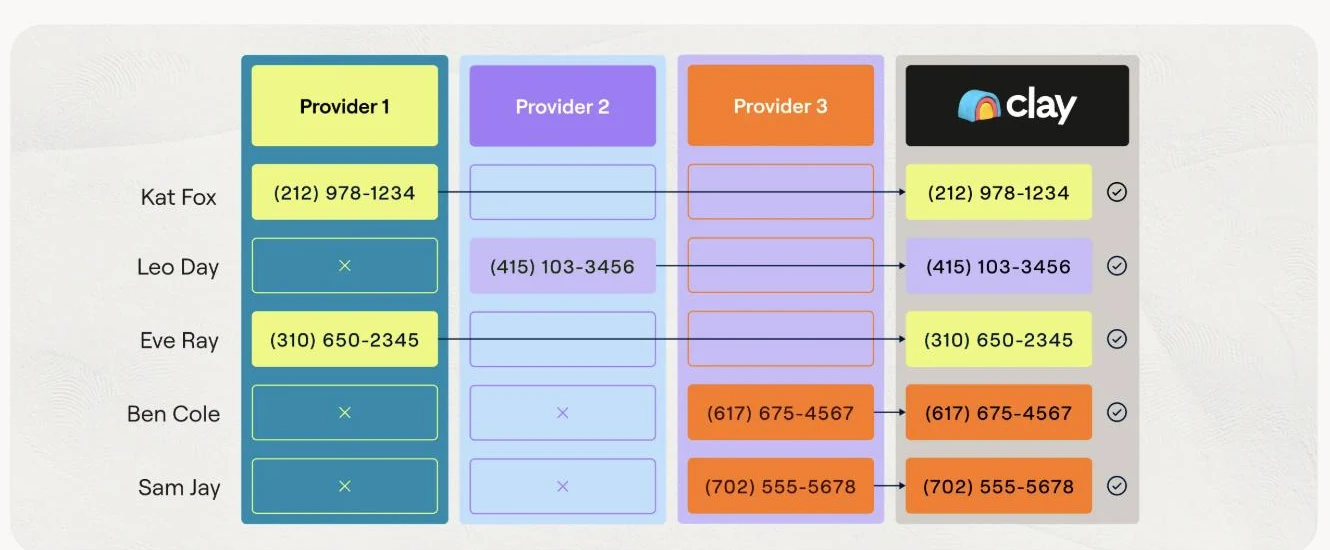
Clay queries providers in order and keeps the first verified hit, so a contact one vendor misses is picked up by the next.
The commercial argument is the one people miss. Buying four data vendors directly means four contracts, four minimums and four renewal conversations.
Buying them through Clay means one bill and volume rates Clay negotiated on behalf of everybody on the platform.
Research agents and signals
On top of the waterfall sit Claygents, which are AI research agents that read a company's site, a job posting or a call transcript and write a column of your own design.
That's the part no sequencer replicates. "Does this company run an outbound team" isn't a field in any database, and a Claygent can answer it across 5,000 rows overnight.
Then signals. Job changes, funding rounds, hiring activity, web intent on the Growth plan, and audience pushes into ad platforms.
Signal-based outbound is a different motion from list-based outbound, and Clay is built for it in a way sequencers are not.
What Lemlist gives you instead
Lemlist's answer is a 650 million contact database that ships with every plan, including the $69 Email tier, plus an email and phone finder and unlimited LinkedIn enrichment.
There's account-based prospecting and lead scoring in there too, and lemAgent handles research and enrichment inside the campaign rather than in a separate table.
That's a real asset and it covers standard prospecting fine. It's just not the same job. Lemlist gives you a database to search. Clay gives you a system to build lists nobody else can build.
Is that depth worth $185 a month to you? For Stan in RevOps building a territory model, obviously. For Amy working 300 accounts she already knows, honestly no.
One caveat worth saying out loud. Bundled databases and enrichment waterfalls both look better in a demo than on your ICP.
Take 200 real accounts in your niche, run them through both on the trial, and count verified emails and direct dials. That number is the only one that matters.
SmartReach.io takes a third position on this. Its B2B lead finder covers 300M+ contacts and 50M+ companies and sits inside the same product that sends the sequence.
No export, no sync, no second subscription. It's less powerful than Clay's orchestration layer and it's meant to be, because the finding and the sending are one workflow rather than two tools with a CSV between them.
Which one sends the email?
Both, now. That's the thing that changed.
Lemlist has been a sender since 2018 and it shows. Sequences branch on conditions, personalization runs deep with Liquid syntax, dynamic images and custom landing pages, and lemwarm ships on every plan.
The unglamorous parts are all there too. Inbox rotation, rotating IPs, custom tracking domains, DNS setup tests, sending limit management, deliverability alerts and in-app domain and mailbox purchase.
Clay Sequencer is newer and built from a different starting point. Instead of importing a list and sequencing it, leads flow in from your CRM, a signal or a Clay table and enter the campaign as they qualify.
Data is pulled fresh at send time, so the personalization reflects what was true this morning rather than what was true when you exported. Exclusions, blocklists and cooldowns are built into the audience rather than bolted on.
The mailbox arithmetic
This is where they part company, and it's arithmetic rather than opinion.
Lemlist's Email plan caps you at 50,000 emails a month. A safe rate of about 40 a day per connected account across roughly 22 sending days is around 880 emails per mailbox.
Filling that cap takes something like 57 warmed mailboxes, spread across enough domains that no single domain carries the load.
Clay is more conservative. Its own send-limit dialog tells you to send 10 to 30 emails a day per account, and warns you to raise it only if you already send high volume safely or you're emailing warm audiences.
At 30 a day across 22 sending days that's 660 emails a mailbox, so the same 50,000 sends needs closer to 76 mailboxes.
That's a defensible position rather than a weakness. Google and Yahoo tightened bulk-sender rules for a reason, and the tools that shipped generous defaults are the ones whose users are now rebuilding domains.
It does mean volume plays in Clay need more infrastructure than the same play in Lemlist, and Clay sells you that infrastructure directly.
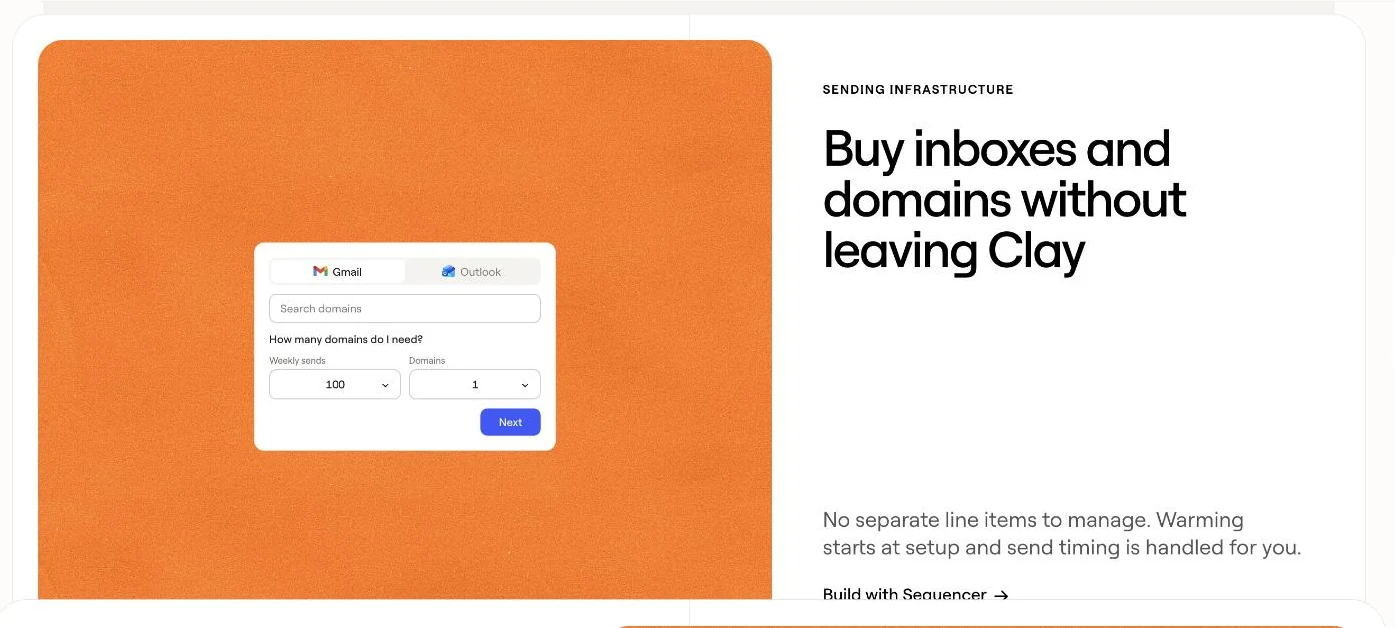
Clay sells the mailboxes and domains inside the product and starts warming them at setup, so the infrastructure isn't a separate vendor and a separate invoice.
Neither tool fixes the part that actually decides inbox placement. Since 2024, Google and Yahoo have required bulk senders to authenticate with SPF, DKIM and DMARC, to offer one-click unsubscribe, and to keep spam complaints under 0.3 percent.
Aim for 0.1 percent. Both tools will happily send for you with none of that in place, and neither will stop you.
Work through Google's sender guidelines before the first campaign, not after the reply rate collapses.
Can Clay replace Lemlist now?
For email-only outbound, more often than you'd think. For anything else, no.
Clay Sequencer covers the real workflow end to end. Audiences that refill themselves, blocklists and cooldowns, AI copy written against your positioning docs and campaign goal, A/B tests, and replies routed into Slack.
That reply flow is the genuinely novel part. When a prospect answers, Clay drafts the follow-up and posts it in Slack for a rep to approve, edit or reject before it sends.
Mafer Bencomo, Demand Gen Manager at DataCamp, says of the Sequencer that "nothing came close to the email quality we see with Clay", and singles out that approval flow for cutting rep response time.
So if your outbound is one channel and your differentiator is research, consolidating into Clay removes a subscription and a sync.
What you give up is everything Lemlist does that isn't email. No LinkedIn steps, no dialer, no WhatsApp, no SMS.
You also give up a mature unified inbox. Slack notifications suit a small team with an ops habit and suit a nine-person SDR floor much less well, because there's no assignment model, no queue and no single view of who owes whom a reply.
And the price still isn't close. Clay Growth at $495 a month is where domain and inbox purchasing for the Sequencer unlocks, against Lemlist Email at $69.
You're not paying $426 more for a better sequencer. You're paying it for the data platform attached to it, and that's a reasonable trade only if you'll use the data platform.
Here's the sharper version of the question. If you deleted every Clay table tomorrow and kept only the Sequencer, would you still pay $495 a month? If the answer is no, you're buying Clay for the wrong reason.
Who runs LinkedIn and calls?
Lemlist, and Clay doesn't compete here at all.
Lemlist's Multichannel plan at $109 per user a month bundles LinkedIn automation, SMS automation, a built-in dialer with VoIP integrations for Aircall and Ringover, task management and 5 senders per user. WhatsApp is a paid add-on.
The LinkedIn step list is deep. Profile visits, follows, invites, text messages and voice messages, all as sequence steps rather than manual tasks.
A cadence can view a profile, send a connection request, wait, send a message, drop to a call task if the request goes unanswered, and pick email back up. One campaign, one report.
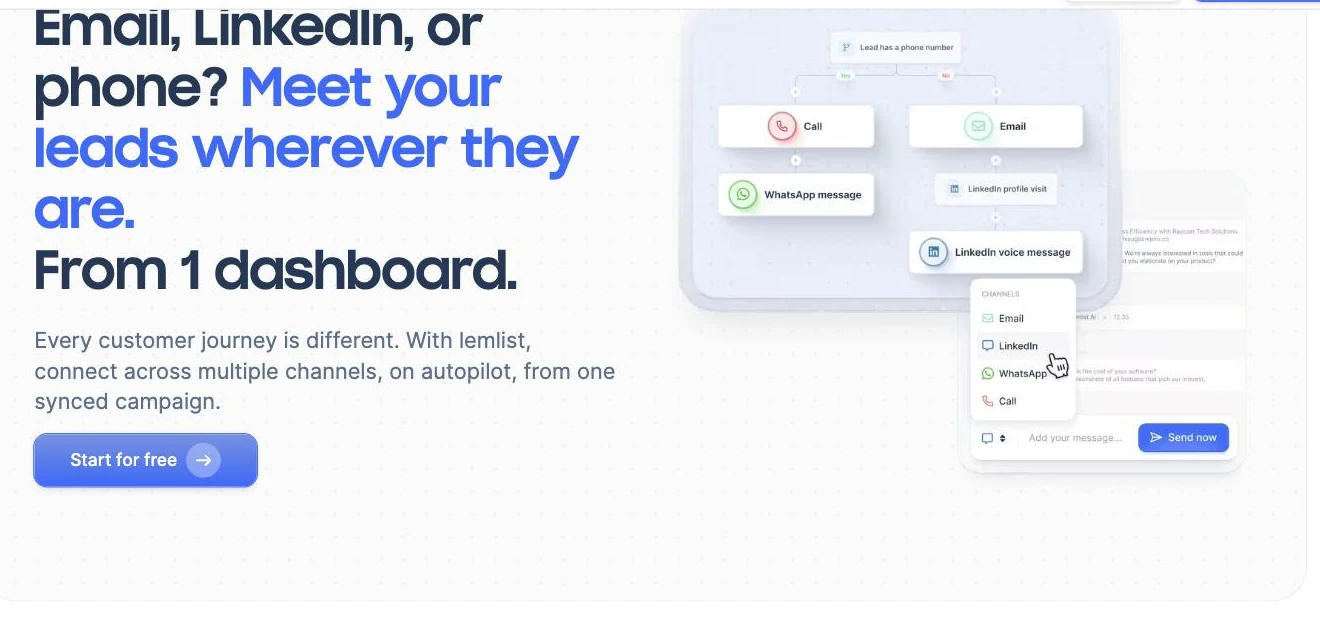
Lemlist branches on lead attributes, so a prospect with no phone number routes to email and LinkedIn instead of stalling on a step that can't run.
That branch in the screenshot is worth copying whatever tool you use. The most common reason a campaign sold internally as multichannel turns out to be email-only is prospects stalling on a LinkedIn or phone step their record can't satisfy.
Two things are worth knowing before you treat LinkedIn automation as solved.
It runs through a Chrome extension driving your own logged-in session, so actions only fire while the browser is open. An overnight campaign doesn't run overnight, and a rep who closes their laptop pauses the sequence.
And LinkedIn caps invitations at roughly 100 a week on most accounts. That ceiling applies no matter what your tool lets you schedule, and it's the real limit on any LinkedIn play.
The guardrails matter more than the tool choice here.
- Warm a new LinkedIn account for two to three weeks before automating anything on it.
- Sit well under the weekly invitation cap rather than at it.
- Spread actions across the working day instead of firing them in one block.
- Keep profile views and messages in a human ratio. An account that views 200 profiles and sends 200 requests in a day reads as a bot.
Here's the correction worth making, because competitor pages seed the opposite. SmartReach.io runs a real four-channel sequence, not email with attachments.
A single SmartReach.io sequence can send an email, wait for a reply, view a LinkedIn profile, send a connection request, place a call through the built-in dialer, and send a WhatsApp message, branching on what the prospect actually did.
Replies from all four channels land in one shared inbox with role-based access for members, admins and owners. LinkedIn automation is $29 per connected LinkedIn account, and calling seats are included on Sales Engagement plans rather than sold per person.
SmartReach.io doesn't do SMS. That's the honest limit against Lemlist, which does.
Which one is harder to learn?
Clay, by a distance, and that gap is the most underrated cost in this comparison.
Lemlist is a sequencer with a familiar shape. Import a list, build steps, connect mailboxes, launch. An SDR who has used any outreach tool will have a campaign live on day one.
The depth is in the personalization layer rather than in the setup. Liquid syntax, dynamic images and custom landing pages take a while to master, but nothing blocks you from sending while you learn.
Clay is closer to a spreadsheet crossed with an automation platform. Tables, columns that call providers, conditional formulas, functions you reuse across workflows, and agents you prompt.
Clay runs a university, a course library, live cohort classes, a Slack community and a directory of certified experts you can hire. Vendors don't build that infrastructure for products people pick up in an afternoon.
That's not a criticism. It's the honest shape of a platform whose value comes from what you build in it rather than from what ships in it.
The practical question is who owns the tool. If the answer is "the SDRs themselves, between calls", weight simplicity heavily.
If it's "our ops person, and they're excited about it", Clay's depth starts earning its keep in about a month. If it's "nobody, we'll figure it out", you'll be paying $185 a month for a very expensive enrichment tool.
What happens at ten people?
The three pricing models finally show their teeth, and they diverge hard.
Take a team running email plus LinkedIn plus calls. Nothing exotic, just the default 2026 motion. Here's what each model does as you add people.
| Team size | Lemlist Multichannel | Clay Growth | SmartReach.io Sales Engagement Plus |
|---|---|---|---|
| 1 person | $109 a month | $495 a month | $99 plus $29 LinkedIn, so $128 |
| 5 people | $545 a month | $495 a month | $99 plus $145 LinkedIn, so $244 |
| 10 people | $1,090 a month | $495 a month | $99 plus $290 LinkedIn, so $389 |
Read that table carefully, because it isn't the story it looks like.
Clay's column is flat because Clay doesn't charge per seat, but Clay's column is also email only. LinkedIn and calls still need a second tool on top, so it isn't a like-for-like row.
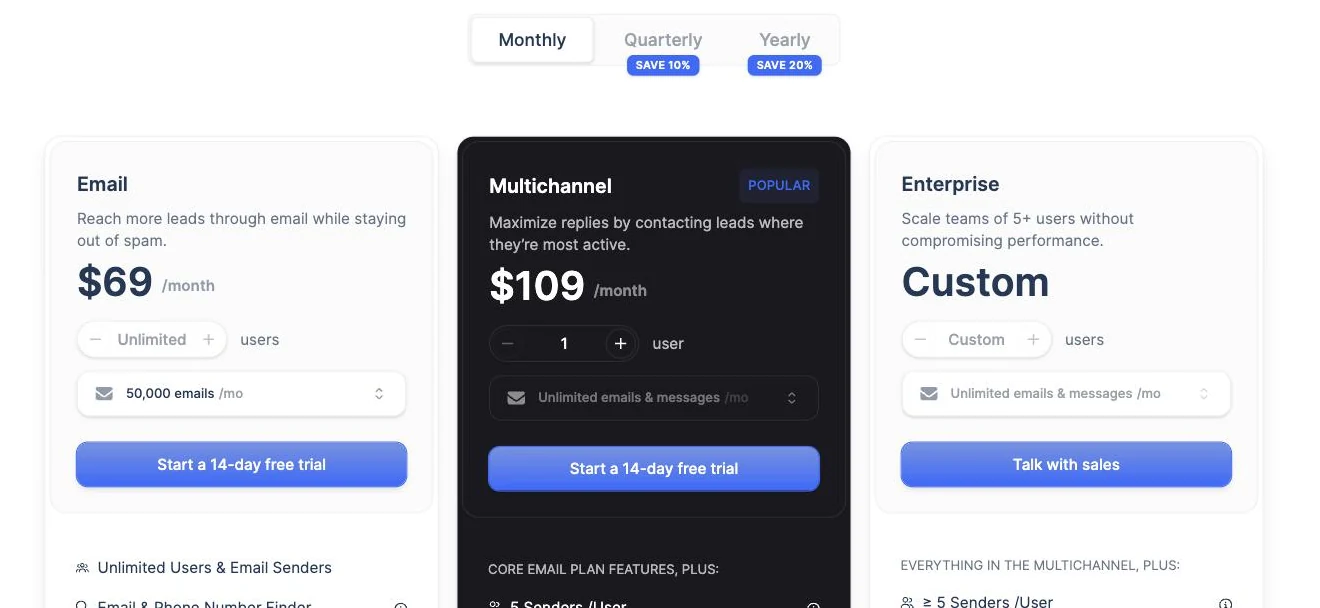
The word under Lemlist's $69 Email price is unlimited users. The word under the $109 Multichannel price is user, singular, and that's where a ten-person bill comes from.
Clay's unlimited-seat model is the underrated one here. Most data platforms punish you for giving a junior rep read access, and Clay simply doesn't, which changes how a team actually uses it.
Lemlist's is the model teams complain about later. The Email plan says unlimited users and the Multichannel plan, the one with the channels people actually bought it for, bills every head.
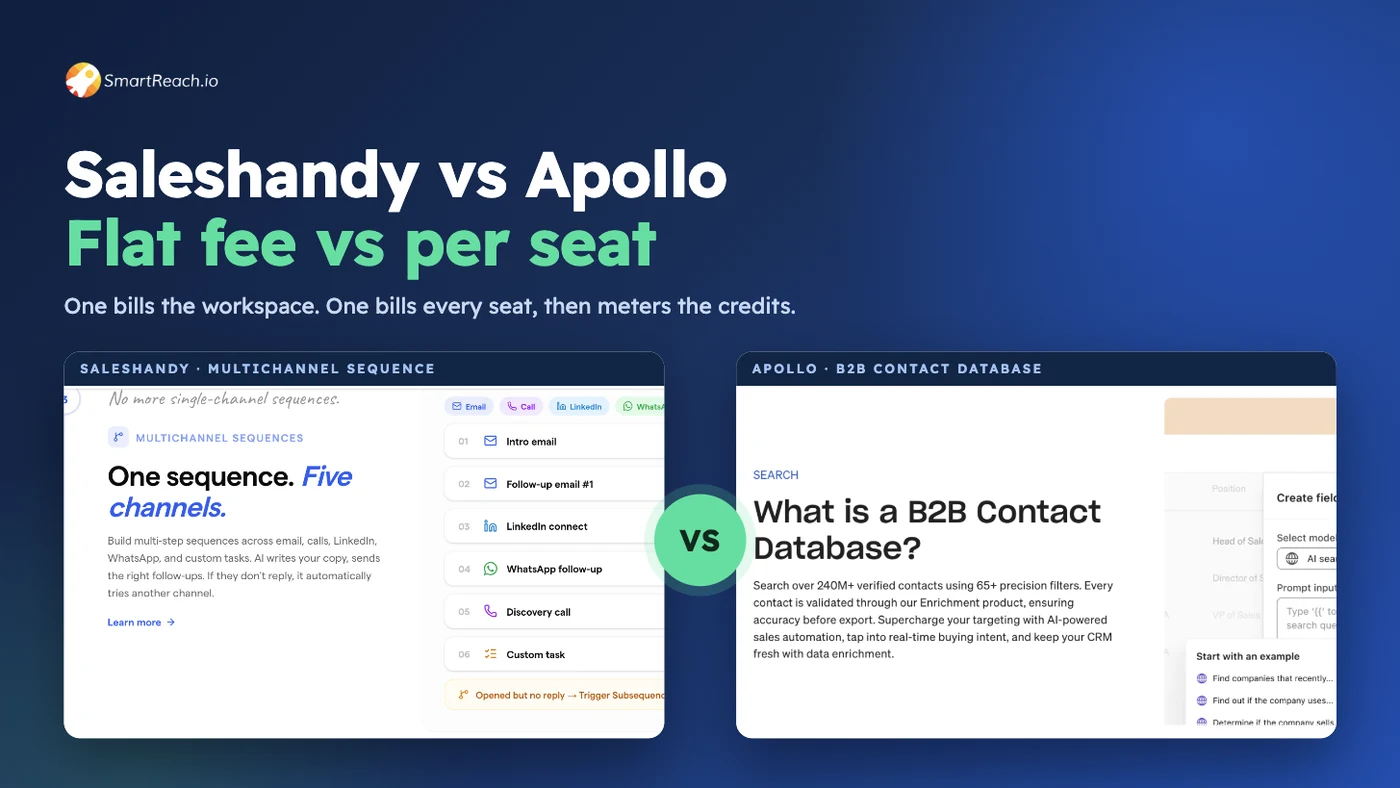
That's the specific gripe behind most of the traffic to our Lemlist alternatives roundup, and it's the same structure we picked apart in Lemlist vs Apollo.
There's a second-order effect nobody prices in. When multichannel costs $109 a head, teams quietly stop giving it to everyone.
Two SDRs get the good plan, four get the cheap one, and the multichannel motion you bought never actually runs across the team.
SmartReach.io answers it with pricing that doesn't count people at all. Plans scale by active prospects, and every plan above Basic includes unlimited users and unlimited sending email accounts.
Sales Engagement starts at $39 a month, Plus is $99 for 50,000 active prospects, and hiring the eleventh rep doesn't move the invoice.
Should you just buy both?
If you can afford it, that's the strongest stack in this article. Most teams can't, and shouldn't pretend otherwise.
The pipeline is straightforward. Clay sources, enriches, researches and scores. The qualified rows push into the sequencer. The sequencer works them across channels and writes results back.
The plumbing is already built. Lemlist lists Clay alongside Zapier, Make and n8n in its integrations, so this isn't a custom job.
For one person that's Clay Launch at $185 plus Lemlist Email at $69, so $254 a month before a single credit gets spent. For five people on multichannel it's $185 plus $545, so $730.
Add Data Credits, Lemlist enrichment credits at 5 per verified email and 20 per phone number, and mailbox costs, and $900 a month is a fair planning number for five people.
That's a real budget, and it buys a genuinely excellent motion. It also buys two tools to administer, two billing meters to watch and two places a campaign can break.
Here's the opinion, though. Most teams buy Clay before they've earned it.
Clay pays off when you have a repeatable play, a defined ICP and someone whose job is building the system. Bought earlier, it becomes an expensive enrichment tool with a steep learning curve attached.
The sequence that works is usually the boring one. Get a motion producing meetings with a simple list, notice exactly which data you keep wishing you had, then buy Clay to go get that specific thing.
If nobody on your team has "GTM engineer" energy, buy the sequencer first and revisit Clay in six months. Our notes on B2B data enrichment for cold email cover what to do in the meantime.
What breaks when you switch?
Campaigns move in an afternoon. Sender reputation doesn't move at all, and that asymmetry is the whole risk.
This matters more than usual here, because moving between Lemlist and Clay isn't a like-for-like migration. You're not swapping sequencers, you're changing where the work happens.
Here's the order that avoids the expensive mistakes.
- Move suppression and unsubscribe lists first. Emailing someone who already opted out is the fastest way to burn a fresh domain, and in most jurisdictions it's a compliance problem rather than a deliverability one.
- Export contacts and rebuild sequences by hand. Don't trust an importer to carry branching logic across. Rebuilding takes an afternoon and you'll find steps you don't need any more.
- Connect and warm the mailboxes before the first real send. Warmup history doesn't transfer. A mailbox well seasoned on the old tool starts cold on the new one.
- Run one small campaign, 200 to 300 prospects, while the old subscription is still live. Compare bounce rate and reply rate against a similar list on the old tool. This is the only real test.
- Cancel last. Cancelling first and then finding a deliverability problem with no fallback makes for a bad month.
Budget two weeks for that, not two days.
One Clay-specific trap. Because Clay pulls data at send time, a campaign that looked fine in a static export can behave differently once it's live on refreshing data.
Test with a small audience and watch what the AI columns actually write before you point 5,000 rows at it.
Any vendor marketing a one-click migration is describing how they move your data, not how they move your sender reputation. The second one decides whether your first month works.
Is there a simpler option?
Yes, and it exists because the two-tool stack is a lot of overhead for a team of five.
SmartReach.io is a cold email software that keeps prospect data and outreach in the same product. Its built-in lead finder covers 300M+ contacts and 50M+ companies, and its sequences run email, LinkedIn, calls and WhatsApp with conditional branching between steps.
It also works as a sales engagement platform for teams priced out of Outreach and Salesloft, on the Sales Engagement plan family.
The pricing model is the real difference. No per-seat pricing, plans scale by active prospects, and every plan above Basic includes unlimited users and unlimited sending email accounts.
Email Outreach starts at $29 a month, Sales Engagement at $39, and Plus is $99 a month covering 50,000 active prospects. LinkedIn automation is $29 per connected LinkedIn account.
Deliverability tooling, inbox rotation, a shared inbox for replies across all four channels, and CRM sync to HubSpot, Salesforce, Pipedrive and Zoho come with the plans rather than beside them.
Two honest limits. SmartReach.io has no SMS, and it doesn't try to be Clay. There's no waterfall across 150+ providers and no agentic research layer, because it's built for teams whose bottleneck is running outreach rather than engineering data.
If your competitive edge genuinely is a data model nobody else has, Clay is the right purchase and this isn't the post that talks you out of it.
SmartReach.io is rated 4.6 on G2 from 60 reviews and 4.7 on Capterra from 27 reviews as of September 2026, with 5,000+ customers and 99.99% uptime. The 14-day free trial covering 200 prospects with no card is a faster way to judge it than any star rating.
So which one should you buy?
Lemlist
Quick facts
- G2
- 4.7 ★
- From
- $69/month flat for email
- Free trial
- 14 days, full Multichannel, no card
- Best for
- Teams that already know who to contact and need email, LinkedIn and calls running from one campaign
What it is. A multichannel sequencer with deep personalization tooling and a 650 million contact database attached.
Key features. Email, LinkedIn, calls and SMS in one branching sequence, WhatsApp as an add-on. Liquid syntax, dynamic images and custom landing pages. lemwarm, inbox rotation and a Deliverability Hub on every plan. Unified Inbox from the entry tier. AI reply-intent and out-of-office detection.
Pros
- Email plan covers unlimited users on one flat $69 fee
- Five channels from one campaign, with real branching
- lemwarm, inbox rotation and deliverability reporting on every tier
- Published, transparent credit rates you can budget against
- Works from Gmail, LinkedIn and, on Enterprise, your CRM
- Native Clay, Zapier, Make and n8n integrations
Cons
- Multichannel is per user and compounds past three people
- Hard 50,000 email monthly cap on the flat Email plan
- Only five sending addresses per user on Multichannel
- Enrichment and intent signals cost credits on top of the plan
- WhatsApp is a paid add-on, not included
- No free tier, only a 14-day trial
Clay
Quick facts
- From
- $185/month, Launch
- Free trial
- Free plan, 500 Actions and 100 Data Credits a month
- Best for
- GTM and RevOps teams whose bottleneck is list quality, research and signals rather than sending
What it is. A data and orchestration platform that builds, enriches and scores GTM lists, with a cold email sequencer attached.
Key features. Waterfall enrichment across 150+ data partners. Claygent research agents and Account Agents. Job change, funding, hiring and web intent signals. Workflows, functions and AI formatting. CRM and data warehouse sync on Growth. Clay Sequencer with in-product inboxes and Slack reply approval.
Pros
- Unlimited seats on every plan, including the free one
- A genuinely usable free tier for evaluating against your own ICP
- Waterfall enrichment no sequencer comes close to matching
- Failed enrichments cost nothing, and your own API keys skip Data Credits
- Data Credits roll over up to twice the monthly allowance
- SOC 2 Type II, ISO 27001 and CCPA alongside GDPR
Cons
- Email is the only outbound channel, with no LinkedIn, calls or WhatsApp
- Two consumption meters make the monthly bill hard to forecast
- $185 entry price, well above every sequencer here
- Steep learning curve, with a university and expert directory to prove it
- Slack notifications instead of a real shared inbox
- Conservative 10 to 30 daily sends per account needs more mailboxes
SmartReach.io
Quick facts
- G2
- 4.6 ★
- Capterra
- 4.7 ★
- From
- $29/month flat
- Free trial
- 14-day free trial, 200 prospects, no card
- Best for
- Growing teams that want lead data, email, LinkedIn, calls and WhatsApp in one product without per-user pricing
What it is. A cold email software with a built-in B2B lead finder and multichannel sequences, priced by active prospects rather than by headcount.
Key features. 300M+ contacts and 50M+ companies in the lead finder. Email, LinkedIn, calls and WhatsApp as steps in one conditional sequence. Built-in dialer. Inbox rotation and deliverability protection. Shared inbox with role-based access. CRM sync to HubSpot, Salesforce, Pipedrive and Zoho.
Pros
- No per-seat pricing, with unlimited users above Basic
- Unlimited sending email accounts above Basic
- Lead finding and sending in one product, no CSV between them
- Four channels branching inside a single sequence
- Calling seats included on Sales Engagement plans
- Rated 4.6 on G2 and 4.7 on Capterra as of September 2026
Cons
- No SMS channel, unlike Lemlist
- No waterfall enrichment or agentic research layer
- LinkedIn automation is a $29 per account add-on
- Smaller review base than either rival
- No free tier, only a 14-day trial
The honest summary of Lemlist vs Clay is that the question is usually mis-asked. These tools sit at different points in the same pipeline, and the right one is decided by which end of that pipeline is broken.
Clay wins if your list is the reason nothing works. Lemlist wins if your list is fine and your outreach isn't running.
And if what's really bothering you is that fixing both means two subscriptions, two learning curves and a per-user bill on one of them, that's the problem the third column exists to solve. Compare the plans and pricing or start a 14-day free trial covering 200 prospects, no card needed.
Questions people actually ask
Is Lemlist or Clay cheaper?
Lemlist, on entry price. Lemlist's Email plan is a flat $69 a month for unlimited users with a 50,000 email monthly cap, while Clay's cheapest paid tier, Launch, is $185 a month on monthly billing. Clay's free tier is genuinely usable for testing at 100 Data Credits and 500 Actions a month, but it caps tables at 200 rows.
Can Clay replace Lemlist?
For email-only outbound, increasingly yes. Clay Sequencer runs cold email campaigns, buys and warms inboxes and domains inside Clay, and routes replies to Slack for rep approval. What it doesn't do is LinkedIn automation, calls or WhatsApp, so a multichannel team still needs a sequencer beside it.
Can Lemlist replace Clay?
Only for straightforward list building. Lemlist ships a 650 million contact database with an email and phone finder, which covers most standard prospecting. Clay's job is different, running waterfall enrichment across 150+ data partners, AI research agents and signal tracking, and no sequencer matches that depth today.
Do most teams use Clay and Lemlist together?
Yes, and that's the honest answer for well-funded teams. Clay sources, enriches and scores the list, then pushes it into a sequencer that executes across channels. Lemlist lists Clay as a native integration. The combined bill starts near $254 a month for one person, before credits and mailbox costs.
What does Clay charge for besides the plan?
Two meters run on every paid Clay plan. Data Credits pay for marketplace data starting at $0.05 each, and Actions pay for platform work at under $0.01 each. Data Credits roll over up to 2x your monthly allowance on Launch and Growth, but Actions reset every cycle and don't carry forward.
Does Lemlist charge per user?
On multichannel, yes. Lemlist's Email plan is a flat $69 a month for unlimited users, but the Multichannel plan that adds LinkedIn, calling and SMS is $109 per user a month. Five people running multichannel costs $545 a month. SmartReach.io has no per-seat pricing and includes unlimited users above Basic.
Which one is better for a five-person SDR team?
It depends on the bottleneck. Five users on Lemlist Multichannel is $545 a month with LinkedIn and a dialer included. Clay Growth is $495 a month with unlimited seats but email-only sending. SmartReach.io Sales Engagement Plus is $99 a month for unlimited users, plus $29 per connected LinkedIn account.
Do Lemlist and Clay both handle deliverability?
Both do warm-up and sending infrastructure now. Lemlist bundles lemwarm, inbox rotation and a Deliverability Hub on every plan including the $69 Email tier. Clay Sequencer sells inboxes and domains in-product, starts warming at setup, and caps daily sends at 10 to 30 per account, which is more conservative than most sequencers.
Stop juggling tools
Book more meetings on every channel
Join 5,000+ teams running multichannel outreach from one sequence, with deliverability built in.