Lemlist vs Instantly: What Changed, and What It Costs

On this page
Search for cold email software long enough and these two end up on the same shortlist, usually for the wrong reason. They rank for the same terms, so they look like substitutes. Run both for a month and you find out they were never really competing.
One is built around getting mail into the inbox at volume. The other is built around getting a human response across whatever channel that human actually uses. Those are different jobs, and most of the advice online compares them as though they're the same job with different logos.
There's also a problem with the advice itself: a lot of it is out of date. lemlist changed how it charges partway through 2026, and the change lands on exactly the point most comparisons treat as settled. If you're reading a post that says lemlist bills per seat, full stop, you're reading something written before the repricing.
So let's do this in the order that actually matters. What changed, who wins where, then what the bill looks like for a team your size.
TL;DR: lemlist vs Instantly
Every price below is monthly list price on monthly billing, for all three tools, in every table and every calculation. Competitor figures are accurate at the time of writing.
lemlist changed how it charges
For years the one-line summary of these two was "Instantly is flat, lemlist is per seat," and that was the whole argument. Add reps, watch lemlist's bill climb, watch Instantly's sit still. It was a clean story and it sold a lot of Instantly subscriptions.
It's now only half true, and the half that broke is the half people quote.
The Email plan is now priced per workspace
lemlist's Email plan is $69 a month for the whole workspace, with unlimited users and unlimited email senders, for 50,000 emails a month and unlimited contacts. Volume tiers run up to 1,000,000 emails. Not per head. One flat fee, no matter how many people you put on it.
That inverts a lot of received wisdom. An eight-person team doing email-only outreach used to be lemlist's worst-case customer. Under the current catalog that same team pays one flat $69 a month, which is less than Instantly's $97 Hypergrowth tier, though Instantly gives you 125,000 sends against lemlist's 50,000. lemlist's 100,000-email tier is $89, still below $97.
Multichannel is still per seat
The Multichannel plan is $109 per user a month, with five sending addresses per user and unlimited emails and messages. That's where LinkedIn automation, SMS, the built-in dialer, and the WhatsApp add-on live. The per-seat tax people warn you about is real, but it now applies only if you want channels beyond email.
Ten seats on Multichannel is $1,090 a month. That number hasn't moved.
Which side of the line you're on
Two things follow, and they pull in opposite directions:
- Email only? lemlist just got far more competitive than its reputation suggests, and the old advice actively misleads you.
- Multichannel? The per-seat math is unchanged and still punishing at scale.
The rest of this post assumes you want to know which side of that line you're on.
Where the contacts come from
Before deliverability or channels or sequence logic, there's a more basic question: where do the contacts come from, and what do they cost once you've got them? This is where the sticker prices start lying to you, on all three tools.
| At the time of writing | lemlist | Instantly | SmartReach.io |
|---|---|---|---|
| Lead database | 650M+ contacts, access included, reveals use credits | 450M+ contacts, separate subscription | 300M+ contacts, 50M+ companies, included |
| Ways to source contacts | Database, email & phone finder | Database (separate sub) | Database, ProspectDaddy |
| Email verification | 5 credits per email | In the credits product | Free on every plan |
| Credit model | Add-on, $20/mo for 2,000 credits | Separate subscription from $9/mo | Included allowance, 0 to 5,000 by tier |
| Contacts stored | Unlimited (Email plan) | 1,000 to 100,000 by tier | 1,000 to 500,000 by tier |
Lead databases, side by side
lemlist has the biggest database here, quoted at 650M+ contacts with email and phone finding built into the same subscription, sourced from what it describes as 25+ data providers. For a team whose bottleneck is genuinely "we don't have enough of the right people to talk to," that scale matters and it's the strongest reason to buy lemlist.
Instantly's database is comparable in size at 450M+ but is sold as a separate product on its own price ladder. That's not a scandal, plenty of tools do it, but it means the $47 headline on Growth isn't what a team without its own lists actually pays. Credits start at $9 a month, but 1,500 to 2,000 of them cost $47 to $77, and at that level the real entry price roughly doubles.
SmartReach.io's B2B lead finder carries 300M+ contacts and 50M+ companies inside the plan. Smaller than lemlist's, with fewer intent signals.
Verdict: lemlist, on raw database size. If a bigger index is the job, it's the better buy.
The two ways SmartReach.io gets you contacts
Database size is only one route to a contact, though, and it's worth knowing that SmartReach.io gives you two that both feed the same campaigns:
- Lead Finder, the built-in database, 300M+ contacts and 50M+ companies with filters, searched and pushed straight into a sequence.
- ProspectDaddy, a Chrome extension that pulls business emails from LinkedIn profiles and saves prospects directly into a SmartReach.io campaign, which covers the "I'm already on their profile" workflow the database can't.
That combination matters more than the headline count for most teams, because prospecting rarely happens in one place. You find some people in a database and some on LinkedIn, and with SmartReach.io both land in the same campaign without a CSV in between.
Verdict: lemlist on the index, SmartReach.io on the workflow. lemlist's database is bigger. SmartReach.io's two routes, the database and the LinkedIn extension, both push straight into a campaign.
Verification, and who charges for it
Different question, and a more expensive one than it looks. A big database with stale rows is worse than a small clean one, because bounces are what actually burn a domain.
SmartReach.io verifies every prospect before send, free, on every plan, using SMTP checks that run automatically. lemlist charges 5 credits per verified email, which is $0.05 at its own credit rate. Instantly folds verification into the same credits product it sells the database through.
At a few hundred contacts a month nobody notices. At 20,000 contacts a month, $0.05 an address is $1,000, which is comfortably more than the subscription you agonized over.
Verdict: SmartReach.io, clearly. Free verification on every tier against a per-address meter is the single biggest hidden-cost difference in this comparison.
Credits, and what they actually cost
All three run credit economies, and this is where comparison tables usually go quiet. Here's what each one actually charges for.
lemlist sells lead data enrichment as a monthly add-on: $20 a month ($16 billed yearly) for 2,000 credits, which buys about 400 verified emails or 100 phone numbers, and unused credits roll over while you stay subscribed. Verified emails cost 5 credits, phone numbers 20. Buying-intent signals are a separate add-on at $29 a month for 100 signals. Both sit on top of your plan.
Instantly goes further and makes the whole lead product a separate subscription, laddering from $9 a month upward as volume grows.
SmartReach.io includes a credit allowance in the plan itself: none on Basic, 1,000 on Plus, 2,000 on Pro, and 5,000 on Scale, drawn from one shared balance. Credits are spent revealing a contact's email (5), revealing a phone number (30), saving a prospect through ProspectDaddy (5), or running the Smart Email AI Agent (1 per preview or send). The thing they're not spent on is verification, which stays free.
That last point is the practical difference. On lemlist and Instantly, cleaning a list draws down the same wallet you use to build it. On SmartReach.io those are two separate budgets, and one of them is zero.
Verdict: SmartReach.io on total cost of a clean list. lemlist's published credit rates are the most transparent of the three, though, and worth crediting for that.
What keeps you out of spam
Sending is easy. Landing is the job. This round has the loudest marketing claims in the whole category, and the honest caveat that your list quality matters more than your tooling.
| At the time of writing | lemlist | Instantly | SmartReach.io |
|---|---|---|---|
| Sending accounts | Unlimited (Email), 5 per user (Multichannel) | Unlimited, every plan | Unlimited sending emails |
| Warmup accounts | lemwarm, included | Unlimited, every plan | 10 / 25 / 75 / unlimited by tier |
| Inbox rotation | Yes, every plan | Yes | Yes, from Plus |
| ESP matching | No | No | Yes, from Plus |
| Blacklist monitoring | No | No | Yes, with auto-pause |
| Placement reporting | Deliverability Hub | Separate paid add-on | In the deliverability suite |
| Buy domains and mailboxes | Yes, in-app, every plan | Yes, done-for-you | Yes, in-platform, incl. Azure |
Warmup and sending accounts
Instantly's offer here is genuinely strong and it's the best argument for the product: unlimited sending accounts and unlimited warmup on every tier, including the $47 Growth plan. If you're running a thirty-mailbox pool on a small budget, nothing else in this comparison matches that entry price.
SmartReach.io includes unlimited sending emails on every plan, and warmup accounts scale with the tier: 10 on Basic, 25 on Plus, 75 on Pro, and unlimited on Scale. So the gap isn't warmup capacity in general, it's warmup capacity at the cheapest tier. A team on Pro is warming 75 mailboxes, which covers the overwhelming majority of real sending operations, and Scale removes the ceiling entirely.
lemlist gives you unlimited email senders on the Email plan and five per user on Multichannel, with lemwarm underneath. On Email that suits a pool; on Multichannel it's fine for a rep working a focused patch and restrictive if you're running a pool.
Verdict: Instantly, on entry-tier generosity. It's the only one giving unlimited warmup at $47. Above the entry tier the practical difference narrows sharply. lemlist's Email plan matches on sender count, while Multichannel trails at five per user.
Inbox rotation and ESP matching
This used to be the sharpest technical split in this post. It isn't any more.
lemlist and Instantly both rotate. lemlist includes inbox rotation and rotating IPs on every plan, and Instantly rotates across your connected pool. Either way 1,000 emails spread over ten mailboxes instead of hammering one, which is the difference between a warm sender and a burned one at volume.
SmartReach.io does inbox rotation from Plus and adds ESP matching, which neither competitor offers at any price: outgoing mail is routed so the sending provider matches the recipient's, because Google-to-Google and Microsoft-to-Microsoft behave measurably better than mail crossing between them. The deliverability suite, Deliver4Sure, bundles rotation, ESP matching, blacklist monitoring that auto-pauses an affected inbox, and human-paced throttling.
Worth being precise about what that means: lemlist and Instantly give you rotation, SmartReach.io gives you all four. Rotation alone protects the pool. Rotation plus ESP matching plus blacklist auto-pause is a different level of protection, and it's the only place in this comparison where one tool has a capability the other two simply don't sell.
Verdict: SmartReach.io, outright. The only platform here with rotation and ESP matching together, and the only one that pulls a blacklisted inbox out of rotation for you.
Secondary domains and mailboxes
lemlist now sells domains and mailboxes in-app on every plan. Instantly sells done-for-you Google and Airmail mailboxes ($4 to $10 a month each) and domains ($15 a year). Doing it yourself instead, one domain is a Tuesday afternoon. Fifty mailboxes across six domains is a project, and a place where a single DNS mistake quietly costs you a quarter.
SmartReach.io sells them inside the platform, pre-authenticated, across Google, Microsoft 365, and Azure. The Azure route changes the arithmetic enough to show:
Verdict: level on access, since all three sell mailboxes in-platform now. SmartReach.io's Azure route is what changes the cost at fifty mailboxes.
Channels, replies and team scale
What happens when 40 people reply, four reps are working the same account, and your manager wants to know which channel booked the meeting?
| At the time of writing | lemlist | Instantly | SmartReach.io |
|---|---|---|---|
| Channels | Email, LinkedIn, calling, SMS, WhatsApp add-on | Email; calls and SMS via separate CRM | Email, LinkedIn, calling, WhatsApp |
| Conditional branching | Yes | Basic | Yes, branches on behaviour |
| Unified inbox | All plans | Unibox, Hypergrowth and up | All plans |
| Users included | Unlimited on Email, per seat on Multichannel | Flat, team features on Hypergrowth | Unlimited from Plus |
| Native CRM sync | Yes | CRM is a separate product | HubSpot, Salesforce, Pipedrive, Zoho |
| Client dashboards | No | No | 1 / 3 / 10 by tier |
Multichannel reach
Instantly's Outreach plans are email only. There is no native LinkedIn automation and no WhatsApp, and calling and SMS sit in its separate CRM rather than in the campaign. That's a deliberate choice and it's why the sending tool feels clean, but if a prospect ignores three emails, the campaign has nothing else to try.
lemlist branches them to a LinkedIn request, then a call task, inside one sequence, and includes LinkedIn automation in the Multichannel seat price. SmartReach.io runs email, LinkedIn, calling and WhatsApp through conditional multichannel drips that branch on what each prospect actually does, including email opens, answering-machine detection, and LinkedIn acceptance, and prices LinkedIn automation as a $29 per month per account add-on.
So the trade is real and it cuts both ways: lemlist bundles LinkedIn into a $109 seat, SmartReach.io charges $29 per LinkedIn account on top of a plan that doesn't charge per head at all. For three reps that's $186 against $327. For one rep it's $68 against $109. lemlist is the simpler purchase; SmartReach.io is the cheaper one at every team size we checked.
Verdict: split. lemlist for bundling LinkedIn into the seat and for the wider channel set, since it adds SMS. SmartReach.io for WhatsApp included rather than added on and the lower total at team scale.
Sequences and conditional logic
Close between lemlist and SmartReach.io, and both well ahead of Instantly, whose branching is deliberately basic because the product targets volume rather than choreography.
lemlist's edge is creative personalization: liquid syntax, dynamic images, personalized video, custom landing pages. If your differentiation is a screenshot with the prospect's own dashboard mocked into it, nothing here comes close.
SmartReach.io's edge is that branches cross channels natively rather than only branching within email, so a non-reply can become a call task and an accepted connection can trigger a different message. Spintax and conditional tags handle copy variation.
Verdict: lemlist for creative depth, SmartReach.io for cross-channel branching.
The shared inbox
Under-discussed and disproportionately annoying when missing. Once more than two people work replies you need one view of every conversation, or two reps answer the same prospect an hour apart.
lemlist includes its Unified Inbox on all plans, including the $69 Email plan. SmartReach.io includes the shared inbox on all plans. Instantly gates Unibox to Hypergrowth at $97, so a team of three on the $47 Growth plan coordinates replies by hand.
Verdict: lemlist and SmartReach.io tie. Instantly loses on where it puts the paywall.
Integrations
lemlist and SmartReach.io both do native, bi-directional CRM sync. SmartReach.io covers HubSpot, Salesforce, Pipedrive, and Zoho natively, plus 8,000+ apps through Zapier and a full API. lemlist's set is solid, and its MCP support is genuinely forward-looking for anyone wiring tools into an AI stack.
Instantly has a CRM, but it's a separate paid product, which is the recurring pattern with this vendor: the sending plan looks lean because much of what surrounds it is sold beside it.
Verdict: SmartReach.io on breadth, lemlist on modern AI tooling.
Teams and agencies
Depends entirely on what your agency sells, and this is where the repricing bites hardest.
Running email-only campaigns for clients? lemlist's Email plan at $69 a month flat with unlimited users is excellent value, and we're not going to pretend otherwise to make a point.
Running multichannel for clients? Per-seat reverses it immediately: fifteen people on Multichannel is $1,635 a month. SmartReach.io keeps unlimited users on every tier from Plus up and adds client dashboards, 1 on Plus, 3 on Pro, 10 on Scale, so each client gets a separate team and separate reporting on one bill. Instantly suits agencies whose growth is measured in mailboxes rather than headcount, since neither changes the fee.
Verdict: lemlist for email-only agencies, SmartReach.io for multichannel agencies.
The three tools in brief
The rounds above are the argument. Here are the tools themselves, for anyone who scrolled straight here.
lemlist
Quick facts
- G2
- 4.6/5 ★
- From
- $69/mo per workspace, unlimited users
- Free trial
- 14-day free trial
- Best for
- Teams that want the biggest lead database, or LinkedIn, calling and email in one sequence.
What it is. A multichannel sequencer with a large lead database attached and the deepest personalization tooling in the category.
Best for. Teams selling into markets where a generic email won't cut through, and anyone who wants prospecting and outreach on one invoice.
Key features. 650M+ contact database with email and phone finding from 25+ providers. Email, LinkedIn, SMS, and built-in calling in one conditional sequence. Liquid syntax, dynamic images, personalized video. lemwarm and a Deliverability Hub. Inbox rotation and in-app domain and mailbox buying on every plan. Unified Inbox on every plan. lemAgent, AI agents, and MCP support.
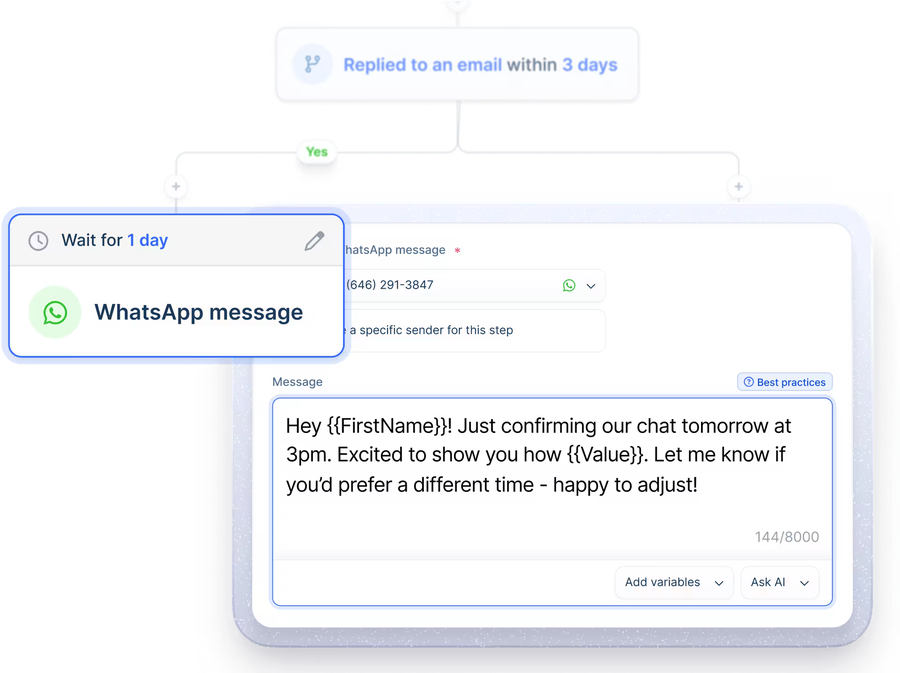
This is what the per-seat premium buys: a reply condition branching the prospect to a wait, then to a WhatsApp step, without leaving the sequence. Instantly has no equivalent because its Outreach campaigns have no second channel.
Pricing. Email at $69 a month per workspace, unlimited users and email senders, 50,000 sends, unlimited contacts, with volume tiers up to 1,000,000 sends. Multichannel at $109 per user a month, five senders each, unlimited sends. Enterprise is custom-priced. Enrichment credits are a separate add-on at $20 a month for 2,000 credits. Annual billing is offered at a discount; every figure quoted here is monthly.
Limitations. No ESP matching. Five sending addresses per user on Multichannel caps mailbox-pool strategies there. Multichannel per-seat pricing compounds fast. WhatsApp is an add-on. Steeper learning curve than Instantly.
Pros
- Largest lead database here at 650M+, included in the plan
- Email, LinkedIn, calling and SMS in one conditional sequence
- The strongest creative personalization in the category
- Email plan covers unlimited users on one flat fee
- Unified Inbox on every plan, including the entry tier
- Transparent credit rates, published on the pricing page
- Inbox rotation and in-app domain and mailbox buying on every plan
Cons
- Calling and SMS only on the per-seat Multichannel plan
- No ESP matching
- Multichannel is still per seat, and it compounds fast
- Only five sending addresses per user on Multichannel
- Verified emails cost 5 credits each on top of the plan
Instantly
Quick facts
- G2
- 4.8/5 ★
- From
- $47/mo flat, unlimited mailboxes
- Free trial
- Free trial, then paid plans
- Best for
- Email-only teams and agencies running large mailbox pools on a tight subscription budget.
What it is. A cold email sending engine. Connect unlimited mailboxes, warm them all, rotate sends across the pool, collect replies in one place.
Best for. High-volume email operators who already have their own lists.
Key features. Unlimited sending accounts and unlimited warmup on every plan. Inbox rotation across the pool. Unibox unified inbox from Hypergrowth. AI sales and reply agents. A 450M+ lead database, sold separately.
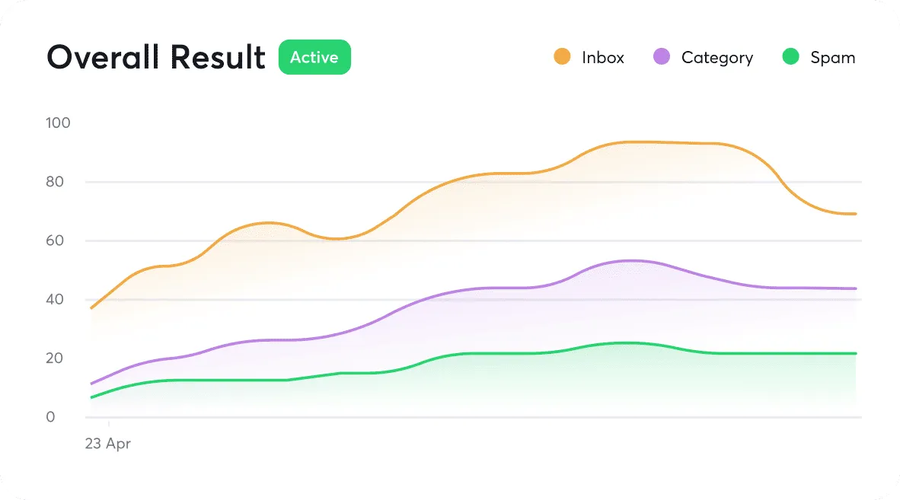
Placement tracked as three separate lines over time, inbox against category against spam, rather than a single bounce number. That reporting is the argument for the product.
Pricing. Growth at $47 a month with 1,000 contacts and 5,000 sends, Hypergrowth at $97 with 25,000 contacts and 125,000 sends, Light Speed at $358 with 100,000 contacts and 500,000 sends. Lead credits, CRM, inbox placement testing, and website visitor tracking are separate subscriptions from around $47 a month each. Annual billing is offered at a discount; every figure quoted here is monthly.
Limitations. Outreach plans are email only, so LinkedIn lives in another tool and calls in Instantly's separate CRM, each another bill. The unified inbox is gated to the $97 tier. The lead database, CRM, and placement testing are separate purchases, so the sticker price understates the real one considerably. No ESP matching. No client dashboards for agencies.
Pros
- Unlimited sending accounts on every plan, including the cheapest
- Unlimited warmup at every tier, at the lowest entry price here
- Inbox rotation from the entry plan upward
- Flat fee, so headcount never changes the bill
- Highest G2 rating in this comparison
- Placement reporting tracks inbox, category and spam separately
Cons
- Outreach plans email only: no native LinkedIn or WhatsApp, calling and SMS only via its separate CRM
- Lead database is an entirely separate subscription
- CRM and inbox placement testing are separate products again
- Unified inbox locked to Hypergrowth and above
- No ESP matching and no blacklist auto-pause
- Real cost is routinely well above the headline
SmartReach.io
Quick facts
- G2
- 4.6/5 ★
- From
- $29/mo email outreach, $39/mo multichannel
- Free trial
- 14-day free trial, 200 prospects, no card
- Best for
- Teams that need lemlist's channels and a deeper deliverability stack than either rival sells, without paying per seat.
What it is. SmartReach.io is a cold email software that on its Sales Engagement plans works as a sales engagement platform covering four channels, with the deliverability tooling and the lead data on the same bill.
Best for. Growing teams that outgrew email-only but can't justify per-seat multichannel pricing.
Key features. Email, LinkedIn, calling, and WhatsApp in one conditional sequence. Inbox rotation and ESP matching from Plus, plus blacklist monitoring with auto-pause. In-platform authenticated domain and mailbox buying, including Azure at $35 a month for a domain and 50 mailboxes. Two ways to source contacts: Lead Finder and ProspectDaddy. Free email verification on every plan. Unified Campaign Inbox on all plans. Native HubSpot, Salesforce, Pipedrive, and Zoho sync plus 8,000+ Zapier apps. Client dashboards for agencies. 99.99% uptime, 5,000+ customers.
Pricing. Email Outreach at $29, $89, $199, and $499 a month. Sales Engagement at $39, $99, $249, and $599. Unlimited users from Plus up, so headcount never changes the bill. LinkedIn automation is $29 per month per account. Annual billing is offered at a discount; every figure quoted here is monthly. Full detail on the pricing page.
Limitations, plainly. The lead database is 300M+ against lemlist's 650M+, with fewer intent signals. Rotation, ESP matching, integrations, and mailbox buying all start at Plus, so the $29 and $39 entry plans are deliberately thin. Warmup accounts scale by tier rather than being unlimited from the bottom, so Instantly is cheaper if you want a big pool on the smallest possible plan. LinkedIn automation is a per-account add-on rather than bundled into a seat.
Pros
- Rotation, ESP matching and blacklist auto-pause in one stack
- Sells pre-authenticated domains and mailboxes in-platform, including Azure at $35 for a domain and 50 mailboxes
- Four channels in one sequence that branches on behaviour
- Unlimited users from the Plus tier, so headcount is free
- Free email verification on every plan, not metered
- Two routes to a contact: Lead Finder and ProspectDaddy
Cons
- Smaller lead database than lemlist, with fewer intent signals
- Rotation, ESP matching and integrations start at the Plus tier
- Warmup accounts scale by tier rather than unlimited from the bottom
- LinkedIn automation is a per-account add-on, not bundled
- Entry plans are thinner than the feature tables suggest
What this actually costs
Feature tables don't decide purchases, invoices do. Same question at three team shapes, all monthly list pricing.
One person, email only
Instantly Growth is $47 with unlimited mailboxes and unlimited warmup. lemlist Email is $69 with the 650M+ database included. SmartReach.io Email Outreach Basic is $29, but Basic has no rotation, no ESP matching, and no integrations, so it's the cheapest and the thinnest; Plus at $89 is the fair comparison once you want rotation.
For a solo operator who wants a big mailbox pool on the smallest possible bill, Instantly's $47 is the best-shaped $47 here.
Three people, email plus LinkedIn
lemlist Multichannel is 3 × $109 = $327. Instantly can't do this at any price without a second tool. SmartReach.io Sales Engagement Plus is $99 flat with three LinkedIn manual seats and three calling seats, or $186 with LinkedIn automation on all three.
So against lemlist's $327, SmartReach.io runs 43% lower with automation on every rep, or 70% lower if manual LinkedIn is enough. The gap is headcount, not features: lemlist charges for the third seat, SmartReach.io doesn't.
Ten people, multichannel at scale
This is where teams end up running both tools, and where the arithmetic gets uncomfortable:
The pattern holds across all three shapes. At one seat the flat-fee tools win on price. Somewhere around three multichannel seats the per-seat model stops competing. By ten it isn't close.
So which one's yours?
Pick Instantly
You send email and only email, and your constraint is running a large mailbox pool on the smallest possible subscription. Unlimited warmup at $47 is the best entry-tier deal here, and you want to be live this week. You already have your own lists, or you're happy buying the database separately.
Skip it if LinkedIn matters at all, if a team of three needs a shared inbox without jumping to $97, or if you want ESP matching or blacklist auto-pause.
Pick lemlist
You want the biggest database in this comparison on one invoice, or personalization is your differentiation and a dynamic image is what gets the reply. Or, the underrated case, you're an email-only team of five-plus where $69 flat for unlimited users is excellent value.
Skip it if you need multichannel across a big mailbox pool, since Multichannel caps you at five senders per seat, or if you want ESP matching.
Pick SmartReach.io
You need lemlist's channels and a deliverability stack neither rival sells: ESP matching alongside rotation, and blacklist auto-pause, plus Azure mailboxes bought in-platform. You're past three multichannel seats, so per-seat pricing has started to hurt. You want verification free rather than metered.
Skip it if the deepest lead database is the single thing you're buying, or if you need unlimited warmup on the cheapest possible plan.
The verdict
One warning that applies to all three, including the parts where we come off well. If your bounce rate is above 5%, switching sending tools won't fix anything, because the problem is your data, not your sender. Fix the list first, then pick the tool. Plenty of teams migrate three times before working out that the tool was never the variable.
And whatever you shortlist, test it the same way. Take 200 real prospects from your actual target market, run a real sequence for two weeks, and measure placement and reply rate rather than feature counts. Tools look identical on a comparison table and behave nothing alike on your domain, with your list, in your niche. Two weeks of your own data beats every comparison post on the internet, this one very much included.
Want a longer look at either tool on its own? We've written a full lemlist review and an Instantly.ai review, plus roundups of the best lemlist alternatives and the best Instantly.ai alternatives if you want to widen the shortlist. If Apollo's on your list too, there's an Instantly vs Apollo breakdown as well, plus lemlist vs Apollo if you want the data-versus-deliverability version of this argument. And if Smartlead is the third name on your list, Instantly vs Smartlead vs Lemlist settles the three-way version.
Questions people actually ask
Is lemlist or Instantly better for cold email in 2026?
Instantly is better if your only channel is email and raw sending volume is the constraint, because unlimited mailboxes and unlimited warmup come on every tier including the $47 entry plan. lemlist is better if you need LinkedIn, calling, and email in one sequence, or if its 650M+ lead database saves you a second subscription. Neither wins outright, because they're solving different halves of the problem.
Is lemlist still priced per seat?
Only partly, and this changed in 2026. lemlist's Email plan is now priced per workspace at $69 a month with unlimited users, so an email-only team no longer pays per head. The Multichannel plan is still per seat at $109 per user a month. Most comparison posts haven't caught up to this yet.
How much does lemlist cost compared to Instantly?
On monthly billing, lemlist's Email plan is $69 a month for unlimited users and lemlist Multichannel is $109 per user a month. Instantly's Growth plan is $47 a month, Hypergrowth $97, and Light Speed $358. The comparison flips depending on headcount: Instantly is cheaper for one person, while lemlist's Email plan gets cheaper per head as the team grows. lemlist includes database access but charges for reveals; Instantly sells data separately.
Does Instantly do LinkedIn outreach?
No, not natively. Instantly has no native LinkedIn automation, and its Outreach plans are email only. It has no built-in connection requests, profile visits, LinkedIn messages or InMail; its Automations reach LinkedIn only through connected third-party tools. If LinkedIn is part of your sequence, you'll need a second tool alongside it, which is how most Instantly users end up running two subscriptions.
Which has better deliverability, lemlist or Instantly?
Closer than most posts say. Both rotate inboxes across a mailbox pool. Instantly's edge is unlimited sending accounts and warmup on every plan from $47; lemlist's is lemwarm plus a Deliverability Hub with useful placement reporting. Worth noting that neither offers ESP matching, which SmartReach.io does. And deliverability still depends more on list quality and domain setup than on which tool you picked. Google's sender guidelines require bulk senders to keep spam complaints under 0.3% and to authenticate with SPF, DKIM, and DMARC, and no tool papers over failing those.
Do lemlist and Instantly charge extra for lead data?
Both do, in different ways. lemlist sells an enrichment add-on at $20 a month for 2,000 credits, so a verified email costs 5 credits and a phone number 20 credits. Instantly sells its lead database as an entirely separate subscription starting at $9 a month. SmartReach.io includes its Lead Finder in the plan and charges credits only to reveal a contact's details, with email verification free on every tier.
Can you use lemlist and Instantly together?
Yes, and plenty of teams do: Instantly for high-volume email, lemlist for LinkedIn and higher-touch sequences. It works, but you pay two subscriptions, split reply data across two inboxes, and reconcile which tool touched which prospect. For a 10-person team on monthly billing that stack runs $1,187 a month before anyone's time is counted.
Stop juggling tools
Book more meetings on every channel
Join 5,000+ teams running multichannel outreach from one sequence, with deliverability built in.