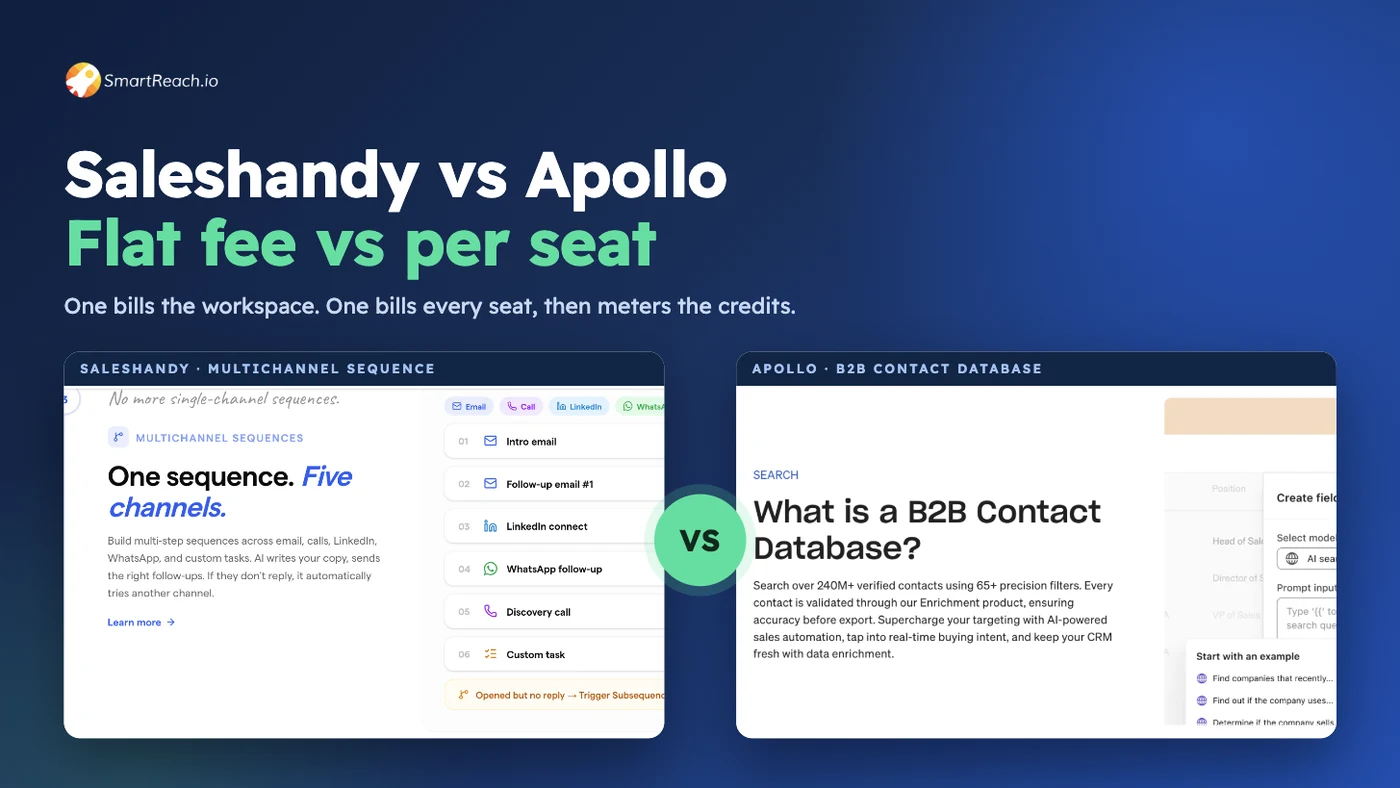
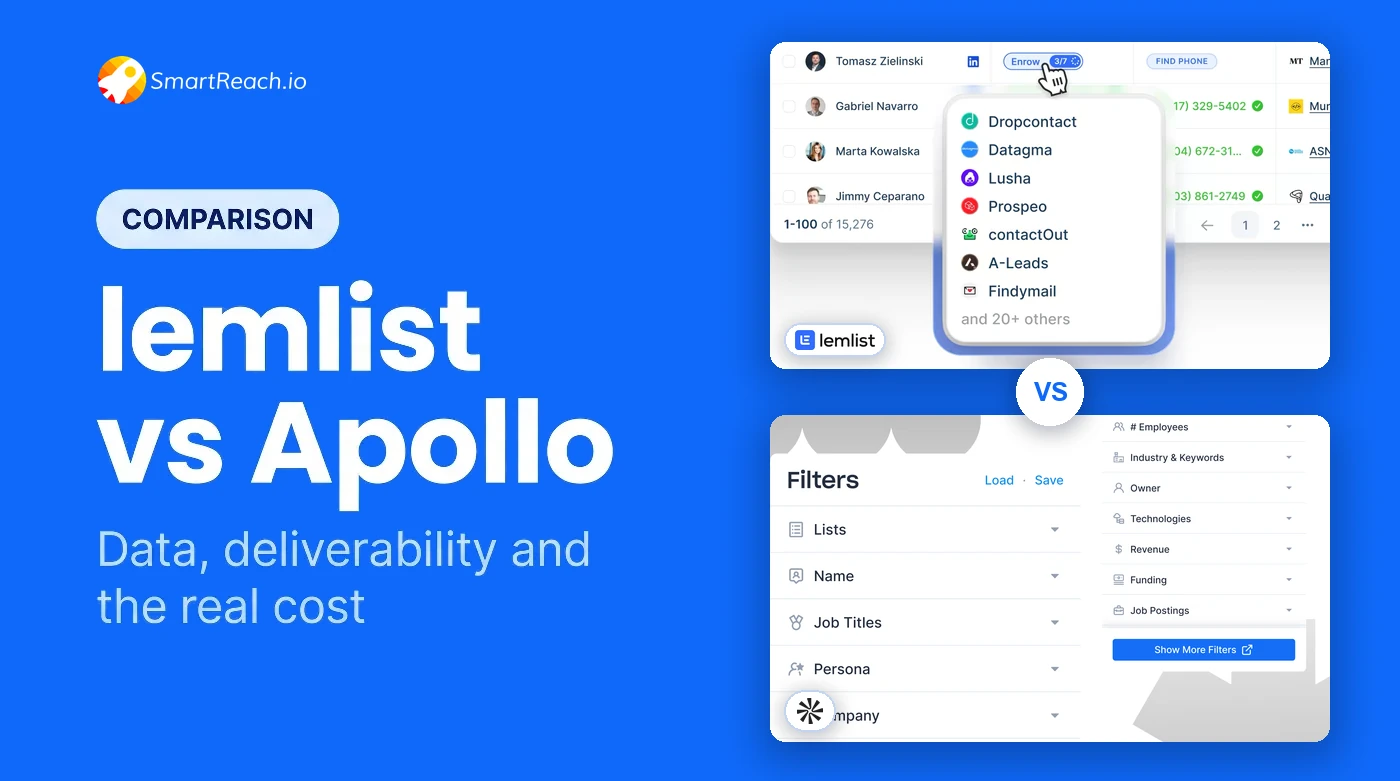
Instantly vs Apollo: Which Wins for Cold Email?

On this page
Ask ten outbound teams whether they run Instantly or Apollo and a good number will answer "both." That sounds like dodging the question. It's actually the most useful thing you'll hear, because it tells you something before you've compared a single feature.
Instantly vs Apollo shows up as a shortlist because both tools surface when you search for cold email software. But they solve different halves of the same problem. One is a contact database with outreach attached. The other is a sending engine with a database attached. Pick the wrong half and you'll spend a quarter wondering why your campaigns are technically running while nothing lands.
So let's skip the feature scorecard. Separate the two jobs first, work out which job is actually your bottleneck, then look at what it costs to solve both.
Instantly vs Apollo in 30 seconds
All three, side by side
Three tools, because the honest answer to "Instantly or Apollo" is often "the thing that does both." Every price below is monthly list price on monthly billing, so the columns are actually comparable. Annual discounts are noted separately later, since blending billing periods is how comparison tables lie.
| Factor | Instantly | Apollo | SmartReach.io |
|---|---|---|---|
| Built around | Cold email sending at volume | B2B contact database and prospecting | Multichannel sales engagement |
| Entry price (monthly) | $47 flat | $59 per user | $29 flat |
| Mid tier (monthly) | $97 flat | $99 per user | $89 email, $99 with calling |
| Pricing basis | Sending volume | Seats | Active prospects |
| Users included | Unlimited | Every seat billed | Unlimited from Plus up |
| Lead database | Separate subscription | Included, credit-metered | Included, 300M+ contacts |
| Native warmup | Yes | Retired in 2024 | Yes |
| Inbox rotation | Yes | No | Yes |
| ESP matching | No | No | Yes |
| Buy domains + mailboxes in-app | Yes, Google from $5, Airmail $4, domains $15/yr | No | Yes, Azure, Google, Microsoft 365 |
| Unified inbox | Yes, with sentiment analysis | Yes, alongside CRM records | Yes, shared with team assignment |
| Channels | Email; calls and SMS via separate CRM | Email, calls, LinkedIn tasks | Email, LinkedIn, calls, WhatsApp |
| Dialer | Via its separate CRM | From the Professional tier | Included on Sales Engagement |
| G2 rating | 4.9/5 | 4.7/5 | 4.6/5 |
| Free trial | 14 days | Free plan | 14 days, 200 prospects, no card |
Read that table by column, not by row. Instantly's column is all sending. Apollo's is all data. The third column is the one that doesn't have an obvious hole, which is exactly what you'd expect from a platform that came later and watched teams duct-tape the first two together.
Two tools, two different jobs
Barely, and two very different problems explain why.
Picture a solo SDR at a 40-person SaaS company. She sends maybe 1,500 emails a month, she knows her ICP cold, and her real headache is that she can't find current contact details for the VPs she wants to reach. She isn't scaling anything. She's trying to stop losing an hour a day to LinkedIn, guessing at email formats.
Now picture an 11-person team. The reps have a list. What they don't have is inbox placement. Reply rates slid from 4% to under 1.5% over two quarters, domains keep getting flagged, and nobody can say whether it's the copy, the list, or the infrastructure. Volume isn't the problem. Landing is.
One's a data problem. The other's a sending problem. Same category, opposite bottleneck, and that's the whole comparison in a sentence. The first buys Apollo. The second buys Instantly. Neither is wrong, and neither one's answer helps the other.
The trouble starts when you're both at once, which most growing teams eventually are. That's the scenario the rest of this piece is really about.
Instantly, up close
Quick facts
- G2
- 4.9/5 ★
- From
- $47/mo flat (about $30/mo billed annually)
- Free trial
- 14-day trial
- Best for
- Teams and agencies sending at volume where inbox placement, not list size, is the constraint.
What it is. A cold email sending platform. Connect unlimited mailboxes, warm each one automatically, rotate sends across the pool, and pull every reply into one inbox. That's the product thesis, and it's coherent.
Best for. Agencies running one offer across dozens of client domains, and any team sending above roughly 200 emails a day.
Key features. Unlimited sending accounts on every plan. Automated warmup that keeps running underneath live campaigns. Inbox rotation across the mailbox pool. Unibox, the unified inbox, with sentiment analysis, bulk actions, in-app notes, and scheduled replies. A separately sold B2B lead database with natural-language search.
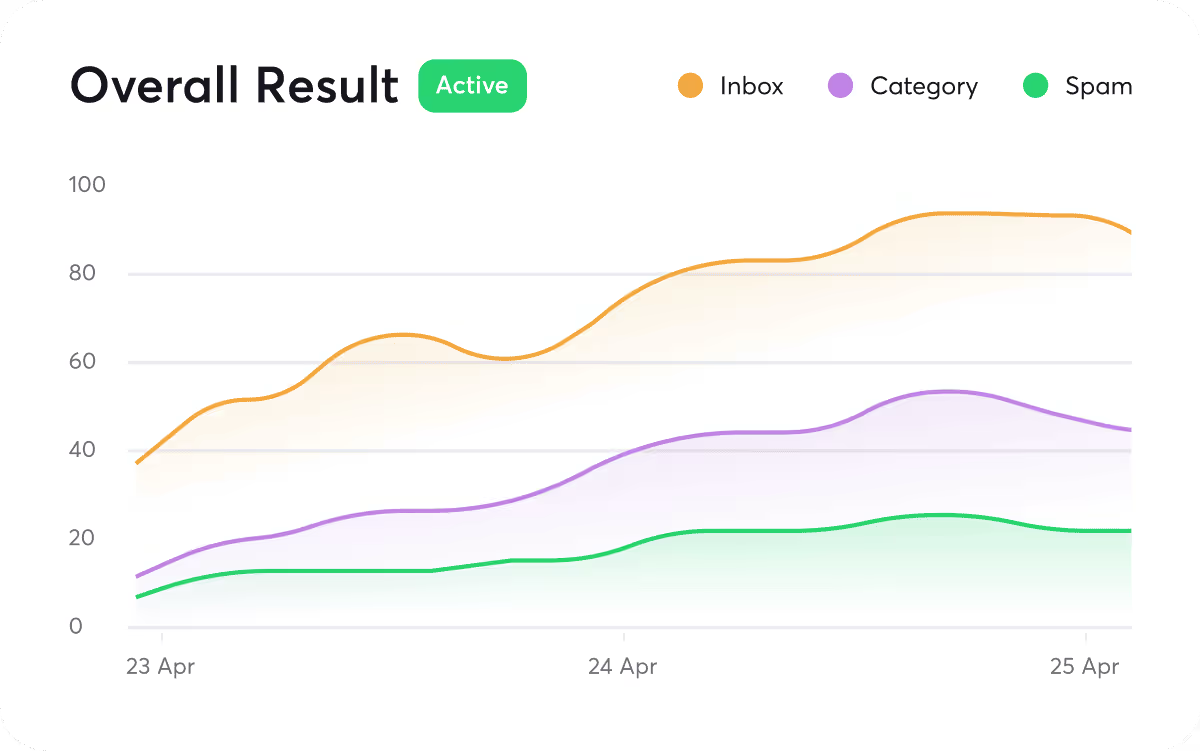
Placement reporting is the heart of the product: inbox, category and spam tracked over time rather than a single bounce number.
Pricing. Growth at $47 a month, Hypergrowth at $97, Light Speed at $358, all on monthly billing. Annual billing cuts roughly 20%. Capacity add-ons run about $87 a month each. The lead database is its own subscription on top.
Limitations. The Outreach plans are email only, so LinkedIn lives in another tool and calls need Instantly's separate CRM, a second purchase. The database being a separate line item means the sticker price understates the real bill. And warmup isn't a guarantee: plenty of reviewers on G2 still describe trial-and-error loops on placement, because deliverability depends on list quality and copy at least as much as tooling.
Pros
- Unlimited sending accounts on a flat fee, so adding mailboxes is free
- Native warmup that keeps running under live campaigns
- Inbox rotation spreads volume without burning a single mailbox
- Unified inbox with sentiment analysis and bulk actions
- Headcount doesn't change the bill, which suits agencies
- Reputation for the simplest setup in the category
Cons
- Lead database is priced separately from the sending plan
- Capacity add-ons stack up as volume grows
- Outreach plans are email only, with no native LinkedIn or WhatsApp and calls only via its separate CRM
- Dialer and CRM are a separate product, not part of the Outreach plan
- No ESP matching, so send timing ignores the recipient's provider
- You still can't buy authenticated domains inside the tool
Apollo, up close
Quick facts
- G2
- 4.7/5 ★
- From
- $0 free plan, then $59/user/mo monthly
- Free trial
- Free plan, no card
- Best for
- Teams whose main bottleneck is finding and enriching the right contacts, with sequencing on the same bill.
What it is. A sales intelligence platform. Prospecting, enrichment, sequencing, and dialing against one contact record, on one contract.
Best for. Small and stable teams, and anyone whose daily grind is finding current contact details rather than getting mail delivered.
Key features. A large B2B contact database with deep filters, seniority and headcount targeting, and technology-stack search. Buying-intent topics and signals. Multi-step sequences with A/B testing. A built-in dialer with call recording from the Professional tier, and international dialing on Organization. Native two-way sync with HubSpot and Salesforce. A browser extension that's among the best-rated parts of the product.
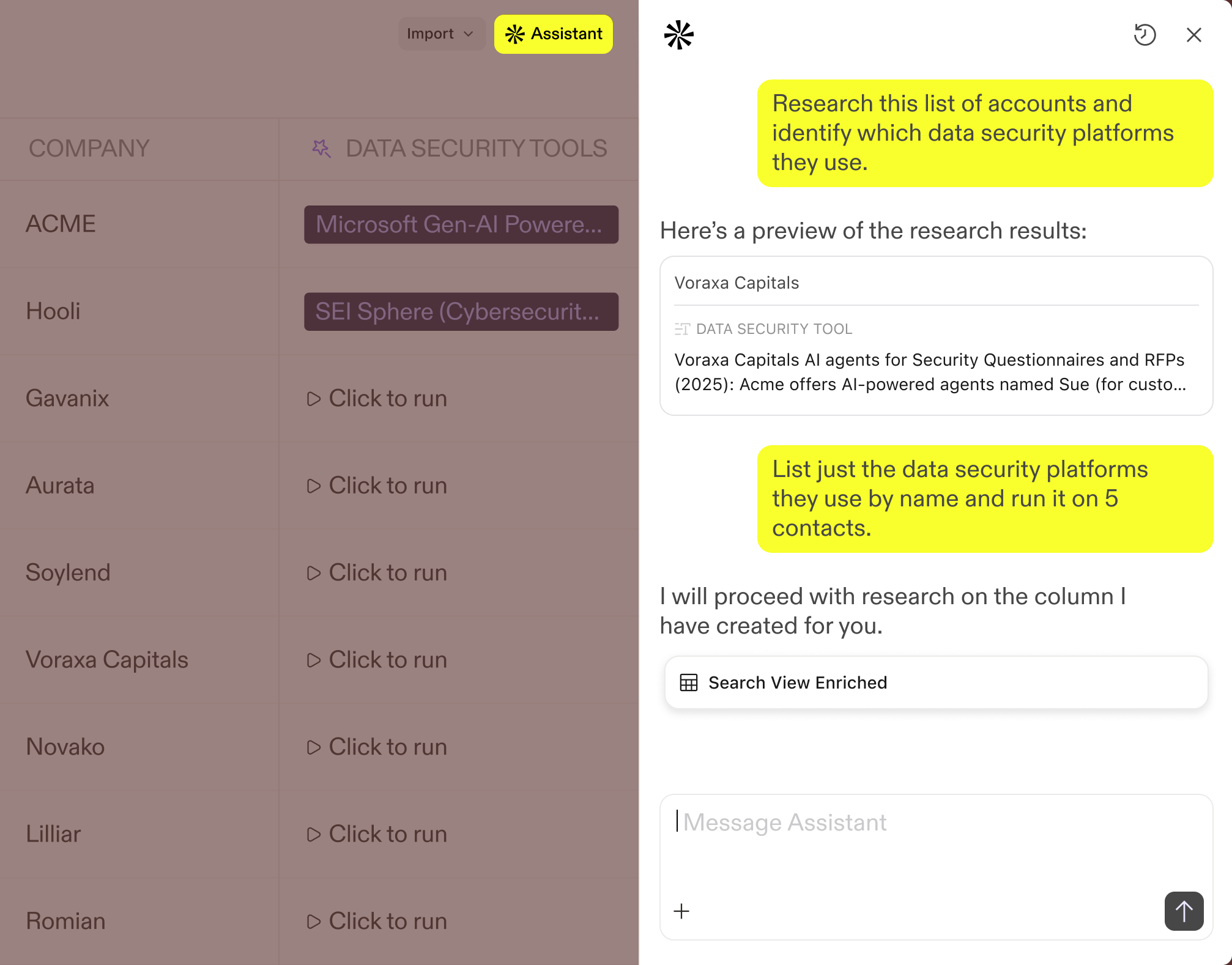
Apollo's strength in one screen: a list of accounts, a custom enrichment column, and an assistant filling it in from web research.
Pricing. Free plan at $0 with limited credits. On monthly billing, Basic is about $59 per user, Professional about $99, and Organization about $149. Annual billing brings those to roughly $49, $79, and $119. Note the unit: per user, every month, for every seat.
Limitations. Data accuracy is the single most common complaint theme across its G2 review corpus. Coverage is strongest for US mid-market and thins outside the US, especially for mobile numbers and current titles in APAC and the Middle East. On the sending side, Apollo uses shared infrastructure and discontinued native warmup in 2024, replacing it with a ramp-up feature that paces volume rather than building reputation.
Pros
- Large B2B database and sequencing on one subscription, one contact record
- Free plan good enough to validate data coverage before paying
- Buying-intent signals and filters no bundled database matches
- Built-in dialer with recording, so email and calls share a queue
- Strong native sync with HubSpot and Salesforce
- Browser extension is genuinely excellent
Cons
- Data accuracy is the top complaint theme in its review corpus
- Coverage drops noticeably outside the US
- Per-seat pricing means every hire raises the bill
- Native warmup was retired in 2024
- Shared sending infrastructure limits how hard you can push volume
- No inbox rotation, so mailboxes can't share a campaign's load
SmartReach.io, up close
Quick facts
- G2
- 4.6/5 ★
- From
- $29/mo flat, priced by prospects
- Free trial
- 14 days, 200 prospects, no card
- Best for
- Teams and agencies that need lead data and a real deliverability stack in one system, without per-seat billing.
What it is. SmartReach.io is a cold email software with email, LinkedIn, calls and WhatsApp as steps in one sequence, a built-in B2B lead database and a full cold email deliverability suite. On its Sales Engagement plans it works as a sales engagement platform for the whole team.
Best for. Teams that just did the seat math on Apollo and didn't like the answer, and anyone tired of syncing a list between two tools.
Key features. Nobody pays per seat: plans bill on active prospects, with unlimited users from the Plus tier up. The B2B Lead Finder holds 300M+ contacts and 50M+ companies with free email verification. Deliverability is a product rather than a tab: warmup, inbox rotation, ESP matching, pre-send spam testing, blacklist monitoring, and inbox placement reports. You can buy authenticated secondary domains and mailboxes inside the platform. A conditional multichannel drip moves a quiet prospect to another channel automatically, and a reply anywhere pauses everything.
Pricing. Email Outreach runs $29, $89, $199, and $499 a month. Sales Engagement, which adds calling and LinkedIn, runs $39, $99, $249, and $599. All monthly, all flat, no seat multiplier. A 14-day free trial covers 200 prospects with no credit card.
Limitations, honestly. The database has fewer filters and fewer intent topics than Apollo's, and Apollo's buying-signal tooling is better. Pipeline and deal management is lighter here. LinkedIn automation is a $29 per month add-on per LinkedIn account, so three LinkedIn seats on Sales Engagement Plus is $99 plus $87, which is $186 a month, not $99. That's the real number.
Pros
- Billed by prospects, not seats, so hiring doesn't change the invoice
- Four channels in one sequence with conditional branching
- Lead data included rather than metered against a credit wallet
- Full deliverability stack including ESP matching and placement reports
- Buy pre-authenticated domains and mailboxes without touching DNS
- Native two-way sync with HubSpot, Salesforce, Pipedrive, and Zoho
Cons
- Database has fewer filters and intent topics than Apollo
- Deal and pipeline management is lighter than a full CRM
- LinkedIn automation is a paid add-on, not bundled
- Smaller G2 review corpus than either competitor
- Mailbox buying is gated to the Plus tier and above
Round by round
Eleven dimensions, each with a verdict. Some of these Apollo wins outright, and a couple Instantly wins outright. A comparison where the host tool sweeps every category isn't a comparison.
Data and prospecting
Apollo's database is the deepest of the three, and it isn't close. More filters, more intent topics, better buying-signal tooling, and a browser extension that turns any LinkedIn profile into a sequence entry. Instantly has a database but sells it separately. SmartReach.io bundles 300M+ contacts with free verification, which covers most mid-market prospecting but won't match Apollo's filter depth.
The honest caveat applies to all three: no vendor's headline contact count predicts accuracy in your niche. Sample a few hundred records in your real target market before committing.
Verdict: Apollo, clearly.
Email deliverability and warmup
This is the mirror image. Instantly is built around sender reputation, with native warmup that keeps running underneath live campaigns. Apollo retired its native warmup in 2024; the replacement paces sending volume, which is not the same as building reputation. If you're standing up new domains, that gap is the difference between a working campaign and a quiet one. Our email warmup guide covers why the reputation curve matters more than the send count.
SmartReach.io matches Instantly on warmup and goes further on diagnostics, with pre-send spam testing, blacklist monitoring, and inbox placement reports that tell you where mail actually landed rather than just whether it bounced.
Verdict: Instantly and SmartReach.io tie, Apollo trails badly.
Inbox rotation and ESP matching
Inbox rotation spreads one campaign across a pool of mailboxes so each stays inside safe daily limits while the campaign runs at real volume. It's the mechanism that makes high-volume outbound survivable, and our guide to inbox rotation walks through the math.
Instantly and SmartReach.io both do it. Apollo doesn't, which is the structural reason its shared infrastructure caps out where it does.
ESP matching is the tiebreaker, and only SmartReach.io has it. It aligns your sending mailbox with the recipient's email provider, so mail from a Google mailbox goes to Google inboxes and Microsoft to Microsoft. Same-provider delivery paths are simply treated better. It's a small lever that compounds across thousands of sends.
Verdict: SmartReach.io, on ESP matching. Instantly a close second.
Secondary domains and mailboxes
Here's a dimension most comparisons skip entirely, and it's the one that quietly decides whether you can scale at all. Sending at volume means spreading across many domains and mailboxes. Buying those, pointing DNS, and getting SPF, DKIM, and DMARC right is where most teams lose a week and still get it wrong.
Apollo doesn't sell you domains or mailboxes, so you go buy them elsewhere and wire them up yourself. Instantly does sell done-for-you Google mailboxes at $5 a month ($10 pre-warmed), Airmail accounts at $4 and domains at $15 a year.
SmartReach.io sells them inside the platform, pre-authenticated with MX, SPF, DKIM, and DMARC configured, live in under three minutes, across Azure, Google, and Microsoft 365. And the Azure option changes the arithmetic:
The reason agencies pick Azure anyway isn't only price. Each tenant comes with its own dedicated IP, which means one client's sending behaviour can't contaminate another's. The wider infrastructure runs across hundreds of IPs with bad ones auto-replaced, so a blacklisting event doesn't stop your campaigns. And managing one tenant instead of fifty separate mailbox subscriptions removes most of the domain admin overhead. One trade-off worth knowing before you buy: domains purchased through the platform are locked to their provider and can't be moved.
If you're weighing mailbox hosts more broadly, we've compared Google Workspace and Office 365 for cold email hosting in detail.
Verdict: SmartReach.io, uncontested. The other two don't compete here.
Unified shared inbox
All three have one, and the differences are about team shape.
Instantly's Unibox is excellent for a solo operator or a small pod: every reply from every mailbox in one view, with sentiment analysis, bulk actions, and scheduled replies. Apollo's inbox sits alongside the CRM record, which is genuinely useful when the reply needs context from the deal.
SmartReach.io's shared inbox is built for handoffs: replies route to the right rep, conversations can be assigned, and the whole team sees status without anyone forwarding an email. If two people might touch the same prospect, that matters more than sentiment tags.
Verdict: Instantly for solo and small teams, SmartReach.io once replies need routing between reps.
Multichannel outreach
Instantly's Outreach plans are email only, by design; calling and SMS sit in its separate CRM, and there is no native LinkedIn automation. Apollo adds calls and LinkedIn tasks, though the LinkedIn steps are manual reminders rather than automation. SmartReach.io runs email, LinkedIn, calling, and WhatsApp as steps in a single sequence, with conditional branching that switches channel when a prospect goes quiet.
If your buyers reply to email, this dimension doesn't matter. If they don't, it's the only one that does.
Verdict: SmartReach.io, comfortably.
Automation and sequences
Apollo's sequencer is competent and linear: steps, delays, A/B tests, reply detection. Instantly's is similar with better sending controls layered on. Both are fine.
Conditional logic is the first split. Branching on whether someone opened, clicked, replied, or went silent, and routing them down a different path automatically, is what separates a sequence from a drip. Instantly and SmartReach.io both do it; SmartReach.io extends the branching across channels rather than only across email steps.
The bigger split is who writes the campaign. SmartReach.io's AI content generator builds a complete sequence in seconds, subject lines, personalized ice-breakers and calls to action included, then varies the copy with spintax so no two prospects get an identical email. You can generate several versions of a subject line or body and pick the one you want.
Then there's the Smart Email AI Agent, which is a different idea entirely. Instead of filling merge tags into a template, it writes a unique email for every prospect from their job title, company, revenue, tech stack, and location. Run it in Copilot mode and emails queue for your review, with every edit teaching it your tone and structure. Switch to Autopilot once you trust it and they send at scale. It handles follow-up steps too, and generates in seven languages.
Neither Instantly nor Apollo has an equivalent. Both offer AI assistance for writing a template; the agent replaces the template.
Verdict: SmartReach.io, and it's the widest gap in this comparison.
Ease of use
Instantly wins this and it isn't controversial. Its G2 reviews single out how fast you get from signup to first campaign, and it scores 95% on ease of use. Apollo carries a real learning curve, especially on reporting and its advanced features, which shows up repeatedly in reviews. SmartReach.io sits in between: more surface area than Instantly because it does more, less sprawl than Apollo.
Verdict: Instantly.
Integrations
Apollo's native CRM sync is the deepest, particularly the advanced Salesforce and HubSpot mapping on higher tiers. SmartReach.io offers native two-way sync with HubSpot, Salesforce, Pipedrive, and Zoho, plus API, webhooks, and Zapier's 8,000+ apps. Instantly has the thinnest native CRM story of the three and leans on webhooks and third-party connectors.
Verdict: Apollo, narrowly, on CRM depth.
Team and agency features
Apollo's per-seat model is the wrong shape for a growing team: every hire is another line item, forever. Instantly's flat fee means headcount is free, which is why agencies gravitate to it. SmartReach.io is flat too, with unlimited users from the Plus tier and client dashboards for agencies managing multiple accounts.
Verdict: Instantly and SmartReach.io tie, Apollo loses on structure rather than features.
Pricing value
Same billing basis, monthly, no annual sleight of hand:
| Monthly, billed monthly | Instantly | Apollo | SmartReach.io |
|---|---|---|---|
| Entry | $47 flat | $59 per user | $29 flat |
| Mid tier | $97 flat | $99 per user | $89 email, $99 with calling |
| Top published tier | $358 flat | $149 per user | $499 email, $599 with calling |
| Lead data | Separate subscription | Included, credit-metered | Included |
| Cost of adding a rep | $0 | Full plan price again | $0 from Plus up |
Annual billing changes the picture roughly evenly: Instantly discounts about 20%, Apollo drops to about $49, $79, and $119 per user, and SmartReach.io trims as well. That's why the table above holds billing period constant. A comparison that puts one tool's annual price beside another's monthly is marketing, not analysis.
Verdict: SmartReach.io, on pure value. It's the cheapest entry point at $29, the only one of the three that includes lead data and a full deliverability stack in the same flat fee, and adding reps costs nothing from Plus up. Two honest exceptions: a solo user who mainly needs data will spend less on Apollo's free plan or $59 Basic, and an email-only sender at extreme volume may find Instantly's Light Speed tier the better fit. Past three or four people needing both jobs done, the arithmetic isn't close.
The two-tool tax
Here's the opinion I'll defend. Apollo for data plus Instantly for sending has become the default stack, and it's also the most expensive way to solve a problem that doesn't have to be two problems.
Run an 11-person team through it on monthly billing:
The subscription cost is the visible half. The other half is operational. Your list lives in one system and your sends happen in another, so someone exports and imports, and the two drift. Suppression lists don't sync cleanly, which is how a prospect who asked to be left alone gets emailed again. Reply data splits across two inboxes, so nobody can report reply rate by segment without a spreadsheet. And when placement drops, you have two vendors who can each point at the other.
Am I saying nobody should run two tools? No. If Apollo's database is genuinely better for your niche than any bundled alternative, and you've tested that rather than assumed it, running it beside a sending platform is a defensible call. Just price the whole chain first, including the hours. If you're weighing the split seriously, our guide to the best Apollo alternatives prices the two-tool stack against a single bill for a ten-person team.
So which one's yours?
Choose Instantly if
Your list is fine and your placement isn't. You're sending above roughly 200 emails a day across multiple domains, or you're an agency adding client mailboxes faster than seats. Email is your only channel and you intend to keep it that way. You already source your own data, or you're happy paying for its database separately.
Genuinely the best pick for high-volume, email-only sending. Go buy it.
Choose Apollo if
Finding current contact details is the daily grind. You're a small, stable team sending moderate volume from an established domain. You want prospecting, sequencing, and dialing on one bill rather than assembling a stack, and intent signals matter to how you prioritise.
Start on the free plan and test data coverage in your actual market before paying. If the database is the job, Apollo is the better buy and we'd say so to your face.
Choose SmartReach.io if
You're both buyers at once: you need data and you need mail to land. You're adding reps and don't want the bill to track headcount. Your prospects need more than email to reply. Or you're spinning up domains and mailboxes and would rather not spend a week in DNS records.
Best fit for teams and agencies past the solo stage who'd rather run one system than reconcile two.
The verdict
Whatever you choose, run the same test on it. Take 200 real prospects from your actual target market, send a real sequence for two weeks, and measure placement and reply rate rather than feature counts. Tools look identical on a comparison table and behave nothing alike on your domain, with your list, in your niche. Two weeks of your own data beats every comparison post on the internet, this one included.
Want the longer look at either tool on its own? We've written a full Instantly.ai review and an Apollo.io review that go deeper on features and real costs, plus a roundup of the best cold email tools if you want to widen the shortlist. If lemlist is also on your list, the lemlist vs Instantly breakdown covers how lemlist's 2026 repricing changes that comparison, and lemlist vs Apollo starts from the invoice at one, three and ten seats.
Questions people actually ask
Should I use Instantly or Apollo for cold email?
Use Apollo if your bottleneck is finding contacts, because its database and filters are stronger. Use Instantly if your bottleneck is landing in the inbox, because it has native warmup, unlimited mailboxes, and inbox rotation. Most teams discover their bottleneck is one or the other, not both.
Does Instantly have a lead database?
Yes, but it's sold separately from the sending plan. Instantly's B2B lead database is its own subscription, so the sticker price on the outreach plan isn't your total bill. Budget for both if you don't already source your own lists.
Can I use Apollo and Instantly together?
Yes, and it's the most common stack in cold email: Apollo for data, Instantly for sending. It works, but you pay two subscriptions, sync lists by export and import, and split reply data across two inboxes. Price the whole chain before committing.
Does Apollo replace Instantly entirely?
Only at low volume. Apollo sends from shared infrastructure and retired its native warmup in 2024, replacing it with a ramp-up feature that paces volume instead of building sender reputation. Most teams find Apollo comfortable under roughly 200 sends a day and start looking for a dedicated sender above that.
Is Apollo good enough for cold email deliverability?
For moderate volume from an established domain, usually yes. For new domains or high volume, the gaps show: no native warmup, shared sending infrastructure, and limited visibility into where mail actually landed. Data accuracy is also the most common complaint theme across its G2 reviews.
Which is better for agencies, Instantly or Apollo?
Instantly, in most cases. Agencies add mailboxes and client domains faster than they add seats, so a flat monthly fee beats per-user pricing. Apollo's per-seat model taxes every hire, which is the wrong shape for agency growth.
What do Instantly and Apollo cost for a 10-person team?
On monthly billing, Apollo Professional runs about $99 per user, so roughly $990 a month for 10 reps. Instantly Hypergrowth is about $97 a month flat regardless of headcount, plus its lead database subscription. Running both puts you near $1,100 a month before list-syncing time.
Is there a single tool that does both jobs?
Yes. Sales engagement platforms like SmartReach.io bundle a B2B lead database with a full deliverability stack, so data and sending share one system and one bill. The trade-off is that a bundled database has fewer filters and intent signals than a dedicated data platform like Apollo.
Stop juggling tools
Book more meetings on every channel
Join 5,000+ teams running multichannel outreach from one sequence, with deliverability built in.