25 Cold Email Statistics to Boost Your Reply Rate

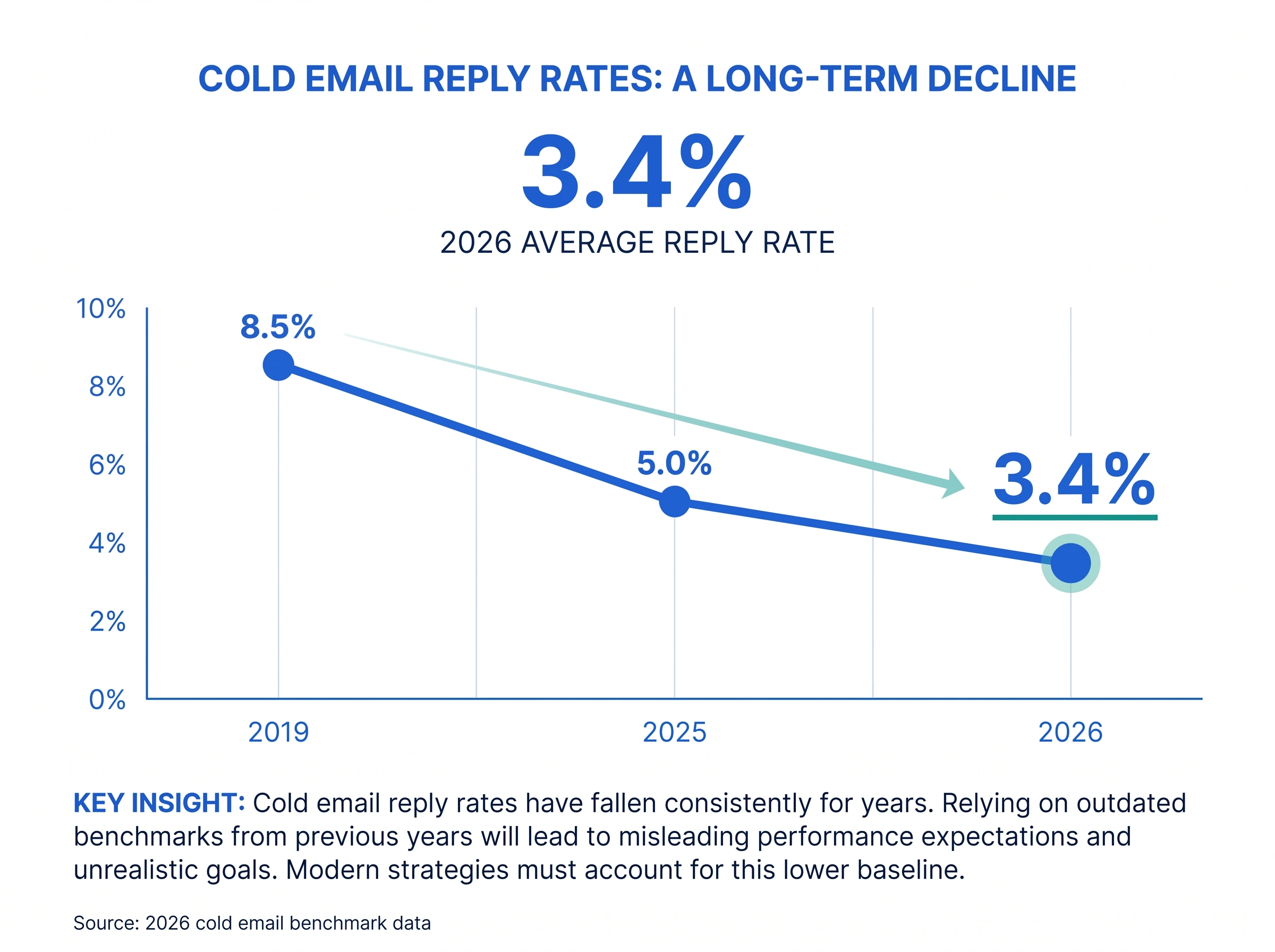
Cold email still works. The problem is that the numbers behind it have moved, and most of the cold email statistics floating around the internet are two or three years out of date. An 8.5% reply rate was normal once. Today it isn’t.
Inboxes are more crowded. Spam filters got smarter. And a flood of low-effort, AI-generated outreach has trained buyers to ignore anything that smells automated. So the benchmarks you measured against a few years ago will quietly lie to you today.
This guide fixes that. Below are 25 cold email statistics that matter in 2026. The first 15 are the ones that move your results most, so each gets the full treatment: the benchmark, the real reasons your number might fall short, and the exact steps to improve it. The final 10 round out the picture. After that, you’ll find direct answers to the three questions reps ask most.
Let’s get into it.
TL;DR for cold email statistics
Short on time? Here are the headline numbers for 2026:
- Average cold email reply rate: ~3.4%. It’s been falling for years (8.5% in 2019, around 5% in 2025). A good reply rate is above 5%; elite campaigns clear 10%, and tightly targeted ones hit 15-25%.
- Average open rate: ~21-28%, but Apple Mail now auto-opens a huge share of emails, so open rate is a directional signal, not a scoreboard.
- Conversion to a booked meeting: 1-3% of emails sent. Cold email costs around $152 per meeting versus roughly $2,800 for cold calling.
- Follow-ups drive ~42% of all replies. The first email gets the other 58%. Four to five emails is the sweet spot.
- Personalization is the biggest lever. Deep, researched personalization can push reply rates near 18% versus under 5% for generic templates.
- Deliverability rules tightened. Keep spam complaints under 0.3%, bounce rate under 2%, and authenticate with SPF, DKIM, and DMARC, or you won’t get measured at all.
- ROI is still huge: around $36-$42 back for every $1 spent.
3.4%
average cold email reply rate
~50%
of tracked opens are machines, not people
42%
of replies come from follow-ups
$36-42
returned for every $1 spent
Where these numbers come from
A quick word on methodology, because it matters. SmartReach.io powers the thousands of cold emails that outbound teams send through our platform every single day, which adds up to millions of sends a year. So we’re not guessing here. The hard benchmark numbers in this guide come from recent published studies that analyze tens of millions of cold emails, and we’ve cross-checked every one against what we actually see across our own platform.
Two findings hold up especially clearly in our data. First, follow-ups recover close to half of all replies, so single-send campaigns leave huge volume on the table. Second, multichannel sequences (email plus LinkedIn or calls) out-reply email-only ones by a wide margin. Where our platform data and the published studies agree, we’ve stated the number with confidence. Where they diverge, we’ve given you the range instead of a false-precision figure.
SmartReach is a sales engagement platform that runs cold email, multichannel sequences, and deliverability tooling for outbound teams, so these benchmarks reflect what’s actually landing in inboxes right now, not theory.
25 cold email statistics that matter in 2026
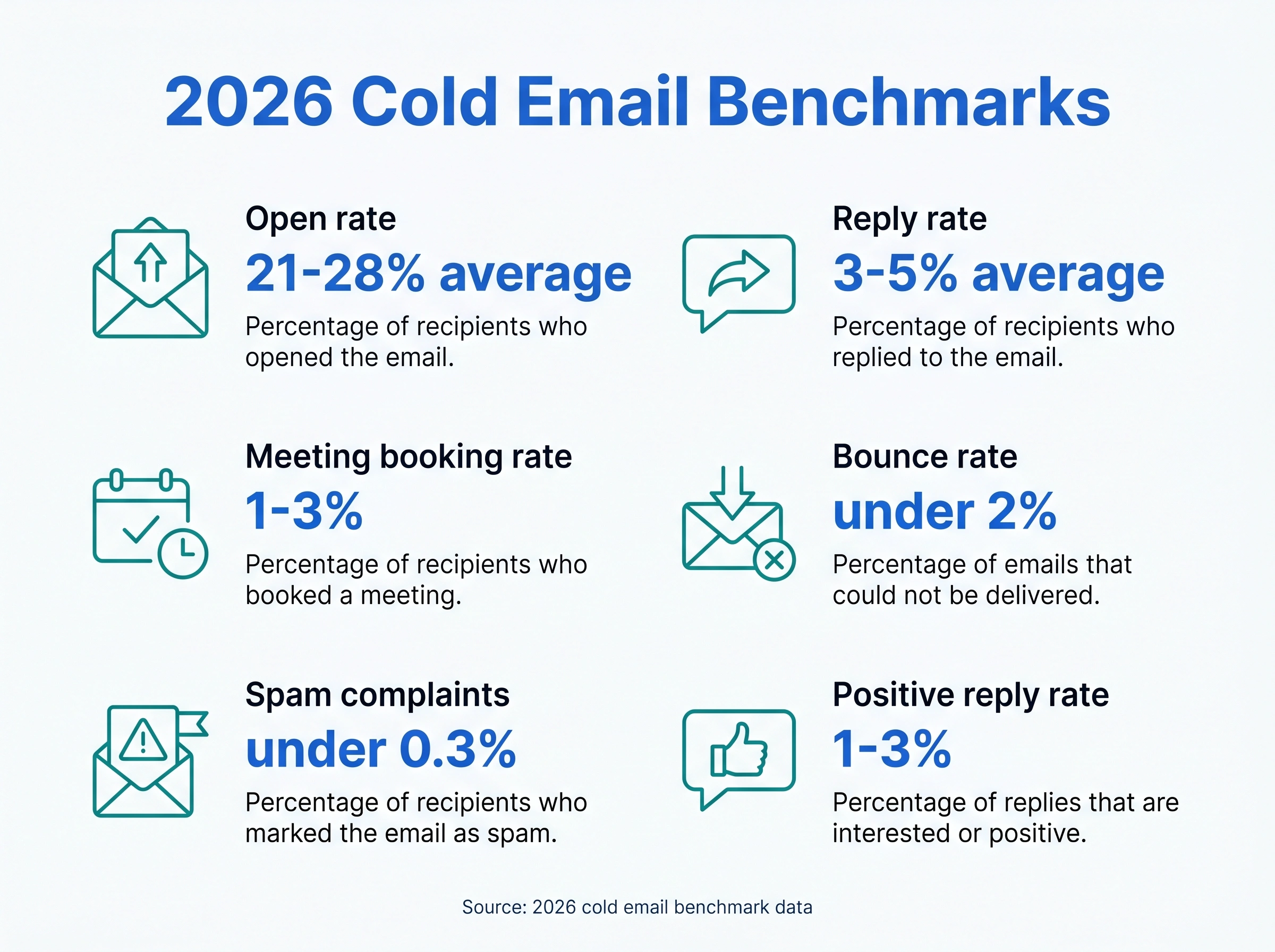
Here’s the at-a-glance view before we break each one down:
| Metric | Average | Good | Elite |
|---|---|---|---|
| Open rate | 21-28% | 40-60% | 65%+ |
| Reply rate | 3-5% | 5-10% | 10%+ |
| Positive reply rate | 1-3% | 3-5% | 5%+ |
| Meeting booking rate | 1-3% | 3-5% | 5-8% |
| Bounce rate | 2-3% | Under 2% | Under 1% |
| Spam complaint rate | 0.1-0.3% | Under 0.1% | Near 0% |
1. The average cold email reply rate is 3.4%
Benchmark analyses of more than 100 million cold emails put the current average reply rate at roughly 3.4%, down from about 5% in 2025 and 8.5% in 2019. A reply rate above 5% puts you ahead of most B2B senders, top-quartile campaigns run near 5.5%, elite ones clear 10%, and tightly targeted lists can reach 15-25%. Anything below 1% signals a real problem.
Why your reply rate is low. It’s almost always one of three things, in this order. Deliverability: your emails are landing in spam, so nobody can reply to what they can’t see. Targeting: you’re emailing people who don’t have the problem you solve, so even a perfect email falls flat. Copy: the message is about you, not them, or the ask is too big. Most teams blame copy first when the real culprit is one of the first two.
How to improve it.
- Check deliverability before anything else. Run an inbox-placement test, confirm SPF, DKIM, and DMARC are set, and look at your spam-complaint and bounce rates.
- Tighten your targeting. A smaller list of people who genuinely fit your ideal customer profile will always beat a big, loose one.
- Rewrite around the prospect. Open with their context, keep it under 80 words, and make the ask small.
- Add follow-ups (see stat 4). Most of your missing replies are hiding in the emails you never sent.
With SmartReach: the B2B Lead Finder and the ProspectDaddy extension build verified, well-fit prospect lists, so your reply rate starts from the right people instead of bad data.
2. The average open rate is 21-28% (and it’s your most misleading metric)
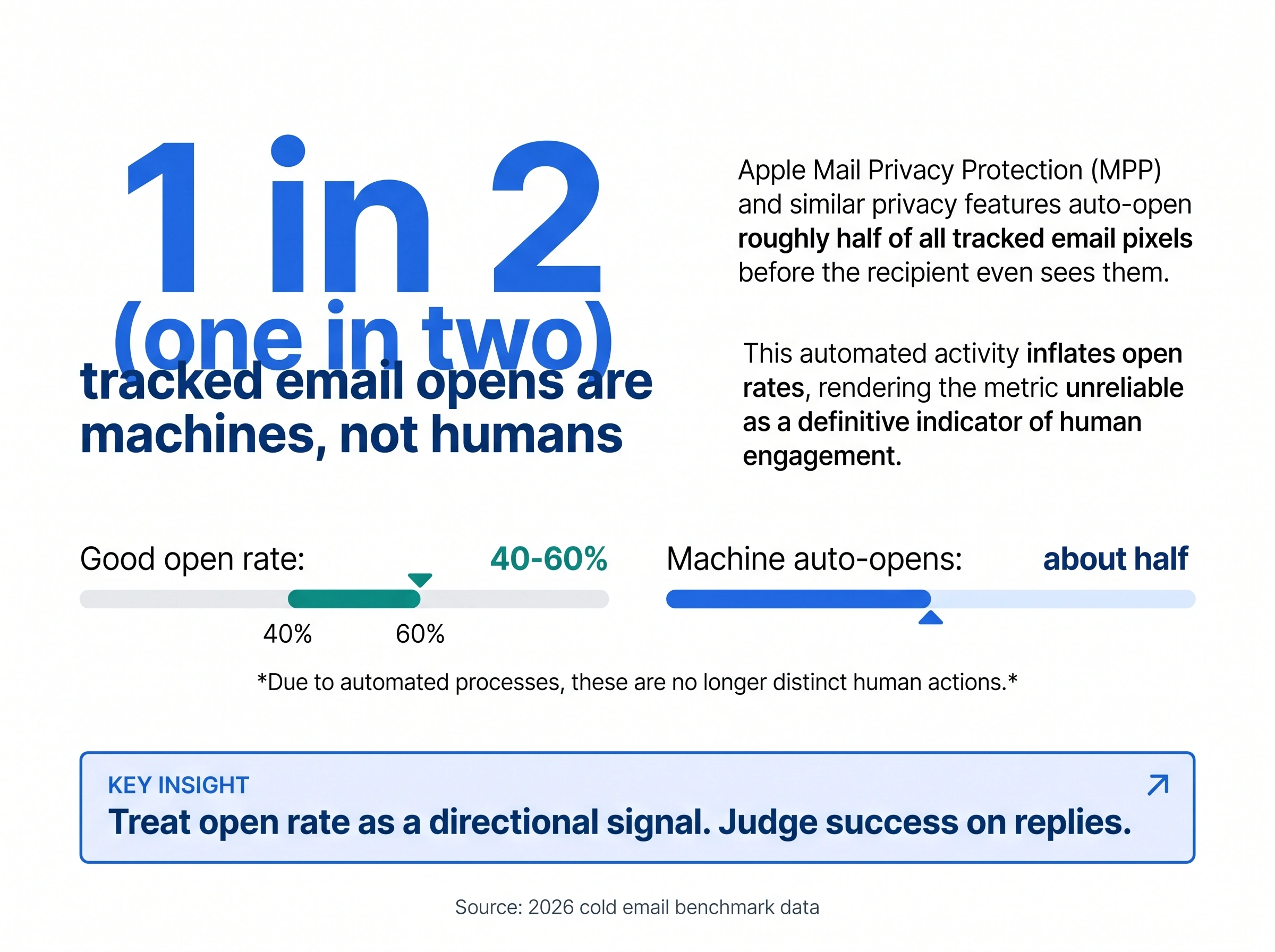
Average cold email open rates sit between 21% and 28%, with a good rate at 40-60% and elite campaigns above 65%. But Belkins data shows opens fell from 36% in 2023 to 27.7% in 2024, and there’s a bigger catch: Apple Mail Privacy Protection auto-loads tracking pixels through its own servers, so close to 1 in 2 “opens” in many datasets are machines, not people. Treat open rate as a directional signal, not a scoreboard.
Why your open rate is low. Four usual suspects. Weak subject lines that don’t earn the click. Poor list quality, so you’re reaching the wrong people or dead addresses. Spam placement, which means the email never reached the inbox at all. And bad timing, landing when the prospect isn’t checking. Cold opens also run lower than broad email marketing sends, so don’t benchmark against the email marketing metrics you’d see on an opted-in newsletter list.
How to improve it.
- Fix deliverability first; a “low open rate” is often a spam-folder problem in disguise.
- Rewrite subject lines to 4-6 words, specific to the prospect (see stat 7).
- Clean the list so you’re only sending to verified, well-fit contacts.
- Send Tuesday or Thursday mid-morning in the prospect’s time zone (see stat 8).
- Stop reporting open rate as success. Judge campaigns on replies and meetings instead.
3. Positive reply rate is the number that actually predicts pipeline
Reply rate counts every response, including “not interested” and “unsubscribe.” Positive reply rate counts only genuine interest, and it’s the one that maps to meetings. Here’s the math: send 1,000 emails, 950 get delivered, and 38 reply. That’s a 4% reply rate (38 ÷ 950). But if only 12 replies are interested, your positive reply rate is 1.3% (12 ÷ 950). The first number flatters you; the second one pays you.
Why your positive reply rate is low. Usually because you’re getting replies, just the wrong kind. A flood of “remove me” or “not the right person” means your targeting or your offer is off, even if total replies look fine. It can also be a message problem: emails that overpromise pull replies that fizzle the moment you respond.
How to improve it.
- Tag every reply by intent (interested, not interested, out-of-office, do-not-contact) so you can see the real number.
- If you’re getting “wrong person” replies, fix your targeting and ask for a referral to the right contact.
- If you’re getting “not interested,” sharpen who you target and the specific pain you lead with.
- Report positive reply rate to leadership, not raw replies. It’s the honest leading indicator of pipeline.
4. Follow-ups generate 42% of all cold email replies
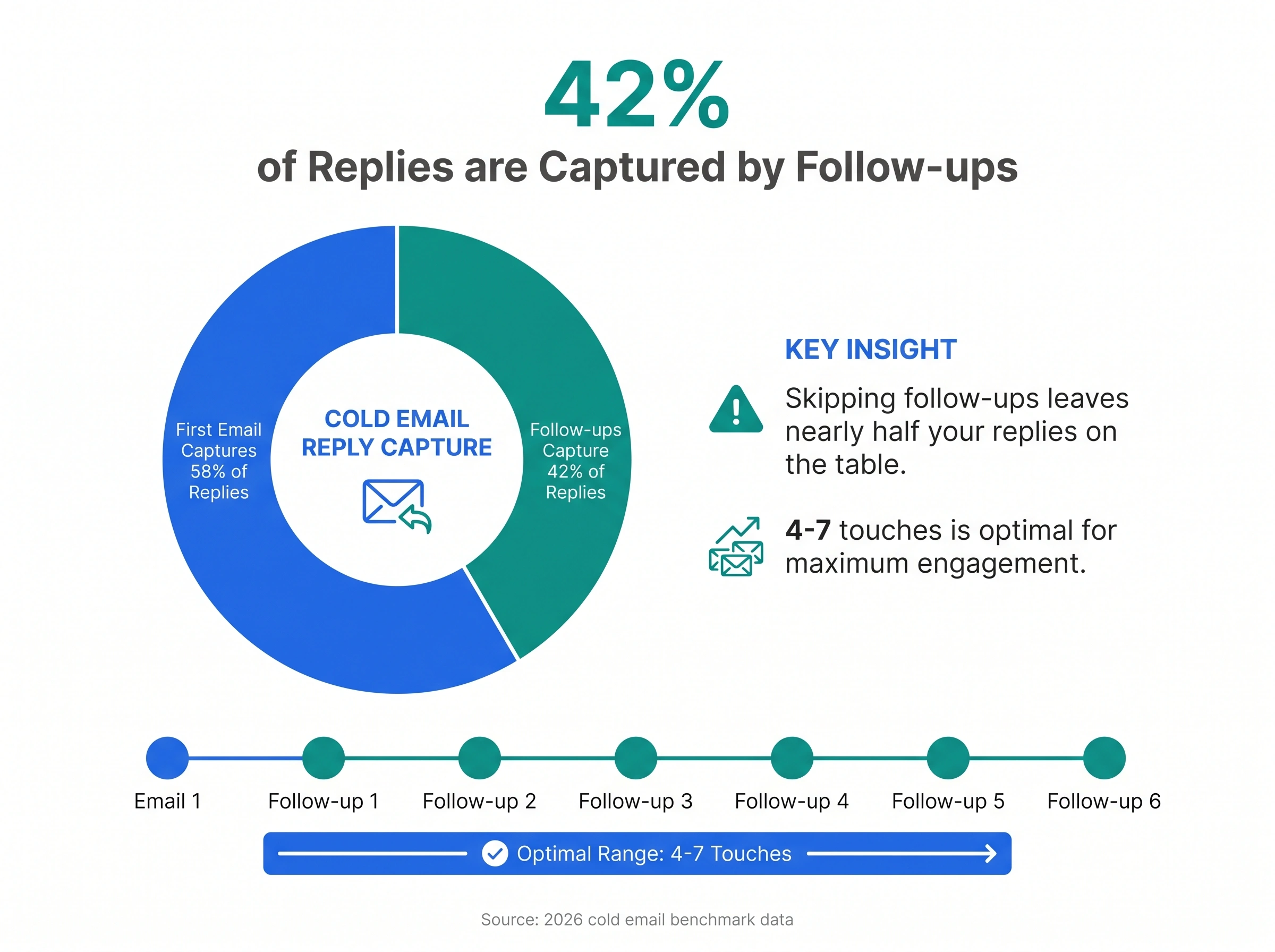
The first email captures about 58% of all replies; follow-ups capture the remaining 42%. A single follow-up can lift response rates by more than 20%, sequences of 4-5 emails beat one-and-done sends, and roughly 80% of closed deals need five or more touchpoints. Yet most reps stop after the first email, and many never send a second.
Why your follow-ups underperform (or don’t exist). Three common failures. You’re not sending them at all, so you forfeit nearly half your potential replies. You’re sending “just bumping this up,” which adds noise and trains people to ignore you. Or you’re sending too many, too fast, which reads as desperate and spikes complaints. The point of a follow-up isn’t to nag, it’s to catch the prospects who saw your first email at the wrong moment and to add a new reason to care.
How to improve it.
- Build the full sequence before you send: 4-5 emails over 14-21 days.
- Give each follow-up a fresh angle (a new insight, a short case study, a different pain point), never a repeat.
- Space touches 3-4 days apart, tight enough to stay top of mind, loose enough to stay polite.
- Cap it at seven touches, then move non-responders to a long-term nurture track instead of hammering them.
- Automate it so reps don’t drop the ball. A structured follow-up sequence runs itself.
With SmartReach: the AI sequence generator drafts a full multi-step follow-up cadence for you, so no prospect slips through after the first email.
5. Cold email converts to a meeting 1-3% of the time
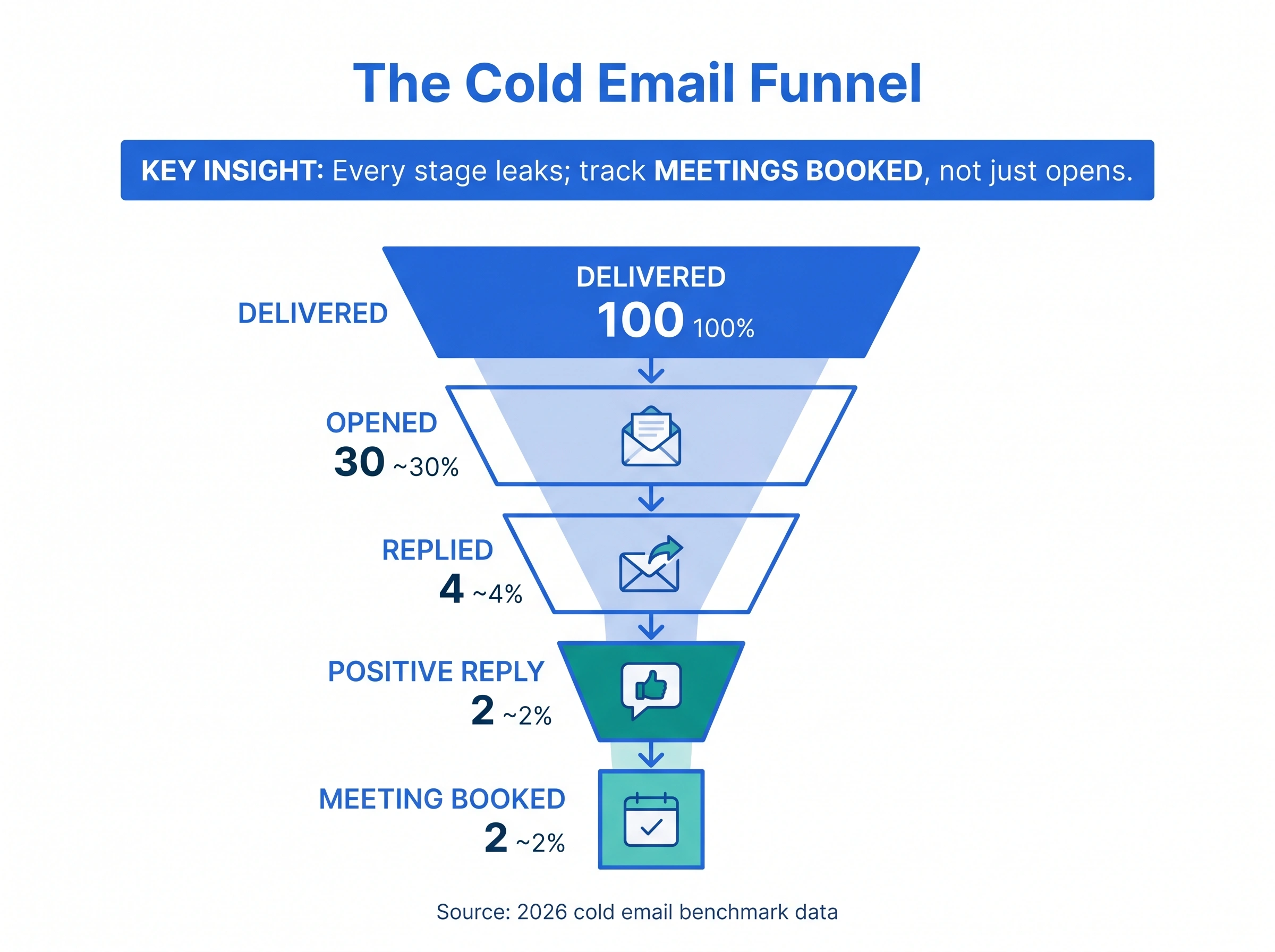
On average, 1-3% of emails sent turn into a booked meeting, with top campaigns hitting 5-8%. Expect roughly 2-3 meetings per 100 cold emails when you’re doing it well, so 500 quality emails a week is about 10-15 meetings. A good email-to-meeting conversion rate is anything above 0.4%, per 2025 Salesforge data.
Why your conversion is low. Every funnel stage leaks, and where it leaks tells you the cause. Low opens point to subject lines or deliverability. Good opens but few replies point to weak messaging or wrong targeting; the email got seen and ignored. Replies but no meetings point to a weak CTA or an offer that doesn’t justify a call. Meetings but no deals is a sales-process problem, not a cold-email one.
How to improve it.
- Diagnose top-down. Find the single leakiest stage and fix only that one this week.
- If replies are healthy but meetings aren’t, rewrite the ask: swap “open to chatting?” for “worth a 15-minute call Thursday?”
- Make the next step tiny. A specific time, a calendar link, a yes/no question all reduce friction.
- Track meetings booked as your north-star metric, not opens or even replies.
6. Advanced personalization lifts reply rates to ~18% versus under 5% for generic
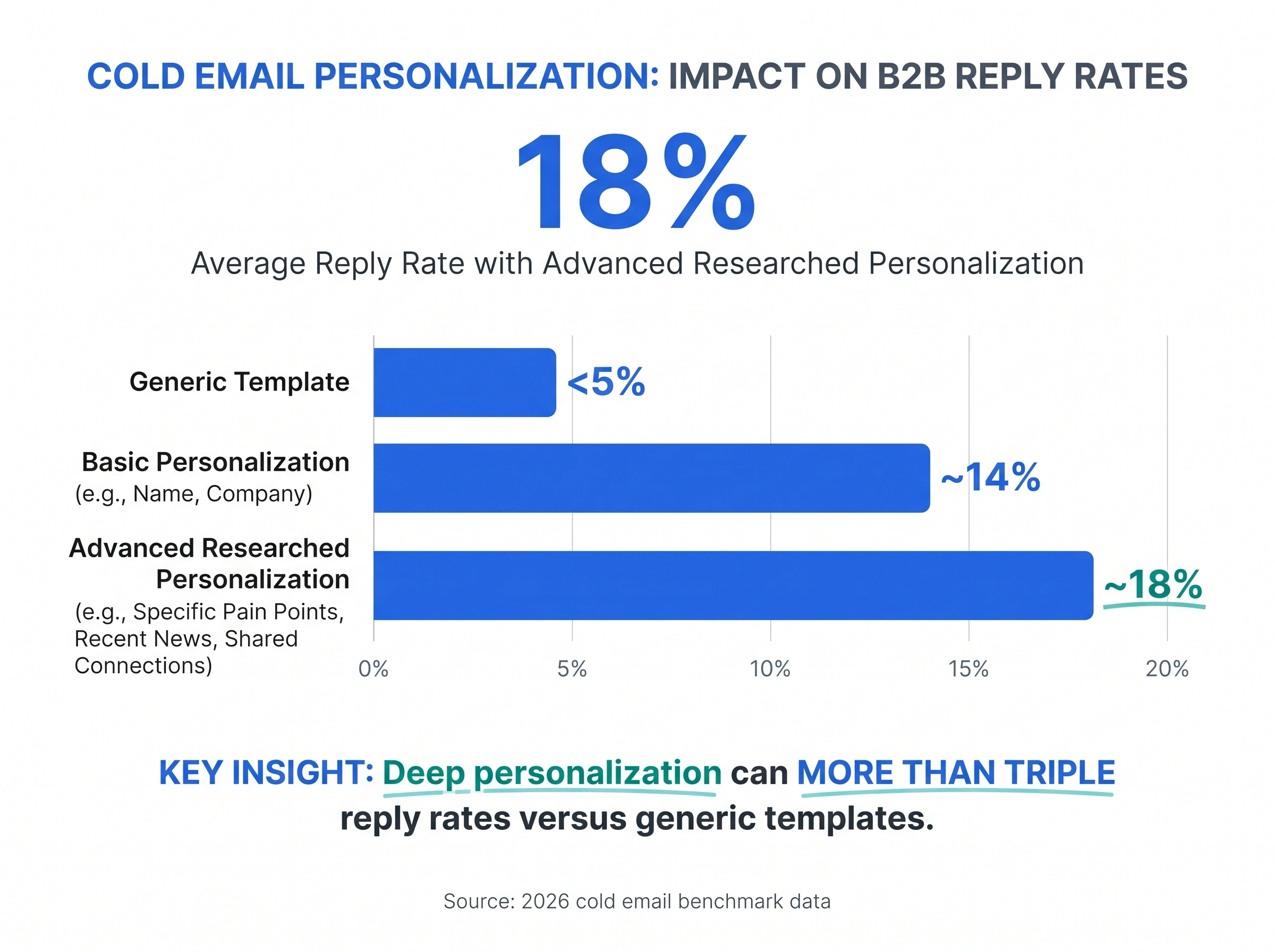
This is the single biggest lever in cold email. Deep, researched personalization can push replies near 18%, while generic templates sit under 5%, and basic merge-tag personalization lands around 14%. The jump from 14% to 18% is the difference between dropping in a first name and referencing something real about the prospect.
Why your personalization isn’t working. Usually because it’s fake. A first-name tag on a mass blast isn’t personalization, and buyers spot it instantly. The other failure is generic “I loved your work” flattery that could apply to anyone. Real personalization references something specific and current, which proves you actually looked. Without that, you’re just a polite blast.
How to improve it.
- Spend two or three minutes per prospect finding two specific, current details: a funding round, a job posting that hints at a pain, a product launch, a recent post.
- Lead the email with their context, not your pitch.
- Use AI to research at scale, then have a human edit so it doesn’t read like every other AI email.
- Prioritize depth over volume. A smaller, deeply personalized batch beats a big generic one. Here’s how personalization in cold emails moves the number.
With SmartReach: the Smart Email AI Agent researches each prospect and drafts personalized openers at scale, so depth doesn’t cost you hours per list.
7. Personalized subject lines lift open rates by about 50%
A personalized subject line can raise open rates by roughly 50%, and length matters: 4-6 words (under 50 characters) tend to win, with 70-character subjects far outperforming 240-character ones. Phone screens cut subjects off after about 6-9 words, so anything longer gets truncated mid-thought.
Why your subject lines fall flat. They’re too long and get cut off on mobile. They’re generic (“Quick question”) so they signal a mass send. They use spam triggers like ALL CAPS, “FREE,” or “GUARANTEED” that hurt both opens and deliverability. Or they use fake “Re:” and clickbait tricks that torch trust the second the email opens and spike unsubscribes.
How to improve it.
- Front-load the hook in the first 4-6 words so it survives mobile truncation.
- Make it specific to them: “Question about [their initiative]” beats “Quick question.”
- Cut spam-trigger words and fake-reply tricks entirely.
- A/B test one variable at a time (length, personalization, a question vs a statement) and keep the winner. Here’s a guide to writing subject lines and body copy.
8. The best send windows are Tuesday and Thursday mornings
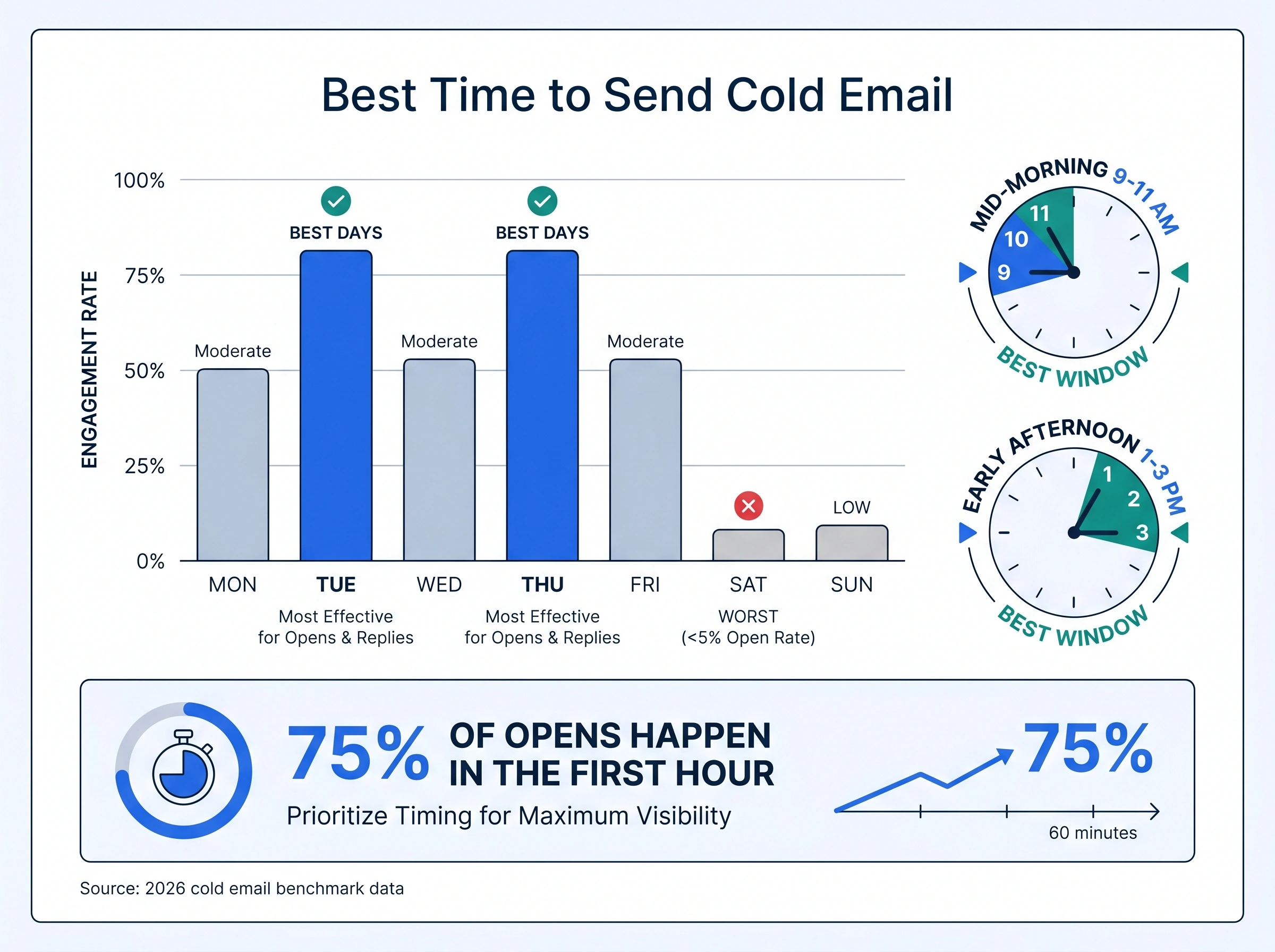
Tuesday and Thursday consistently top the charts, with mid-morning (9-11 AM) and early afternoon (1-3 PM) in the recipient’s time zone performing best. Saturday is the worst, often under 5% open rate. And speed matters on both ends: around 75% of opens and 40% of replies happen within the first hour.
Why your timing is hurting you. The usual mistake is blasting everyone at 9 AM your time, which lands at 6 AM or midnight for prospects in other zones. Sending on weekends or late evenings buries you. And being slow to answer replies lets hot interest cool, since a prospect is most engaged in the minutes after they hit send.
How to improve it.
- Schedule sends for Tuesday or Thursday mornings in the prospect’s time zone, not yours.
- Use timezone-aware sending so a tool splits delivery automatically. Here’s a cheat sheet on the best time to send emails.
- Avoid weekends and after-hours sends unless your data says otherwise.
- Turn on instant reply alerts and answer interested replies within minutes, not hours. Speed-to-lead is a top predictor of whether a reply becomes a meeting.
With SmartReach: Prospect-timezone sending delivers each email in the recipient’s local Tuesday or Thursday morning window automatically, so good timing never depends on your own clock.
9. Multichannel outreach can lift positive replies up to 8x
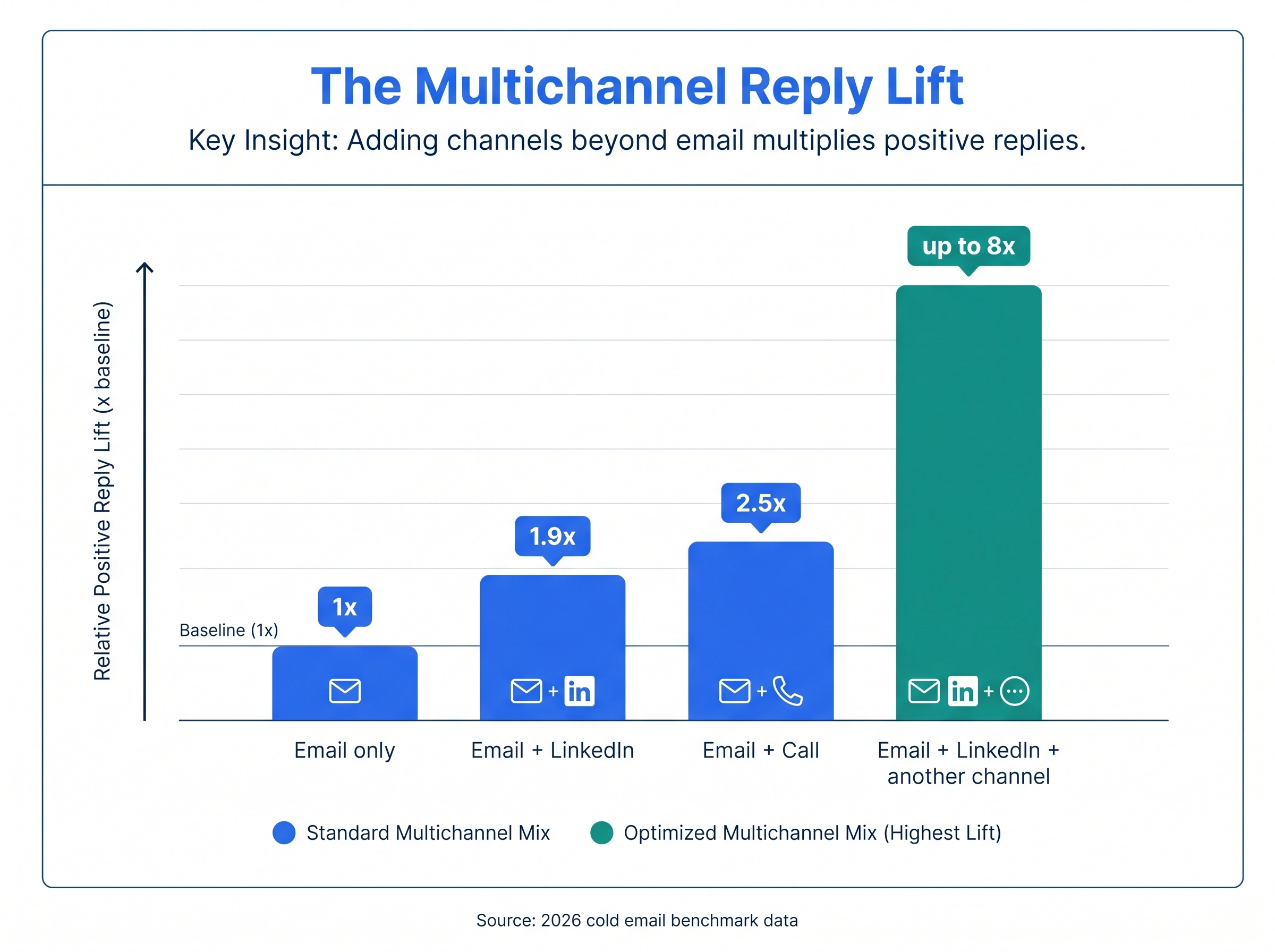
Adding channels beyond email multiplies positive reply rates: email plus LinkedIn runs about 1.9x, email plus a call about 2.5x, and a three-channel mix up to 8x versus email alone. Yet most sequences are still email-only, which means the biggest lift in outbound is sitting unused for most teams.
Why email-only underperforms. A single channel gives you a single shot at attention, and cold email reply rates are falling on their own. If your prospect ignores email but is active on LinkedIn, an email-only sequence never reaches them where they actually are. Relying on one channel also concentrates all your risk in your sending domain’s deliverability.
How to improve it.
- Add a LinkedIn touch (a profile view, then a connection request or comment) and a call to your highest-priority sequences first.
- Sequence the channels: email, then LinkedIn, then a call, spaced over the cadence so each reinforces the last.
- Build it into a multichannel sequence so reps don’t have to remember each manual step.
- Start with your best-fit accounts, where the extra effort per prospect pays off most.
With SmartReach: the multichannel feature runs email, LinkedIn, and calls from one sequence, so the 8x lift doesn’t add manual work for your reps.
10. The average cold email bounce rate is 7-8%, but it should be under 2%
Cold lists bounce far more than opt-in ones (7-8% versus under 2%). Verified lists get roughly 2x the reply rate of unverified ones and bounce about 40% less, so list hygiene pays off twice. Anything over 3% is a danger zone.
Why your bounce rate is high. Bought or scraped lists full of dead and invalid addresses. Stale data that’s gone out of date since you collected it. Or sending to role addresses (info@, sales@) that bounce or get filtered. A high bounce rate tells Google and Microsoft your list is low quality, and they throttle your whole domain for it, which quietly drags down every campaign you run.
How to improve it.
- Run every list through email validation before you send a single email.
- Stop buying lists. Build from verified sources and keep them fresh.
- If a live campaign climbs over 3%, pause it and clean the data rather than pushing through.
- Remove role-based and catch-all addresses that inflate bounces and complaints.
With SmartReach: the spam test report flags deliverability and list problems before you hit send, so bounces don’t quietly damage your domain.
11. Keep spam complaints under 0.3% or your domain gets throttled
Google’s Q4 2024 rules (with Microsoft following in 2025) set a hard 0.3% complaint ceiling, with under 0.1% as the real target. Cross it and your sender reputation tanks for everyone on the domain, not just one campaign. Deliverability is now the gate that decides whether any of your other numbers even exist.
Why you’re landing in spam or getting complaints. Missing authentication (no SPF, DKIM, or DMARC). A cold domain sending volume on day one with no warmup. Sending too many emails too fast, or to too many contacts at one company. Spam-trigger language and heavy links. And irrelevant targeting, since the fastest way to earn a complaint is to email someone who never wanted to hear from you.
How to improve it.
- Authenticate every sending domain with SPF, DKIM, and DMARC.
- Warm up new domains and mailboxes before sending real volume, and use inbox rotation to spread the load.
- Keep daily volume per mailbox modest and ramp gradually.
- Cut spam-trigger words and keep links light.
- Monitor complaint and placement rates weekly, and protect sender reputation like the asset it is. For the full picture, see our guide to cold email analytics and the 15 KPIs to track.
12. Elite cold emails stay under 80 words
The best-performing first emails run under 80 words, with 50-125 words as the workable range. Long enough to make a point, short enough to read on a phone in ten seconds. Nobody replies to a wall of text from a stranger.
Why your emails are too long. You’re explaining too much before earning the right to. Long emails usually try to make the whole case in one shot, list multiple features, or include several asks. On mobile, where most cold emails are read, that’s an instant delete. Length also dilutes your one clear ask into a paragraph the prospect has to decode.
How to improve it.
- Cut to one idea and one ask per email. Save the detail for the reply.
- Write it, then delete a third. Most cold emails are 30% padding.
- Read it on your phone. If it needs scrolling, it’s too long.
- Replace background paragraphs with a single specific, relevant line about the prospect.
13. Reaching 1-2 contacts per company beats blasting 10+
Targeting 1-2 well-chosen people at an account tends to produce reply rates around 7-8%, while spraying 10+ people at the same company can drop toward 3-4%. Precision beats volume, and it protects your domain at the same time.
Why spray-and-pray fails. Emailing everyone at a company looks like spam to both the recipients and the inbox provider, and it raises your complaint risk fast. It also wastes sends on people who don’t own the problem you solve, dragging down your reply rate. More names is not more pipeline; it’s usually more noise and more risk.
How to improve it.
- Cap contacts per account at two or three, chosen by how directly they own the problem you solve.
- Lead with the single person most likely to feel the pain, and ask them for a referral to the right colleague.
- Spend the time you save on researching those few contacts deeply (see stat 6).
- Build tighter lists. A focused list of 200 great-fit contacts outperforms 1,000 loose ones.
14. Cold email costs about $152 per meeting versus $2,800 for cold calling
Industry estimates put a cold-email meeting near $152 against roughly $2,800 for one booked by calling, and cold email returns about $36-$42 for every $1 spent. The economics are the real reason cold email survives even as reply rates fall: it scales cheaply.
Why your cost per meeting is too high. Low conversion at any funnel stage drives the cost up, since you’re paying (in time and tools) for sends that go nowhere. Burning expensive rep time on cold calls that could have started as email. And chasing volume instead of fit, which means more sends for the same number of meetings.
How to improve it.
- Measure cost per opportunity, not cost per send. That’s the number finance cares about.
- Lead with email to fill the funnel cheaply, and reserve calls for prospects who’ve already shown interest.
- Improve the conversion levers above (targeting, personalization, follow-ups), since each one lowers cost per meeting directly.
- Automate the repetitive work so rep time goes to replies and meetings, not manual sending.
15. The average cold email click-through rate is 3-4%
When your email includes a link (a calendar, case study, or demo), click-through rate becomes a useful mid-funnel signal, averaging 3-4%. But a click isn’t a conversion: it shows interest, not intent, and plenty of clicks lead nowhere if the next step is unclear.
Why your clicks don’t convert. Too many links competing for attention, so the prospect doesn’t know what you actually want. A landing page or booking step that doesn’t match the email’s promise. Or no tracking, so you can’t even tell which clicks turned into outcomes. A clever subject that earns the open but a muddled CTA wastes the whole effort.
How to improve it.
- Use one clear call-to-action (CTA) per email, not three competing ones.
- Make the click’s destination match the email exactly (same offer, same language).
- UTM-tag every link and connect it to your CRM so you can measure click-to-meeting, not just clicks.
- Reduce friction at the next step: a direct calendar link beats “let me know and we’ll find a time.”
The 15 above are where most of your gains live. These last 10 round out the picture, and each still points to a clear action.
16. Cold email reply rates have fallen every year since 2019
Reply rates have slid steadily: 8.5% in 2019, around 5% in 2025, and roughly 3.4% in 2026. This isn’t a blip, it’s a structural shift. Every year more teams pile into cold email, inbox providers tighten their filters, and AI tools flood inboxes with near-identical messages that train buyers to ignore anything templated. The result is a rising bar: the same email that earned replies three years ago now gets skipped. The teams holding steady or climbing treat cold email as a craft, not a volume game.
Quick trick: pull your own reply-rate trend for the last 12 months and lay it next to this decline. If you’re falling faster than the market, the problem is yours to fix (usually deliverability or targeting), not the channel’s.
17. Open rates dropped from 36% in 2023 to 27.7% in 2024
Belkins data shows average open rates fell nearly ten points in a single year. Two forces drive it: privacy changes like Apple Mail Privacy Protection that distort tracking, and inbox providers filtering more aggressively. The practical effect is that an open rate you’d have called weak two years ago might be perfectly healthy today, so judging this year’s campaigns against old numbers will mislead you every time. Open rate is also the metric most polluted by bot opens, which makes year-over-year comparison shaky on its own.
Quick trick: rebaseline once a year. Set your target from your own last-90-day average, then watch the trend line instead of chasing an absolute number that the whole industry has quietly moved.
18. About 80% of closed B2B deals need five or more touchpoints
Roughly 80% of closed deals need five or more touchpoints, yet most reps stop after one or two. That gap is where pipeline quietly dies. The first email rarely lands at the right moment, and a single follow-up isn’t enough to break through a busy inbox. The fifth touch, the one almost nobody sends, is frequently where the prospect finally has the bandwidth to engage. Done right, persistence reads as confidence, not nagging.
Quick trick: count the average number of touches in your current sequences. If it’s under five, you’re leaving deals on the table, so add non-email steps (a LinkedIn view, a call) to reach five-plus touches without sending five emails that all look the same.
19. 75% of opens and 40% of replies happen within the first hour
Cold email has a short half-life. If your message doesn’t catch the prospect during an active inbox session, it slides down and rarely resurfaces. This cuts two ways. On the send side, timing decides whether you land during a checking window. On the reply side, an interested prospect is hottest in the minutes right after they respond, and your odds of booking drop with every hour you wait.
Quick trick: turn on instant reply notifications and treat interested replies like inbound leads. Answering within five minutes instead of five hours is often the difference between a booked meeting and a trail that goes cold.
20. Verified email lists get roughly 2x the reply rate of unverified ones
Verified lists reply at about twice the rate of unverified ones and bounce around 40% less. The logic is simple: clean lists actually reach real people, while dirty lists waste sends on dead addresses and quietly wreck your sender reputation. Every hard bounce tells Google and Microsoft your data is stale or bought, and they throttle your whole domain in response, dragging down even your good campaigns. So verification lifts replies and protects deliverability at the same time.
Quick trick: make validation a non-negotiable step, not an afterthought. Run every list through an email validator before the first send, and re-verify any list older than 30 days, because contact data decays faster than most teams expect.
21. Cold email returns $36 to $42 for every $1 spent
Cold email still posts one of the highest ROIs of any marketing channel. That economics is why it survives the deliverability crackdowns and falling reply rates: even at a 3.4% average reply rate, the cost per opportunity stays low because sending is cheap and scales. The trap is measuring the wrong thing. Teams that obsess over cost per send miss the point, when the number that matters is cost per booked meeting or per opportunity.
Quick trick: calculate your true cost per opportunity by dividing total program cost (tools plus rep time) by opportunities created, then track it monthly. It’ll guide your budget far better than open or reply rates alone.
22. AI now handles close to 80% of prospect research for elite teams
AI agents now do close to 80% of prospect research and sequencing for top outbound teams, and AI-assisted personalization can lift replies meaningfully. But the catch is sharpening: buyers and spam filters are learning to spot generic AI writing, and an unedited AI email reads exactly like the thousand others in the inbox. The winners use AI as an accelerator, not an autopilot. They let it research at scale and draft a first version, then a human adds the specific detail and trims the robotic phrasing.
Quick trick: use AI for the research and the skeleton, then rewrite the opening line yourself with one real, current detail about the prospect. That single human touch is what separates a reply from a delete.
23. Tightly targeted campaigns (under 200 prospects) reply at 15-20%
Campaigns to fewer than 200 well-chosen prospects routinely reply at 15-20%, while big generic lists over 1,000 often fall below 8%. The math is counterintuitive but consistent: fewer, better-fit contacts beat more loosely-targeted ones, because relevance drives replies while irrelevance drives deletes and complaints. A smaller list also lets you research each prospect properly and protects your domain from the volume that trips spam filters. Quality of fit beats quantity of names every time.
Quick trick: before launching, audit your list against your ideal customer profile and cut anyone who doesn’t clearly fit. A focused list of 200 great-fit contacts will out-book a sloppy list of 1,000, in less time.
24. Around 99% of outreach sequences are still email-only
Almost all outreach sequences remain email-only, which is exactly why the multichannel lift is such an easy edge. While most teams fight over the same inboxes, adding a LinkedIn touch or a call reaches prospects where they actually pay attention and multiplies positive replies (up to 8x for a three-channel mix). The old barrier was effort, since coordinating channels by hand is painful, but modern sequencing tools make it practical to run email, LinkedIn, and calls from one cadence.
Quick trick: take your single best-performing email sequence and add two non-email steps: a LinkedIn profile view and connection request early, then a quick call after the second email. You’ll stand out simply because almost nobody else bothers.
25. Most cold emails are now read on mobile
Most cold emails are opened on a phone, and mobile changes everything about how your message lands. Phone screens cut subject lines off after roughly 6-9 words, so a long subject gets truncated mid-thought and loses its hook. Long emails that look fine on a desktop become a wall of text deleted with one thumb. The reader is scanning in seconds between other tasks, not studying your pitch.
Quick trick: write and proof every cold email on your phone, not your laptop. Keep subject lines to 4-6 words with the hook up front, and keep the body under 80 words so the whole message fits on one screen without scrolling.
What’s a realistic cold email response rate?
Here’s the honest answer: it depends on your market, but for most B2B teams in 2026, a realistic cold email response rate is 3-5%, and a genuinely good one is above 5%.
The reason “realistic” is slippery is that reply rates swing hard by industry. Based on Belkins benchmarks, software and SaaS often sit at the bottom (sometimes under 1%, because everyone targets the same buyers), while marketing, eCommerce, healthcare, and finance cluster higher around 4-5%:
| Industry | Avg reply rate | Avg conversion range |
|---|---|---|
| Software / SaaS | 0.5-2% | 1.5-3% |
| Marketing | 4.3% | 2-5% |
| eCommerce | 4.8% | 2.5-4.5% |
| Healthcare | 4.9% | 1-3% |
| Finance | 4.8% | 1-2.5% |
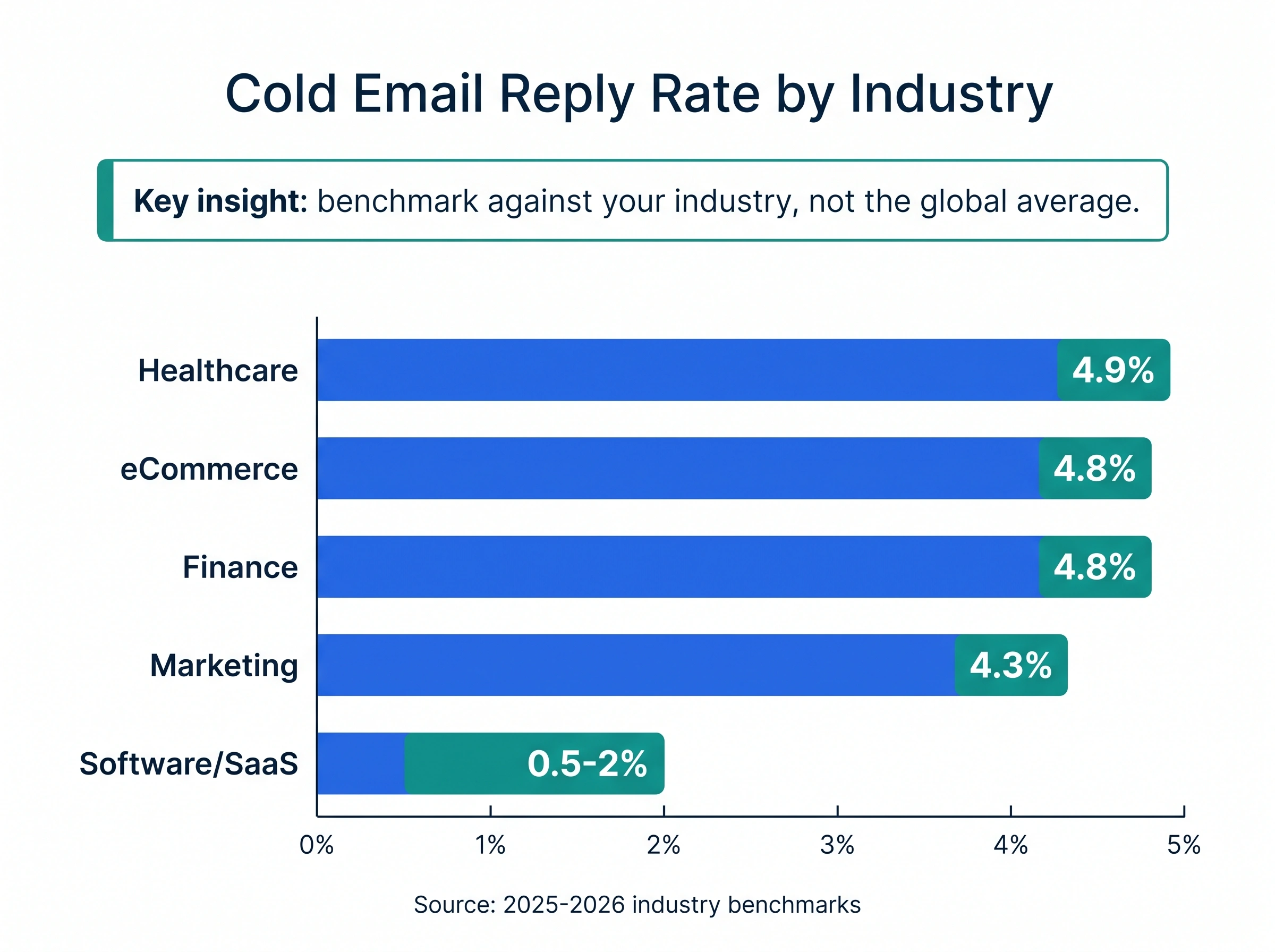
So don’t chase the global average. Beat your industry’s benchmark, grow your positive reply rate over time, and treat 5% as the line that separates an average campaign from a good one.
How many cold emails until you get one reply?
At the 3.4% average, you need about 30 delivered emails per reply. But that number drops fast with the right approach, and a quick example shows why.
Take Amy, a senior SDR sending 200 emails a week. At a 4% reply rate, her first send earns about 8 replies. Add three well-spaced follow-ups and she lands closer to 14, without sourcing a single new prospect. Now have her cut her list to the 1-2 best contacts per account instead of 10, and her reply rate climbs toward 7-8%, roughly doubling her conversations again.
So the real answer to “how many cold emails until a reply?” is about 20-30 at average rates, but you can cut that to 12-15 with tight targeting and a proper follow-up sequence. Volume is the lazy lever. Targeting and follow-ups are the smart ones.
How to track cold email performance?
You can’t improve what you don’t measure. Here’s a repeatable way to track performance, whether you’re a solo founder or running a team of SDRs.
- Pick your core metrics. At minimum: delivery rate, open rate (directional), reply rate, positive reply rate, meetings booked, and bounce rate.
- Use the right formulas. Reply rate = replies ÷ delivered × 100. Positive reply rate = interested replies ÷ delivered × 100. Always divide by delivered, not sent.
- Track the eight signals the pros watch. Beyond opens and replies, lead-gen teams track positive reply rate, deliverability health score, lead-to-meeting rate, spam complaint rate, sequence drop-off points, bounce type (hard vs soft), reply intent (interested, not interested, out-of-office, do-not-contact), and response time to inbound replies.
- Connect clicks and replies to outcomes (meetings, pipeline, revenue) with UTM tags and your CRM. A high open rate that produces zero meetings is a vanity metric.
- Watch deliverability weekly. Bounce rate, spam complaints, and inbox placement catch problems before they kill a campaign.
- Compare against your own baseline. Last month versus this month tells you more than any global benchmark.
A good sales engagement platform automates this. SmartReach.io tracks open, reply, and positive reply rates, sequence-level drop-off, deliverability health, and link clicks in one dashboard, so you’re not stitching spreadsheets together to answer “is this working?”
That single-dashboard view is the difference between reacting to problems and catching them before they sink a campaign.
Cold email trends shaping 2026
The benchmarks tell you where things stand. These trends tell you where they’re going.
Agentic AI is replacing manual outbound steps. AI agents now handle close to 80% of prospect research and sequencing for elite teams, and AI-assisted personalization can lift replies meaningfully. The catch: AI-written emails that aren’t carefully edited get ignored or flagged because they read the same. The winners use AI to scale research, then humanize the AI output and rewrite drafts with tools like TheReword so emails still sound human.
ESPs now judge behavior, not just content. Spam filters used to scan words. Now Google and Microsoft watch sending patterns: volume spikes, engagement, complaint rates, authentication. You can write a clean email and still land in spam if your sending behavior looks robotic, which is why warmup and inbox rotation matter more than ever.
Multichannel is becoming the default. With email-only reply rates falling, more teams add LinkedIn, calls, and other touches. The multichannel lift (up to 8x positive replies) is too big to ignore.
Brand presence is a quiet ranking factor. Buyers Google you before replying. A real website, active LinkedIn, and visible content make cold outreach warmer and convert cold into “I’ve heard of them.”
Signal-based outreach is winning. Instead of blasting a static list, top teams trigger emails off signals (a funding round, a new hire, a tech change). Timing the message to a real event beats volume every time.
The bottom line
Cold email isn’t dead, but the lazy version is. The averages keep sliding because most senders still blast generic emails to loose lists and stop after a single touch. The teams pulling ahead do the opposite: they target tightly, personalize with real research, follow up four or five times, add LinkedIn and calls, and guard their deliverability like the asset it is. Every benchmark in this guide is a lever you can actually move.
So pick one. Don’t try to fix all 25 numbers at once. Find your weakest metric, work through the “how to improve it” steps above, and measure the change against your own baseline next month. Small, compounding wins beat chasing one perfect campaign.
Run your targeting, personalization, multichannel follow-ups, and deliverability tracking from one place.
Start your free trial on SmartReach
No credit card needed to start.
Frequently asked questions
What is a good open rate for cold email in 2026?
A good cold email open rate is roughly 40-60%, with elite campaigns above 65%. But because Apple Mail Privacy Protection auto-opens many emails, treat open rate as a directional signal and judge success on replies and meetings instead.
What is a good cold email response rate?
A good cold email response rate is above 5%. The 2026 average sits around 3-4%, so beating 5% puts you ahead of most senders. Above 10% is elite, and tightly targeted campaigns can reach 15-25%.
Is cold email still effective in 2026?
Yes. Cold email still returns roughly $36-$42 for every $1 spent and costs far less per meeting than cold calling. Average reply rates have fallen, but well-targeted, personalized, multichannel campaigns perform better than ever.
What is a good cold email conversion rate?
A good cold email conversion rate is 1-5% to reply and 1-3% of sent emails to a booked meeting. Top performers convert 5-8% of emails into meetings, or about 2-3 meetings per 100 emails sent.
Why are my cold email open rates so low?
Low open rates usually come from four causes: weak or generic subject lines, poor list targeting, landing in spam (a deliverability problem), or bad send timing. Check deliverability and subject lines first, since those move the number most.
How do you measure cold email success?
Measure success by positive reply rate and meetings booked, not opens. Track reply rate (replies divided by delivered), positive reply rate, bounce rate, and conversion to meetings, then compare against your own baseline over time.
How many cold emails can you send per day?
To protect deliverability, keep new mailboxes to about 20-50 emails per day and scale gradually as your domain warms up. Spreading volume across multiple mailboxes with inbox rotation lets you send more without hurting sender reputation.