Email Compliance Laws: Definitive Legal Guide for Marketers

Understanding and complying with email compliance laws are critical for anyone who runs some sort of email campaigns to reach prospects globally.
According to Statista, in 2023, nearly 46% of all global emails were categorized as spam source—highlighting the need for businesses to remain compliant.
Violating email marketing regulations can lead to heavy fines, damaged reputations, and legal trouble.
In this guide, we will break down the key email compliance regulations and the best practices to avoid them.
By the end of this article, you will have a thorough understanding of how to structure your cold email outreach while ensuring compliance with major email marketing laws worldwide.
Before we proceed for the strategies, let’s answer the most important question first.
Is sending cold emails illegal?
Cold emailing is legal in most regions if it follows the right email compliance rules of the region.
These email marketing laws differ based on where you operate and who you are emailing.
You need to understand the differences between cold emails, unsolicited emails, and spam to actually be safe from any penalties or restrictions.
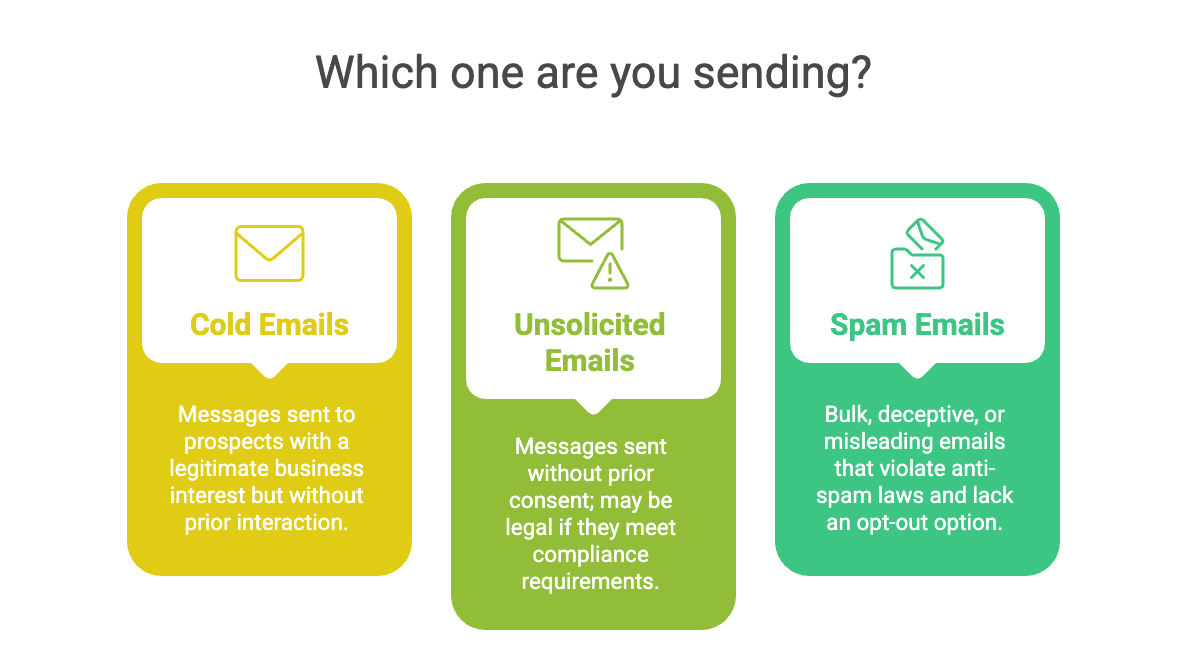
- Cold emails → Messages sent to potential prospects with a legitimate business interest but without prior interaction.
- Unsolicited emails → Messages sent without prior consent; may be legal if they meet compliance requirements.
- Spam emails → Bulk, deceptive, or misleading emails that violate anti-spam laws and lack an opt-out option.
Now to maintain compliance, follow the email marketing regulations of your target region (such as GDPR, CASL, CAN-SPAM etc.)
TL;DR – Cold email compliance Checklist
Before you dive into the laws in detail, here’s a quick checklist to keep your cold email campaigns compliant across major jurisdictions:
- ✅ Include a clear opt-out or unsubscribe link in every email
- ✅ Use real sender name and a valid reply-to email address
- ✅ Never use misleading subject lines or “clickbait” tactics
- ✅ Respect regional laws: GDPR (EU), CAN-SPAM (US), CASL (Canada), etc.
- ✅ Honor opt-out requests within 10 business days (US), immediately (EU/Canada)
- ✅ Use double opt-in or documented consent for GDPR/CASL compliance
- ✅ Maintain records of consent and communication
- ✅ Authenticate emails using SPF, DKIM, and DMARC
- ✅ Avoid scraping email addresses without permission
- ✅ Use SmartReach.io to automate compliance features like opt-outs and domain authentication
Different email compliance laws and regulations
To comply with anti-spam laws for cold emailing, you first need to understand the email compliances and regulations of different countries where your prospects might be located.
So, let’s take a look at the most important email compliance laws first.
Here’s a table that outlines the differences between the most important email laws.
| Requirement | CAN-SPAM (US) | GDPR (EU) | CASL (Canada) |
|---|---|---|---|
| Consent Required? | No, but opt-out is | Yes, explicit opt-in | Yes, express or implied |
| Opt-out Deadline | Within 10 business days | Immediate | Immediate |
| Sender Identity | Must be clear | Must be clear | Must be clear |
| Subject Line Rules | No misleading content | No deceptive language | No misleading claims |
| Record Keeping | Not mandatory | Mandatory | Mandatory |
| Penalty for Violation | Up to $46,517 per email | Up to €20 million or 4% of global revenue | Up to $10M CAD |
| Applies to B2B? | Yes | Yes | Yes |
Now we have discussed about them in details below.
1) CAN-SPAM Act (United States)
The Controlling the Assault of Non-Solicited Pornography and Marketing Act of 2003 (CAN-SPAM) governs commercial email practices in the U.S. It applies to all promotional emails, not just bulk messaging.
Key requirements include ⤵️
- No misleading header information in the email
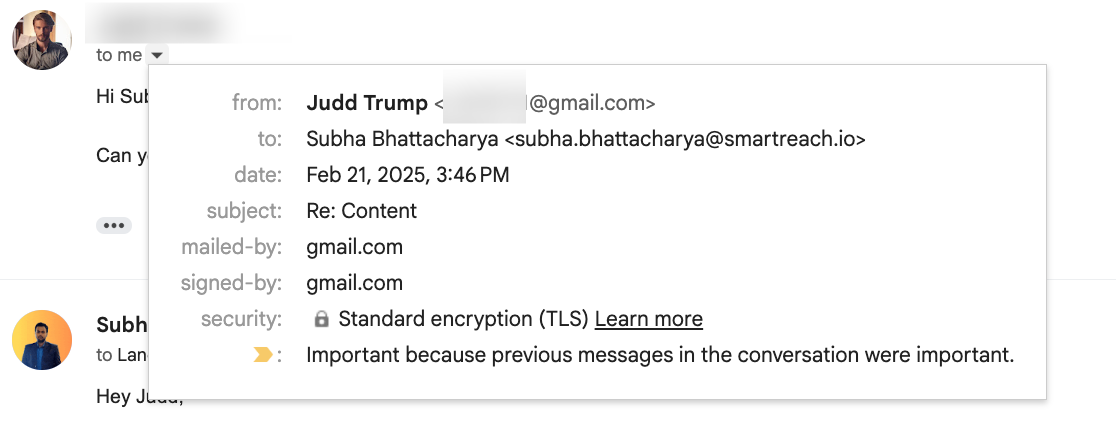
The “From,” “To,” and “Reply-To” fields must accurately identify the email sender.
- No deceptive email subject lines
The email subject line must reflect the content of the email.
- Include a valid postal address
A physical mailing address must be present in the email.
- Provide a clear opt-out method from the emails
Recipients must have an easy way to unsubscribe, and opt-out requests must be processed within 10 business days.
- Identify advertisements in the mail
If the email contains promotional content, it should be clearly labeled as an ad.
💡 Note: Violations of CAN-SPAM can result in fines of up to $53,088 per email (FTC, 2024).
Now that you know the rules, here’s how to apply them in your day-to-day email marketing campaigns.
Steps to ensure CAN-SPAM compliance
Following these steps will help your business stay compliant with the CAN-SPAM Act and build trust with your audience:
- Use an accurate sender name and email address – Make sure the “From,” “To,” and “Reply-To” fields clearly show your business identity.
- Write honest subject lines – Avoid clickbait or misleading language. Your subject should reflect the actual content of the email.
- Include a valid business address – Add your physical mailing address in every marketing email.
- Provide a clear unsubscribe option – Add a visible opt-out link in every email and process requests within 10 business days.
- Label promotional content – Clearly state when an email is an advertisement to maintain transparency.
______________________________
2. GDPR (General Data Protection Regulation – Europe)
GDPR, enforced by the European Union, is one of the most stringent data protection regulations. It applies to businesses that process the personal data of EU citizens, regardless of location.
GDPR imposes strict requirements on email marketing:
- Explicit consent required
Businesses must obtain opt-in consent before sending marketing emails.
- Right to be forgotten
Recipients can request the deletion of their personal usage data.
- Data transparency
Companies must disclose how they collect and use personal data.
💡 Note: Failing to comply with GDPR can result in penalties of up to €20 million or 4% of global annual revenue, whichever is higher.
To make sure your campaigns follow GDPR and avoid costly mistakes, follow these simple steps.
Steps to ensure GDPR compliance
If you send marketing emails to recipients in the EU, these steps will help you comply with GDPR requirements:
- Get explicit consent before sending emails – Use clear opt-in forms and avoid pre-checked boxes. Double opt-in is recommended for stronger proof.
- Be transparent about data use – Tell recipients how their information will be used and link to your privacy policy.
- Offer an easy opt-out and data deletion option – Make it simple for users to unsubscribe or request deletion of their data at any time.
- Keep consent records – Store the date, method, and content of each consent so you can prove compliance if needed.
- Update your privacy practices regularly – Review your email marketing process to make sure it meets current GDPR standards.
__________________
3. CASL (Canada’s Anti-Spam Law)
Canada’s CASL is one of the most restrictive anti-spam laws in the world. It applies to both domestic and international businesses sending emails to Canadian recipients.
Key CASL requirements ⤵️
- Express or implied consent is required
Businesses must obtain either express (direct permission) or implied consent (existing business relationship) before emailing recipients.
- Unsubscribe mechanism in emails
Emails must include a clear and functional opt-out option.
- Clear email sender identification
Emails must contain accurate sender information, including a valid mailing address.
💡 Note: Non-compliance with CASL can lead to fines of up to $10 million per violation for businesses.
______________________
4. Other global email regulations
- PECR (UK) → A UK-specific law similar to GDPR, requiring consent for marketing emails.
- Australia’s spam act → Requires explicit permission before sending marketing emails and mandates clear unsubscribe options.
- California consumer privacy act (CCPA): Requires businesses to provide recipients with the ability to opt-out of having their personal data sold or shared, impacting how companies handle cold email lists
- Singapore’s PDPA (Personal Data Protection Act) → Requires organizations to seek consent before sending marketing communications.
7 Best practices for maintaining compliance for cold emails
Following are some of the best practices that you should follow in your cold email outreach process to stay clear of anti-spam laws.
1. Obtain proper consent
Determine whether explicit or implied consent is required based on the laws in your target region.
For example, under GDPR, you must obtain explicit consent before emailing prospects, whereas CAN-SPAM allows outreach if you provide an opt-out option
When in doubt, always use permission-based outreach to stay compliant.
2. Provide a clear & easy opt-out system in every email
Include a visible and functional unsubscribe link in every cold email.

Make opt-out requests easy to complete, and remove unsubscribers immediately from your email list. (within 10 business days for CAN-SPAM compliance).
3. Use business email addresses for cold outreach
Avoid sending cold emails from free email services like Gmail or Yahoo, as they appear unprofessional and may trigger spam filters.
Always send cold emails from business email addresses with custom secondary domains (e.g., [email protected]) to improve credibility and deliverability.
For example, if you are doing cold email outreach ⤵️
❌ [email protected] → reduce trust + looks unprofessional ☹️
✅ [email protected] → signals legitimacy + increases response rates 😃
4. Write helpful & honest email subject lines
Deceptive subject lines violate email compliance laws and may appear shady.
Such subject lines are mostly ignored and never opened by the recipients. So, your overall email campaign suffers from it.
Ensure your subject lines are clear, relevant, and accurately describe the content of your email.
Suggested: How to Write Cold Email Subject Line & Body Copy?
5. Include your contact information in emails
Always provide your company’s name, physical address, and a working reply-to email to comply with email laws and establish trust.
And it’s also a good idea to include –
- Your company’s Linkedin
- Website
- Social media channels (Youtube, X etc.)
- Ratings and reviews
For some additional branding and trust-building
💡Practical tip: You can include the above information in the email signatures.

6. Keep the email lists clean & updated
Regularly remove inactive contacts, invalid addresses, and unsubscribed recipients to avoid sending emails to people who don’t want them.
This will save you from unwanted spam complaints and your sender reputation doesn’t get hurt.
7. Process email unsubscribe requests immediately
Ignoring unsubscribe requests can result in email compliance violations and damage your sender reputation.
Always process opt-outs promptly and ensure recipients are removed from future emails.
💡 Practical tip: Try to process it within 24 hours as a best practice.
A warning for spammers ⚠️
Sending mass unsolicited emails without following regulations is a fast track to blacklists, legal fines, and reputation damage.
Email spamming damages your credibility and reduces deliverability rates.
Respect email laws and recipient preferences if you want long-term success in cold outreach.
Conclusion
To run a successful cold email outreach campaign while staying compliant, outbound teams must adhere to global email compliance laws.
SmartReach.io simplifies this process by providing automated email sequencing, built-in compliance checks, and easy opt-out management that ensure all your email outreach campaigns align with CAN-SPAM, GDPR, and CASL and other email law requirements.
The platform also offers AI-driven email personalization, email warm-up, and detailed analytics to help you make data-driven decision while ensuring full email compliance.
Trusted by over 3500+ businesses, SmartReach.io helps companies maintain a strong sender reputation, improve email deliverability, and avoid legal pitfalls.
Try SmartReach.io for FREE for 14-days. (No credit card required)
By following best practices and respecting recipient preferences, you can build trust, improve engagement rates, and maximize their cold email success without violating email regulations.
Frequently Asked Questions (F.A.Qs)
Q. Can you send marketing emails without consent?
In some countries like the U.S., you can send cold emails without prior consent if they comply with CAN-SPAM. However, GDPR and CASL require explicit permission before sending marketing emails.
Q. Is cold emailing illegal?
No. Cold emailing is legal if it follows regulations such as CAN-SPAM, GDPR, and CASL.
Q. Can you send unsolicited emails?
Yes, you can but they must comply with email regulations such as including opt-out options and accurate sender details.
Q. Is it illegal to email someone?
It is not illegal to email someone if you have their consent and comply with email marketing regulations. Always follow the best practices for cold email compliance, including obtaining consent, providing clear identification, and including an opt-out option.
Q. Can you cold email businesses?
Yes, B2B cold emails are generally allowed under CAN-SPAM, but GDPR and CASL require consent for certain contacts.
Q. What is CAN-SPAM?
The CAN-SPAM Act is a U.S. law that sets the rules for commercial email. It requires that emails are not misleading, include a clear opt-out mechanism, and honor opt-out requests promptly. Non-compliance can result in penalties of up to $43,792 per violation.
Q. Which type of communication does the CAN-SPAM act outlaw?
The CAN-SPAM Act prohibits misleading, fraudulent, and deceptive emails, particularly those without opt-out mechanisms or proper sender identification.
Q. Is it illegal to sign someone up for spam?
Yes, it is illegal to sign someone up for spam without their consent. Always obtain explicit consent from recipients before sending them commercial emails. This can be done through sign-up forms, double opt-in processes, or during business interactions.
Q. Do I need consent to email someone under GDPR?
Yes, in most cases. GDPR requires explicit opt-in consent or a legitimate interest with documented proof for outreach.
Q. What are the penalties for violating email laws?
Penalties vary by region—CAN-SPAM fines up to $46,517 per email, GDPR fines up to €20 million or 4% of global turnover, CASL fines up to $10M CAD.
Q. How can I automate compliance in email outreach?
Use tools like SmartReach.io that auto-insert unsubscribe links, provides authenticated email accounts, and provide sender ID transparency.
Q. Can I cold email B2B contacts legally?
Yes in the U.S. under CAN-SPAM. In the EU and Canada, you’ll need consent unless you meet specific business exemptions and log proof of legitimate interest.