Saleshandy vs Lusha | Finding Contacts or Reaching Them

On this page
Saleshandy vs Lusha is a comparison people run for a reason that is usually unspoken. They have a budget for one tool and two problems, and they are hoping one purchase solves both.
It will not, and the reason is worth understanding before you spend anything. Lusha exists to tell you who to contact and how to reach them. Saleshandy exists to do the contacting at volume. Those are different jobs with different unit economics, and the tools price them in ways that look comparable and are not.
Lusha did add a sequencer, which makes this closer than it used to be. Not as close as its pricing page implies.
Saleshandy vs Lusha at a glance
| Saleshandy | Lusha | SmartReach.io | |
|---|---|---|---|
| What it is | Cold email platform | B2B contact database | Cold email software |
| Entry price, monthly | $41 | Free, then $49.90 | $29 |
| Mid plan, monthly | $99 | $69.90 | $89 |
| Top published plan | $189 | $399.90 | $199 |
| Meter | Active prospects and emails | Credits | Active prospects |
| Credits a month | 1,500 / 4,000 / 8,000 | 40 free, then 400 / 600 / 3,400 | Included monthly |
| What a credit reveals | Verified email | Whole contact, phone included | Verified contact |
| Phone numbers | No | Yes, 85% US accuracy published | Via lead finder |
| Sequencing | Yes, the core product | Yes, Lusha Engage | Yes, conditional multichannel |
| Email warmup | Free, every plan | None | Included, 10 then 25 accounts |
| Inbox rotation | Yes | None | From Plus |
| Sending accounts | Unlimited | Not a sending platform | Unlimited from Basic |
| Emails a month | 6,000 / 100,000 / 200,000 | Not metered as sends | 10,000 on Basic, then unlimited |
| Intent signals | No | Yes | No |
| G2 rating | 4.6 | 4.3 | 4.6 |
They are not competing for the same job
The clearest way to see this is to ask what breaks if you only have one.
With Lusha alone you have a spreadsheet of accurate contacts and no safe way to email more than a handful of them. You can use Engage for a small sequence. Push volume through it and you are sending cold email from an unwarmed mailbox with no rotation, which is the fastest route to a spam folder in this entire category.
With Saleshandy alone you have sending infrastructure and 4,000 email credits a month on Pro, which is genuinely enough prospecting for most small teams. What you do not have is phone numbers, job-change signals or intent data.
So the question is not which tool is better. It is which half of the problem is actually stopping you.
If your reps have a list and cannot get replies, the constraint is deliverability and the answer is Saleshandy. If your reps have good sending set up and cannot find the right people, the constraint is data and the answer is Lusha.
What a credit costs on each side
Both sell credits. Their credits are not the same thing, and comparing the prices straight across is the single most common error in this comparison.
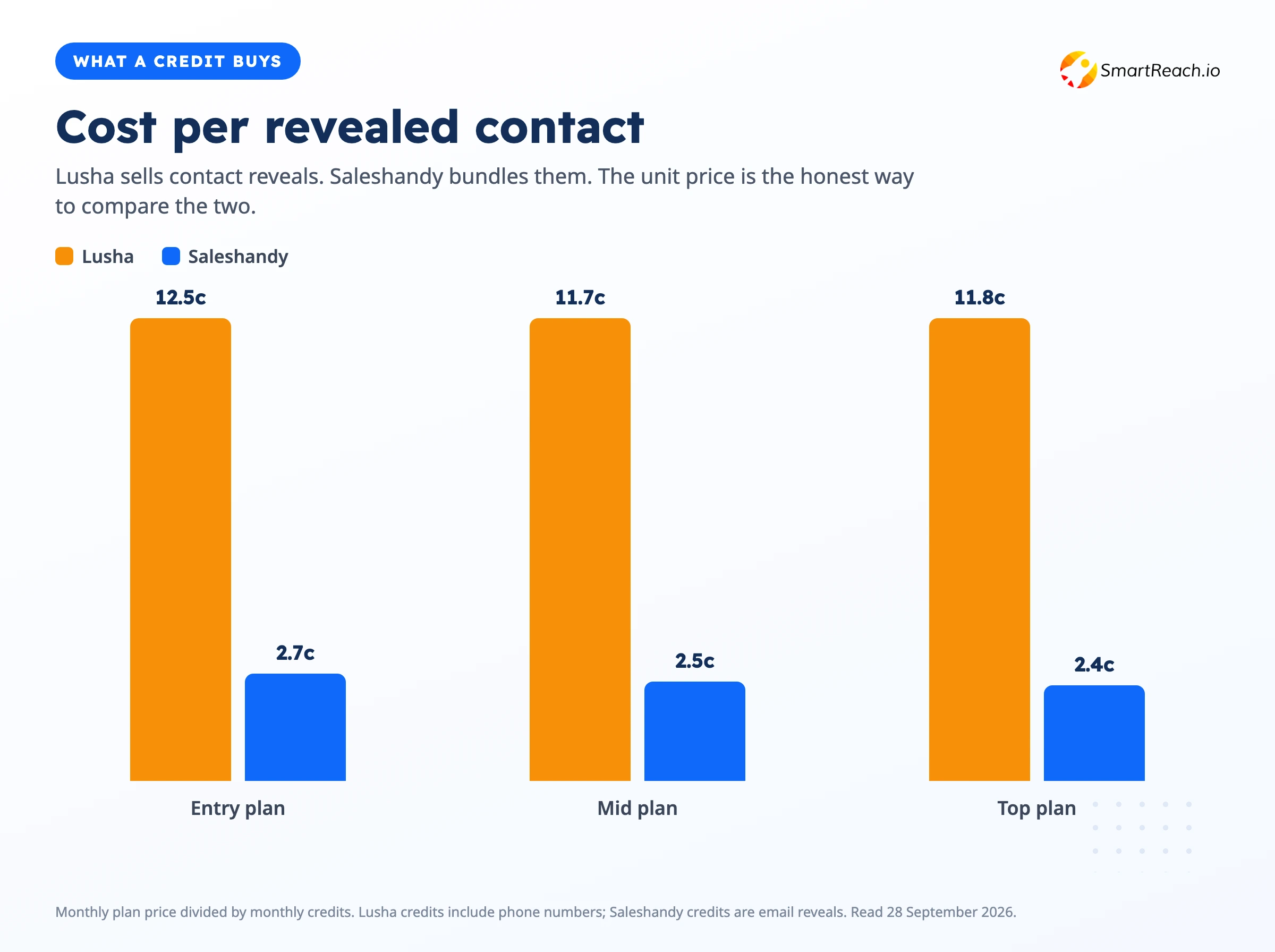
Lusha credits are four to five times the price of a Saleshandy credit, and they are not buying the same record.
Lusha Starter is $49.90 a month for 400 credits, which works out near 12.5 cents each. Professional is $69.90 for 600, about 11.7 cents. Premium is $399.90 for 3,400, about 11.8 cents. The price per credit is essentially flat across the range, which is unusual and worth knowing, because volume buys you no discount at all on the middle plans.
Saleshandy grants 1,500 credits a month on Starter, 4,000 on Pro and 8,000 on Scale. Against its plan prices that is roughly 2.7, 2.5 and 2.4 cents per credit, four to five times cheaper.
Now the caveat that makes the comparison fair. A Lusha credit reveals a whole contact record including the direct phone number where Lusha holds one. A Saleshandy credit reveals a verified email address. If you need the phone number, Saleshandy's cheaper credit does not solve your problem at any price.
Lusha Engage and what sits under it
Lusha Engage is a real sequencer. It runs multistep outreach, it is available across the paid plans, and any comparison that still describes Lusha as data-only is out of date.
What matters is what is not underneath it.
There is no email warmup, so a domain you start sending from has no reputation-building phase. There is no inbox rotation, so every send concentrates in the mailbox you connected. There is no mailbox or domain provisioning, no inbox placement testing and no blacklist monitoring.
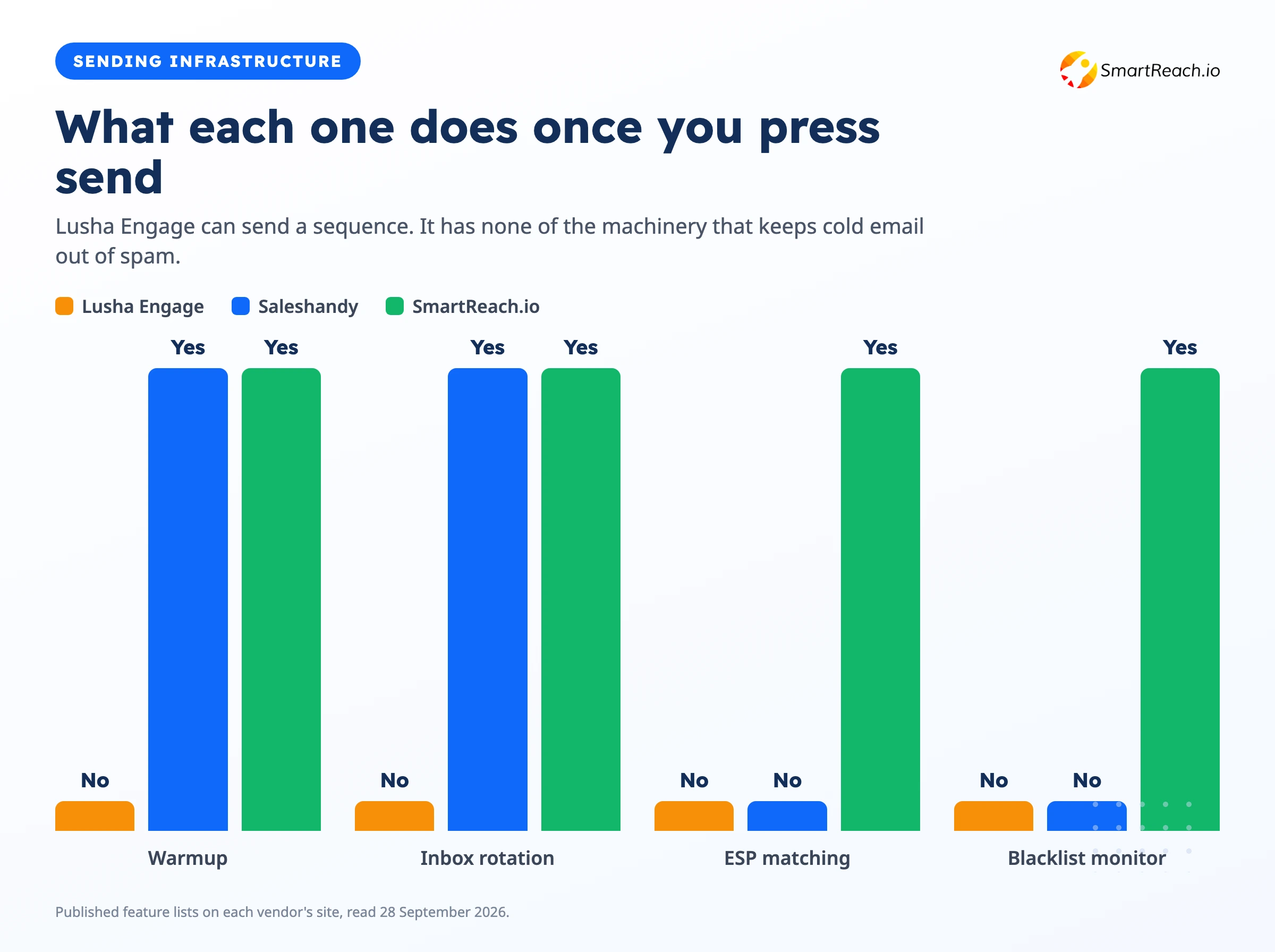
Engage can send a sequence. The four features that keep cold email out of spam are a different question.
That is a reasonable design choice rather than a defect. Engage is built for a rep following up on contacts they just revealed, maybe thirty or forty a week, sent from a real mailbox that already has a sending history. Used that way it works fine and saves a tab.
Used as a cold email platform against a two thousand person list, it is the wrong tool, and the failure mode is not subtle. Sender reputation collapses, the domain starts landing in spam, and the damage outlasts the campaign.
Saleshandy's whole product is the layer Engage is missing. Free warmup on every plan, sender rotation across unlimited mailboxes, and mailboxes at $2.99 to $3.99 each a month with DNS configured automatically.
Data quality, and what Lusha publishes
This is where Lusha is genuinely strong, and where it is honest in a way this category often is not.
Lusha publishes accuracy by data type rather than a single blended figure. 98% for email, 85% for US phone numbers and 86% globally. Splitting those out is more useful than one headline number, and the gap between them is the thing to plan around. Emails from Lusha are reliable. Roughly one dial in seven will be wrong, and you should staff for that.
It also offers job-change tracking as a search filter, which almost nothing else in this price range does. Pull everyone who changed roles in the last three, six or nine months and you have the warmest cold call available, because a new decision-maker is rebuilding a stack and has no preferred vendor yet.
The counterweight is the rating. Lusha sits at 4.3 on G2, the lowest of the major data vendors, with data inaccuracy the most common complaint theme. That is consistent with the 85% phone figure it publishes itself, and it is a fair trade rather than a scandal.
Saleshandy publishes 852M+ contacts and 42M+ companies but does not publish accuracy rates at all, which is the more common practice and the less useful one. Treat both record counts as self-reported, because nobody audits them.
The only test that settles it is the same for every vendor here. Pull fifty contacts in your real segment during the trial and count the bounces.
Where Saleshandy and Lusha both fall short
Neither is a complete outbound stack. That is the honest summary of this whole comparison. One is missing the data, one is missing the infrastructure, and most teams buying either end up buying something else within a year.
Neither automates LinkedIn. Saleshandy puts a LinkedIn step in the sequence and asks a human to perform it. Lusha does not sequence LinkedIn at all.
Neither does ESP matching or blacklist monitoring. Saleshandy has warmup and rotation, which is the first layer. Routing by recipient mailbox provider and pulling a campaign when a domain gets listed is the second, and neither reaches it.
Both meter in a way that hides the real number. Saleshandy's pricing page opens on annual. Lusha quotes credits per year. Neither is dishonest, and both make the headline figure look better than the monthly reality.
Which one should you buy
You have a list and cannot get replies
Saleshandy. The constraint is deliverability, and Pro at $99 a month gives warmup, rotation, unlimited mailboxes and 4,000 lead credits that cover early prospecting anyway.
Your reps live on the phone
Lusha. Direct dials at 85% published US accuracy, job-change filters and intent signals. Professional at $69.90 for 600 credits a month is the tier most calling teams land on.
You are sending fewer than 50 emails a week
Lusha Engage is probably enough, from a mailbox that already has sending history. Do not scale it without warmup underneath.
You need both halves and one bill
Neither on its own. Adding Lusha Professional to Saleshandy Pro is about $169 a month for two tools that do not share a view of the prospect.
Buying both, and what overlaps
The common pairing is Lusha for finding and Saleshandy for sending. One seat on both middle plans is roughly $169 a month, which is fair for full coverage.
Before you buy that stack, check the overlap. Saleshandy Pro already grants 4,000 email credits a month. If your reps mostly need email addresses, you are buying Lusha for the 600 credits that carry a phone number, and paying about 11.7 cents each for them. That may still be worth it. It is a different purchase from the one most people think they are making.
The second cost is the one no invoice shows. Two tools means two sources of truth about a prospect, and the reveal in Lusha does not know about the reply in Saleshandy. At fifty prospects a week that is a minor annoyance. At five hundred it is a data problem.
If the honest answer is that both halves matter, tools that include a database and real sending infrastructure on one bill are the shape worth shortlisting, and the Saleshandy alternatives roundup compares ten of them. The Saleshandy review breaks down its tiers, and Saleshandy versus Dripify and Saleshandy versus Smartlead cover the other two shortlists readers usually run alongside it. Saleshandy versus Apollo is the one to read if you want the database and the sequencer from a single vendor.
Is Saleshandy or Lusha better for cold email?
Saleshandy, clearly, because it is built for sending. It includes free warmup, sender rotation across unlimited mailboxes and up to 200,000 emails a month. Lusha Engage can send a sequence but has no warmup or rotation behind it. SmartReach.io adds ESP matching and blacklist monitoring on top of both, from $29 a month.
What does a Lusha credit actually buy?
A whole contact record, including the direct phone number where Lusha has one, which is why its credits cost more than an email-only reveal. Starter is $49.90 a month for 400 credits, about 12.5 cents each. Saleshandy grants 4,000 email credits on its $99 Pro plan, nearer 2.5 cents, but no phone numbers.
Does Lusha have email sequences?
Yes. Lusha Engage runs multistep sequences and is available across its paid plans, which is newer than most comparisons acknowledge. What it does not have is warmup, inbox rotation, mailbox provisioning or deliverability testing. Saleshandy has all but the last. SmartReach.io includes warmup, rotation and ESP matching from its $89 Email Outreach Plus plan.
How accurate is Lusha's data?
Lusha publishes accuracy by data type rather than one blended figure, at 98% for email and 85% for US phone numbers, which is more honest than a single number. Its G2 rating sits at 4.3, the lowest of the major data vendors, with accuracy the most common complaint. SmartReach.io draws from 300M+ contacts and 50M+ companies.
Can I use Saleshandy and Lusha together?
Yes, and it is a common pairing, with Lusha finding contacts and Saleshandy sending to them. One seat on both middle plans costs about $169 a month. The overlap is that Saleshandy already grants 4,000 email credits on Pro, so you are paying Lusha mainly for phone numbers and intent signals. SmartReach.io bundles lead credits with sending.
Which is cheaper, Saleshandy or Lusha?
Saleshandy at every comparable tier, though they sell different things. Saleshandy runs $41, $99 and $189 a month. Lusha runs $49.90, $69.90 and $399.90, and its credits are counted per month while quoted per year on the pricing page. SmartReach.io Email Outreach starts at $29 a month with lead credits included.
Does Lusha limit how many emails you can send?
Lusha meters credits rather than sends, so the practical ceiling is how many contacts you can reveal, at 400 a month on Starter and 600 on Professional. Saleshandy meters emails directly at 6,000, 100,000 and 200,000 a month. SmartReach.io meters only its $29 Basic plan at 10,000 emails and removes the ceiling above it.
Which one should a small sales team buy first?
Buy the sending tool first if you already have any list at all, because a contact you cannot email is worth nothing. Saleshandy Pro at $99 a month includes 4,000 lead credits, which covers early prospecting. SmartReach.io Email Outreach Plus is $89 a month with unlimited users, 50,000 active prospects and lead credits included.
Stop juggling tools
Book more meetings on every channel
Join 5,000+ teams running multichannel outreach from one sequence, with deliverability built in.