How to Increase Email Reply Rate for Cold Email Outreach?

On this page
Email is one of the most effective ways of communication and outreach, especially for small and medium businesses. With the number of email users growing past 4.6 billion, keeping track of and improving email metrics matters more than ever for sales teams. Of all those metrics, the one that maps most directly to pipeline is the email reply rate, and this guide is how to increase it, along with the benchmarks to measure against.
What is the email reply rate in the context of cold email outreach?
"Reply" denotes the response received from a prospect during the campaign period, and "reply rate" denotes the ratio of replies to the total number of prospects contacted successfully. It is the clearest early read on whether an outreach campaign is working, because unlike open rate it cannot be faked by automated inbox behaviour.
Reply rate vs positive reply rate
Not every reply is a good reply. Total reply rate counts every response, including "not interested," "unsubscribe," and "wrong person." Positive reply rate counts only genuine interest, and it is the number that maps to pipeline. As a rule of thumb, roughly one in five replies is positive, and about half of those positive replies turn into a booked meeting for a well-run team. Track both: total reply rate tells you whether your list and copy are landing, while positive reply rate tells you whether you are reaching the right people with the right offer.
How is the email reply rate calculated?
The email reply rate can be calculated by:
(Number of Replies received / Total number of Prospects Contacted Successfully) X 100 = Email Reply Rate
For example, if you contacted 100 prospects, 90 were reached successfully, and 5 replied, the reply rate would be:
(5/90) x 100 = 5.6% email reply rate
Reply rate varies by industry, list quality and offer, so treat any single benchmark with care. For cold email in 2026 the industry average sits around 3 to 5% (about 3.4% across large samples), down from 8.5% in 2019. Most in-house teams land near 5%, while specialist agencies that run cold email every day hold near 10%. You only see 15 to 20% on tightly targeted, signal-based lists of a few hundred prospects, never at volume. A practical target: 5% is baseline, 8% or higher is strong, and 10% or more is elite. For the wider picture, see our cold email statistics.
Cold email reply rate benchmarks by industry
Reply rates differ by vertical, and the gap between an average in-house program and a specialist agency running the same segment is remarkably consistent. These figures come from SmartReach.io's State of Cold Email 2026, first-party benchmarks drawn from 40M+ emails across 100+ agencies:
| Industry | In-house reply rate | Agency reply rate |
|---|---|---|
| Professional services | 6.0% | 10.5% |
| Healthcare | 5.0% | 8.5% |
| SaaS and technology | 4.5% | 8.0% |
| E-commerce and retail | 4.5% | 7.5% |
| Financial services | 4.0% | 7.0% |
Benchmark against your own industry rather than a global average, and read the agency column as what a well-run operation can reach, not an out-of-reach ceiling. The difference is process, not talent.
The factors which affect the email reply rate are:
- Email content. An email with a clear, specific offer earns a far higher reply rate than generic content like a newsletter or a product update.
- Target audience. A tight, well-segmented list replies more than a large, generic one. Relevance beats reach.
- Industry and seniority. Reply rates vary by vertical and by how senior the buyer is, so benchmark against your own segment, not a global average.
Recommended Read: How to Reduce Email Bounce Rate for Cold Email Outreach?
Why is it important to track email reply rates?
Email reply rate is one of the most important metrics for sales teams, agencies and enterprises because:
- It shows the real engagement level of your prospects: which messages land, and how buyers choose to interact with your brand.
- A healthy reply rate signals that the campaign is generating pipeline and returning on its cost.
- It confirms the fundamentals are right: deliverability, targeting, offer, and calls to action are all working together.
What are the reasons for a low or declining reply rate?
Chasing a reply rate above 20% at scale is not realistic in 2026. The useful goal is steady improvement from 3 to 5% toward 8% and beyond, so it helps to understand the reasons for low replies:
- Poor deliverability. If authentication or domain reputation is weak, emails land in spam and never get the chance to be answered.
- A stale or poorly targeted list. Outreach to the wrong person, or to contacts whose data has decayed, produces bounces and silence.
- A weak or missing offer. If there is no clear reason to reply, most prospects simply will not.
- Generic, templated copy. Mail that reads as mass outreach gets pattern-matched and skipped by buyers and filters alike.
- Confusing or competing calls to action. More than one ask splits attention; a single, easy next step wins.
- Wrong timing or time zone. Emails that arrive while a prospect is asleep or slammed get buried under everything else.
- Stopping after one email. Roughly 42% of replies come from follow-ups, so a single send leaves most of them unclaimed.
- Broken or untested content. Typos, formatting errors, and skipped proofreading quietly cost you replies.
How to increase your cold email reply rate
These are the levers that move reply rate the most in 2026, in rough priority order:
- Fix deliverability first. A reply is impossible from the spam folder, and roughly one in six cold emails never reaches the inbox. Authenticate every sending domain with SPF, DKIM and DMARC, warm new domains before you scale, and keep an eye on spam placement.
- Tighten and time the list. A smaller, signal-based list (a funding round, a new exec, a tech install, a hiring post) out-replies a big cold one, and B2B contact data decays about 2% a month, so verify and refresh it on a schedule.
- Lead with a specific offer, not a request for time. A single, low-risk, valuable offer earns more replies than a vague "can we hop on a call?" Make saying yes the easy choice.
- Personalise the angle, not just the merge tag. A researched, prospect-specific opening line moves replies far more than a first-name merge tag, and AI-assisted personalisation makes that possible at volume.
- Follow up with restraint. About 42% of replies come after the first email (Backlinko), so follow-ups matter, but returns bend after the third or fourth touch and aggressive sequences now hurt your sender reputation. Plan three to four well-spaced touches, then stop. See how to follow up on cold email.
- Keep the email short and human. The best cold emails run under 80 words, use a business sending address and a simple signature, and end with one low-friction question the prospect can answer in seconds.
How SmartReach.io helps you increase reply rates
SmartReach.io is built around the levers above: a full deliverability suite with email validation and a spam test, multichannel sequences across email, LinkedIn, WhatsApp and calls, and reporting that tracks reply and positive-reply rates rather than vanity metrics. A few settings that move the number directly:
- Follow up automatically, and stop on a reply. Set up a sequence in SmartReach.io; follow-ups auto stop when the prospect or someone from their domain responds, so you work the 42% without over-emailing.
- Send when prospects are active. Add each prospect's time zone and send during their working hours to lift the odds of a reply.
- Personalise at scale. Use custom merge tags and AI-assisted copy to add one specific, researched detail per email instead of hollow personalisation.
- Protect the domain. Keep sends under 40 per day per mailbox and spread volume across 5 to 7 mailboxes per domain rather than pushing one hard. The fewer emails per inbox, the better your deliverability.
How long does it take to improve your reply rate?
Most of these fixes work faster than people expect. Deliverability and list changes show up within one or two send cycles, often a week or two, because they change how many emails actually reach a human. Offer and copy changes show up in the very next campaign. The slowest lever is domain reputation: warming new domains and recovering a damaged sender score takes weeks, not days. A realistic plan is to fix deliverability and list quality first for a quick lift, then iterate on the offer, personalisation and cadence over the following month to move from the 3 to 5% average toward 8% and beyond.
Reply rate is only readable per step, which is where a stalled sequence shows itself.
- Open the campaign and go to Reports
- Read Email activity for replies against prospects contacted
- Check the step-wise table to find the touch where replies stop coming
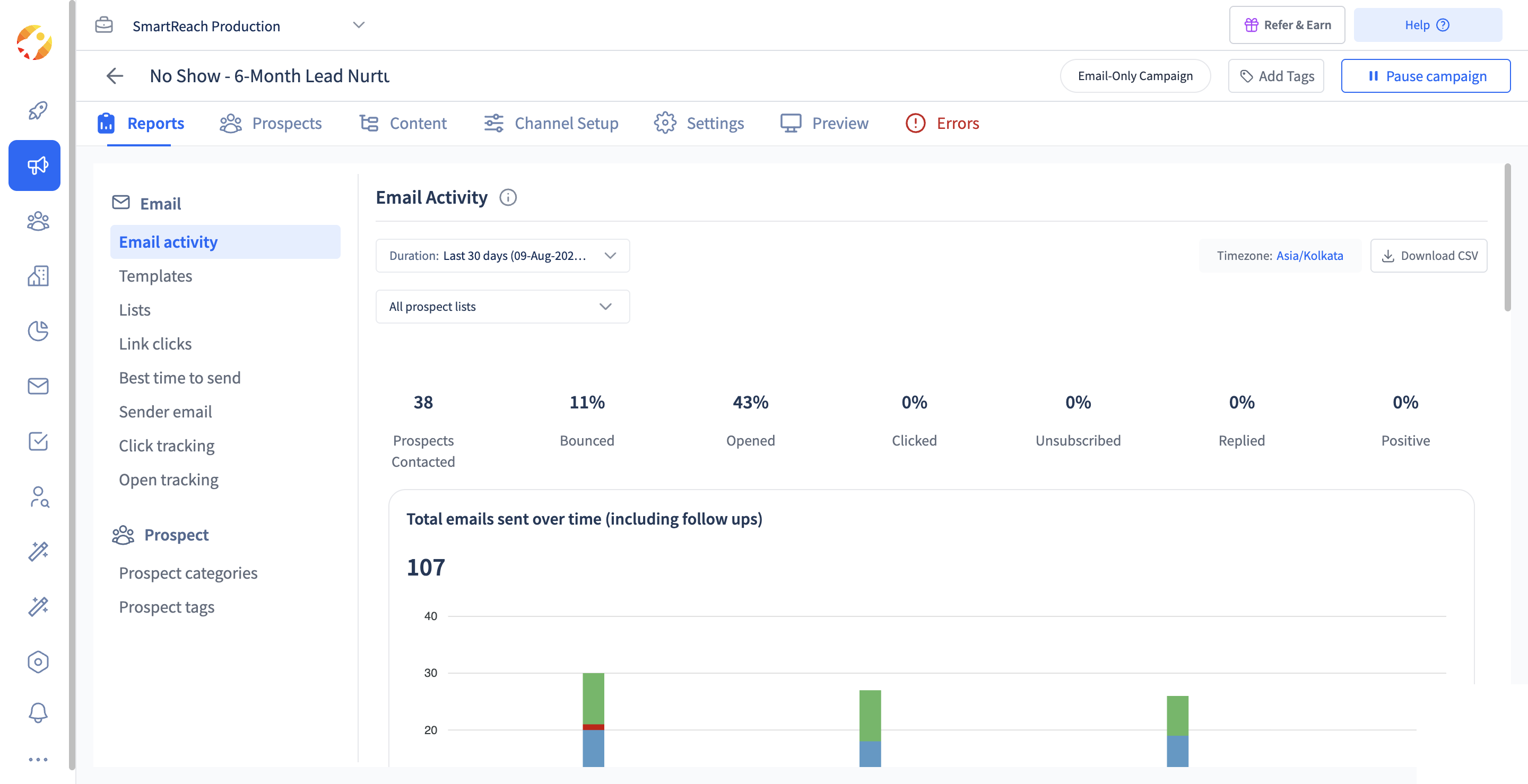 Email activity in SmartReach.io. Campaign performance without stitching spreadsheets.
Frequently asked questions
What is a good cold email reply rate in 2026?
The industry average is about 3 to 5%, and it is still falling from 8.5% in 2019. Most in-house teams land near 5%, while specialist agencies that run cold email every day hold near 10%. Treat 5% as your baseline, 8% as strong, and 10% or more as elite.
How do you calculate email reply rate?
Divide the number of unique prospects who replied by the number contacted successfully, then multiply by 100. If 5 of 90 delivered prospects reply, that is a 5.6% reply rate. Count one reply per prospect and exclude out-of-office and automatic replies.
Why is my cold email reply rate so low?
The usual causes are poor deliverability, a stale or untargeted list, a weak offer, generic copy, and stopping after one email. Fixing authentication and list quality, leading with a specific offer, and following up three to four times lifts most campaigns.
How many follow-ups should I send to increase replies?
Plan a focused sequence of three to four well-spaced touches. About 42% of replies arrive after the first email, so follow-ups matter, but returns bend after the third or fourth touch and aggressive sequences hurt your sender reputation.
Should I track open rate or reply rate?
Reply rate. Since Apple Mail Privacy Protection auto-opens emails, roughly half of reported opens are machines, so open rate is inflated and unreliable. Manage reply rate and positive-reply rate, which map directly to pipeline.
Conclusion
Cold email still works in 2026 for the teams that treat it as a system. Analysing reply rate in depth, then fixing deliverability, targeting, the offer, and follow-up in turn, is what moves you from the 3 to 5% average toward the 8% and beyond that funds real pipeline. Pay attention to every response, keep testing, and measure the honest numbers: reply, positive reply, and meetings booked. When you want a platform that runs all of this in one place, SmartReach.io is built for exactly this kind of outreach.

Stop juggling tools
Book more meetings on every channel
Join 5,000+ teams running multichannel outreach from one sequence, with deliverability built in.