Cold email vs Cold Call: Which Works Better For B2B Sales?

Choosing between cold email and cold calling for B2B outreach? You’re not alone. This decision impacts your sales pipeline, team efficiency, and bottom-line ROI.
Both channels have proven track records in B2B lead generation, but the data tells a clear story: cold email delivers 8.7x better ROI than cold calling for most B2B companies. However, cold calls excel in specific scenarios, like qualifying high-value enterprise deals or reaching decision-makers in industries resistant to email.
In this comparison, I’ll break down cold email vs cold call across six critical metrics: lead generation potential, ROI, data accessibility, setup complexity, scalability, and cost. By the end, you’ll know exactly which channel (or combination) fits your B2B sales strategy.
Let’s start with the fundamentals.
Cold email vs Cold call: Quick comparison table
Before diving deep, here’s a side-by-side comparison of both channels:
| Criteria | Cold Email | Cold Call | Winner |
|---|---|---|---|
| Lead Generation Rate | 1.3% conversion | 0.15% conversion | Cold Email |
| ROI | $9 per $1 spent | $1.8 per $1 spent | Cold Email |
| Daily Reach | 200-1000 prospects | 30-60 prospects | Cold Email |
| Setup Time | 1-2 days | 1-2 hours | Cold Call |
| Scalability | High (automation-friendly) | Low (needs more headcount) | Cold Email |
| Personalization | Medium (at scale) | High (1-on-1 basis) | Cold Call |
| Response Time | 24-72 hours | Immediate | Cold Call |
| Data Accessibility | Easy (email databases) | Difficult (phone verification) | Cold Email |
| Cost per Lead | $3-$10 | $40-$100 | Cold Email |
| Best For | Volume-based outreach, SMB targets | High-value deals, enterprise | Depends |
Key Takeaway: Cold email wins on scalability, ROI, and cost-efficiency. Cold calling wins on personalization and immediate feedback. For most B2B companies, a multichannel approach combining both yields the best results.
Now let’s examine each channel in detail.
What is a cold email?
A cold email is an unsolicited email sent to a prospect without prior contact. It’s an outboound approach to introducing your product or service to decision-makers in companies that might benefit from your offering.
Unlike cold calls, cold email campaigns allow you to reach out to multiple prospects simultaneously, making it a scalable option in the cold email vs cold call debate.
Pros of running cold email campaigns 👍🏼
- Scalability: You can send hundreds of personalized emails in one go, reaching more prospects than cold calling.
- Cost-effective: No need for expensive phone systems or call center setups.
- Non-intrusive: Recipients can read and respond at their convenience, unlike cold calls that may interrupt their work.
- Trackable: Easy to measure open rates, click-through rates, and responses, allowing for data-driven improvements.
- Customization: You can tailor your message to specific industries or roles, increasing relevance.
- Attachments: Easily include product brochures, case studies, or other supporting materials.
Cons of running cold email campaigns 👎🏼
- Low response rates: Average cold email response rates in B2B are often below 5%.
- Spam filters: Your carefully crafted message might never reach the inbox, especially if not properly optimized.
- Lack of personal touch: It’s harder to build rapport through text alone compared to a cold call.
- Delayed responses: Unlike cold calls, you might wait days or weeks for a reply.
- Email fatigue: Decision-makers receive numerous emails daily, making it challenging to stand out.
- Legal considerations: Must comply with anti-spam laws like CAN-SPAM in the US or GDPR in Europe.
When weighing cold email vs cold call strategies, consider these pros and cons in the context of your specific B2B sales goals and target audience.
When cold email works best
Cold email is most effective for:
- High-volume outreach: Reaching 500+ prospects per month
- Content-heavy offers: Products requiring detailed explanation (whitepapers, case studies)
- SMB targeting: Small to mid-sized businesses with accessible decision-makers
- International markets: Different time zones where calls are impractical
- Budget constraints: Limited resources for large sales teams
For Example: A B2B SaaS company using SmartReach.io sent 5,000 cold emails over 30 days, generating 65 qualified meetings at $8 cost per meeting, far below their $85 cost per meeting from cold calling.
If you need more hands-on tips, strategies and information on cold emailing for B2B lead generation, check out Cold Email Masterclass.
Now let’s move on to the second channel in this cold email vs cold call debate.
What is a cold call?
A cold call is an unsolicited phone call to a prospect who hasn’t previously expressed interest in your product or service. It’s a direct approach to reach decision-makers in B2B companies and start a conversation about your offering.
In the cold email vs cold call comparison, cold calling provides immediate, personal interaction with prospects.
Pros of Cold calling prospects for sales outreach 👍🏼
- Immediate feedback: You get instant reactions and can adjust your pitch in real-time.
- Human connection: Voice-to-voice communication builds stronger relationships than text-based methods.
- Higher engagement: When you get through, you have the prospect’s full attention.
- Opportunity for deeper conversations: You can ask follow-up questions and provide detailed explanations.
- Bypass gatekeepers: With persistence, you can often reach decision-makers directly.
- Qualification on the spot: You can quickly determine if a prospect is a good fit for your offering.
Cons of Cold calling prospects for sales outreach 👎🏼
- Time-consuming: Sales reps can typically make only 30-40 cold calls per day, compared to sending hundreds of emails.
- Low connection rates: On average, it takes 8 cold call attempts to reach a prospect.
- Potential for negative reception: Some people find cold calls intrusive, which can harm your brand reputation.
- Higher cost: Cold calling requires more time and resources per prospect than cold emailing.
- Limited scalability: You can only call one prospect at a time, unlike mass email campaigns.
- Difficulty in tracking: It’s harder to measure and analyze cold call performance compared to email metrics.
When considering cold email vs cold call strategies, remember that cold calling can be more effective for complex B2B products or services that require detailed explanation.
When cold calling works best
Cold calling is most effective for:
- High-ticket B2B sales: Deals >$50K where personal touch matters
- Enterprise targeting: Reaching C-level executives who ignore email
- Complex offerings: Products requiring real-time Q&A and objection handling
- Relationship-driven industries: Professional services, consulting, commercial real estate
- Immediate qualification: Quickly filtering serious prospects from tire-kickers
For Example: An enterprise software company closed three $120K deals from 180 cold calls to Fortune 500 CTOs, a 1.67% close rate that justified the higher cost per call.
Suggested Reading: 23 Cold Calling Scripts for B2B – Elements & Examples
Cold email vs Cold call: Detailed comparison
Let’s compare these channels across key sales metrics:
| Aspect | Cold Email | Cold Calling |
|---|---|---|
| Daily Reach | 200-1,000 prospects (with automation) | 30-60 prospects (manual dialing) |
| Personalization | Scalable personalization using merge tags, dynamic content, AI | Highly personalized, but time-intensive |
| Response Timing | Prospect responds at their convenience (24-72 hours typical) | Immediate conversation (if they answer) |
| Information Delivery | Attachments, links, video embeds, case studies | Verbal only—requires follow-up materials |
| Tracking & Analytics | Precise metrics: open rates, click rates, reply rates, A/B testing | Manual logging, harder to track consistently |
| Gatekeepers | Often bypasses gatekeepers (direct to inbox) | Frequently screened by assistants/receptionists |
| Legal Compliance | Must follow CAN-SPAM, GDPR, unsubscribe requirements | Must comply with TCPA, do-not-call registries |
| Average Sales Cycle | Longer (7-14 days from first email to meeting) | Shorter (if decision-maker reached—same-day meetings possible) |
| Lead Qualification | Requires follow-up steps to qualify | Real-time qualification during conversation |
| Best Use Case | Volume-based prospecting, nurture campaigns, SMB outreach | High-value deals, enterprise targets, relationship-building |
The verdict on cold email vs cold calling
For most B2B companies: Cold email should be your primary channel due to superior scalability, ROI, and cost-efficiency. Cold calling should be used strategically for:
- Following up on engaged email prospects
- Reaching high-value enterprise accounts
- Qualifying warm leads before booking demos
The smartest approach? Use both in a multichannel sequence—more on that below.
Cold email vs cold call – which one should you pick for sales outreach?
Now let’s compare these two channels to find out which you should choose for ideal sales outreach.
We will be comparing cold email vs cold call based on 6 important parameters such as –
- Lead generation potential
- ROI each channel is capable to generate
- Contact data accessibility
- Ease of channel set-up
- Execution scope and timing required
- From the POV of set-up cost
1. Cold email vs cold call – based on lead generation potential
Let’s help you understand which one maximizes your sales qualified lead generation between cold email and cold call.
We will take 100 prospects for this example.
Average sales qualified lead generation via cold email:
- Sent 100 cold emails
- 55-60% open rates
- 6-7% reply rate
- 40% positive response rate (we are counting positive replies as the final stage in the lead generation process)
| Sales leads generated via cold email = (1.3 – 1.7) So, it’s safe to assume that cold email gives you minimum 1.3% email to lead conversion ratio. |
Average sales qualified lead generation via cold calling:
- Called 100 prospects
- 15% connection rate. (20 people picked up the call)
- 1% positive response (which is considered the lowest)
| So, sales leads generated via cold calling = 0.15 So, it’s safe to conclude that cold calling gives you nearly 0.15% cold calling to lead conversion ration. |
Verdict ➡️ Cold email generates more leads than cold calling
2. Cold email vs cold call – based on ROI each channel generates
Let’s find out how much ROI both of these channels provide.
For testing this hypothesis, we are taking into account the sales opportunities created in the previous month by doing sales prospecting.
ROI from cold emailing
ROI is where cold email truly shines. According to DMA (Data & Marketing Association), email marketing generates an average ROI of $42 for every $1 spent. While cold email typically performs lower than permission-based email marketing, it still significantly outperforms cold calling on cost-efficiency. Here’s the breakdown:
Cost of setting up cold email process:
| Salary of 1 sales rep | $4000 per month |
| Cost of the cold email software | $100 per month |
| Cost of the email service providers (e.g., Gmail, Outlook, Zoho etc.) | $7-$9 per seat |
The total cost of setting up a cold email campaign should be around $4200.
Let’s look at the revenue part from cold email.
| Offer: $10,000 ACV (Annual Contract Value) |
| 1000 cold emails sent |
| 55% open rate = 550 emails opened |
| 5% reply rate = 27.5 replies |
| 30% positive replies = 8.25 meetings booked |
| 50% closing rate = 4.13 deals closed |
It is evident that for every 1000 prospect you reach, cold email can give you $41300 after spending around $4200 which is equivalent to the ROI of earning $9 per $1 spent.
ROI from cold calling
Cold calling ROI is heavily dependent on connection rates and deal values. For low-ticket products (<$10K), cold calling rarely justifies its cost. However, for enterprise deals (>$50K), the higher close rates can offset expenses. Here’s a realistic scenario:
Cost of setting up cold calling
| Salary of 1 sales rep for calling & closing | $4,000 |
| Software licensing cost for cold calling | $1000 |
So, total cost of cold calling set-up is around $5,000.
Now, check out the revenue part of the cold calling.
| Offer: $10,000 ACV (Annual Contract Value) |
| 1200 cold calls done |
| 180 calls connected with the prospects |
| 1% meeting booked = 1.8 meetings |
| 50% deals closed = 0.9 deals |
For 1,200 prospects contacted, cold call can give you $9,000 for $5000 spent which a ROI of $1.8 per $1 spent.
Verdict ➡️ Cold email has a better ROI than cold calling
ROI of cold email can be easily increased as you start scaling your outreach process more. The best thing is you can scale it without hiring a large team and not incurring huge salaried expenses.
3. Cold email vs cold call based on access to contact data
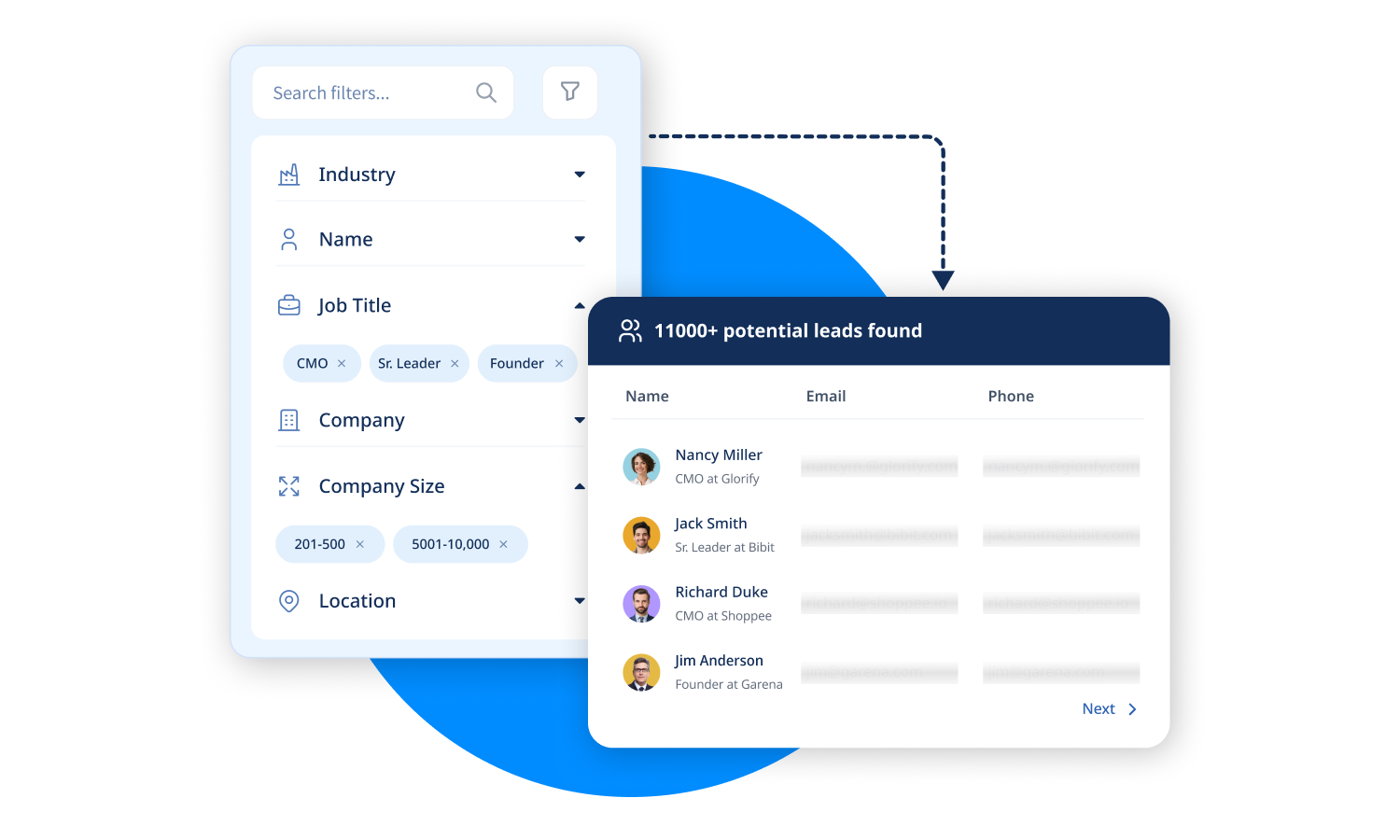
For running cold email and cold calling information, you need prospect information such as email addresses and phone numbers. It’s easier to get prospect email addresses than finding accurate phone numbers of the decision makers of the businesses.
There are very few sources on the internet that gives you accurate, verified and updated contact number information for cold calling.
On the other hand, there are a lot of places to find email addresses for running cold email campaigns.
Verdict ➡️ Cold emailing wins for the ease of data accessibility.
To find prospect contact numbers and email addresses for sales outreach try Lead Finder by SmartReach.io.
Export the contact information to your cold calling and cold emailing campaigns in one-click.
4. Cold email vs cold call based on ease of set-up
Cold calling is easier to set-up and execute as compared to cold email.
Anyone who can speak on phone can start cold calling and can bring some positive results with consistency.
But for cold email, you need to have some knowledge about the email deliverability aspects and copywriting skills to bring some positive results from cold email campaigns.
Using a tool like SmartReach.io, you can set-up your cold calling campaigns with ease.
You can start dialing prospects one by one, analyze the calling sentiments, record the calls, monitor the metrics such as connection rates, calling duration and more.
Verdict ➡️ Cold calling wins for ease of set-up
5. Cold email vs cold call based on execution scope and timing
An effective cold email campaign takes more time to set-up but less time to scale.
For example, you will need to write well-though cold email copies with the right sequence gaps to yield positive results from the cold email campaigns.
Additionally, you will require strong knowledge of the email sending limits of the different email service providers (e.g., Gmail, Outlook,Yahoo) to scale your email outreach process effectively without getting flagged as SPAM.
But you only need one person with the right cold email knowledge to scale up an email campaign from sending 20 emails to 2000 emails.
That’s the biggest advantage of cold email in this cold emailing vs cold calling debate.
On the contrary, cold calling takes less time to set-up but more time and resources to scale effectively.
For example, with even an experienced single sales rep, you will not be able to scale up beyond 60-70 cold calls per day.
Cold calling is only brings leads when you do it on scale and when you are low on headcount cold calling is unlikely going to work as a channel.
Verdict ➡️ Cold email wins for taking less time to scale as a channel
6. Cold email vs cold call based on cost
As discussed during the ROI part of this cold email vs cold call debate, the set-up cost may initially be high for cold emailing with spendings on –
- Cold email automation software
- Email service providers
- Contact database software
- CRM etc. (not mandatory)
In the long-run cold email ROI overpowers the initial investment and give you a higher ROI.
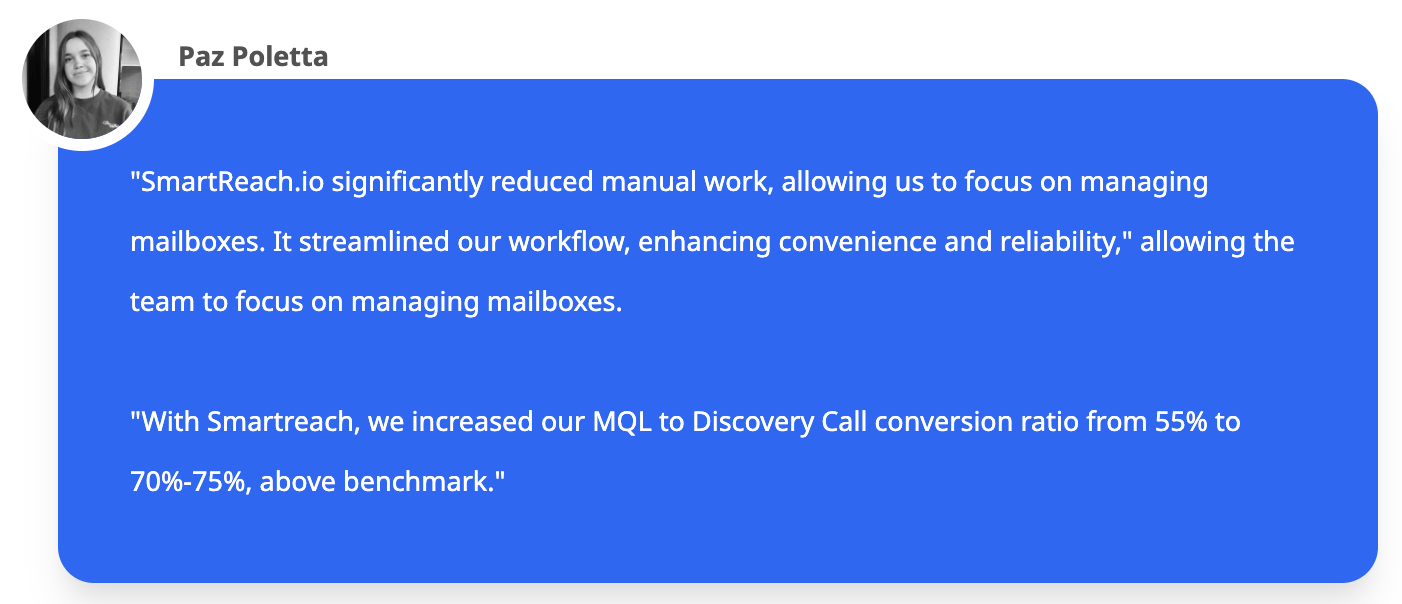
For example, SmartReach.io users have reported upto 30% increase in their lead generation efforts with the cold email automation capabilities.
Now, coming to cold calling, you will need more headcount even with a cold calling software to scale up the cold calling outreach.
More headcount = more salary cost which may not be a good ROI indicator even for the long-term.
Verdict ➡️ Cold email is less expensive and and easy to scale on budget
So finally, based on all 6 parameters cold email as a channel wins for sales outreach.
If you are a 2-3 person start-up in the B2B space and starting a fresh outbound system, start with cold calling first.
It will validate your ICP quicker with faster positive and negative responses. You will arrive at quick conclusion on if you are targeting the right cohort of people.
Keep cold emailing as a long-term strategy. Try to optimize the campaigns and generate better results with every new campaign.
The best thing you can do is to go for an multichannel campaign approach. It consists of both cold emailing and cold calling for the best deliverability and more responses.
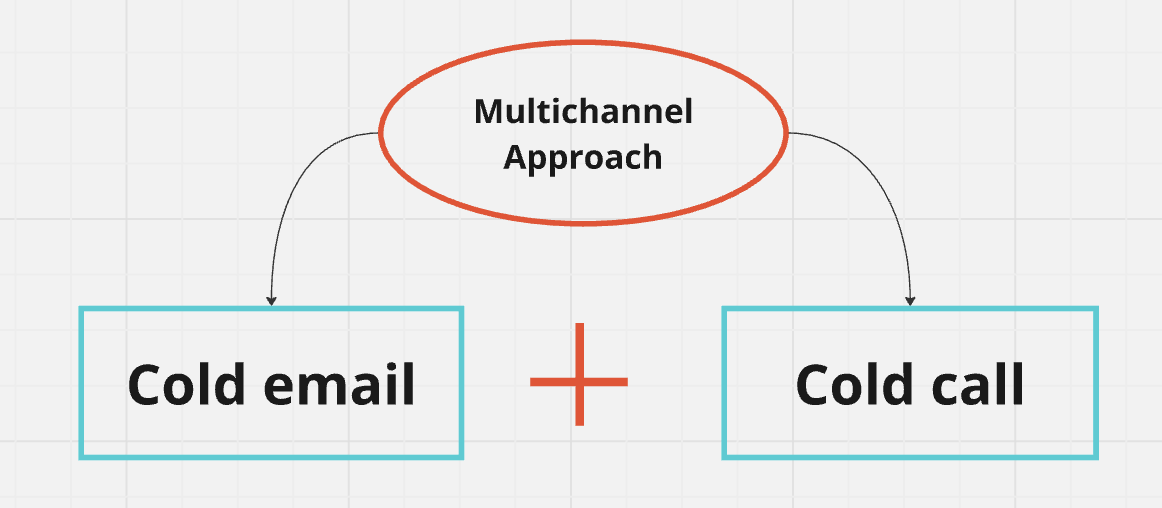
Using a sales engagement tool like SmartReach makes it easier for running cold email campaigns + cold calling campaigns from one platform.
- You can use AI to generate email sequences based on the prompts you provide ✅
- Export prospect contact information from SmartReach’s lead finder tool to your multichannel campaigns ✅
- Connect upto 25 sender emails and your email campaign is ready to shoot ✅
- Similarly, you can obtain a free international calling number and start calling from SmartReach directly ✅
Try running a multichannel campaign for FREE for 14-Days. (No credit card required)
How to use cold email + calling calling together to book more meetings?
This is the best approach for B2B lead generation. I will be using SmartReach’s specific features
Here’s a practical approach to leverage both channels effectively:
#1 Start with a targeted cold email campaign
Begin by sending personalized cold emails to your prospect list.
Use Smartreach.io’s advanced personalization features such as Content AI, merge tags, custom column etc. to create emails that resonate with each recipient. With spintax, you can create dynamic content making each of your email copies unique, thus improving the deliverability.
This initial contact sets the stage for your outreach and allows prospects to engage on their own terms.
#2 Track email engagement meticulously
Use Smartreach.io’s real-time email tracking to monitor opens, clicks, and replies.
This data is crucial for identifying your most interested prospects and timing your follow-up calls effectively.
#3 Follow up with cold calls to engaged prospects
Now, call prospects who have shown interest in your emails but haven’t responded.
Smartreach.io’s integrated calling features allows you to seamlessly transition from email to call within the same platform, ensuring a cohesive outreach strategy.
#4 Use cold calling for high-value prospects
For your top-tier prospects, consider leading with a cold call.
These direct conversations can be more effective for complex offerings or when trying to reach C-level executives.
Follow up these calls with a personalized email summarizing your conversation.
#5 Create a multi-touch sequence
Develop a sequence that alternates between emails and calls.
Smartreach.io’s sequence builder can help you create and automate this process, ensuring consistent follow-ups without overwhelming your team.
#6 Personalize your approach based on prospect behavior
Use the data from your email campaigns to tailor your cold calls.
If a prospect has clicked on a specific resource in your email, reference this in your call to make the conversation more relevant and engaging.
#7 Optimize your timing of outreach
Analyze when your emails get the most engagement and when your calls are most likely to be answered.
Smartreach.io’s analytics can help you identify these optimal times, allowing you to schedule your outreach for maximum impact.
Read more: Importance Of Timing For Lead Generation Using Cold Emails
#8 Continuously refine your messaging
Use the feedback from both your emails and calls to improve your overall messaging.
Smartreach’s A/B testing features for emails can help you identify what resonates best with your audience, informing both your email and call scripts.
#9 Integrate with your CRM
Ensure all interactions, whether email or call, are logged in your CRM.
Smartreach.io offers seamless integration with popular CRMs, providing a complete view of your prospect’s journey and enabling better-informed follow-ups.
By implementing these strategies and using tools like Smartreach.io, you can create a multichannel approach to cold outreach that maximizes your lead generation.

Frequently Asked Questions
Q. Are cold emails or cold calls better?
Neither is universally better, it depends on your target audience, deal size, and resources. Cold emails excel at scalability and cost-efficiency, ideal for reaching hundreds of prospects. Cold calling shines in building immediate rapport and qualifying high-value enterprise deals. Most successful B2B teams use both strategically.
Q. What is the difference between cold text and cold call?
Cold texting sends unsolicited SMS messages to prospects, while cold calling uses phone calls. Both are outbound tactics, but texts offer asynchronous communication, prospects respond when convenient, unlike calls requiring immediate attention. Cold texting has lower engagement but higher convenience; cold calling offers real-time conversation but faces more resistance.
Q. What is a cold email?
A cold email is an unsolicited email sent to a potential customer without prior contact or relationship. It’s a B2B outreach method introducing your product or service to decision-makers who might benefit. Effective cold emails are personalized, value-focused, and clearly articulate benefits rather than pushing for immediate sales.
Q. Why cold email is used?
Cold email is used because it efficiently reaches large audiences, generates leads at scale, and costs significantly less than cold calling. It allows targeted messaging, personalization through automation, and gives prospects time to consider offers. Unlike cold calls, emails don’t interrupt workflows, resulting in higher acceptance among busy decision-makers.
Q. What is cold calling?
Cold calling is making unsolicited phone calls to potential customers to introduce products or services. It’s a traditional B2B sales technique focusing on immediate conversation and persuasion. While effective for complex offerings needing explanation, cold calling faces challenges from increasing call screening, consumer resistance, and higher costs per contact.
Q. Which is more effective, cold email or cold calling?
Cold email is more effective for most B2B companies, delivering 1.3% lead conversion rates versus 0.15% for cold calling. Cold email also provides 8.7x better ROI ($9 per $1 spent vs $1.80). However, cold calling excels for high-value enterprise deals where personal interaction is critical.
Q. Is cold calling more personal than cold email?
Yes, cold calling offers higher personalization through voice-to-voice conversation, real-time objection handling, and human connection. However, cold email can achieve scalable personalization using merge tags, dynamic content, and AI-powered customization, making it more practical for reaching large prospect lists without sacrificing relevance.