How Lead Gen Agencies Prove ROI to Clients

On this page
The month-3 renewal call has a script. The client's founder joins two minutes late, says the emails "seem fine," and then asks the question that ends retainers: "We've paid you for three months. What's actually in our pipeline because of this?" If the honest answer lives in a spreadsheet of opens and replies, the retainer is already gone, whatever the campaign numbers say.
Recognize that call? Most writing about agency churn tells you the fix is better reporting, and most of that writing is selling a dashboard. So let's be more honest than that. Some month-3 churn is good campaigns nobody connected to revenue, and reporting fixes it. Some is clients whose unit economics never supported cold outbound, and no report saves them. Some is campaigns that genuinely underperformed. The attribution chain in this guide doesn't just fix the first kind: it tells you which of the three you're living through, months before the renewal call does, and that early warning is worth more than the dashboard.
What follows is how lead generation agencies prove ROI to clients in practice: a four-stage chain from sequence to reply to meeting to CRM opportunity, the ownership boundary inside that chain that most agencies never report on, the kickoff model that makes month-3 numbers mean something, and the report to send when a month goes badly. Plus the funnel benchmarks to hold yourself against, with their caveats attached, because you've seen enough screenshot bravado to distrust round numbers.
Why do clients churn at month 3?
Because month 3 is when the client's own math kicks in. Months 1 and 2 get written off as setup: domains warming, lists building, sequences launching. By month 3 the client has paid three retainers, their CFO or co-founder has asked about it at least once, and they go looking for evidence. What do they find? Whatever you've been sending them.
Here's the trap: cold outreach genuinely back-loads its results. Domains take weeks to warm, sequences take weeks to complete, and an opportunity created in month 3 often traces back to a prospect first emailed in month 1. So the moment of maximum client scrutiny arrives exactly when the work is starting to compound and slightly before the revenue shows up. An agency still reporting sends and replies at that moment is asking the client to take compounding on faith, and clients don't extend faith at month 3.
But before reaching for reporting as the cure, separate the three kinds of month-3 churn, because they have different fixes:
- Invisible good work. The campaign is on track and nobody can see it. This is the pure reporting problem, and the chain below solves it outright.
- A client who should never have been signed. Run the math this guide gets to shortly: a well-run program produces about six opportunities per 1,000 prospects contacted. If the client sells a $3k product with a small addressable list, that yield never pays back the retainer, and the kindest thing attribution does is prove it by month 2 instead of month 5. That's not a reporting failure. It's a client-selection failure being invoiced monthly, and the filter catching it early is a feature: month-3 churn with full visibility costs you a retainer; month-7 churn without it costs you a reference.
- Genuine underperformance. The campaign is behind. Here the chain doesn't defend you; it tells you where it's behind, which is what makes the difference between a fixable month and a lost account. More on that in the bad-month section.
Founders sometimes resist full transparency precisely because of that third case: if the client can see everything, they can see the bad weeks too. That instinct has it backwards. Opacity doesn't hide bad numbers from a client; it just delays the discovery until the moment they've already decided you were hiding them. The chain is what earns you the right to have a bad month and keep the account.
How lead generation agencies prove ROI to clients: the four-stage chain
The chain has four links, and it only works if all four hold. A gap anywhere and the client's trace breaks, and with it the ROI story.
- Sequence: every send belongs to a named, per-client campaign the client can audit.
- Reply: every response is classified, because raw reply counts hide "unsubscribe" and "wrong person."
- Meeting: booked and held are tracked separately, with the sourcing sequence attached.
- CRM opportunity: the meeting's contact carries its source into the client's CRM, so the opportunity a rep opens later inherits it.
Notice where the chain changes hands. Links one through three are yours: you write the sequences, work the replies, book the meetings. Link four belongs to the client's reps, who decide whether a held meeting becomes an opportunity in their CRM. The chain crosses an ownership boundary at the held meeting, and that boundary is so important to your renewal that it gets its own section below.
What does "good" look like across the chain? SmartReach.io's State of Cold Email 2026, built on 40M+ emails from 5,000+ campaigns including 100+ agencies, publishes the agency funnel end to end:
Before you benchmark against those numbers, read them the way the report itself does. All four are per prospect contacted, not per email sent, which matters because per-send figures run 2-3x lower and plenty of loud numbers online don't say which they are. They count human replies with autoresponses stripped out. And they describe a specific cohort: agencies running at meaningful scale on one platform, which skews toward operators who survived long enough to get good. Your book might run below them, and that's workable, as long as the model you show clients is built on your numbers rather than borrowed ones.
With that said, do the translation for a client and the chain becomes concrete: contact 1,000 well-targeted prospects and a well-run program lands around 100 replies, of which roughly 1 in 5 is positive, about half of those positives become a booked meeting, and roughly half of booked meetings survive to a real opportunity. Call it six opportunities per 1,000 prospects. That's a sentence a client can repeat to their own board, and it's also the input to the payback math you should run before signing them. In-house programs, for reference, reply at about half the agency rate, which is worth stating (gently) in your kickoff deck: it's the quantified case for paying you at all.
The report's larger point is the one to tattoo on your reporting: reply rate is where most reports stop, and it's a vanity number if it doesn't connect to pipeline. The rest of this guide is the chain, one link at a time, plus the two artifacts that make it persuasive: the model and the boundary.
Stages one and two: from sequence to classified reply
Stage one is unglamorous naming discipline. Every client gets their own campaigns, every campaign gets a name a client could read cold (acme-cfo-saas-outbound-q3, not test-final-v2), and nothing sends outside a named sequence. This sounds trivial until month 3, when "which sequence produced this meeting?" has to be answerable in one click. If you run lead generation software built for agencies, per-client separation comes with the platform: separate campaigns, domains, and inboxes per client, so one client's dirty list can't contaminate another client's deliverability, and neither can their reports bleed together.
Stage two is where most reporting quietly lies, so here's the strong opinion we'll defend: open rate should never appear in a client report. Not de-emphasized. Absent. Apple Mail Privacy Protection pre-loads tracking pixels and security scanners fire them automatically, which is why reported open rates near 28% no longer separate interested prospects from indifferent ones. An agency that reports opens is building its ROI story on a number the client will eventually discover is inflated, and once one number in your report goes down as untrustworthy, they all do.
Replies need classification, not counting. A raw reply count treats "book me for Tuesday" and "take me off this list" as the same event. Split every response into positive (expression of interest), negative, referral ("talk to our VP instead," which is a live lead, not a rejection), and automatic (out-of-office, bounces), then report the positive reply rate as the headline. This mirrors the conversion metrics lead gen agencies track internally, and it survives client scrutiny because it's conservative: you're voluntarily reporting a smaller, harder number than "replies."
One more thing belongs in stage two, because it changes how clients read slow weeks: 42% of replies come from follow-ups, not the first touch. A sequence that looks quiet after send one isn't failing, it's mid-flight. Show clients the reply distribution across steps and the case for disciplined follow-up emails makes itself, in their data, not your promises.
Stages one and two read straight off the campaign report. Prospects contacted, opens, replies and the sends-over-time chart sit on one screen per campaign in SmartReach.io, which is the screen a client-facing report exports from.
- Open the client's campaign and go to Reports
- Read Email activity for contacted, opened, replied and bounced over the reporting period
- Click Download CSV to attach the numbers to the client's month-1 report
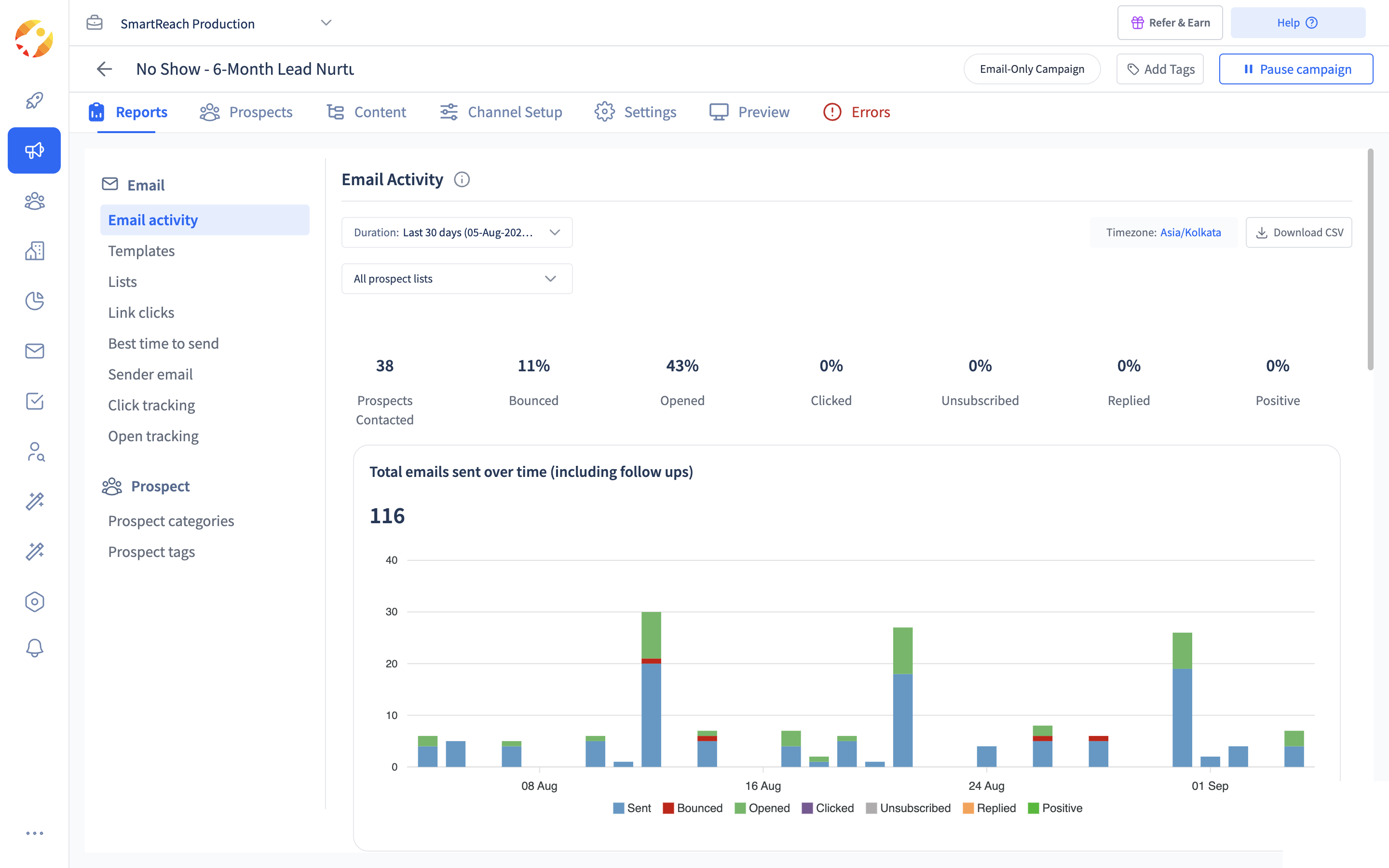 The first two stages of the attribution chain, per client campaign, in SmartReach.io.
Yield per prospect: the number that decides how long you keep the client
Here's a churn driver no reporting fixes, and most agency content never mentions: list exhaustion. Your client's addressable market is finite. A niche B2B client might have 8,000 workable prospects in total, and at a few thousand touches a month, somewhere around month 6 to 8 you've contacted most of them. Performance decays, the next report is softer than the last, and the engagement dies of starvation with perfect attribution the whole way down. Month-3 churn is a visibility problem. Month-8 churn is a yield problem.
That's why the metric that decides engagement lifetime isn't reply rate. It's meetings per 1,000 prospects, because prospects are the scarce input and everything else is arithmetic on top. And it's the number that channel mix moves hardest. From the same report data, across agency campaigns:
One honest caveat, straight from the report: teams that add calling are usually the better-resourced ones, so part of that lift is who runs multichannel, not just that they do. Discount for it, and coordinated sequences still book meaningfully more meetings from the same thousand prospects than email alone. The mechanism isn't mysterious. Buyers complete 60-90% of a buying decision before they ever contact a vendor, so a single channel rarely catches the moment; an email warms a LinkedIn touch, a call references the email. For an agency, the strategic consequence is direct: multichannel roughly doubles how much pipeline a finite list can produce, which means the same client stays viable months longer. Attribution keeps the client at month 3. Yield keeps them at month 8.
There's a second, sneakier reason channel mix belongs in an article about proving ROI: attribution dies at tool seams. Run email in one tool, LinkedIn in another, and calls from a spreadsheet, and the meeting that came from three emails plus a connect request gets credited to whichever tool you exported from last, or to nothing. Every seam is a place where the chain from the previous sections silently breaks, and month-end becomes reconciliation archaeology. The fix is structural, not procedural: run the channels as one conditional sequence per prospect (no reply after step three, then LinkedIn view, then connect, then call task) on a multichannel platform that keeps a single touch timeline per prospect. One timeline means "this meeting came from this sequence" is a query, not a reconstruction, and the LinkedIn assist gets honest credit instead of invisible credit.
Stage three: from positive reply to held meeting
The meeting is where the client's trust actually turns. Replies are your metric; meetings are theirs, because a meeting is the first artifact of your work that shows up on their calendar with their prospect on it. It's also where two of the classic agency-client fights live, and both are preventable with conventions agreed before the first send.
Fight one: "the meetings were junk." Eleven meetings held means nothing if the client decides half were students and tire-kickers, and by renewal that verdict is unfalsifiable. So don't let it be a verdict; make it a process. Agree the ICP definition in the kickoff document (title bands, company size, geography, whatever defines a real buyer), then give the client 48 hours after each meeting to accept it or reject it with a reason. Accepted meetings count toward your numbers; rejected ones don't, and their rejection reasons become targeting feedback for the next sprint. Reporting only accepted meetings is the same conservative move as reporting positive replies instead of replies: a smaller number nobody can argue with beats a bigger number everyone can.
Fight two: whose calendar? If meetings book straight onto the client's AE's link, you lose sight of holds, no-shows, and everything downstream, and your month-3 report is suddenly built on numbers you have to ask the client for. Booking through your flow (with the sourcing sequence attached at booking time) and handing off with an agreed SLA keeps the record intact. Track booked and held separately either way: no-shows run high in cold outbound, and a report that counts booked as delivered gets falsified every time an AE sits in an empty Zoom room. Chase the no-shows too; a reschedule sequence is the cheapest pipeline you'll ever generate.
The audit standard for this stage: if a client picked one meeting from last month at random and asked "show me the exact sequence, step, and email this came from," could your team answer in under a minute? That's the question clients actually ask, usually right before renewal.
Stage four: land the opportunity in the client's CRM
Stan runs RevOps for a 12-client lead gen agency, and his rule is the whole stage in one sentence: "If it isn't in the client's CRM with our name on the source field, it didn't happen." Agencies lose the ROI argument in the gap between their platform and the client's system of record. Your dashboard says 9 meetings; the client's HubSpot says nothing; at renewal, the client believes HubSpot.
The mechanics are straightforward once you decide to do them: sync contacts and activities into the client's CRM (HubSpot, Salesforce, Pipedrive, or Zoho) through a native integration rather than a monthly CSV, with every synced contact carrying a source field: your agency, the campaign, the sequence. When the client's rep opens an opportunity on that contact inside the agreed window, the opportunity inherits the source, and your report can list it with a straight face.
Then come the three disputes that the simple version of that setup doesn't survive. Stan has had all three; if you've run an agency for two years, so have you.
- The forwarded reply. Your email lands with a director, who forwards it to their VP, who books the meeting. The opportunity gets created on the VP, a contact you never emailed, and contact-level attribution hands you nothing. Match at the account level, not just the contact level: an opportunity opened at an account you sourced, inside the window, traces to your campaign. Agree that convention at kickoff, because arguing it deal-by-deal at renewal goes badly for whoever needs the deal more, and that's you.
- The dead-lead fight. Your list will overlap the client's CRM, where some of your prospects sit as leads marked dead eight months ago. You re-engage one, it becomes a meeting, and the client's AE says "that was already ours." Sometimes they're right. Settle it before it happens: agree which CRM statuses are yours to work (dead past a threshold, never-contacted, unassigned), sync the exclusions as suppression lists so the platform enforces the agreement mechanically, and decide upfront how re-engagements get credited.
- Shared credit. A prospect you emailed also saw the client's ads and met them at a conference. Your "sourced" claim is one-third true, and the client's marketer knows it. The clean answer is two lines in every report: sourced (first touch was yours, full credit) and influenced (your touches appear in the journey, partial story). Splitting them costs you nothing when things go well and buys enormous credibility when someone checks.
What if the client won't give you CRM access?
It happens, especially with security-conscious clients. Don't let the chain die there; agree a substitute system of record. A shared pipeline sheet the client's team updates weekly, or a scheduled CRM export filtered to your source field, does the job at 12 clients even if it wouldn't at 50. What matters isn't the tool, it's the property: one place both sides treat as the truth, updated on a cadence, never reconstructed at month-end. If the client won't agree to any shared record at all, that's worth treating as the retention red flag it is.
Report the handoff, not just the pipeline
Now the boundary from earlier pays off. Your accountability runs through the held meeting. Opportunity creation belongs to the client's reps: their qualification bar, their follow-up speed, their CRM discipline. Which means the ≈0.6% opportunity benchmark should never be an agency KPI, because it makes you answerable for a step you don't control. Plenty of agencies let clients judge them on pipeline anyway, and then eat the blame for an AE who let nine warm meetings rot in a queue.
The fix is one extra line in every report: the handoff conversion, held meetings that the client's team turned into opportunities. Report it next to your own numbers and the funnel stops being a single blame-shaped number and becomes a diagnosis with an address. "We delivered 14 accepted, held meetings against a model of 12; your team opened 2 opportunities against a typical conversion near half." That sentence changes the renewal conversation from "defend your retainer" to "here's where the funnel leaks, and it isn't on our side of the boundary." Delivered without smugness, it's also genuinely useful to the client, because their meeting-to-opportunity leak is costing them more than your fee.
And when the leak is on your side (meetings held but rejected as off-ICP, positives that never book), the same line says so, which is exactly what makes the rest of your report believable. A boundary you only invoke when it flatters you isn't a boundary, it's an excuse. If your client contact has to defend the spend to their CFO, this is also the shape that survives finance scrutiny; hand them the playbook for proving outreach ROI to a CFO along with the CRM view.
The kickoff model, and the cadence that reports against it
Everything so far produces clean actuals. Here's the uncomfortable truth about actuals: on their own, they prove nothing. "11 meetings held" is a good month against an expectation of 8 and a firing offense against a promise of 30, and if no expectation was ever agreed, the client supplies their own, usually sourced from whatever a competitor's ad promised them. You can't prove ROI at month 3 unless month 3 had a definition before month 1 started.
So the kickoff deliverable that matters most isn't the deck, it's the model: list size × funnel benchmarks × ramp curve, producing expected ranges per month. Some 2,000 workable prospects at benchmark rates puts month 3 near 40-50 positive replies, 12-16 meetings booked, 9-12 held, 4-6 opportunities, and month 1 deliberately near zero meetings because domains are warming and sequences are mid-flight. Build it from your own book's numbers if you have them (after a year of running clients through one platform, you do, and that cohort data is the most defensible sales asset an agency owns; "across our book, this vertical produces X meetings per 1,000" beats any industry benchmark). Write the model into the statement of work next to the attribution conventions. Every report after that is one honest question: where are we against the model?
Month 1: leading indicators, vs model
Infrastructure and inputs, reported without apology, against a model that promised no meetings yet. Domains warmed and authenticated, list built and verified, sequences live, early positive reply rate against the ≈2.2% benchmark. The frame is explicit: "the model says meetings start in weeks 5-7; here's the leading evidence we're on it."
Months 2-3: meetings, then pipeline, vs model
Month 2 leads with accepted meetings booked and held against the modeled range, each traceable to its sequence. Month 3 leads with opportunities and pipeline read from the client's CRM, plus the handoff line. This is the report that makes renewal a formality: pipeline in their system, sourced to your name, tracking a forecast they signed.
The month-3 report deserves to be an email the founder can forward to their CFO without editing:
Hi Priya,
Month 3 actuals against the model from our kickoff doc. Everything below is traceable in your HubSpot (source = "Agency outbound"):
Prospects contacted: 2,140 across 3 sequences (model: 2,000) Positive replies: 49, a 2.3% rate (model: 2.0-2.4%) Accepted meetings booked / held: 16 / 11 (model: 13 / 9) Opportunities your team opened: 5, $210k in sourced pipeline (model: 4-6) At your 22% historical win rate, that's about $46k in expected revenue against $18k in fees to date. Influenced pipeline is tracked separately in the attached sheet.
One finding: 3 of the 5 opportunities came from the CFO sequence. We're shifting 30% more volume to it in month 4, which moves the model to 13 held meetings.
Full report attached. Thursday to walk through it?
Stan
Which of those two emails would you renew: this one, or a dashboard screenshot of opens? Notice what makes it work. Every line has a model figure next to it, the pipeline number is deflated to expected value using the client's own win rate before their CFO can do it for them, and the one editorial sentence is a decision, not a mood. None of the numbers are unusually good; they're roughly the benchmarks applied to one client's volume. What's unusual is that every line is auditable by the person reading it.
The bad-month report is the one that earns the renewal
Every playbook shows you the good-month report. Two years in, you know the real question is what you send when the month comes in at 60% of model, because hiding it doesn't work and neither does a happier metric hastily promoted to headline. The answer is that a behind-model month is where the chain stops being a reporting tool and becomes a diagnostic one, because each failure mode leaves a different fingerprint in the funnel:
- Delivery down, replies down proportionally: a deliverability problem. Placement dropped on specific domains; here's the rotation and warmup response, and the recovery curve to expect.
- Delivery fine, positive replies down: a list or offer problem. The targeting was off, or the message stopped landing; here's the segment data and what we're rewriting.
- Positives fine, meetings down: a booking problem. Interest isn't converting to calendar; we're testing the CTA and the booking flow.
- Meetings held, opportunities missing: the handoff line. The leak is past the boundary, and the report says so with the same directness it would use for your own miss.
So the bad-month email reads: "We're at 60% of model. The leak is at one specific stage, here's the evidence, here's the fix, here's what the model says recovery looks like." That report requires instrumentation granular enough to tell those four stories apart, which is the real argument for running the funnel in one system rather than four tools and a spreadsheet: an agency that can only see that the month was bad, not where it broke, can't write the diagnosis, retreats to activity metrics, and lands back at the month-3 call this article opened with. With a book of clients on one platform, you even get an early-warning system for free: when one client's positive-reply rate sits far below your book's median on identical infrastructure, it's the offer, and you have the comparative evidence to say so kindly.
We've seen the pattern enough times to state it as a rule: one honest, well-diagnosed bad month builds more client trust than three good months, because it proves the good months were real. The bad-month report is not damage control. It's the strongest proof of competence an agency ever sends.
Report to the pipeline, not the inbox
The agencies that keep clients past month 3 aren't reliably the ones with the best reply rates. They're the ones whose clients signed a model at kickoff, can trace every meeting to a sequence, can see the handoff conversion when the funnel leaks on their own side, and get told the truth in the bad months with a diagnosis attached. That's the whole system: the chain makes the work visible, the model makes the numbers mean something, the boundary makes the accountability fair, and the yield math keeps the engagement alive after the easy list is spent.
None of it requires heroics. It requires conventions agreed before the first send, a source field written on day one, and a stack that carries attribution from the first touch to the client's CRM without a human re-keying it. The reporting isn't extra work on top of delivery. Done right, it's a property of how the delivery runs.
Frequently asked questions
How do lead generation agencies prove ROI to clients?
Three artifacts, agreed before the first send: an attribution chain (every sequence tagged per client, every reply classified, every meeting logged as booked and held, every opportunity created in the client's CRM with the sourcing campaign attached), a kickoff model that forecasts what each month should produce from the client's list size and funnel benchmarks, and monthly reports that show actuals against that model. When the client can trace a pipeline number in their own CRM back to the sequence that started it, and compare it to what you both agreed to expect, ROI stops being a claim and becomes a record.
What metrics should a lead gen agency report to clients each month?
Positive reply rate, meetings booked and held, the handoff conversion (held meetings that the client's team turned into opportunities), opportunities created, and pipeline value with a win-rate-adjusted expected value next to it, all against the kickoff model. Leave open rate out entirely: Apple Mail Privacy Protection and security scanners inflate it, so it tells the client nothing about interest. Replies and everything downstream are the numbers that can't lie.
What is a good cold email funnel benchmark for agencies in 2026?
Per SmartReach.io's State of Cold Email 2026, drawn from 40M+ emails, well-run agency campaigns reply at roughly 10%, with positive replies near 2.2%, booked meetings near 1.2%, and CRM opportunities near 0.6% of prospects contacted. Read the definitions before you benchmark against them: those figures are per prospect contacted (not per send), count human replies with autoresponses removed, and come from a cohort of agencies running at scale on one platform. Your book may run lower, which is fine if your kickoff model was built on your own numbers.
How do agencies attribute CRM opportunities to cold email sequences?
Write the source at creation time (agency, campaign, sequence on the contact via a native HubSpot, Salesforce, Pipedrive, or Zoho integration), then match at the account level, not just the contact level, so a forwarded reply that books through a colleague still traces back. Agree the attribution window (typically 90 to 180 days for B2B) and the dead-lead convention (what counts as re-engaging a contact already in the client's CRM) at kickoff, and report sourced and influenced pipeline as two separate lines.
How can a lead gen agency stop clients churning at month 3?
Qualify the client's unit economics before signing, agree a month-by-month model at kickoff, then report to the stage the program is in: leading indicators in month 1, meetings in month 2, opportunities and pipeline in the client's CRM by month 3, always as actuals against the model. When a month comes in behind, send the diagnosis, not a happier metric. Clients churn when they expected pipeline and got activity numbers; they stay when they can see where they are on a path they agreed to.
Stop juggling tools
Book more meetings on every channel
Join 5,000+ teams running multichannel outreach from one sequence, with deliverability built in.