11 Best Dialpad Alternatives & Competitors

On this page
Looking for better CRM integrations, more flexible pricing, or smarter AI call features than what Dialpad offers?
You’re not alone. Dialpad’s published price has also stopped meaning what it used to. The headline $15 is annual billing, month to month is $27, and the plan most sales teams actually need carries a 3-user minimum.
So this guide prices 11 Dialpad alternatives the way the bill arrives. Every number below came off the vendor’s live pricing page on 28 September 2026, with monthly billing selected wherever a toggle exists. 👇🏼
TL;DR: the 11 best Dialpad alternatives at a glance
Why teams are leaving Dialpad?
Dialpad is a capable VoIP platform. These are the five reasons buyers give for shopping around, with the current numbers attached.
1. The price on the page is the annual price. Dialpad Connect Standard is $15 per user a month on an annual commitment and $27 month to month. Pro is $25 annual, $35 monthly, and carries a 3-user minimum. Enterprise is quote-only with a 100-user minimum.
2. The product’s centre of gravity moved to AI. Dialpad now leads with AI agents sold on conversation credits rather than per-user seats. That’s a fine direction, and it’s a different purchase from the phone system many teams originally bought.
3. Per-user billing punishes growth. Every hire reprices the plan. dialnote bills flat from $19 a month, and SmartReach.io prices by active prospects with unlimited users on every plan above Basic, so headcount stops driving the invoice.
4. Outbound features sit a tier up. Power dialing, local presence and call coaching land on higher plans right across this category. Aircall’s power dialer is on Professional at $50 per licence with a 3-licence minimum, which is $150 a month before anyone dials.
5. Calls live apart from the rest of the cadence. A dialer knows a rep called. It doesn’t know the prospect replied to an email that morning. Sequence-level calling knows both, and pauses the queue.
Quick overview of top Dialpad competitors
Prices checked 28 September 2026. Scroll the table sideways to see all columns →
| # | Tool | Entry price | Seat minimum | What the price scales with | Channels | Best for |
|---|---|---|---|---|---|---|
| Base | Dialpad (the incumbent) | $15/user/mo annual, $27 monthly | 3 users on Pro | Users, plus AI credits | Calls, video, SMS | The baseline you’re replacing |
| 1 | dialnote | $19/mo flat ($15 annual) | None | Account tier, not headcount | Calls, SMS, AI agents | VoIP and SIM on one account |
| 2 | SmartReach.io | $39/mo | None | Active prospects, no per-seat pricing | Email, LinkedIn, calls, WhatsApp | Calling inside a sequence |
| 3 | Aircall | $30/licence/mo | 3 licences | Licences, then dialer tier | Calls, SMS | CRM-native calling |
| 4 | JustCall | $29/user/mo annual | 2 users | Users, then plan tier | Calls, SMS, WhatsApp | Global numbers and texting |
| 5 | CallHippo | Free, then $18/user/mo | None | Users, then plan tier | Calls, SMS, WhatsApp | A free start |
| 6 | Ringover | $15/user/mo annual | 3 users | Users, then plan tier | Calls, SMS, email | Inbound call centres |
| 7 | Nextiva | $15/user/mo annual | None | Users, then plan tier | Calls, video, messaging | Voice plus support |
| 8 | Bitrix24 | Free, paid from $49/mo | None | Org tier and its user cap | Calls, chat, video | CRM and calling in one |
| 9 | Ooma Office | $19.95/user/mo | None | Users, then plan tier | Calls, SMS on Pro | Month-to-month phones |
| 10 | 8×8 | Not published | Not stated | Quote | Calls, video, contact centre | International coverage |
| 11 | Grasshopper | $14/mo annual | None | Numbers and extensions | Calls, texting | Solo operators |
Read the seat-minimum column next to the price column. Aircall at $30 is $90 before you start, because three licences is the floor. Ringover at $15 is $45 for the same reason. The two flat-billed tools, dialnote and SmartReach.io, are the only ones here where adding a fifth rep doesn’t change the number at all.
How to choose the right Dialpad alternative?
Before jumping into the list, it’s worth knowing which of these five questions actually decides the tool for you.
Q. Do you rely heavily on a CRM like HubSpot, Salesforce, or Pipedrive?
If yes, prioritise tools with native CRM call integration, so notes, recordings and call logs sync automatically. Top picks: Aircall, JustCall, SmartReach.io.
Q. Is multichannel outreach (calls, email, LinkedIn and WhatsApp) essential?
If yes: you need a sequencing tool rather than a phone system. Top picks: SmartReach.io (email, LinkedIn, calls and WhatsApp in one cadence), JustCall (calls, SMS and WhatsApp).
Q. What’s your average call volume per rep per day?
If high (50 to 100+ calls/day): you need a power dialer or power caller, local presence and call cadences. Top picks: SmartReach.io (PowerCaller, a power caller), Aircall (Professional tier), Ringover.
Q. Do you need advanced features like call coaching, voicemail drops, or auto-logging?
If yes: listen, whisper and barge-in are table stakes among business phone systems. Top picks: Ringover, Aircall.
Q. What’s your per-month budget, and does it survive your next five hires?
- Free to start: Bitrix24 (unlimited users), CallHippo Basic (six months free)
- Flat billing, headcount-proof: dialnote from $19/mo, SmartReach.io from $39/mo
- Per user, $14 to $20: Grasshopper, Ringover, Nextiva, CallHippo, Ooma Office
- Per user, $25 and up: JustCall, Aircall, and anything carrying a licence minimum
Work out the second number, not the first. A $15 per-user tool with a 3-user minimum costs more on day one than a $39 flat plan, and considerably more by the time you’ve hired twice.
Top 11 Dialpad Alternatives Compared
Whether you’re a startup looking for a budget-friendly VoIP system, a sales team that needs automation, or a global business wanting local presence with area code-based numbers, there’s a Dialpad alternative here that fits.
Each entry carries the live entry price, the seat minimum behind it, and one line on who it’s wrong for.
1. dialnote: best for VoIP and SIM calling on one account
- From
- $19/mo flat (Solo), $49/mo Team
- Free trial
- 10 days, no card
- Best for
- Small teams that want flat billing and the option to fall back to SIM calling where the internet is unreliable.
dialnote is a cloud calling platform that bills per account rather than per user, starting at $19 a month, with SIM-based calling alongside VoIP. That combination is rare. Most of this list charges per seat and runs VoIP only.
The SIM option matters more than it sounds. A rep dialing from a patchy hotel connection switches to the carrier network and the call still happens, which is the single most common cause behind "the call quality is bad" tickets.
Solo is $19 a month with 250 minutes included, and Team is $49 with 700 minutes and unlimited users. Annual billing takes 20% off, which brings those to $15 and $39 a month, and Business and Pro run $79 and $159 a month on annual terms. Team and above include unlimited users, so the price tracks the feature tier rather than headcount. AI agent minutes are metered separately at $0.89 a minute from a prepaid wallet.
Key features of dialnote
- Hybrid calling: switch between VoIP and SIM-based calling for the better connection.
- Flat per-account pricing: unlimited users on Team, Business and Pro.
- Smart call routing: route by time, location or agent availability.
- Call recording and transcription: recorded and transcribed automatically.
- AI agents: metered by the minute instead of bundled into a seat price.
- CRM integrations: Salesforce, HubSpot, Pipedrive and Zoho.
- Call whispering, barging and monitoring: live coaching for managers.
Pros
- Flat billing, so hiring doesn’t reprice the plan.
- VoIP and SIM calling on the same account.
- Published prices, no quote required.
- 10-day free trial with no credit card.
Cons
- Phone numbers cover the US, Canada and the UK only, so it isn’t a global-numbers play.
- AI agent minutes are metered on top of the plan.
- Smaller integration catalogue than Aircall or JustCall.
2. SmartReach.io: best for calling inside a multichannel sequence
- From
- $39/mo, 1 calling seat included
- Free trial
- 14 days, no card
- Best for
- Sales teams that want a dial to be one step in a cadence, sitting next to email, LinkedIn and WhatsApp steps.
SmartReach.io is a cold email software whose Sales Engagement plans run calls, email, LinkedIn and WhatsApp from a single sequence, starting at $39 a month with one calling seat included. On those plans it also works as a sales engagement platform, which is why it turns up on dialer shortlists and outreach shortlists at the same time. It’s rated 4.6 on G2 from 60 reviews as of September 2026.
It is not a business phone system and doesn’t try to be one. There’s no call routing, no reception desk and no company-wide telephony. dialnote is the sibling product that covers that job. What SmartReach.io does is put the dialer in the same cadence as the emails.
The difference from everything else here is structural rather than featural. Dialpad and the phone systems on this list hand a rep a call list that lives in the dialer. The email sequence lives somewhere else, and nobody reconciles the two, so a prospect who replied on Tuesday still gets dialed on Wednesday.
In SmartReach.io the dial is step three of a cadence and a LinkedIn touch is step four. A reply on any channel pauses every other channel for that prospect, and an account-level pause stops two reps working two people at the same company in the same week.
Key Features of SmartReach.io
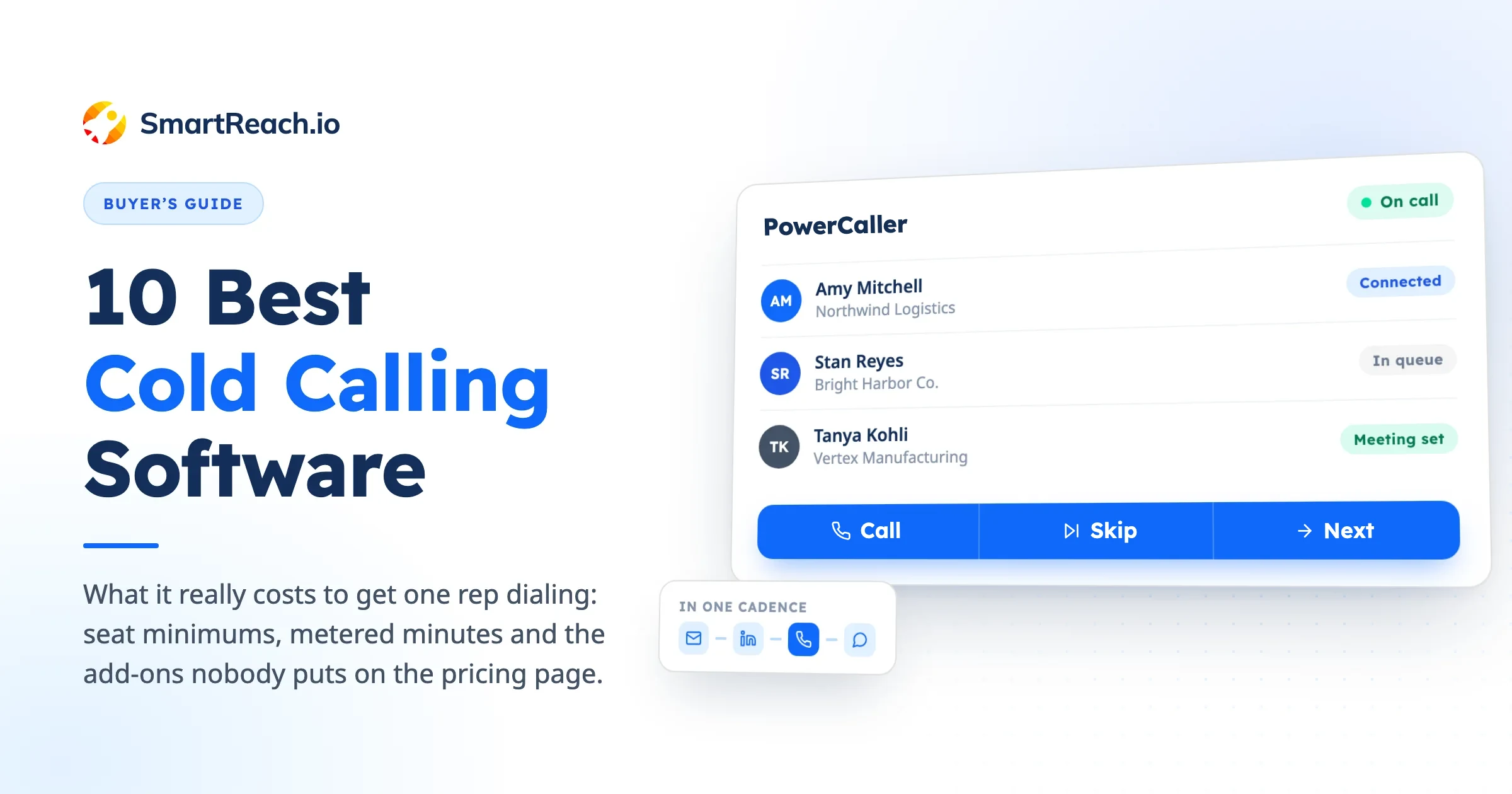
- PowerCaller: the SmartReach.io power caller. Work a full day’s call list from one screen, clicking to dial each prospect and moving to the next call.
- Calling as a sequence step: calls sit beside email, LinkedIn and WhatsApp steps in the same cadence.
- Call sentiment and dispositions: tag every call, then map the pattern back to the account.
- Personalised caller ID: show a local number, controlled per campaign.
- Reach across 200+ countries: pick the calling number for the country you’re dialing.
- Call recording and transcription: every call stored and searchable for coaching.
- B2B lead database: find prospects and their phone numbers inside the same tool.
- Two-way CRM sync: HubSpot, Salesforce, Pipedrive and Zoho, with fields mapping both ways.
- Built-in sales CRM: lead status and reporting for teams without a separate CRM.
Pros
- Calling is a sequence step, not a second product with its own list.
- No per-seat pricing. Plans scale by active prospects, and every plan above Basic includes unlimited users.
- $39/month includes a calling seat, with no licence minimum to clear first.
- Extra calling seats are an add-on at $19 per calling seat per month, charged only for the reps who actually dial.
- Email deliverability tooling is bundled rather than bought from a third vendor.
Cons
- No free plan, though the 14-day free trial needs no credit card.
- Local calling sits on the Scale plan, and there is no automatic local presence, so reps choose which local number to call from.
- It’s a sequencing platform with a dialer in it. Teams that do nothing but dial all day will out-dial it with a dedicated parallel dialer.
How much does SmartReach.io cost?
| Plan | Monthly | Prospects | Users | Calling seats | LinkedIn seats |
|---|---|---|---|---|---|
| Sales Engagement Basic | $39/mo | 1,000 | 1 | 1 | 1 |
| Sales Engagement Plus | $99/mo | 50,000 | Unlimited | 3 | 3 |
| Sales Engagement Pro | $249/mo | 100,000 | Unlimited | 10 | 10 |
| Sales Engagement Scale | $599/mo | 500,000 | Unlimited | 100 | 100 |
Add-ons: extra calling seats $19 per seat per month. LinkedIn automation $29/month per account.
Real cost for a 5-rep calling team: $99/month on Sales Engagement Plus covers three calling seats and unlimited users, plus $38/month for two more seats. That’s $137/month for five reps dialing, emailing and running LinkedIn from one queue, against $150/month for five Aircall Professional licences that only make calls.
3. Aircall: best for plug-and-play CRM calling
- From
- $30/licence/mo, 3-licence minimum
- Free trial
- Free access trial
- Best for
- Teams that want calling bolted onto an existing CRM in an afternoon, with no telephony project.
Aircall is a cloud phone system built around CRM integrations, at $30 per licence a month with a 3-licence minimum, which makes $90 the real floor. It’s used by sales teams at Spotify and Typeform, and the setup genuinely is same-day.
The catch is tier placement. The power dialer, the feature most people arrive for, sits on Professional at $50 per licence monthly ($37.50 on annual billing). With the same 3-licence minimum, that’s $150 a month to get a dialer running.
Key Features of Aircall
- Power dialer for automated outbound calling, on Professional and above.
- Native integrations with Salesforce, HubSpot and Zendesk.
- Call monitoring and whispering for live agent coaching.
- Customisable call routing and IVR.
- Mobile apps for iOS and Android.
Pros
- The deepest CRM integration catalogue on this list.
- Fast to deploy, with very little admin work.
- Clear published pricing, with the minimums stated up front.
Cons
- A 3-licence minimum on every published plan.
- The power dialer is a $50 per licence tier, not an entry feature.
- Unlimited outbound calling only appears on Custom, which needs 25 licences.
4. JustCall: best for calls, SMS and WhatsApp in one inbox
- From
- $29/user/mo annual, 2-user minimum
- Free trial
- 14 days
- Best for
- Distributed teams that text and WhatsApp prospects as much as they call them, across many countries.
JustCall is a global VoIP platform with virtual numbers in 70+ countries, from $29 per user a month on annual billing with a 2-user minimum. Team is the entry plan, Pro is $49 and Pro Plus is $89, all with a 14-day free trial and no card required.
Where it earns its place is messaging. Calls, SMS and WhatsApp land in one inbox, which is genuinely useful in markets where a prospect will reply on WhatsApp and never pick up the phone.
Key Features of JustCall
- Virtual phone numbers in 70 or more countries.
- SMS and WhatsApp messaging in a shared inbox.
- AI call scoring and performance analytics.
- Click-to-dial and auto-dialer.
- Call recording and transcription for compliance and training.
Pros
- Strong international number coverage.
- Calls, SMS and WhatsApp in one place.
- 14-day free trial with full feature access, no card required.
Cons
- A 2-user minimum, so $58 is the real entry bill.
- The sales dialer sits on SalesPro, which is quote-only.
- Reporting is thinner than Ringover’s at a similar price.
5. CallHippo: best free entry point
- From
- Free for 6 months, then $18/user/mo
- Free trial
- 10 days
- Best for
- Startups that want a working business phone number before committing any budget to it.
CallHippo is a lightweight VoIP system whose Basic plan is free for the first six months from signup, after which Starter is $18 per user a month. Professional is $30 and Ultimate is $42, with a 10-day trial on the paid tiers.
It’s the softest landing on this list for a team that isn’t sure it needs a phone system yet. The trade is depth. Support quality is the recurring complaint in user reviews, and the analytics stop well short of what Ringover gives you for a similar price.
Key Features of CallHippo
- Call forwarding and IVR for call handling.
- A free Basic plan for the first six months from signup.
- Integrations with Zoho CRM and Slack.
- Call recording and monitoring for quality assurance.
- Speech analytics on the higher tiers.
Pros
- Genuinely free for the first six months.
- No user minimum on the published plans.
- Simple to set up without technical help.
Cons
- The free plan converts to a paid Starter plan after six months.
- Customer support is the most common complaint in user reviews.
- The parallel dialer and AI voice agent are priced separately.
6. Ringover: best for call centres
- From
- $15/user/mo annual, $24 monthly, 3-user minimum
- Free trial
- Free trial
- Best for
- Inbound and blended call centres that need supervisor tooling and real-time dashboards.
Ringover is a call-centre-grade VoIP platform starting at $15 per user a month on annual billing, $24 month to month, with a 3-user minimum. The Business tier, which carries the analytics most call centres want, is $47 annual and $57 monthly.
Worth noting if you read a version of this post a year ago. Ringover used to be a "contact sales" vendor and now publishes its rate card, which makes it far easier to compare against Aircall.
Key Features of Ringover
- Advanced IVR and call queues.
- Real-time performance monitoring for supervisors.
- AI call analytics and transcription.
- Call whispering and barging for live coaching.
- Voice, SMS and email in one interface.
Pros
- Supervisor and monitoring tooling that matches products costing more.
- Published pricing on both billing terms.
- Strong analytics and dashboards for inbound teams.
Cons
- A 3-user minimum, so $45 is the annual-billing floor.
- The useful analytics sit on Business at $47 per user.
- Outbound cadence features are thinner than a dedicated sales tool.
7. Nextiva: best for voice and customer support together
- From
- $15/user/mo annual, $23 monthly
- Free trial
- Free trial
- Best for
- Businesses that want one vendor for the phone system and the customer support desk.
Nextiva is a unified communications platform whose Core plan is $15 per user a month on an annual term and $23 month to month. Engage is $25 annual and $50 monthly, Scale is $75, and the enterprise contact-centre plans start around $75 per agent.
It’s the safe institutional choice here. Voice, video, messaging and support workflows come from one vendor with 24/7 support behind them, which is worth real money to a team with no IT function.
Key Features of Nextiva
- Unified voice, video and messaging.
- Advanced call routing with auto-attendants and IVR.
- CRM and helpdesk integrations including Salesforce and Zendesk.
- Call recording and analytics.
- 24/7 support on every plan.
Pros
- One vendor for phones and customer support.
- No user minimum on the small business plans.
- Reliable, with support that answers.
Cons
- The annual rate needs a 12-month term, and monthly billing costs 35 to 50 percent more.
- Outbound sales dialing isn’t the product’s strength.
- The jump from Engage to Scale is steep at $75 per user.
8. Bitrix24: best for CRM and calling on a flat fee
- From
- Free for unlimited users, paid from $49/mo (5 users)
- Free trial
- Free plan
- Best for
- Small teams that want a CRM, tasks and calling on one flat organisation-level bill.
Bitrix24 is an all-in-one business platform with a free tier for unlimited users, and paid plans billed per organisation rather than per user, from $49 a month covering 5 users on annual billing. Standard is $99 a month for up to 50 users and Professional is $199 for up to 100.
That flat structure is the reason it belongs here. You pay the same whether the Standard plan carries six users or forty-nine, which is unusual in this category and genuinely cheap at the top of a tier.
Key Features of Bitrix24
- Built-in CRM for contacts and sales pipelines.
- VoIP calling and video conferencing.
- A free tier with unlimited users and core CRM.
- Task and project management for the whole team.
- Cloud and on-premise deployment options.
Pros
- A real free tier, limited on features rather than headcount.
- Flat per-organisation billing, so users are effectively free inside a tier.
- CRM, tasks and telephony from one vendor.
Cons
- The interface is dense and the learning curve is steep.
- Telephony is a component of a suite, not a focused calling product.
- Crossing a user cap moves you a whole tier, not one seat.
9. Ooma Office: best for month-to-month small business phones
- From
- $19.95/user/mo, no contract
- Free trial
- Month-to-month, cancel any time
- Best for
- Small businesses that want reliable phones, a virtual receptionist and no annual commitment.
Ooma Office is a small business phone system at $19.95 per user a month, month to month, with no contract and no per-line minimum. Pro is $24.95 and adds the desktop app, texting and call recording. Pro Plus is $29.95 and adds CRM integrations, HIPAA Mode and call queuing.
Nothing here is aimed at outbound sales. What it does well is be a phone system a non-technical team can run, and let you cancel at the end of any month.
Key Features of Ooma Office
- A simple VoIP phone system with no contracts.
- Virtual receptionist for call routing.
- Voicemail transcription.
- Mobile and desktop apps, desktop from Pro upward.
- HIPAA Mode and CRM integrations on Pro Plus.
Pros
- True month-to-month billing with no contract.
- Easy for a non-technical team to administer.
- Unlimited calling across the US, Canada, Mexico and Puerto Rico.
Cons
- The Essentials tier has no desktop app and no texting.
- CRM integrations only appear on Pro Plus at $29.95.
- No sales dialer or cadence features at all.
10. 8×8: best for broad international coverage
- From
- Not published, quote only
- Free trial
- Contact sales
- Best for
- Multinational organisations that need unlimited international calling and formal compliance coverage.
8×8 is an enterprise cloud communications platform with unlimited calling into 48 or more countries, and it no longer publishes a rate card. Every price now comes through a sales conversation, so budget for a procurement cycle rather than a signup.
For a global organisation with compliance obligations it’s a strong shortlist entry. For a five-person sales team, the quote process alone makes it the wrong shape.
Key Features of 8×8
- Global voice, video and chat on one platform.
- A contact centre suite for omnichannel support.
- AI speech analytics.
- Unlimited calling to 48+ countries on the international plans.
- Enterprise security with HIPAA and GDPR coverage.
Pros
- The widest international calling footprint on this list.
- Full contact centre capability under the same vendor.
- Compliance coverage that satisfies regulated buyers.
Cons
- No published pricing, so you can’t budget without talking to sales.
- Overbuilt and overpriced for a small sales team.
- Deployment is a project, not an afternoon.
11. Grasshopper: best for solopreneurs
- From
- $14/mo annual, $18 monthly
- Free trial
- Free trial
- Best for
- Solo operators and freelancers who want a business number on their existing phone, with no hardware.
Grasshopper is a virtual phone system for one-person businesses, at $14 a month on annual billing and $18 month to month. Solo Plus is $25 annual with three extensions, and Small Business runs from $55 to $80 depending on the term.
It isn’t a sales tool and doesn’t pretend to be. It keeps business calls off your personal number, and it does that well.
Key features of Grasshopper
- Virtual phone numbers: a business number with custom extensions.
- Call forwarding: route calls to mobile, office or home.
- Voicemail transcription: read voicemails as text.
- Instant response: automatic text replies to missed calls.
- Mobile and desktop apps: no hardware required.
Pros
- The cheapest published entry price on this list.
- Running in minutes, with no technical setup.
- A professional business number without a second device.
Cons
- No CRM integrations at all.
- Not workable beyond about five users.
- The lowest G2 rating in this comparison, at 3.9.
Still deciding? Try SmartReach.io for FREE
Choosing the right Dialpad alternative comes down to your call volume, your headcount plan, and whether calls need to sit beside your other channels.
Here’s the quick decision guide:
Best for VoIP and SIM on one flat bill: dialnote ($19/mo)
Best for calls inside an email, LinkedIn and WhatsApp sequence: SmartReach.io ($39/mo, one calling seat included)
Best for CRM-native calling: Aircall ($30/licence, 3-licence minimum)
Best for international numbers and messaging: JustCall, 8×8
Best free start: Bitrix24, CallHippo
Best for call centres: Ringover, Nextiva
Best month-to-month phone system: Ooma Office
Best for solopreneurs: Grasshopper
Not sure which one is right for you? Start with a trial:
- SmartReach.io: 14-day free trial, no credit card required
- JustCall: 14-day free trial
- dialnote: 10-day free trial, no credit card
- CallHippo: 10-day free trial, or the free Basic plan
F.A.Qs
What’s better than Dialpad?
It depends what the calls are for. As a business phone system, dialnote is the closer replacement: VoIP plus SIM calling with global numbers on a flat plan rather than per seat. If the calls are outbound prospecting, SmartReach.io puts a dialer inside the email and LinkedIn cadence on Sales Engagement Plus at $99 a month with unlimited users.
Who competes with Dialpad?
The direct rivals are business phone systems: dialnote, Aircall, JustCall, RingCentral, Nextiva and 8×8, all covering routing, shared numbers and voicemail. SmartReach.io competes for a narrower slice, the outbound sales call, because its dialer sits inside an email and LinkedIn sequence rather than functioning as a company phone system in its own right.
Is there a free version of Dialpad?
Dialpad has no permanently free version, only a 14-day free trial. Among the alternatives, dialnote starts at $19 a month on Solo and $49 for unlimited users on Team, and Bitrix24 offers a genuinely free basic tier. SmartReach.io runs a 14-day trial covering 200 prospects with no card, though it is an outreach tool rather than a phone system.
What is the best Dialpad alternative for small businesses?
Small businesses want a flat plan and a short setup, which is where per-seat pricing hurts most. dialnote covers unlimited users from $49 a month with AI call handling included. Grasshopper at $14 a month on annual billing suits a solopreneur who only needs a number. SmartReach.io fits when the calling is prospecting and needs to sit in the same sequence as the emails.
Do these Dialpad alternatives support CRM integrations?
Yes, though the depth varies more than the feature lists suggest. Aircall and JustCall both have deep native HubSpot and Salesforce integrations built for sales teams. SmartReach.io syncs two ways with Salesforce, HubSpot, Pipedrive and Zoho, so a call placed in the dialer logs against the prospect record automatically rather than needing a second entry afterwards.
Which alternative is best for remote teams?
JustCall suits distributed teams well, with virtual numbers in 70+ countries and AI call insights. dialnote works for a remote team that needs one flat-priced phone system rather than per-seat licences across time zones. SmartReach.io fits a distributed sales team specifically, because the shared task manager keeps reps on one call queue alongside their email and LinkedIn steps.
Are there alternatives with SIM-based calling?
Yes. dialnote offers SIM-based calling alongside VoIP, which matters where mobile networks are more reliable than the data connection, or where a local mobile number answers better than a VoIP one. The trade-off is cost against connectivity: VoIP is cheaper per minute, SIM tends to connect more consistently on the move and in regions with patchy broadband.
What is the cheapest Dialpad alternative for startups?
Quo, the business phone service that was OpenPhone until its September 2025 rebrand, is a strong startup pick at $15 per user a month on annual billing, covering texting, VoIP calling and call recording with no seat minimum. dialnote's Solo plan at $19 includes 250 minutes and free porting. Check the seat minimum before comparing headline prices, because several rivals bill three licences regardless.
Can I migrate from Dialpad to another provider easily?
Yes, and the mechanics are standard across the category. Aircall, RingCentral and dialnote all support contact import, number porting and guided setup. Porting typically takes 7 to 14 business days, so start it before cancelling Dialpad rather than after, and keep the old account active until the numbers have actually moved to avoid losing inbound calls mid-transfer.
Which alternative is best for call recording and compliance?
All the alternatives here support call recording, so the question is really about compliance rather than the feature. For healthcare and finance, 8×8, RingCentral and Nextiva carry the HIPAA and GDPR documentation, along with automatic consent workflows and encrypted storage. Check which party is responsible for obtaining consent in your jurisdiction, because the platform records but does not decide.
Can I port my existing Dialpad phone numbers to a new provider?
Yes. Aircall, RingCentral, JustCall and dialnote all support number porting, and the process typically takes 7 to 14 business days end to end. Start the request with the new provider before cancelling the old account, because a number cannot be ported away once the account holding it has closed, and recovering one afterwards is rarely straightforward.
Are there month-to-month alternatives without annual contracts?
Yes. CallHippo, Ooma and Grasshopper all bill month to month with no annual commitment, and dialnote's plans are monthly as well. Aircall and SmartReach.io both offer monthly billing alongside discounted annual terms. Annual contracts in this category typically save 15 to 20%, which is worth taking only once you are confident the tool fits.
Stop juggling tools
Book more meetings on every channel
Join 5,000+ teams running multichannel outreach from one sequence, with deliverability built in.