Outreach vs Salesloft: Which One Fits Your Team

On this page
Two names come up in almost every sales engagement shortlist, and they've been circling each other for a decade. Both run multi-step cadences. Both sync to Salesforce. Both dial, log, report and coach.
Ask ten sales leaders which one they'd pick and you'll get ten answers that all start with "it depends on your team." That's not a useful answer when you're the one signing an annual contract.
The honest version is that these platforms overlap on maybe ninety percent of what a revenue team touches day to day. The decision lives in the other ten percent, and in 2026 that ten percent moved.
One of them repriced around AI credits and stopped calling itself a sales engagement platform. The other got acquired into a much larger revenue company and is still working out what that means for its roadmap.
So the question isn't which platform has more features. It's which one's bet matches yours, and what each one quietly expects you to buy separately.
TLDR for Outreach vs Salesloft
The 60-second comparison
Every figure for Outreach and Salesloft below is the reported market position at the time of writing, because neither vendor publishes a price. SmartReach.io figures are its published monthly list prices on monthly billing.
| Outreach | Salesloft | SmartReach.io | Who it favours | |
|---|---|---|---|---|
| Category it claims | AI revenue workflow platform | Sales engagement, inside Clari | Sales engagement for outbound | Tie |
| G2 rating | 4.3 | 4.5 | 4.6 | SmartReach.io |
| Published pricing | No, quote only | No, quote only | Yes, on the site | SmartReach.io |
| Reported cost | ~$100-170/user/mo | ~$125-165/user/mo | $29-$599/mo total | SmartReach.io |
| Billing unit | Seats + AI credits | Seats | Active prospects | SmartReach.io |
| Contract | Annual | Annual | Monthly or annual | SmartReach.io |
| Free trial | Demo only | Demo only | 14 days, no card | SmartReach.io |
| Ease of use (G2) | 8.3 | 8.8 | Not scored head-to-head | Salesloft |
| Channels | Email, calls, SMS | Email, calls, LinkedIn, SMS | Email, LinkedIn, calls, WhatsApp | SmartReach.io |
| Conversation intelligence | Yes, Kaia | Yes, plus Clari's | No | Outreach |
| Forecasting and deals | Native | Via Clari, separate app | No | Outreach |
| Email warmup | No | No | Yes, built in | SmartReach.io |
| Inbox rotation and ESP matching | No | No | Yes, from Plus up | SmartReach.io |
| Secondary domains and mailboxes | No | No | Yes, buy in app | SmartReach.io |
| Best for | Large orgs with sales ops | Mid-market wanting fast rollout | Outbound teams and agencies | Depends |
Are Outreach and Salesloft even competitors?
They compete for the same budget line. They don't always solve the same problem.
Picture a 180-person revenue organization running on Salesforce, with a dedicated RevOps team and AEs who own complex multi-threaded deals. A VP gets asked for a forecast number every Monday.
This team's pain isn't sending email. It's that pipeline data lives in six places, coaching happens on gut feel, and nobody trusts the forecast until the last week of the quarter.
What they need is one system where the engagement data and the deal data are the same data.
Now picture a 14-person outbound team at a Series A company. Four SDRs, six AEs, a founder still doing demos.
They're sending cold email into accounts that have never heard of them, from domains that are eighteen months old. Their reply rate dropped by half last quarter and nobody can explain why.
Their pain is that emails aren't landing. Forecasting is a spreadsheet and that's fine, because there are nine deals.
Both teams will end up on a shortlist that says "Outreach vs Salesloft," because that's what the category pages say. Only the first team is actually being sold to.
The second team is about to pay enterprise per-seat rates for forecasting they won't open, while the problem that's actually costing them pipeline goes untouched by both products.
Hold onto that through the rest of this. The Outreach and Salesloft decision is a real one, and a good one to be making, but it assumes your bottleneck is orchestration. If your bottleneck is the inbox, you're comparing the wrong two things.
Outreach: depth, at the price of predictability
Quick facts
- G2
- 4.3/5 ★
- From
- Quote only, seats plus AI credits
- Free trial
- Demo only
- Best for
- Large revenue organizations on Salesforce with a sales ops function and an annual procurement cycle.
What it is now
Outreach spent years as the definitional sales engagement platform. It doesn't describe itself that way anymore.
Its own site now leads with agentic AI for revenue teams, covering prospecting, deal management, forecasting, coaching and conversation intelligence. G2's breadcrumb for it reads Revenue AI Platforms rather than Sales Engagement.
Even the domain moved: outreach.io now redirects to outreach.ai, which tells you where the company thinks it's going.
That repositioning matters more than it sounds. The product you'd have bought in 2022 was a very good sequencer with reporting attached.
The product you're quoted for in 2026 is a revenue platform where sequencing is one module among several, and you're paying for the whole shape whether or not you use it.
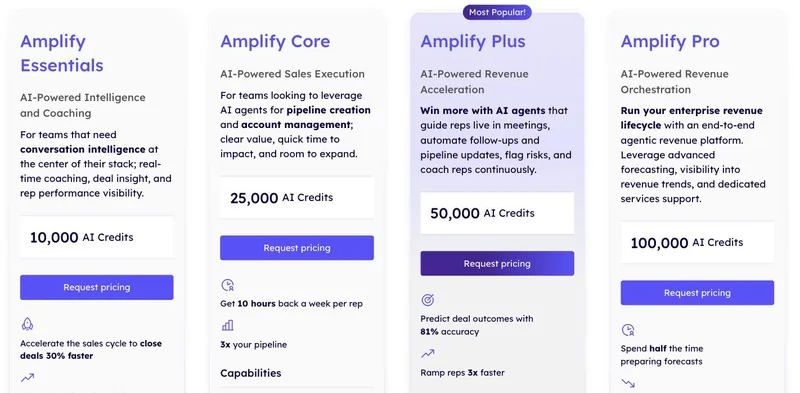 Four packages, four credit allowances, and four Request pricing buttons. The tiering is real and public. The number isn't.
Best for
Revenue organizations big enough to have someone whose job is configuring this.
Outreach rewards investment. The workflow engine is genuinely deep, the custom object support is real, and if you have the ops capacity to build against it you'll get things out of it that lighter tools can't do.
Buyers on G2 report roughly a month to implement, which is only a problem if nobody warned you.
Key features
- Multi-step sequences with the deepest conditional and trigger configuration of the three tools here
- Kaia, the conversation intelligence layer: real-time transcription, action item detection, topic and sentiment analysis, searchable call history
- Native deal management and forecasting, in the same product rather than a connected one
- Agent Studio and a set of AI agents for meeting prep, research and follow-up
- Deep bi-directional Salesforce sync, with custom objects scaling by tier
- Outreach Voice as a dialer add-on
Pricing
Four Amplify packages: Essentials, Core, Plus and Pro. They differ by AI credit allowance (10,000, 25,000, 50,000 and 100,000), API calls, custom objects and knowledge storage.
Every one of them says "Request pricing." The model is stated plainly on the page as a combination of seat-based pricing and consumption-based pricing powered by AI credits, with no platform fee.
Third-party estimates at the time of writing land around $100 to $170 per user per month, on annual contracts, with implementation fees reported anywhere from four to five figures.
Add-on modules include data sharing, connectors, additional instances and listener licences. You can buy extra credit packs at any time.
For a fuller breakdown of the credit model, we went through it properly in our Outreach.io review.
Limitations
The credit line is the real one. Outreach won't publish what a single credit buys.
So you can see that Amplify Plus bundles 50,000 of them and still have no way to work out whether that's a year of usage or six weeks for a team of twelve.
Seat pricing is annoying but predictable. Consumption pricing on an undefined unit is a variable your finance team can't model until after you've signed.
Beyond that: there's no trial and no monthly option, so evaluation runs through procurement. The learning curve is steep enough that G2 buyers score it lowest of the two on ease of setup.
And nothing in the product addresses cold-email deliverability, because it was never built for teams sending into cold domains at volume.
Pros
- Deepest workflow and automation configuration of the three
- Kaia is a genuinely strong conversation intelligence layer
- Forecasting and deal management are native, not a second application
- Consumption pricing is arguably fairer for orgs where AI usage varies wildly by rep
- Strong custom object and API scaling for teams that build against it
Cons
- Undefined AI credit unit makes total cost impossible to forecast before signing
- No published price, no trial, no monthly billing
- Lowest ease-of-setup score of the two at the time of writing
- Reported implementation fees on top of licence cost
- No warmup, inbox rotation, ESP matching or secondary domain supply
Salesloft: easier to land, harder to predict
Quick facts
- G2
- 4.5/5 ★
- From
- Quote only, per seat, annual
- Free trial
- Demo only
- Best for
- Mid-market revenue teams who want a fast rollout and broad app coverage without a dedicated ops build.
What it is now
Salesloft is the sales engagement half of a much bigger company than it was two years ago.
Clari and Salesloft completed their merger on 3 December 2025, putting Salesloft's engagement and conversation intelligence alongside Clari's forecasting and pipeline intelligence, with a combined base reported above 5,000 customers.
Forrester covered the strategic logic in its analysis of the deal. The short version is that the ambition is real and so is the execution risk.
What buyers should understand is what the merger has and hasn't done so far. It combined the companies. It hasn't unified the products.
Salesloft still runs as its own application beside Clari's forecasting rather than inside it, and the public answer on when that changes has been measured in years rather than quarters.
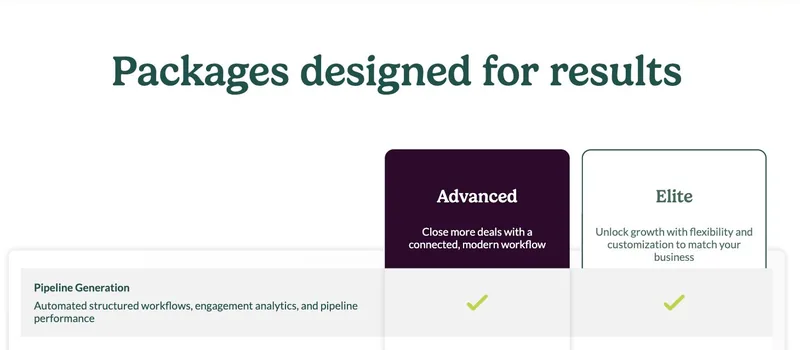 Two packages now, not the three tiers most comparison posts still quote. Checkmarks everywhere, prices nowhere.
Best for
Mid-market teams that want most of the enterprise capability without an enterprise implementation.
Salesloft has spent years optimising for the rep experience rather than the ops experience, and it shows in the adoption numbers.
If your last tool died because reps quietly stopped opening it, that history should weigh heavily here.
Key features
- Cadences with strong multichannel coverage across email, calls, LinkedIn and SMS
- Rhythm, which turns buyer signals into a prioritised action list for each rep
- Conversation intelligence and coaching, well regarded on its own before the merger
- Forecasting and pipeline intelligence through Clari, post-merger
- Reported integrations with 160-plus apps, the widest ecosystem of the three
- Mobile app with more depth than the competition's
- Bi-directional CRM sync with real-time contact history
Pricing
Not published. What the pricing page does show, at the time of writing, is two packages: Advanced and Elite, over a capability matrix and a "Talk to Sales" button.
That's worth flagging, because most comparison posts still describe a three-tier Essentials, Advanced and Premier lineup that the live page no longer shows. If you're reading older roundups, check the tier names against the current page before you walk into a call.
On cost, reported market rates sit around $125 to $165 per user per month on annual contracts. The seat minimum in North America has been reported anywhere from three to ten depending on the source and the tier.
The dialer is a separate add-on, reported at roughly $200 to $400 per user per year. Treat all of it as directional. The only number that binds is the one in your quote.
Limitations
The merger is the honest risk. You're signing into a group running two conversation intelligence systems and two engagement paths on top of a forecasting engine that wasn't built to unify them.
The integration timeline is open-ended. That's not a reason to avoid Salesloft, but it is a reason to ask hard questions about roadmap commitments before agreeing to a multi-year term.
Otherwise: same structural gaps as Outreach. No warmup, no inbox rotation, no ESP matching, no secondary domain supply, no monthly billing, no self-serve trial.
Teams running genuine cold outbound on Salesloft end up buying a second stack for the sending layer.
Pros
- Clearly ahead on ease of use and ease of setup at the time of writing
- Widest integration ecosystem of the three
- Rhythm gives reps a prioritised queue instead of a blank cadence list
- Higher G2 rating than Outreach
- Faster rollout for teams without a dedicated RevOps function
Cons
- Post-merger roadmap is unresolved and the products aren't unified
- Forecasting lives in a second application, not the same one
- No published price, no trial, no monthly billing
- Dialer is a separate per-user add-on on top of the seat cost
- No cold-email deliverability layer at all
SmartReach.io: the third option, with its limits stated
Quick facts
- G2
- 4.6/5 ★
- From
- $29/mo, priced by active prospects
- Free trial
- 14-day free trial, no card
- Best for
- Outbound teams and agencies who need the sending half done properly without an annual enterprise contract.
What it is
SmartReach.io is a cold email software built around outbound execution rather than revenue orchestration. On its Sales Engagement plans it works as a sales engagement platform with email, LinkedIn, calls and WhatsApp in one cadence.
Multi-step sequences with conditional logic, and multichannel cadences that branch on what the prospect does.
Underneath that sits a full deliverability suite, a shared inbox, a built-in lead database with 300M+ contacts and 50M+ companies, and native sync to HubSpot, Salesforce, Pipedrive and Zoho.
It's used by 5,000+ businesses and rates 4.6 on G2. The scope is deliberately narrower than either platform above. What sits inside that narrower scope is deeper.
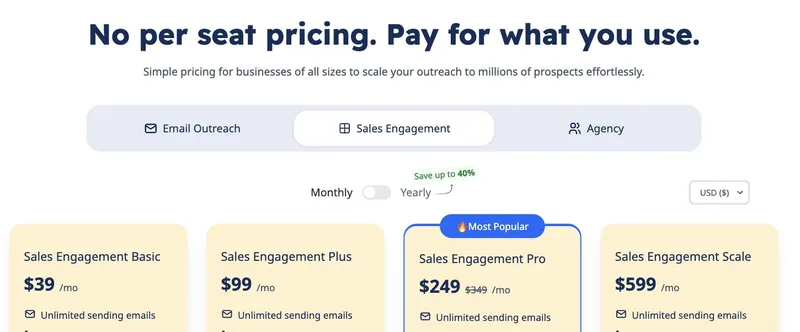 The whole argument in one screen. Four tiers, four numbers, a monthly toggle, and no "Request pricing" button anywhere.
Best for
Teams of roughly 3 to 50 reps doing real cold outbound, and agencies running campaigns for multiple clients.
The billing model is the tell. You pay for active prospects, not seats, so an agency onboarding a fourth client and a startup hiring three SDRs have very different cost curves than they would on either platform above.
Key features
- Sequences across five channels with conditional branching and auto-pause on reply from any channel
- Email warmup built in, with free warmup accounts on every tier
- Inbox rotation and ESP matching from the Plus tier up
- Secondary domains and mailboxes you can buy in the app, authenticated and ready to send
- Unified campaign inbox on every plan, with unlimited users from Plus up
- Cold calling seats and LinkedIn automation as part of the Sales Engagement family
- A working set of AI agents today: sequence generation, per-prospect email writing, reply sentiment classification and AI-drafted replies
- AI SDR, coming soon: an agent that prospects, runs outreach and books meetings against your audience on its own, rather than assisting a rep who's driving
- Client dashboards for agencies, from one on Plus to ten on Scale
A note on that AI SDR line, because vendor roadmaps deserve scepticism: it isn't shipped yet. It's on the published roadmap, not in your account today, and you should price the platform on what it does now and treat the agent as upside.
Pricing
Published, on the site, in two families.
Email Outreach runs $29, $89, $199 and $499 a month for Basic, Plus, Pro and Scale. Sales Engagement, which adds calling seats and LinkedIn manual seats, runs $39, $99, $249 and $599.
All of those are monthly list prices on monthly billing. Annual billing is discounted separately: Email Outreach Plus is $948 a year against $1,068 at the monthly rate, which works out around $79 a month.
LinkedIn automation is a $29/month add-on per LinkedIn account, so a team putting five reps on LinkedIn adds $145 to the monthly bill.
The full pricing page has the tier-by-tier detail, and there's a 14-day free trial with 200 prospects and no credit card.
Limitations, stated plainly
This is where a lot of comparison posts go quiet, so let's not.
- No forecasting or deal management. It's an execution tool. Pipeline lives in your CRM, and if you want a revenue platform that owns the forecast, this isn't one.
- LinkedIn automation costs extra. $29/month per LinkedIn account, on top of the plan. The sticker price is not the invoice, and any vendor who lets you assume otherwise is doing you a disservice.
- Smaller integration ecosystem. 14 named native integrations against Salesloft's reported 160-plus apps. Zapier covers 8,000+ apps beyond that, but native depth is not the same thing.
Pros
- Published pricing, billed by active prospects rather than seats
- Full cold-email deliverability stack included, not bought separately
- Four channels in one conditional cadence, including WhatsApp
- Unlimited users from the Plus tier up on both families
- 14-day trial with no credit card and no demo gate
- Client dashboards make agency work practical
Cons
- No forecasting or deal management
- LinkedIn automation is a per-account add-on above the plan price
- Narrower native integration list than either enterprise platform
Head to head, dimension by dimension
Twelve places where these three actually differ, and what the difference costs you. Each one ends with a call, and they don't all go the same way.
Data and prospecting
Neither Outreach nor Salesloft sells you contact data. Both assume you arrive with a list, sourced from ZoomInfo, Apollo, Clay or wherever your ops team decided.
That's a defensible design choice for enterprise teams who already own a data contract. It's an annoying one for everyone else.
The practical effect is that the platform bill is never the whole bill. A ZoomInfo contract on top of a Salesloft contract is a common shape, and the data line is often the bigger of the two.
SmartReach.io ships LeadFinder in the box, drawing on 300M+ verified contacts and 50M+ companies. Access runs on SmartReach credits, bundled with each tier from Plus up: 1,000 credits on Plus, 2,000 on Pro, 5,000 on Scale.
The honest caveat: a bundled database and a dedicated data vendor are not the same product. On hard segments, obscure geographies or deep firmographic filtering, a specialist will out-resolve a database that ships alongside a sequencer.
If data quality is the entire job, buy a data vendor and plug it into whatever sends. If you want a workable list without a second contract, the bundled one earns its place.
Verdict: SmartReach.io, on the grounds that it's the only one of the three where a list is included rather than assumed.
Automation and sequence logic
All three build multi-step sequences with branching. The difference is ceiling, not whether the feature exists.
Outreach's workflow engine goes deeper than either alternative. More trigger types, more conditional complexity, custom object support that scales by tier from 5 objects to 20, and API call allowances running from 250,000 up to a million.
What that actually buys you is the ability to build things the UI doesn't offer. If your ops team wants to fire a sequence off a custom Salesforce object that only your company has, Outreach is the one that lets them.
Salesloft's cadences are cleaner and cover the common patterns well. Rhythm adds something the others don't: it turns buyer signals into a ranked action list, so a rep opens the tool to a prioritised queue rather than a blank cadence picker.
SmartReach.io branches on prospect attributes and engagement across all four channels, auto-pauses the whole sequence when someone replies anywhere, and uses conditional merge tags for per-prospect variation. That's plenty for outbound execution. It isn't the same depth of orchestration.
The question that decides this one isn't which engine is most capable. It's whether you have someone whose job is to build against it. Outreach's depth is worthless to a team with nobody to wield it.
Verdict: Outreach. If you have the ops capacity to build against a workflow engine, nothing else here gives you as much to build with.
Deliverability and warmup
This is the widest gap in the whole comparison and the one most rarely covered.
Neither Outreach nor Salesloft includes email warmup. That isn't an oversight, it's a design assumption.
Both were built for reps sending modest volumes from established corporate mailboxes into accounts that already know the company. In that world warmup genuinely isn't needed, because the domain has years of reputation behind it.
Point either platform at fresh cold domains at volume and the assumption breaks. You'll be shopping for a warmup tool within a month, and a deliverability monitor shortly after.
SmartReach.io includes warmup on every tier at no extra cost, scaling from 10 accounts on Basic to 25 on Plus, 75 on Pro and unlimited on Scale. Around it sits deliverability tooling built for cold sending: automatic email validation before send, and global blacklist monitoring on your sending domains.
That last one matters more than it sounds. Finding out you're on a blacklist from your reply rate rather than from an alert costs you a quarter.
Verdict: SmartReach.io outright. The other two don't compete here because they were never trying to.
Ease of use and rollout speed
G2's head-to-head is unambiguous at the time of writing. Salesloft scores 8.8 on ease of use against 8.3, and 8.6 on ease of setup against 7.7.
The setup gap is the one that costs money. The difference between a two-week rollout and a two-month rollout is two months of reps not using the thing you're already paying for.
Buyers on G2 report roughly a month to implement Outreach and eleven months to see return. Those two numbers describe the same product from different ends.
The uncomfortable part is that Outreach's depth and its learning curve are the same property. You can't have a workflow engine that does everything and also have it be obvious. Salesloft made the opposite trade deliberately, optimising for the rep opening the tool rather than the admin configuring it.
SmartReach.io isn't scored head-to-head against these two on G2, so there's no clean number to quote. It's a smaller surface area and easier to get running, but that's a function of scope rather than craft, and it would be dishonest to bank a win on it.
Verdict: Salesloft, outright. If rep adoption has killed a tool for you before, this is the number that should decide it.
Inbox rotation and ESP matching
Two features that sound like plumbing and decide whether your campaign lands.
Rotation spreads a campaign's sending across multiple mailboxes, so no single one carries a volume signal big enough to trip a filter. Instead of one mailbox sending 400 a day, eight send 50.
ESP matching sends each message from a mailbox on the same email provider as the recipient, Google to Google and Microsoft to Microsoft. Providers treat same-provider mail more favourably, and the placement difference is measurable.
Neither Outreach nor Salesloft offers either one, for the same reason they don't offer warmup. Their buyer sends from one corporate mailbox per rep, and rotation across a mailbox pool isn't part of that motion.
SmartReach.io has both from the Plus tier up, at $89 a month on Email Outreach and $99 on Sales Engagement.
Worth stating the cap honestly: neither is on the entry tier. If you're on Basic at $29 or $39, you don't get rotation or ESP matching, and the tier you actually need for serious cold sending is Plus.
Verdict: SmartReach.io outright, though by default rather than by contest.
Conversation intelligence and coaching
Kaia does real-time call transcription, action item detection, topic and sentiment analysis, and searchable call history. Conversation intelligence as a category was largely shaped by tools like it.
The reason this matters beyond the feature list is coaching at scale. A manager with eight reps can listen to a handful of calls a week. A manager with a searchable transcript corpus can find every call where pricing came up and see which framing closed.
Salesloft's own conversation layer was well regarded before the merger, and now sits alongside Clari's. That's a capability story and an overlap problem in the same sentence, because the merged group is running two of these systems with no published plan for which survives.
SmartReach.io has nothing in this category. No call recording, no transcription, no coaching analytics. If you're running a calling-led motion where call quality is the thing you manage, it doesn't meet the requirement.
Verdict: Outreach, outright. If conversation intelligence is the job, Outreach is the better buy and we'd say so to your face.
Secondary domains and mailbox supply
Serious cold outbound means sending from domains that aren't your primary one. Burning your main domain's reputation is a company-level problem, not a campaign-level one, and it takes your invoices and password resets down with it.
Doing it properly is a chore. You buy lookalike domains, authenticate SPF, DKIM and DMARC on each, point them at the primary, provision mailboxes, then warm every one of them before you send anything real.
Outreach and Salesloft leave every step of that to you. They'll send from whatever mailbox you connect, and how that mailbox came to exist is your problem.
SmartReach.io sells authenticated secondary domains inside the app, with SPF, MX, DKIM and DNS already set up and redirection to your primary. Alongside that it provisions Google, Microsoft 365 and Azure mailboxes, with an Azure tenant of 50 mailboxes plus a domain at $35 a month.
Both are available from the Plus tier up. The practical difference is a morning of work instead of a fortnight of DNS tickets.
Verdict: SmartReach.io. Not so much a feature comparison as a category the enterprise platforms don't enter.
Forecasting and deal management
This is the dimension the Outreach and Salesloft decision usually turns on, and the merger scrambled it.
Outreach built forecasting and deal management natively, in the same product as the engagement data. When a rep logs a call, the forecast sees it without a sync running in between.
Salesloft's forecasting arrives through Clari, which is a stronger forecasting engine on its own merits and a genuinely bigger ambition. Clari has spent a decade on revenue intelligence, and Salesloft has not.
But seven months after close it's still a second application. There's no published unification date, and the answer on when sequencing and forecasting become one product has been measured in years.
So the choice is between depth of integration today and ceiling tomorrow. For a buyer signing a contract this quarter, "one product now" beats "one product eventually," because you have to run the motion in the meantime.
The fair counter, and it's a real one: if you're making a three-to-five-year platform bet rather than solving this year's problem, Clari's forecasting ceiling is plausibly higher than anything Outreach ships natively. That's a bet on execution, and the last seven months are the evidence you have.
Verdict: Outreach, narrowly, on the strength of shipping rather than the strength of vision.
Unified shared inbox
All three centralise replies so a team isn't hunting through individual mailboxes. The differences are about what the inbox is connected to.
Salesloft's is the most CRM-connected of the three, with real-time bi-directional sync and contact history visible in the same view. A rep answering a reply can see the account's full history without leaving the pane, which is what mid-market teams consistently praise it for.
Outreach's is capable and sits inside a heavier interface. It does the job, but it's one surface in a large product rather than a place reps live.
SmartReach.io's unified campaign inbox is on every plan including the $29 tier, which is unusual at that price.
It also does something the others don't. An AI sentiment classifier sorts replies by intent, so genuinely interested prospects surface above auto-responders and unsubscribes, and an AI response agent drafts context-aware replies.
The trade is a smaller CRM footprint behind it. Four native CRMs is enough for most of its buyers and thin next to Salesloft's ecosystem.
Verdict: Salesloft, on CRM connectedness rather than inbox features.
Multichannel reach
Outreach covers email, calls and SMS. Salesloft adds LinkedIn to that set. SmartReach.io runs email, LinkedIn, calls and WhatsApp in a single conditional sequence.
The count matters less than the coordination. On SmartReach.io a reply on any channel auto-pauses the whole sequence, so a prospect who answers on LinkedIn doesn't get the scheduled follow-up email two days later.
WhatsApp is the genuine differentiator, and it's regional rather than universal.
If you're selling into India, Brazil, Southeast Asia or much of the Middle East, it isn't a nice-to-have channel. It's where business conversations actually happen.
If you sell only into North America, it's close to irrelevant and you shouldn't pay for it.
The caveat on LinkedIn: manual LinkedIn seats are included in the Sales Engagement plans, at 1, 3, 10 and 100 by tier. Automated LinkedIn actions are the $29/month per-account add-on. Those are different things and the pricing page distinguishes them.
Verdict: SmartReach.io, the only one of the three with WhatsApp in the cadence, with the honest note that WhatsApp only matters in some markets.
Integrations and ecosystem
Salesloft reports integrations with 160-plus apps, the widest of the three by a distance. If your stack already has ten tools that need to talk to the sequencer, that number is the one that decides your evaluation.
Outreach has fewer native connectors but deeper ones, particularly into Salesforce, along with an API and custom object model built for teams doing real integration work. Fewer, but the ones that exist go further.
SmartReach.io has 14 named native integrations covering the CRMs most of its buyers run, plus Zapier reaching 8,000+ apps beyond that.
It's worth being precise about what Zapier breadth is and isn't. A Zapier connection is a real integration, but it adds latency, another failure surface, and a per-task cost that grows with volume.
Counting 8,000+ apps against 160 native ones isn't a like-for-like comparison, and we're not going to pretend it is.
Verdict: Salesloft, outright, if the length of your existing stack is the constraint.
Team, agency and pricing predictability
Outreach bills seats plus a metered credit line whose unit it won't define. Salesloft bills seats, with a dialer add-on and a reported seat minimum.
Both share a property that matters more than the rate: your bill grows every time you hire. Approving a headcount plan and approving a software budget become the same conversation.
SmartReach.io bills by active prospects with unlimited users from the Plus tier up. Adding five SDRs doesn't move the invoice. For agencies, client dashboards run from one on Plus to ten on Scale, so each client gets a separate team and workspace without a separate contract.
Here's the inversion nobody selling prospect-based pricing mentions. If you have three people working a list of 400,000 prospects, seat pricing is cheaper for you.
Three Salesloft seats at the reported $125 is $375 a month. The SmartReach.io tier that holds 500,000 prospects is Scale at $499 or $599. Prospect billing rewards teams with more people than list, and punishes the opposite shape.
Verdict: SmartReach.io for teams that are growing headcount, with the honest caveat that a small team working a very large list pays more here than on seats.
The second invoice
Neither Outreach nor Salesloft includes the cold-email sending layer. That sounds like a gap in a feature table. In a budget it's a second purchase.
Here's what happens in practice, in order.
One. You buy the platform. It orchestrates sequences, logs activity, reports on it and syncs to your CRM. All of that works well.
Two. You start sending cold, from newer domains, at real volume. Reply rates come in under forecast and nobody's sure why.
Three. You discover the platform has no warmup, no inbox rotation, no ESP matching and no way to buy authenticated secondary domains. It was never built to.
Four. You buy a second tool for the sending layer. Now you're running two subscriptions, two logins, two support queues, and prospect data that has to stay in sync between them.
That fourth step is the second invoice, and almost nobody prices it during the evaluation.
The comparison isn't apples to apples and it shouldn't pretend to be. You're giving up forecasting and call coaching to get here.
The question is whether you were going to use them.
So which one's yours?
Buy Outreach
Your organization is large enough to have a sales ops function, your AEs run complex multi-threaded deals, and you want engagement, conversation intelligence, deal management and forecasting under one contract with one product owning all of it.
You have the procurement patience for an annual cycle and the ops capacity to configure a deep workflow engine.
Go in with one written question answered: what does a single AI credit buy, and what happens when the team runs out in month eight.
Buy Salesloft
You're mid-market, you don't have a dedicated RevOps team, and the last tool you bought died because reps stopped opening it.
You want most of the enterprise capability with a rollout measured in weeks, and a long list of existing apps that need to connect.
Go in with one written question answered: where do sequencing and forecasting converge post-merger, and on what date.
Buy SmartReach.io
Your bottleneck is the inbox, not the forecast. You're sending cold, at volume, from domains that need warming and rotating.
You'd rather not fund an enterprise contract plus a second deliverability stack to do it, and you want a price you can read and a trial you can start today.
Go in knowing what you're giving up: no conversation intelligence, no forecasting, and LinkedIn automation billed per account.
If you want the wider field rather than these three, we've compared the 10 best sales engagement platforms and gone deeper on Outreach competitors specifically.
For a straight two-way on the Salesloft side, there's Salesloft vs SmartReach.io.
The verdict
Outreach and Salesloft are both good products aimed at a buyer who has already solved sending. That buyer exists, and if it's you, this is a genuinely close call that comes down to depth against adoption.
Take the reported prices in this post as directional and get your own quote, because the only figure that binds either vendor is the one with your signature under it.
If you're the other buyer, the one whose reply rate halved and whose forecast is nine rows in a spreadsheet, the shortlist was wrong before you started comparing.
FAQ
What's the main difference between Outreach and Salesloft?
Outreach is one platform that covers sequencing, conversation intelligence, deal management and forecasting under a single contract, and it now prices seats alongside consumption-based AI credits. Salesloft is the sales engagement layer of the merged Clari group after the two companies completed their merger in December 2025, so its forecasting story runs through a second application rather than the same one. At the time of writing, Outreach rates 4.3 on G2 and Salesloft 4.5.
Is Salesloft cheaper than Outreach?
Usually a little, but neither publishes a price so no one can say for certain. Third-party estimates at the time of writing put Outreach around $100 to $170 per user per month and Salesloft around $125 to $165, and both figures assume an annual commitment because neither vendor sells month to month. The bigger cost difference is structural: Outreach adds a metered AI credit line on top of seats, which Salesloft does not.
Do Outreach or Salesloft offer a free trial?
No. Both are demo-and-quote products with annual contracts, so you evaluate them through a sales process rather than by signing up. If you want to test a sales engagement platform yourself before committing budget, SmartReach.io runs a 14-day free trial with 200 prospects and no credit card.
Which is easier for reps to actually adopt?
Salesloft, and it isn't especially close. G2's head-to-head at the time of writing gives Salesloft 8.8 on ease of use against 8.3 for Outreach, and 8.6 on ease of setup against 7.7. If rep adoption is the thing that has killed tools for you before, that setup gap is the number to weigh.
What are AI credits in Outreach and why do they matter?
They're the metered unit behind Outreach's AI agents. The Amplify packages bundle 10,000 credits at Essentials up to 100,000 at Pro, sitting on top of per-seat licences. Outreach doesn't publish what a single credit buys, so you can't model burn before you sign. Ask in writing what one credit covers and what happens when a team runs out mid-quarter.
Does the Clari merger change whether I should buy Salesloft?
It changes what you're buying into rather than whether the product works. Salesloft still runs as its own application alongside Clari's forecasting rather than inside it, so the combined pitch is real but the unified product isn't here yet. If you're signing a multi-year deal, ask where sequencing and forecasting converge and on what date.
Can a 10-person team justify Outreach or Salesloft?
Rarely on cost alone. Ten seats at reported rates land somewhere around $1,250 to $1,650 a month before add-ons, and neither platform includes warmup, inbox rotation or secondary domains, so a cold-outbound team adds a second stack on top. Teams that need forecasting and conversation intelligence can justify it. Teams that mostly need to send well usually can't.
Do Outreach and Salesloft handle cold email deliverability?
Not really, and that's by design. Both are built around sending from a small set of trusted corporate mailboxes into known accounts, so neither ships email warmup, inbox rotation, ESP matching or secondary domain supply. Teams doing genuine cold outbound on either platform typically buy a separate deliverability stack, which is the cost most comparisons leave out.
Stop juggling tools
Book more meetings on every channel
Join 5,000+ teams running multichannel outreach from one sequence, with deliverability built in.