Best Cold Email Closing Lines: 70+ Examples to Drive Action & Engagement

Crafting the perfect email closing lines can be the difference between sealing a deal and being ignored.
Email closing lines are more than just polite farewells, they’re strategic elements designed to prompt action, build rapport, and reinforce your message.
Whether you’re looking to create a sense of urgency, personalize your outreach, or simply end on a strong note, knowing how to craft effective closing lines is crucial.
In this guide, you’ll discover 70+ proven cold email closing lines categorized by intent, from CTAs and urgency to personalization and follow-ups. Plus, learn how to write closing lines that increase response rates and avoid common mistakes that kill engagement.
What are cold email closing lines?
Cold email closing lines are the final sentences or phrases in a cold email designed to leave a positive impression and encourage the prospect to take a desired action. Effective closing lines are clear and concise, and include a call to action (CTA).
Think of your closing line as the final pitch in a sales conversation, it’s your last chance to motivate the prospect to respond, schedule a call, or take the next step.
Now, we can divide closing lines into 2 groups –
- Good closing lines
- Bad closing lines
Good cold email closing lines ✅
A good email closing line is like the climax of a film.
Just like a movie’s ending leaves a lasting impression, a strong closing line can determine if your email gets a reply or gets lost in the clutter of the email inbox.
Bad cold email closing lines ❌
A bad closing line is like serving a burnt cake – it leaves a terrible taste in the mouth and ruins the whole experience of a dinner you had.
Definitely, you don’t want your prospects to have a burnt taste that would ruin their experience.
So, how do you ensure your closing lines fall into the “good” category? Let’s explore 70+ examples organized by the type of response you want to trigger.
70+ Cold Email Closing Line Examples (By Category)
Below are some cold email closing lines that are categorized based on the type of your cold email outreach.
#1. Call to Action (CTA) based closing lines
A CTA email closing line should be used when you’ve clearly outlined a benefit or solution and want the prospect to take a specific action.
This is often the most direct and effective approach, especially if there’s a time-sensitive offer or limited availability.
| Some email closing lines are: 📍 Book a free consultation now. 📍 Schedule a demo to see it in action. 📍 Start your free trial today. 📍 Claim your discount code now. 📍 Reply to this email to get started. 📍 Let’s schedule a 15-minute call. Does Tuesday work? 📍 Click here to book a time that works for you. 📍 Ready to get started? Reply with your availability. 📍 I’d love to show you how this works. Can we connect this week? 📍 Let’s set up a quick demo. What time works best? 📍 Hit reply to claim your free trial. 📍 Can we schedule 10 minutes next week to discuss? 📍 Interested? Let’s chat. Here’s my calendar link. 📍 Ready to see results? Book your demo now. 📍 Let’s connect, reply with your preferred time. |
Creating a Sense of Urgency:
📍 Don’t miss out on this limited-time offer.
📍 Act now before our prices increase.
📍 Limited spots are available – reserve your spot today.
📍 This deal ends in 48 hours.
📍 Only 3 slots left this month – secure yours now.
📍 Last chance to lock in this rate.
📍 This offer expires Friday – don’t wait.
📍 Early bird pricing ends soon – claim yours today.
Creating Curiosity:
📍 Ready to see how we can help? Reply now.
📍 Intrigued? Let’s chat.
📍 Curious to learn more? Click here.
📍 Want to see something interesting? Check this out.
📍 There’s more to this – let me show you.
#2. Value proposition-based closing lines
Reinforcing the value proposition is ideal when you believe the prospect understands the problem but needs a final push to see the value of your solution.
It’s a good strategy to summarize the key benefits and encourage them to take the next step. It is used widely in cold emails for B2B Sales.
| Some email closing lines are: 📍 Imagine saving 20% on your monthly expenses with our solution. 📍 Ready to boost your sales by 30% in the next quarter? 📍 Increase customer satisfaction by 25% through our platform. 📍 Experience a 50% reduction in paperwork with our automated system. 📍 Let’s discuss how we can help you achieve your growth goals. 📍 Our platform can help you streamline your operations and improve efficiency. 📍 Ready to discover the full potential of your team? 📍 Let’s explore how we can help you achieve a better ROI. 📍 See how we helped [Company] increase revenue by 40% in 6 months. 📍 Let’s discuss how to cut your costs by 30%. 📍 Ready to scale without adding headcount? 📍 Imagine closing deals 2x faster – let’s make it happen. 📍 Let’s talk about how to double your outreach efficiency. 📍 Our clients save 10+ hours per week – want to join them? 📍 Ready to see a 25% lift in response rates? 📍 Let’s discuss how to automate your workflow and save time. |
#3. Curiosity and intriguing closing lines
This type of closing line is effective when you want to pique the prospect’s interest without being overly salesy.
It can be used to create a sense of mystery or to highlight a unique aspect of your offering.
| Some email closing lines are: 📍 Want to know how we helped [similar company] increase their revenue by 40%? 📍 Curious about how our AI-powered tool can transform your business? 📍 There’s something revolutionary we’re doing in the industry. Let’s chat. 📍 Ready to discover a game-changer for your [industry]? 📍 I have an idea that could significantly impact your bottom line. Let’s connect. 📍 Want to learn about a new approach to [problem]? 📍 Imagine a world where [desired outcome] is a reality. Let’s make it happen. 📍 I think I can help you achieve something you didn’t know was possible. Intrigued? 📍 There’s a strategy most competitors miss – want to hear it? 📍 I’ve got an idea that could save you hours each week. 📍 What if I told you there’s a faster way to [outcome]? 📍 Curious how [Company X] cracked this problem? Let me share. 📍 Want to see what’s working for your competitors? 📍 There’s a trend in [industry] you should know about – interested? 📍 I found something that might surprise you. Can we chat? |
#4. Showing scarcity and urgency
Creating a sense of scarcity or urgency can be powerful, but it’s important to use it judiciously.
This approach is best when there’s a genuine reason for the urgency, such as a limited-time offer, a popular product with low inventory, or an upcoming deadline.
| Some email closing lines are: 📍 Our early bird discount ends in 48 hours. Don’t miss out! 📍 Limited spots are available for our upcoming webinar. Reserve your seat now. 📍 This offer expires on [date]. Act fast! 📍 Only 5 spots left for our exclusive coaching program. 📍 High demand for our product. Secure your order before it’s too late. 📍 Time is running out to claim your free trial. Start today! 📍 This is a limited-time opportunity. Reply now to learn more. 📍 Don’t wait until it’s too late. Contact us today. 📍 Only 2 demo slots available this week – grab one now. 📍 We’re onboarding just 10 new clients this quarter. 📍 This pricing won’t last – lock it in today. 📍 Beta access closes Friday. Interested? 📍 We’re fully booked next month – let’s connect now. 📍 This promotion ends Monday at midnight. 📍 Last call for [offer] – reply before we’re at capacity. |
#5 Closing line based on personalization
Email personalization shows that you’ve done your research and care about the prospect.
This type of closing line can be effective when you have a genuine connection to the person or their company, or when you want to build rapport.
| Here are some personalized email closing lines: 📍 I noticed you recently launched a new product, congrats! Can we discuss how our service can support your growth? 📍 I see we share a common interest in [Industry/Event]. Would love to chat more about it. 📍 I read your recent article on [Topic]. Can we explore how our solution aligns with your insights? 📍 As a fellow [College/University] alum, I’d love to connect and discuss a potential collaboration. 📍 I enjoyed your talk at [Conference/Event]. Can we discuss how our solutions might complement your goals? 📍 Given your expertise in [Field], I’d value your feedback on our proposal. 📍 I see you’re expanding your team, congrats! Can we chat about how we can support your growth? 📍 I saw your post on [Platform] about [Topic]. Let’s discuss how we can address that challenge together. 📍 I admire your work in [Field]. Can we set up a time to discuss potential synergies? 📍 I noticed your company is growing rapidly. Can we connect to discuss how we can assist with your scaling efforts? 📍 Saw your post about [Topic] – I have thoughts to share. Interested? 📍 Congrats on the [Award/Milestone]! I’d love to discuss how we can support your next phase. 📍 I noticed you’re hiring for [Role] – scaling? Let’s talk about how we can help. 📍 Your recent [LinkedIn post/article] resonated with me. Can we connect? 📍 I see we’re both connected to [Mutual Connection]. They suggested I reach out. 📍 Based on your work in [Field], I think you’d find this interesting. Quick chat? 📍 I followed your journey with [Company]- impressive! Can we discuss a partnership? |
Suggested Read: What is Email Personalization and the Importance of Email Personalization
#6 Social proof-based closing lines
Using social proof can build credibility and trust with the prospects
Use this approach when you have strong testimonials, case studies, or industry awards to share.
| Some email closing lines are: 📍 Our clients rave about how our product has transformed their business. 📍 As a top-rated [industry] solution, we’re confident we can help you. 📍 Join countless satisfied customers who have benefited from our services. 📍 Our recent award for [award] is a testament to our commitment to excellence. 📍 Trusted by industry leaders, we deliver results. 📍 Don’t just take our word for it. Read what our clients say. 📍 Backed by [number] positive reviews, our product is proven to deliver. 📍 Our track record speaks for itself. Let’s discuss how we can help you. 📍 We’ve helped 500+ companies like yours achieve [result]. Let’s add you to the list. 📍 [Company X, Y, Z] trust us – can we show you why? 📍 Rated 4.9/5 by 1,000+ users. Want to see what the hype is about? 📍 Featured in [Publication] – let’s discuss how we can help you. 📍 Winner of [Award] – ready to experience the difference? 📍 [Impressive Stat] – let’s replicate this for your team. 📍 Our clients see [X%] improvement on average. Interested in similar results? |
#7 Closing line based on email Follow-up
An email follow-up closing line can be used to maintain interest and indicate that you’ll be in touch again. This is a good option when you want to give the prospect time to consider your offer without appearing pushy.
| Some email closing lines are: 📍 I’ll follow up next week to see if you’re available for a quick chat. 📍 I look forward to discussing this further with you soon. 📍 I’ll reach out again in a few days to see if you have any questions. 📍 Let’s connect again in a week to explore this opportunity further. 📍 I’ll send over some additional information for your review. 📍 I’ll be in touch to schedule a follow-up meeting. 📍 I’m available to answer any questions you may have. 📍 Please don’t hesitate to reach out if you need anything else. 📍 I’ll circle back early next week – looking forward to connecting. 📍 I’ll send a quick follow-up on Thursday with more details. 📍 Let me know if you’d like me to check back in a few weeks. 📍 I’ll reach out with a case study that might interest you. 📍 If I don’t hear back, I’ll follow up next Tuesday. Sound good? 📍 I’ll send a calendar invite for next week – let me know if it works. 📍 I’ll keep this brief for now and follow up with more info soon. |
How to end a cold email?
Knowing what closing lines to use is one thing – but understanding how to end a cold email strategically is what separates good emails from great ones.
Here’s a 5-step framework for ending any cold email:
Step 1: Recap Your Value Proposition
Briefly remind the prospect why you reached out and what value you offer. Keep it to one sentence.
Example: “Our tool helps sales teams like yours increase outreach efficiency by 40%.”
Step 2: Choose the Right Closing Line Type
Based on your goal, select from the 7 categories above:
- Need immediate action? → Use a CTA-based closing.
- Building rapport? → Use personalization.
- Want them to think it over? → Use a follow-up closing.
Step 3: Include a Clear Call-to-Action
Don’t leave prospects guessing. Tell them exactly what to do next:
- “Reply with your availability.”
- “Click here to book a demo.”
- “Let me know if you’re interested.”
Step 4: Keep It Short (1-2 Sentences Max)
Long closings dilute your message. Aim for 1-2 punchy sentences that drive action.
Step 5: End with a Professional Sign-Off
Use appropriate sign-offs based on your relationship:
- Formal: “Best regards,” “Sincerely,”
- Semi-formal: “Best,” “Thanks,”
- Friendly: “Cheers,” “Looking forward,”
Example of a Complete Cold Email Ending:
| Our platform can help you automate 80% of your outreach and save 10+ hours per week. Ready to see how it works? Let’s schedule a quick 15-minute demo – does Tuesday at 2 PM work? Looking forward to connecting, [Your Name] |
Best closing lines for sales emails
Sales emails require different closing strategies depending on where the prospect is in the buying journey. Here’s how to end sales emails at each stage:
Early-Stage Prospects (Awareness):
- “Curious to learn how we can help? Reply with a quick yes.”
- “Want to see how [Company X] solved this problem? Let’s chat.”
- “I’d love to share a case study relevant to your industry.”
Mid-Stage Prospects (Consideration):
- “Ready to see how this works? Schedule a demo here.”
- “Let’s discuss how we compare to [Competitor]. Available this week?”
- “I can walk you through our ROI calculator. Interested?”
Late-Stage Prospects (Decision):
- “Ready to move forward? I can send over a proposal today.”
- “Let’s finalize the details. Can we schedule a call tomorrow?”
- “This pricing is valid until Friday. Shall we get started?”
Post-Demo Follow-Up:
- “What did you think of the demo? Any questions?”
- “Ready to take the next step? I can send a contract today.”
- “Let’s discuss your team’s specific needs. When can we connect?”
Email closing lines when waiting for a response
Sometimes prospects go silent. Here’s how to close follow-up emails that re-engage cold leads:
First Follow-Up (3-5 Days Later):
- “Just circling back – did my last email get buried?”
- “Still interested in [benefit]? Let me know.”
- “Quick question – is this still a priority for your team?”
Second Follow-Up (1 Week Later):
- “I haven’t heard back, so I’m assuming the timing isn’t right. Let me know if that changes.”
- “Should I close your file, or is there still interest?”
- “No worries if this isn’t a fit – just let me know either way.”
Final Follow-Up (2-3 Weeks Later):
- “This is my last email. If I don’t hear back, I’ll assume you’re not interested.”
- “I’ll take your silence as a no, but the door is always open.”
- “Last chance to connect. After this, I’ll close your file.”
Breakup Email Closing:
- “I’ll stop reaching out now. Best of luck with [their goal].”
- “Doesn’t seem like the right time. Feel free to reach out if things change.”
- “I won’t bother you again. Wishing you success with [their project].”
What is the importance of cold email closing lines?
The importance of cold email closing lines can be summarized in the following bullet points:
- Encourage Action: Prompt the prospect to take a specific action, increasing the likelihood of a response.
- Create Urgency: Instill a sense of urgency, motivating the prospect to respond promptly.
- Show Professionalism: Reflect professionalism and attention to detail, enhancing the sender’s credibility.
- Maintain Engagement: Keep the prospect engaged and interested in continuing the conversation.
- Facilitate Clarity: Provide a clear next step, making it easy for the prospect to know what is expected of them.
- Personalize Communication: Tailor the message to the prospect, making it more relevant and appealing.
- Reinforce Message: Reinforce the main message or value proposition, ensuring it remains top of mind.
- Establish Rapport: Build a connection with the prospect, fostering a positive relationship.
- Improve Response Rates: Well-crafted closing lines can increase reply rates by up to 30%.
- Reduce Friction: Clear CTAs remove ambiguity, making it easier for prospects to respond.
- Build Trust: Professional closings signal that you respect the prospect’s time and decision-making process.
Suggested Reading: 165 Email Opening Lines To Increase Engagement & Get Results
Tips for writing the best cold email closing lines
When writing the best cold email closing lines, it’s important to focus on clarity, conciseness, and relevance to ensure your email leaves a positive impression and prompts the prospect to take the desired action.
Here are some detailed tips for your reference:
Be clear and direct
Clarity eliminates any guesswork for the prospect and makes it easy for them to understand what you want.
- Use straightforward language.
- Clearly state the next step you want the prospect to take.
Example:
❌ Vague: “Let me know if you’re interested.”
✅ Clear: “Reply with your availability for a 15-minute call this week.”
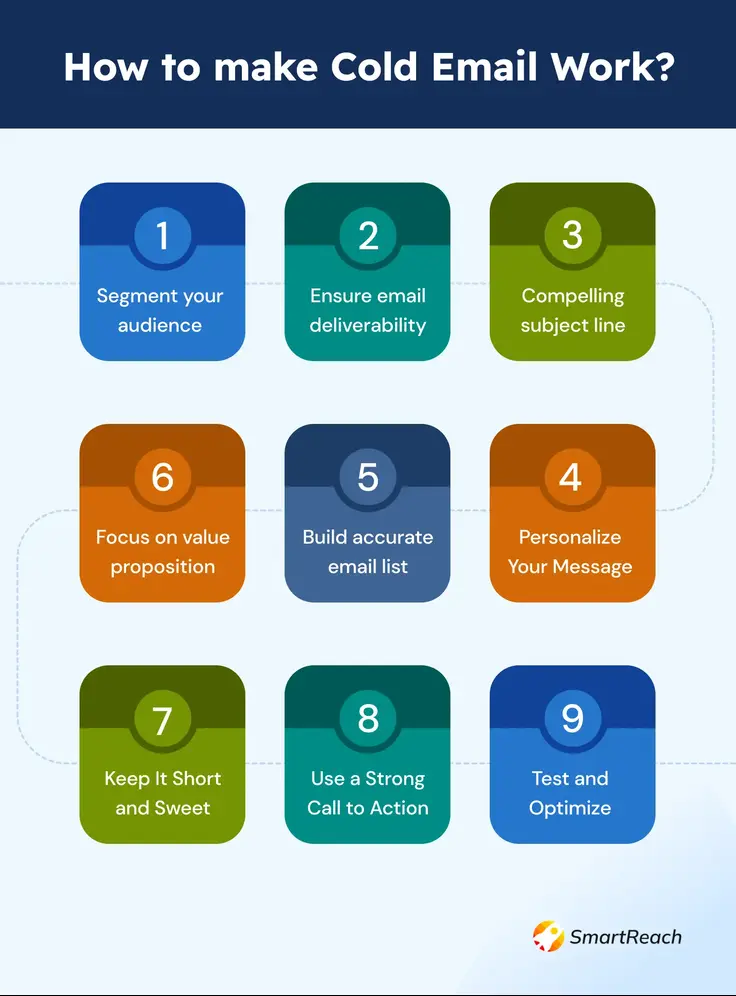
Incorporate a call to action (CTA)
A CTA guides the prospect toward the desired response, whether it’s scheduling a meeting, replying with information, or signing up for a service.
- Use action-oriented language.
- Be specific about the action you want them to take.
Example:
❌ Weak CTA: “Let’s connect sometime.”
✅ Strong CTA: “Book a demo here: [calendar link].”
Personalize your closing
Personalization shows that you’ve done your homework and are genuinely interested in the prospect and their needs, which can increase the likelihood of a response.
- Mention specific details about the prospect’s work, company, or interests.
- Tailor the closing to reflect your knowledge of their recent activities or achievements.
Example:
❌ Generic: “Let’s discuss how we can help your business.”
✅ Personalized: “I saw you’re expanding into the EU market – let’s discuss how our compliance tools can help.”
Keep it concise
A concise closing respects the prospect’s time and keeps the focus on the main message without unnecessary fluff.
- Limit your closing to one or two sentences.
- Avoid adding unnecessary details or overly complex language.
Example:
❌ Too Long: “I would really appreciate it if you could possibly find some time in your busy schedule to perhaps consider scheduling a brief meeting where we can discuss potential opportunities for collaboration.”
✅ Concise: “Can we schedule 15 minutes next week? Reply with your availability.”
Create a sense of urgency
A sense of urgency can motivate the prospect to act quickly, rather than postponing their response.
- Use time-sensitive language.
- Highlight any deadlines or time constraints.
Example:
❌ No Urgency: “Let me know when you’re ready.”
✅ Urgent: “This offer expires Friday – claim your spot now.”
Be polite and professional
Politeness and professionalism help build a positive rapport and ensure you come across as respectful and considerate.
- Use courteous language.
- Thank the prospect for their time and consideration.
Example:
❌ Abrupt: “Reply now.”
✅ Polite: “Thanks for considering this. Looking forward to your response.”
End with a question
Ending with a question encourages the prospect to respond, keeping the conversation open and ongoing.
- Pose a relevant question related to the email’s content.
- Ensure the question is easy to answer and directly related to the next steps.
Example:
❌ Statement: “I’ll send more information.”
✅ Question: “Would you like me to send over a case study first?”
Provide contact information
Including your contact information makes it easy for the prospect to reach out to you without needing to look up your details.
- Include your phone number or an alternative email address.
- Add any relevant links (e.g., calendar scheduling tool).
Example:
“Feel free to reply here or call me at [phone]. Here’s my calendar: [link].”
Add a P.S.
Including a P.S. (postscript) can draw attention to key points, reinforce your message, or add a final touch of personalization. It often stands out in the prospect’s inbox, making it a useful tool to emphasize important details or calls to action.
- Use the P.S. to highlight a key benefit or offer.
- Mention something personal or relevant that ties back to the main message.
- Keep it brief and focused.
Example:
“P.S. We helped [Similar Company] increase replies by 35% in 3 months. Want similar results?”
Common mistakes to avoid in cold email closing lines
Even the best email can fail if the closing line makes one of these critical mistakes:
1. Being Too Vague
❌ “Let me know if you’re interested.”
✅ “Reply with your availability for a 15-minute call this week.”
2. Asking Too Much Too Soon
❌ “Can we schedule a 60-minute strategy session next week?”
✅ “Can we chat for 10 minutes to see if this is a fit?”
3. Using Passive Language
❌ “I hope to hear from you.”
✅ “Looking forward to your response.”
4. Overloading with Multiple CTAs
❌ “Reply to this email, book a demo, or visit our website for more info.”
✅ “Ready to see a demo? Book here: [link].”
5. Forgetting the CTA Entirely
❌ “Thanks for reading. Best regards, [Name].”
✅ “Thanks for reading. Can we schedule a quick call? Reply with your availability.”
6. Using Generic Closings
❌ “Let’s connect soon.”
✅ “Let’s connect Tuesday at 2 PM. Does that work?”
How does SmartReach.io help with cold email closing lines?
SmartReach.io is a powerful sales engagement platform that helps your sales team achieve their target in a faster and automated way.
With SmartReach’s AI-powered feature, you will be able to generate email content within seconds and the content targeted towards your ICP.
The only task you have to do is provide input based on your email’s intent. Such as what you want to convey, your audience details, tonality, merge tags, etc.
Key Features for Optimizing Closing Lines:
- AI Email Generator: Creates personalized closing lines based on your prospect’s industry, role, and pain points
- A/B Testing: Test multiple closing line variations to see which drives the highest response rates
- Sequence Automation: Pre-schedule follow-up emails with different closing strategies for each touchpoint
- Spintax Support: Rotate closing line variations to keep outreach fresh and avoid spam filters
- ESP Matching: Ensures your emails land in the primary inbox, not spam, so closing lines actually get read
Here is a video for your reference.
After the content is generated you will have the option to change any selected paragraphs or phrases based on your requirements. The AI will provide you with options.
The whole process makes your email generation automated and faster.
SmartReach also provides an AI sequence generator, where you will get the whole sequence generated based on your input.
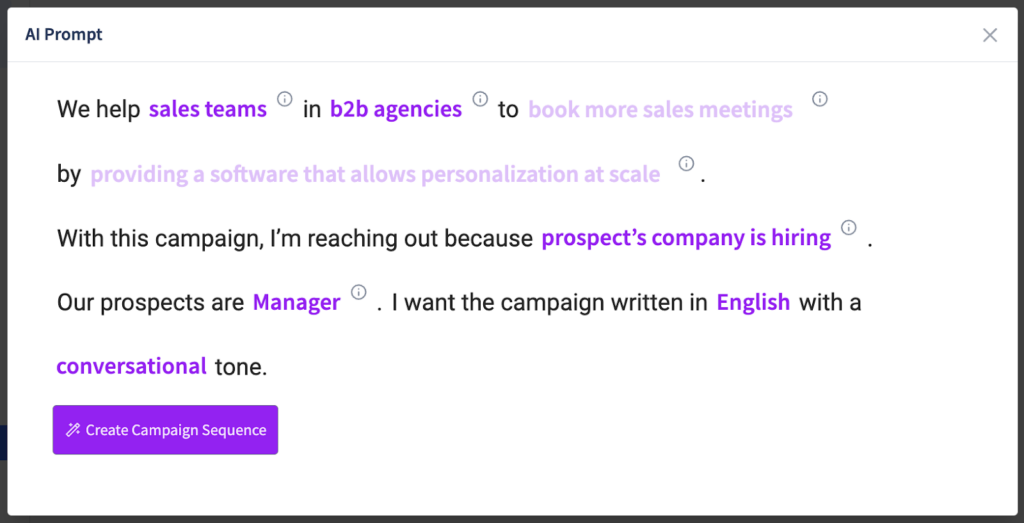
You can tweak the sequence based on your use case.
SmartReach.io provides a huge range of features such as cold email automation, shared inbox, multichannel outreach, inbox rotation, ESP matching, spintax, and many more.
You can sign up for 14-day free trial to explore all the features or else, schedule a 15-min call with our support to answer all your queries. (No Credit Card Required)
Frequently Asked Questions (FAQs)
How should you end a cold email?
End with a clear, specific call-to-action that tells the prospect exactly what to do next. Include your value proposition briefly, express appreciation, and guide them toward a response or meeting.
What is a good closing line for an email?
A good closing line is direct, relevant, and action-oriented. It should be concise, polite, and encourage the prospect to take a specific next step.
How to end a cold call letter?
Include a clear CTA and polite closing remark. Restate your outreach purpose and suggest a specific next step, such as scheduling a call or requesting a response.
How do I write the last line of an email?
Summarize your main point or request, provide a clear call-to-action, and use polite language that prompts the prospect to respond or take action.
How to end an email politely?
Use courteous language, thank the prospect for their time, and include a closing line that reinforces your message while inviting further communication in a respectful manner.
Is “best” a professional email closing?
Yes, “best” is a professional shorthand for “best regards” or “best wishes.” It’s friendly and informal, appropriate for most professional contexts, especially in less formal industries.
What are closing lines?
Closing lines are the final sentences in an email that summarize the main point, provide a call-to-action, or express gratitude while guiding the prospect toward next steps.
How to end an email in a cold way?
Use straightforward, professional closings with minimal personal connection. Examples include “Best regards,” “Sincerely,” “Thank you,” or “Regards” to maintain professional distance while staying polite.
How do I close out a pitch email?
Reinforce your value proposition and include a clear call-to-action. Express enthusiasm and openness to discussion while making it easy for the prospect to respond.
How do I close a prospecting email?
Encourage the recipient to take the next step with a professional, action-oriented closing. Include a clear CTA and express appreciation for their consideration.
What is a closing phrase?
A closing phrase is the final sentence or sign-off in an email, used to conclude the message positively or professionally. Examples include “Best regards,” “Looking forward,” and “Thank you.
How to end a sales email?
End sales emails with a benefit-driven closing that reinforces value and includes a clear next step. Use urgency or social proof when appropriate, and always make responding easy.
What are the best email closing lines for getting responses?
The best closing lines include specific CTAs, create urgency or curiosity, personalize to the prospect, and make the next step crystal clear. Test different types to see what works.
How to write email closing lines when waiting for a response?
Use follow-up closing lines that acknowledge the silence, re-state your value, and create urgency. Consider a “breakup email” approach after multiple attempts to re-engage prospects.
What are professional email closing phrases for business?
Professional business email closings include “Best regards,” “Sincerely,” “Thank you,” “Looking forward,” and “Kind regards.” Choose based on your relationship formality and company culture.
How to close a networking email?
End networking emails with a low-pressure ask, such as “Would you be open to a quick 10-minute call?” or “I’d love to hear your thoughts.” Keep it casual and respectful.