
Apollo.io vs SmartReach.io Compared for SDR Teams

Choosing between Apollo.io vs SmartReach.io isn’t as simple as checking a feature list. Both tools help sales teams run outbound campaigns, but they’re built around different priorities. Which one fits your team depends on what problem you’re actually trying to solve.
Apollo built its reputation on data: 210 million+ contacts, solid sequences, strong CRM integrations. SmartReach.io brings both to the table: a database of 300 million+ contacts, 50 million+ companies and the execution infrastructure to back it up: deliverability tools, sending controls, and multichannel automation that goes further than what most outreach platforms offer. If your team runs cold email at volume, that combination matters more than the sticker price alone.
Before we get into the feature breakdown, let’s cover something most comparison articles skip: pricing context.
Pricing for outreach and sales engagement platforms varies widely, and comparing plan prices without that context usually leads to the wrong decision.
Most platforms structure pricing around four main variables:
- Number of sending accounts connected to the platform (how many mailboxes you can send from)
- Number of users or team members who can access the tool
- Number of prospects or contacts you can reach per month
- Volume of emails you can send per month
One platform might charge $49 per user per month and cap you at two connected mailboxes. Another charges $89 flat for up to ten users with unlimited sending accounts. The sticker price looks very different from the actual cost per outcome. Keep that in mind as we walk through this.
Apollo vs SmartReach at a glance
| Apollo | SmartReach | |
| Starting price | $49/user/month | $29/month (team) |
| Email accounts | Limited per plan | Unlimited on all plans |
| Contact database | 210M+ contacts | 400M+ contacts |
| Email warmup | Inbox ramp-up | Built-in AI warmup |
| Multichannel | Email + LinkedIn tasks + calls | Email + LinkedIn (full auto) + calls + WhatsApp |
| Deliverability suite | Available | Email deliverability (full suite) |
| LinkedIn automation | Task reminders (manual) | Full automation ($29/seat/month) |
| Prospect timezone sending | Not available | Sends in each prospect’s local timezone |
| Best for | Prospecting + outreach in one tool | Cold email execution at scale |
Pricing comparison: what you’re actually paying
The sticker price on any outreach tool rarely tells the full story. What you’re actually paying depends on how the platform counts users, sending accounts, and contact limits, and Apollo and SmartReach handle all three very differently.
Apollo charges per seat. Every SDR on your team is a separate billable user:
- Basic: $59/user/month
- Professional: $99/user/month
- Organization: $149/user/month (minimum 3 users, annual billing only)
Each plan also comes with a monthly credit allocation per user, 2,500 on Basic, 4,000 on Professional, 6,000 on Organization. These credits are consumed by contact reveals, mobile number lookups, and data exports.
SmartReach provides unlimited sending emails with all its plans.
- Email Outreach Basic: $29/month – 1 user, 1,000 active prospects, 10,000 emails/month
- Email Outreach Plus: $89/month – up to 10 users, 50,000 active prospects, unlimited emails
- Email Outreach Pro: $199/month – unlimited users, 100,000 active prospects, unlimited emails
- Email Outreach Scale: $499/month – unlimited users, 500,000 active prospects, unlimited emails
Every SmartReach plan includes unlimited sending accounts and free email verification — two things Apollo restricts or charges separately for.
What a team of 10 SDRs actually pays:
| Apollo Basic | Apollo Professional | SmartReach Plus | SmartReach Pro | |
| Monthly cost (10 SDRs) | $590 | $990 | $89 | $199 |
| Sending accounts | Limited per plan | Limited per plan | Unlimited | Unlimited |
| Email verification | Paid separately | Paid separately | Free, built-in | Free, built-in |
| Active prospects | Credit-based | Credit-based | 50,000 | 100,000 |
For a team of 10, SmartReach’s Plus plan at $89/month versus Apollo’s Professional at $990/month is not a marginal difference; it’s over 11x cheaper for the same headcount. Even at Pro, SmartReach at $199/month is still 5x less than Apollo Professional for the same team.
Both tools include a built-in lead finder, so you’re not paying for a separate data provider. But how each platform handles prospecting, and what it costs you, works very differently.
Apollo’s lead finder is credit-based. Contact reveals, mobile number lookups, and data exports each draw from your monthly credit allocation (2,500 on Basic, 4,000 on Professional, 6,000 on Organization).
Heavy prospecting teams can burn through credits quickly, and once you hit the cap, you’re locked out until the billing date resets. Apollo’s database of 210M+ contacts is also more enriched, stronger intent signals, deeper firmographic layers, and tighter CRM enrichment workflows. If data quality and enrichment depth are the priority, Apollo’s lead finder is the stronger product.
SmartReach’s B2B Lead Finder gives you access to 300M+ contacts and 50M+ companies, with filters for job title, industry, location, company size, and tech stack. Credits apply per verified contact exported.
The key difference from Apollo: SmartReach.io runs an email verification check before any contact leaves the platform, so what you export is clean and ready to use without a third-party verification tool. The database is larger in raw coverage, but the enrichment depth, intent signals, buying signals, and firmographic layering is not as developed as Apollo’s.
The honest comparison: SmartReach wins on coverage volume and the fact that verified exports don’t require an additional tool or budget. For teams whose leads primarily come from marketing, account-based lists, or a dedicated data provider, SmartReach’s lead finder is a useful built-in bonus. not the core reason to choose the platform.
Email deliverability: how each platform protects your sender reputation
SmartReach’s deliverability tools are more comprehensive than Apollo’s, built around five integrated features that work together rather than separately. Here’s what that includes.
Apollo.io includes a deliverability suite with mailbox health monitoring, inbox placement checks, and an inbox ramp-up system to build sender reputation gradually. Their published guidance is to keep daily sends at or below 50 emails per mailbox. Need more volume? Connect additional mailboxes. It’s honest, practical advice backed by real tooling.
SmartReach.io takes deliverability further with a dedicated framework.
Inbox Rotation
Inbox rotation distributes sends across all connected accounts within a single campaign automatically. Instead of all emails going from one mailbox, SmartReach rotates through the full pool. Individual sending volumes stay low without requiring you to manually split campaigns.
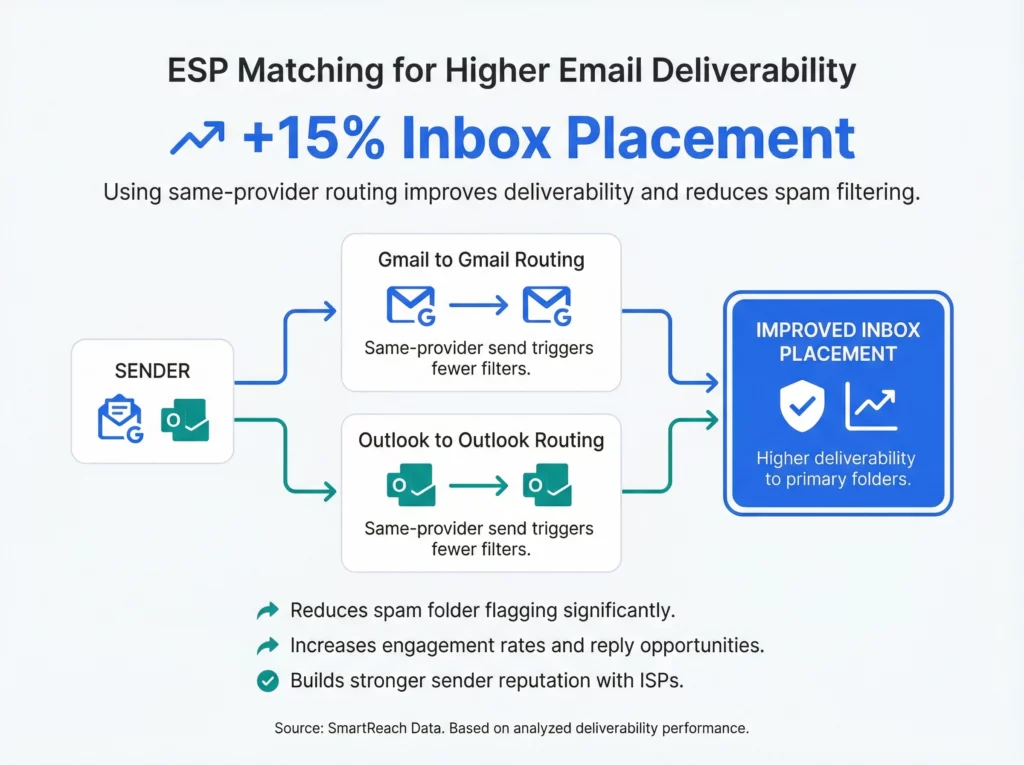
ESP Matching
ESP matching routes outgoing emails through a provider that matches the recipient’s. When you’re sending to a Gmail address, SmartReach uses a Gmail account. Outlook to Outlook. According to SmartReach, this approach reduces spam flagging and improves inbox placement by around 15%, and it makes sense because same-provider sends trigger fewer spam filters than cross-provider sends. Apollo doesn’t offer native ESP matching.
Secondary Domains and Mailboxes
Secondary domain management lets you create and configure sending domains inside SmartReach directly. The platform auto-configures MX, SPF, DKIM, and DMARC records and sets domains to redirect to your main website automatically. You can build hundreds of mailboxes from one dashboard across three infrastructure options, SMTP, Google Workspace, and Microsoft Azure, each priced transparently:
- SMTP: Domain at $3/month + mailbox at $4/month
- Google Workspace: Domain at $5/month + mailbox at $4/month
- Microsoft 365: Domain at $5/month + mailbox at $4/month
- Microsoft Azure: Domain + 50 mailboxes at $35/month flat – that’s $0.70 per mailbox
The Azure option is SmartReach’s latest infrastructure addition, and it’s worth calling out specifically. Most outreach platforms don’t offer Azure mailbox provisioning at all. At $35 for a domain plus 50 mailboxes on a dedicated personal IP, the cost efficiency is hard to match.
Each Azure tenant runs on its own IP, which matters operationally, if you buy three Azure tenants and one IP develops a deliverability issue, the other two are completely unaffected. Your campaigns on those tenants keep running without disruption.
For agencies managing outreach across multiple clients, or teams scaling sending volume across dozens of domains, this combination of Google, SMTP, and Azure options from a single dashboard cuts setup time significantly while giving you infrastructure flexibility that most platforms simply don’t offer.
Email Warmup and Soft Start
AI email warmup uses a network of real inboxes, not synthetic accounts, to build sender reputation. SmartReach.io generates contextual warmup conversations, gradually increases sending volume, and tracks inbox placement rates for each account. You can run warmup across multiple accounts at once, with separate reporting per inbox.
Apollo dropped their native warmup feature in mid-2024 and moved users to the inbox ramp-up system, which increases outbound volume gradually from existing mailboxes. SmartReach covers both processes independently.
The AI warmup builds sender reputation at the mailbox level, while the ramp-up equivalent in SmartReach called Soft Start is enabled by default on every campaign automatically, so your sending volume increases gradually from day one without any manual configuration. Where Apollo now offers only the ramp-up piece, SmartReach runs both in parallel: Soft Start at the campaign level, AI warmup at the mailbox level.
Global Blacklist Monitoring
Global blacklist monitoring runs continuously. If a domain gets listed, SmartReach alerts you and auto-pauses affected campaigns before more damage accumulates. Apollo doesn’t offer equivalent automated campaign pausing on blacklist detection.
Honest take: if deliverability is a core concern for your team, SmartReach’s infrastructure is more comprehensive. That doesn’t mean Apollo’s tools don’t work. But SmartReach has built deliverability as a first-class feature, not a checklist item.
Scheduling and sending controls: where SmartReach pulls ahead
SmartReach.io gives you more sending controls than Apollo does, including several features Apollo doesn’t offer at all. For teams where timing and volume precision drive campaign results, this is the most important section to read.
Sending at the wrong time wastes campaigns. Open rates, reply rates, even domain health respond to how precisely you control when and how emails go out. Most platforms offer basic time windows. SmartReach offers controls that go deeper.
Prospect-level timezone sending
Apollo.io lets you send based on a contact’s timezone when location data is available.
SmartReach.io applies timezone-aware sending at the prospect level across the entire campaign, not just when you toggle the setting. Emails arrive during business hours in each recipient’s local timezone. For teams reaching prospects across multiple countries in one campaign, this isn’t a minor detail. It’s the difference between a 3pm send and a 9pm send landing in someone’s inbox.
Holiday calendar
Apollo.io comes pre-configured with a list of major US holidays: Labor Day, Independence Day, Memorial Day, Thanksgiving, Christmas Eve, Christmas Day, and New Year’s Day. You can turn this off, but you can’t add holidays from other countries without workarounds.
SmartReach’s holiday calendar works differently. You build named calendars (“US Holidays”, “UK Holidays”, “APAC Holidays”) and add specific dates and date ranges. Each campaign gets one calendar assigned. The exclusions apply based on each prospect’s timezone where location data exists, falling back to the campaign default otherwise.
For SDRs targeting buyers in both the US and Western Europe in the same campaign, this matters. A Thanksgiving exclusion that fires for US prospects but not for German prospects is meaningfully more accurate than a blanket block for everyone.
Reply safety
This is a SmartReach.io feature with no direct Apollo equivalent.
When someone at a company responds to your outreach, SmartReach automatically pauses the campaign for that entire company domain. If Sarah ABC Corp replies, no one else at @abccorp.com receives another email until you’ve handled the conversation. This prevents the awkward situation where your sequence keeps sending to the CFO while your SDR is already in talks with the VP of Sales.
Apollo doesn’t have domain-level reply safety. You’d need to manually suppress the domain or rely on your rep to catch it before the next touch fires.
Domain-level sending caps
SmartReach lets you set hard limits on how many emails can go to any single company domain per day or week. If a target account has 40 contacts in your prospect list, you can cap outreach to five per week rather than hitting the whole company at once. For account-based outreach where burning a high-value target is a real risk, this level of control matters.
Apollo doesn’t have an equivalent feature.
Missing merge tag detection
Before any email sends, SmartReach.io scans for personalization tags that weren’t filled in. An email still containing “{firstName}” doesn’t go out. You’re alerted to fix it first. It seems like a small thing until you’ve accidentally sent “Hi {firstName}, I noticed…” to 200 prospects.
Smart throttling
SmartReach builds random delays and volume throttling into sends at the platform level, adjusting automatically based on your sending limits and timezone windows.
You configure the parameters once. Apollo recommends enabling random delays as a best practice but leaves the setup to the user.
Is Apollo’s approach simpler? Yes.
Does SmartReach’s give you more control? Also yes. And for teams that’ve been burned by spam filters, blacklists, or burned domains in the past, that control is exactly what they come back to SmartReach.io for.
Personalization and email intelligence
Most outreach tools start with merge tags and call it personalization. SmartReach.io starts somewhere further ahead.
Smart Email AI Agent – personalization without the manual work
SmartReach’s Smart Email AI Agent removes the need for merge tags, templates, or manual copy altogether. You configure campaign-level context once, your company, your offer, the pain points you’re addressing, the tone you want, and the target persona.
From there, the AI builds a unique subject line and email body for every single prospect in the campaign, pulling from enriched data including job title, company revenue, industry, and recent signals. You’re not sending one template to 500 people.
You’re sending 500 different emails, each written specifically for the person receiving it.
Email Sequence AI Agent – build entire campaigns from a single prompt
If the Smart Email AI Agent handles per-prospect personalization, the Email Sequence AI Agent handles the campaign architecture itself.
Give it your campaign goal, target persona, and offer, and it generates a complete multi-step sequence: the messaging for each touchpoint, the follow-up structure, and the timing between steps.
Rather than building sequences step by step, your SDR describes what they’re trying to achieve and the AI builds the framework around it. For new SDRs ramping up or teams launching into new markets, what would typically take days of sequence-building gets done in minutes.
Apollo offers AI-assisted email generation, but has no equivalent to a full sequence generator built into the workflow.
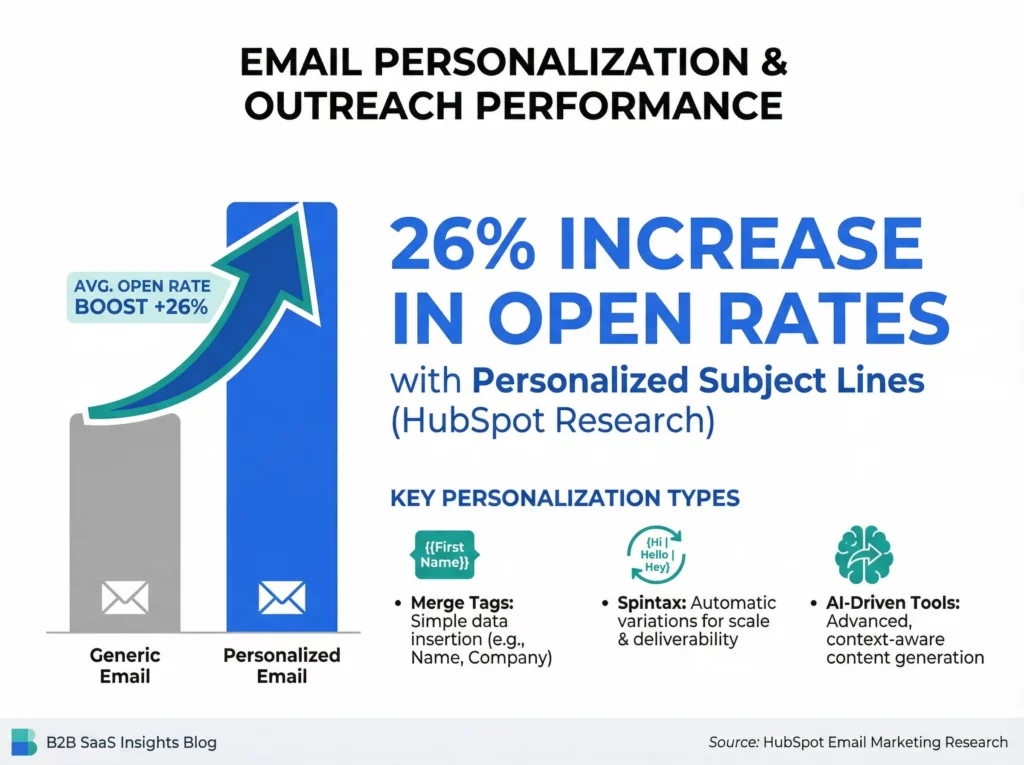
If you prefer manual control, merge tags, spintax, and custom fields are all there
For teams that want to build and control their own templates, SmartReach.io gives you the full toolkit. Merge tags cover first name, company name, job title, and any custom field you bring in.
Spintax lets one template automatically produce multiple variations, “Hi {firstName|there}” sends “Hi Sarah” to one prospect and “Hi there” to another, reducing the likelihood of your emails being flagged as identical bulk sends across hundreds of contacts. Apollo doesn’t support native spintax.
How Apollo compares
Apollo includes AI-assisted email generation, but it operates differently. You’re typically generating one email at a time rather than building an entire campaign from a single prompt. There’s no equivalent to the Smart Email AI Agent’s per-prospect generation at campaign scale, and Apollo doesn’t offer native spintax for template variation.
According to Hubspot, personalised subject lines increase open rates by 26% on average. Basic merge tags get you part of the way there. AI-generated copy written specifically for each prospect, without any manual templating, is a different level of personalization entirely.
Multichannel outreach: what the word actually means on each platform
Both platforms call themselves multichannel. What that means in practice is very different.
Apollo covers email, phone via a built-in dialer, and LinkedIn through task reminders. When a LinkedIn step triggers in your Apollo sequence, a task appears in your queue. Your SDR clicks through and manually sends the message from LinkedIn. The sequence tracks when it’s done, but the action itself isn’t automated. The channels exist, but they operate largely independently of each other.
SmartReach.io is built around four fully integrated channels, email, LinkedIn, calls, and WhatsApp and the key difference isn’t just that these channels exist, it’s how they work together.
LinkedIn, two modes, depending on how much control you want
For teams that want full LinkedIn automation, SmartReach handles connection requests, profile visits, direct messages, and follow-ups entirely within the sequence, no manual action required from your rep. The sequence runs on its own.
For teams that prefer a more hands-on approach, SmartReach also offers a co-pilot mode where LinkedIn tasks are created inside the platform and executed by the rep, closer to how Apollo handles LinkedIn, but managed within the same unified workflow rather than jumping between tools.
Calling, a comprehensive outbound system, not just a dialer
SmartReach includes a full outbound calling system with power dialing, call recording, call dispositions, listen/whisper/barge-in capabilities, and local area code numbers. Calling steps live inside the same sequence as email and LinkedIn, not in a separate tool or tab.
Where SmartReach pulls decisively ahead, conditional drip logic
All four channels can be stitched together using conditional drip logic, with over 15 condition types controlling how prospects move through a sequence. This is where the multichannel comparison stops being close.
Some examples of what’s possible:
- LinkedIn profile not found? Automatically switch to email for that prospect
- Connection request not accepted after 5 days? Trigger a call task instead
- Email opened three times without a reply? Shift the next touch to LinkedIn
- WhatsApp message sent to markets where it’s the primary business channel
The sequence adapts based on what each prospect actually does, or doesn’t do. Apollo doesn’t offer this kind of branching logic. Its sequences are linear, with task reminders at channel touchpoints rather than conditions that change the path.
According to LinkedIn’s B2B sales research, outreach combining email with social selling consistently shows higher engagement than single-channel approaches. The difference between SmartReach and Apollo here isn’t just automation depth, it’s whether your multichannel outreach is genuinely adaptive or just a checklist running in parallel.
Contact databases compared: SmartReach’s 300M+ vs Apollo’s 210M+
This is one area where the common assumption gets it backwards.
Apollo.io has a well-known database of 210 million+ contacts and 30 million+ companies, with filters for job title, company size, industry, location, technology stack, funding stage, and buying intent signals. It’s one of Apollo’s most cited strengths, and it’s real.
SmartReach’s B2B lead finder gives you access to 300 million+ contacts, a larger pool than Apollo’s. You get the same core filters: industry, job title, location, company size. For teams that need to build prospect lists before running outreach, SmartReach’s database means you don’t have to pay for a separate data provider.
The practical difference comes down to what each database is built to do. Apollo has invested more in intent signals and enrichment layers, it’s a stronger pure data product. But the assumption that this depth translates into a tighter workflow advantage doesn’t hold up in practice.
SmartReach.io lets you take prospects directly from the lead finder and auto-add them into active campaigns without any manual export or import step. The enriched data, job title, company revenue, industry, tech stack, don’t just sit in a contact record. It feeds directly into the Smart Email AI Agent, which uses that information to generate hyper-personalized emails for each prospect automatically.
So the enrichment isn’t decorative. It’s actively driving what gets written and sent. Apollo’s data is richer on the intelligence side. SmartReach’s data is more directly connected to execution, from finding a prospect to reaching them with a personalized message happens within the same platform, in one continuous workflow.
Both give you data and outreach in one tool, which changes the comparison from earlier in this article, you’re not choosing between a data platform and an outreach platform. You’re choosing between two tools that do both, with different strengths in each area.
Who should use Apollo.io?
Apollo.io works best for:
- Teams that need prospecting and outreach in one tool. If your SDRs build lists and run sequences from the same platform, the workflow is efficient.
- Small teams or solo SDRs. The free plan is a real starting point. The Basic plan at $49/month works for individuals or very small teams.
- Teams with simpler outreach needs. If you’re running email sequences with LinkedIn follow-up task reminders and your focus is on finding the right contacts as much as contacting them, Apollo handles it well.
Who should use SmartReach?
SmartReach works best for:
- Teams running cold email at scale. Unlimited sending accounts, inbox rotation, ESP matching, and email deliverability are built for volume without burning your sender reputation.
- Agencies managing multiple clients. Flat team pricing, multiple client dashboards, and secondary domain management keep costs and complexity manageable across client accounts.
- SDR teams targeting international markets. Prospect-level timezone sending, customizable holiday calendars by country, and multichannel support for WhatsApp-heavy regions.
- Teams that’ve had deliverability problems. If burned domains or spam filters have cost you campaigns before, SmartReach’s infrastructure was built specifically to prevent that.
- Outbound-first teams with existing lists. If your leads come from marketing, a data provider, or account-based targeting, you don’t need a prospecting database. You need better execution. That’s SmartReach’s lane.
Apollo.io vs SmartReach comes down to what your team is actually trying to solve.
Want a deeper, neutral analysis of the platform before you decide? Read our full Apollo.io review.
If you need a contact database paired with solid outreach sequences, Apollo is a natural fit. The free plan is a low-risk starting point, and for teams where prospecting is a core daily workflow, having data and sequences in one place is genuinely efficient.
If your primary constraint is execution, not prospecting, SmartReach.io is the stronger platform. The deliverability infrastructure, granular sending controls, and fully automated multichannel sequences are built for teams where reply rates are the number that matters.
Most teams that’ve used both end up with the one that solved their actual bottleneck. Knowing which problem you’re solving makes the choice clear.
Try SmartReach free for 14 days at SmartReach.io, no credit card required.
Frequently asked questions
Is SmartReach better than Apollo.io for cold email outreach?
SmartReach has a stronger cold email infrastructure: unlimited sending accounts, inbox rotation, ESP matching, and Deliver4Sure. For teams where deliverability is the priority, it’s the more capable platform.
How does Apollo.io pricing compare to SmartReach for a team of 5?
Apollo charges $49-$119 per user per month, putting a 5-person team at $245-$595/month. SmartReach’s Plus plan covers up to 10 users at $89/month flat, making it significantly cheaper for team use.
Does SmartReach automate LinkedIn outreach fully?
Yes. SmartReach offers full LinkedIn automation (connection requests, messages, profile views) at $29/month per seat, built directly into multichannel sequences alongside email, calling, and WhatsApp.
Did Apollo.io remove email warmup?
Apollo removed their native warmup feature in mid-2024 and shifted to an inbox ramp-up system. SmartReach’s AI warmup remains fully built-in, using real inboxes with placement tracking and per-account reporting.