How local presence dialing lifts cold call answer rates

On this page
Your SDRs make 60 dials a day and most of them ring out. The prospect looks at an unfamiliar out-of-state number, assumes it's spam, and goes back to work. Cold calling connect rates have been sliding for years, and one of the few levers still working is embarrassingly simple. Call from a number that looks local.
This guide consolidates everything we've published on area codes and local calling numbers into one page for outbound teams. What local presence dialing is, what it actually does to answer rates, which area codes are worth buying, and how to run it without getting your numbers flagged as spam.
What is local presence dialing?
Local presence dialing is the practice of displaying a phone number with the prospect's own area code when your sales team calls them. A rep in Austin calling a prospect in Seattle shows a 425 number instead of a 512 one. The prospect sees a local call, not a long-distance stranger, and picks up more often.
There are two ways teams do it, and the numbers are real numbers you own either way, provisioned through your calling platform with voicemail and callback routing attached.
Manual local presence
Buy a handful of local numbers in your target metros and assign each one to the matching campaign. Simple to run, full control over which number fronts which territory, and enough for teams working three to five regions.
Automated local presence
A dialer feature picks the closest matching number from your pool for every outbound call. Reps never think about it, and coverage scales as you add territories. This is the mode built into dialers like SmartReach.io's.
Do local area codes really lift answer rates?
The honest answer is that local numbers help, but the industry numbers deserve some skepticism. Here's the data that exists.
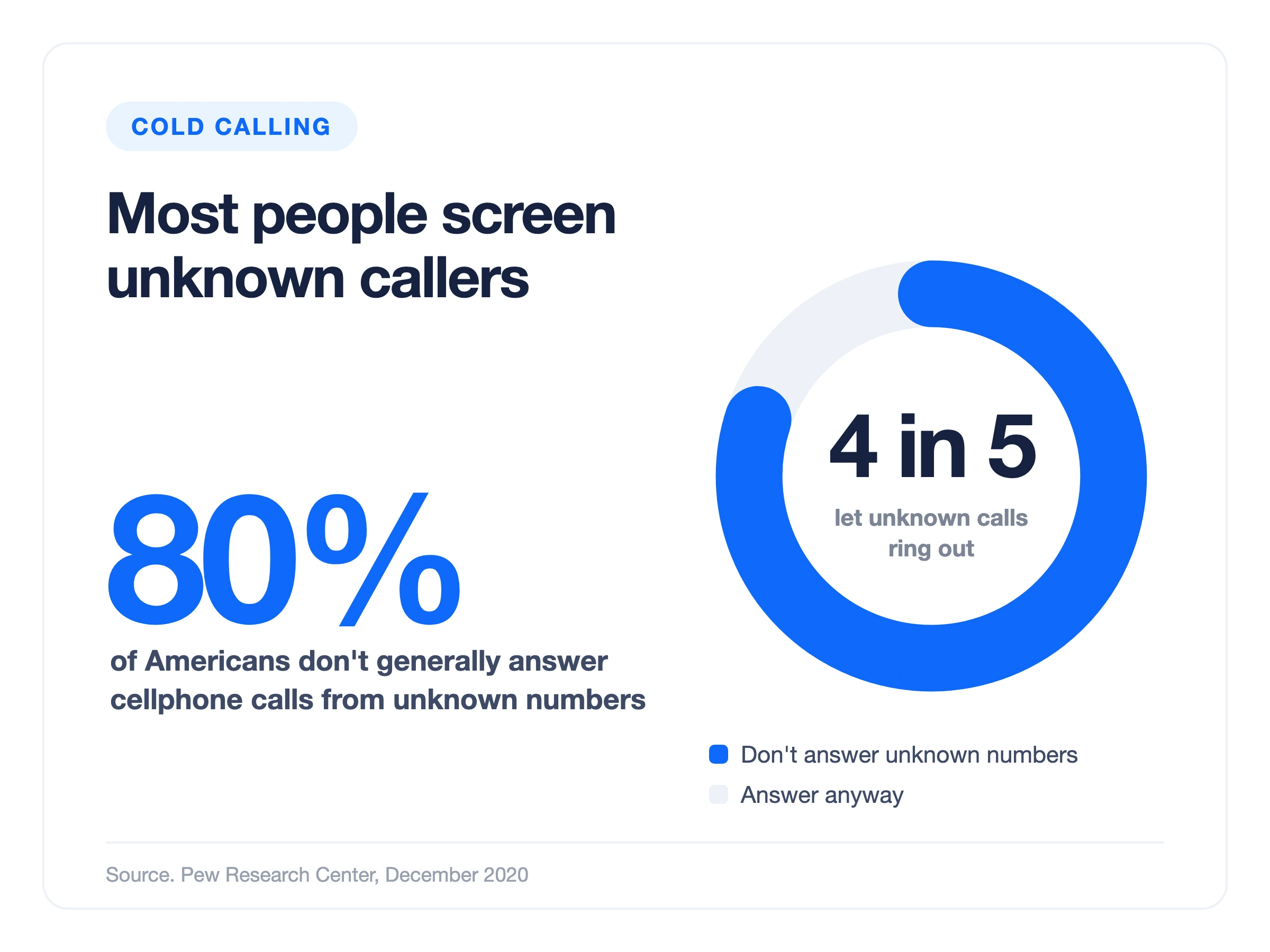
The strongest independent data point is from Pew Research Center, which found that about 80% of Americans don't generally answer cellphone calls from unknown numbers. A local area code is one of the few signals that moves a call out of the "unknown stranger" bucket before the prospect decides.
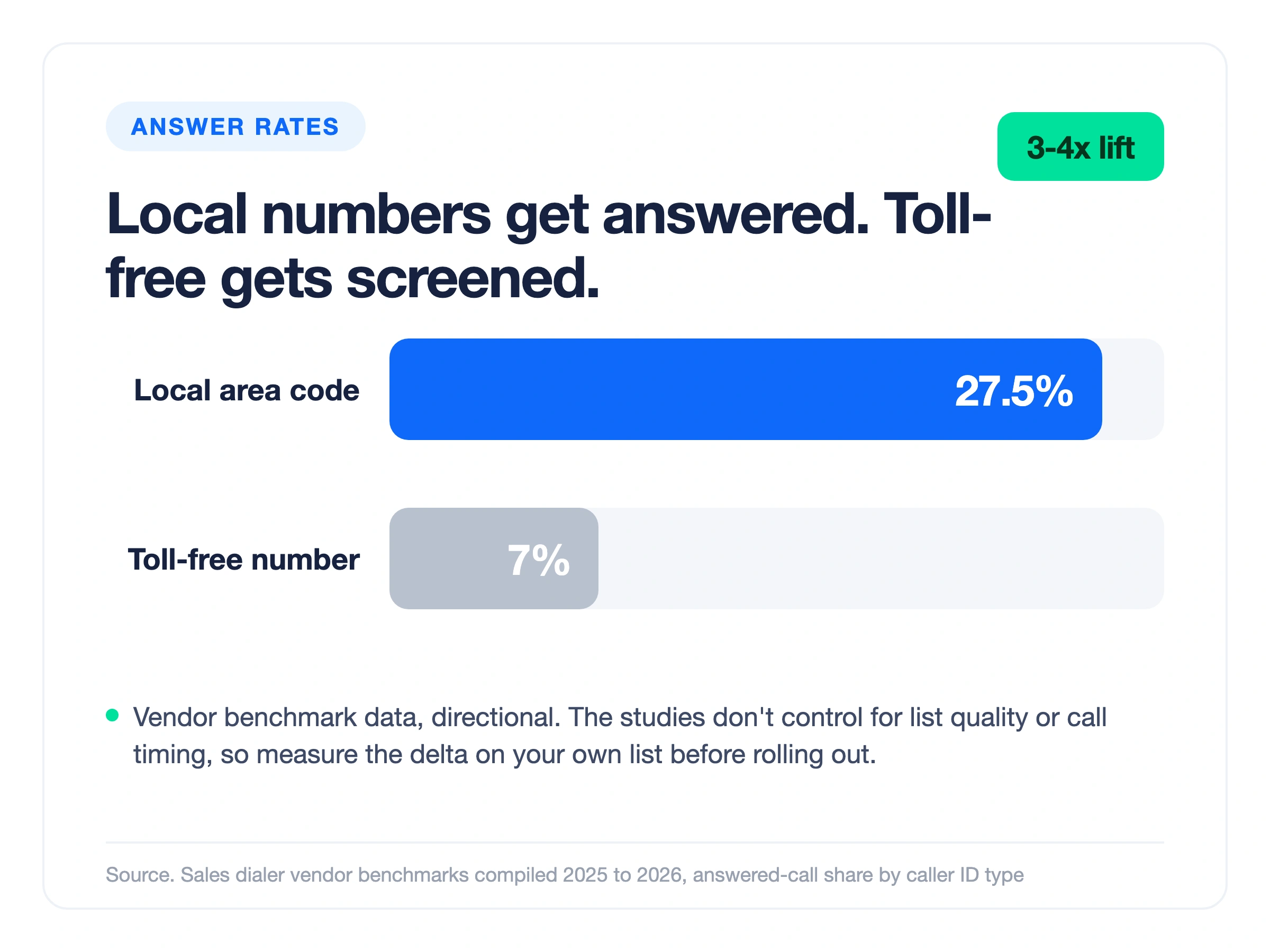
The lift numbers themselves come from dialer vendors. Their benchmarks put local direct dials at roughly 27.5% answered against about 7% for toll-free caller IDs, a three to four times difference. Those studies come from companies selling local presence features, and none of them controls for list quality or call timing, so treat the lift as directional rather than gospel. We haven't run our own controlled study on this yet, and the right move is to measure the delta on your own list for two weeks before rolling it out.
What we can say from working with outbound teams is that the mechanism is real. People screen unknown out-of-area calls hard. A local area code gets past the first filter, especially in metros where residents strongly identify with their code. Ask anyone from Houston what 281 means to them.
Two caveats keep the tactic honest. First, a growing share of consumers block all unknown numbers regardless of area code, so local presence does nothing for that segment. Second, prospects who answer and then realize the caller is not actually local can react badly. The area code gets you the pickup. What you say in the first ten seconds decides whether the pickup was worth it.
Is the lift worth the setup effort anyway? For a team doing real outbound volume, almost always yes. Even a modest improvement in answer rate compounds across thousands of dials a quarter, and local numbers are cheap compared to every other lever at that scale.
How to set up local numbers for cold calling
The setup is a morning of work, not a project. Here's the sequence most teams follow.
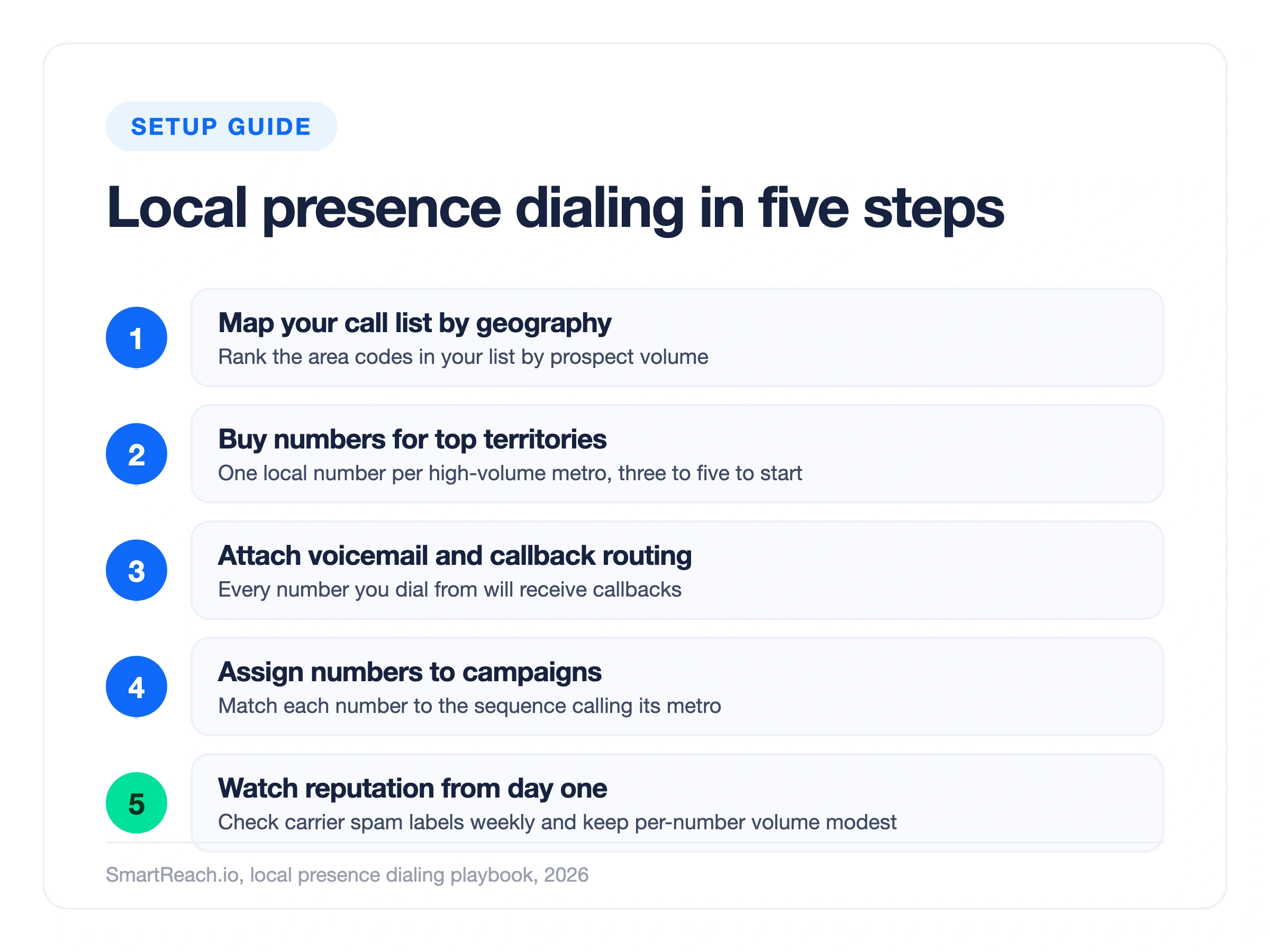
- Map your call list by geography. Pull the area codes of your prospects and rank them by volume. Most B2B lists concentrate heavily. A team we work with found 70% of their US list sat in six metro areas.
- Buy numbers for your top territories. Provision one local number per high-volume metro through your calling platform. Start small. Three to five numbers cover most teams' real needs.
- Attach voicemail and callback routing. Every number you dial from will receive callbacks. Route them somewhere a human or an answering service picks up, because a dead callback number wastes the very interest your call created.
- Assign numbers to campaigns. Match the 425 number to your Seattle sequence, the 817 number to Dallas Fort Worth, and so on. In a platform with a built-in dialer, reps then call straight from the sequence without switching tools.
- Watch reputation from day one. Check your numbers weekly against carrier spam labels and keep per-number daily volume modest. More on this below.
Done outside your outreach platform, this is usually a support-ticket dance with a telephony provider, then a copy-paste job to get the numbers where your reps dial. The faster way is provisioning the number inside SmartReach.io, a cold email software whose Sales Engagement plans include the built-in dialer, so the local number lands in the same sequence that runs your email, LinkedIn, and WhatsApp steps.
- Open Settings and select Phone numbers under Call
- Click Add Phone Number
- Pick the country for the number
- Request the area code you need (allocation depends on availability)
- Add call credits to your team account to start dialing
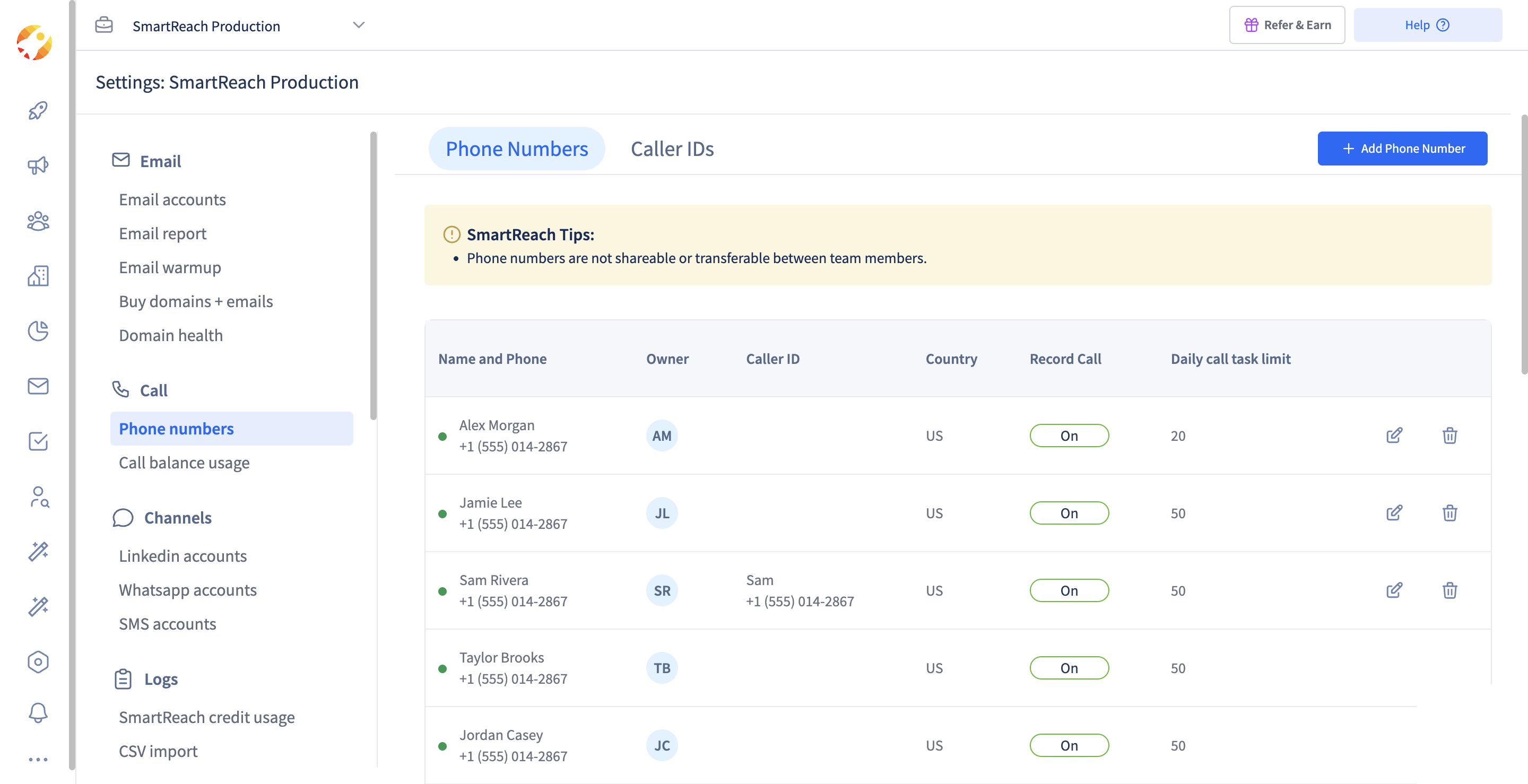 The Phone Numbers screen in SmartReach.io, where each rep's calling number, caller ID and daily call task limit live.
Each user holds one calling number, so a pod covering three metros splits the codes across reps. Once the number exists, assign it to the campaign calling its metro and the sequence dials from it without the rep thinking about caller ID again. On the Sales Engagement plans SmartReach.io also works as a full sales engagement platform, which is exactly the shape a calling-heavy outbound team needs.
Which area codes should outbound teams buy?
Buy the area codes where your pipeline lives, not the ones with the best trivia. Our strong opinion here is that a spread of twenty area codes is a vanity setup. It splits your call volume so thin that no number builds a healthy reputation, and reputation beats locality once carriers start scoring you.
That said, some metros come up constantly for US outbound teams. These are the codes we used to cover in individual guides, now in one place.
| Area code | Market | Time zone |
|---|---|---|
| 202 | Washington DC | Eastern |
| 646 / 347 | New York City | Eastern |
| 919 | Raleigh Durham | Eastern |
| 330 | Akron Canton, Ohio | Eastern |
| 281 | Houston | Central |
| 817 | Fort Worth | Central |
| 425 | Seattle east side | Pacific |
| 818 | San Fernando Valley, LA | Pacific |
| 949 | Orange County | Pacific |
A few practical notes from years of provisioning these. Prestige codes like 202 and Manhattan's 646 carry real recognition but run short on supply, so take what's available rather than hunting a specific prefix. Newer overlay codes like 347 work just as well as the legacy code they overlay. And time zone matters more than the specific code, because a Pacific number calling at 8 am Eastern gives the game away instantly.
For teams calling beyond the US, the same logic applies country by country. SmartReach.io can provision calling numbers in 200+ countries, so a team working UK and DACH territories runs local presence there the same way a US team does across states.
How does SmartReach.io handle local calling numbers?
SmartReach.io is a cold email software with a built-in dialer on its Sales Engagement plans, and local presence is part of that dialer's job. You provision numbers for the area codes your territories need, calls are placed from the sequence itself, and call outcomes are logged next to your email opens and LinkedIn replies, so a prospect's whole multichannel history sits in one view.
The pricing model is the part calling-heavy teams notice. There's no per-seat pricing. Plans scale by active prospects, and every plan above Basic includes unlimited users, so adding reps to a calling team doesn't add license cost. Sales Engagement plans start at $39 per month, there's a 14-day free trial, and SmartReach.io is rated 4.6 on G2 from 60 reviews as of September 2026.
"Teams overthink the area code and underthink the callback," says Lance DSouza, CMO at SmartReach.io. "A local number gets you the pickup, but the teams that win route every callback to a live answer and keep their number reputation clean. That's the whole playbook."
What about the callbacks your local numbers generate?
Here's the part most local presence guides skip. When you dial a metro from a local number, a meaningful share of missed prospects call that number back within the hour. Curiosity does the work for you. If those callbacks ring into silence or a generic voicemail, the tactic leaks pipeline at the exact moment it created interest.
Bigger teams solve this with call routing to an SDR pod. Smaller teams and agencies often can't staff a phone all day, and that's where a dedicated inbound line works well. dialnote is a calling system for inbound calls, the kind of support lines and business lines small businesses run. Its AI receptionist picks up around the clock, takes a message or books the caller, and hands you the summary. Pointing your local calling numbers' callback routing at an inbound line like that means no returned call goes unanswered, even at 7 pm on a Friday.
Whichever way you solve it, solve it before you scale dial volume. A callback is the warmest cold-call outcome there is.
Caller ID reputation and compliance
Local presence only works while your numbers stay clean, so treat reputation as part of the system.
Keep per-number volume modest. Carriers and analytics apps score numbers on volume and answer patterns. A single number blasting hundreds of daily dials with a low pickup rate earns a spam label fast. Spreading volume across your number pool and keeping daily dials per number in the low dozens keeps the pattern looking human.
Register your numbers. The US carriers run STIR/SHAKEN caller ID authentication, and the FCC's caller ID rules explain what's prohibited and how attestation works. Registering your business numbers with the carrier reputation services (Free Caller Registry covers the big three US analytics providers) materially reduces false spam labels.
Respect the DNC list. For US calling, screen lists against the National Do Not Call Registry and your sector's rules before a campaign, not after a complaint. TCPA penalties are per call, so this is cheap insurance.
Rotate and retire. Check labels weekly. When a number picks up a spam flag despite the hygiene above, retire it, provision a replacement, and warm the new one up with lower volume for its first weeks.
None of this is exotic. It's the calling equivalent of email deliverability work, and teams that already think about warmup and sending limits adapt to it quickly.
FAQs on local presence dialing
What is local presence dialing?
Local presence dialing is the practice of calling prospects from a phone number that matches their area code, so the caller ID looks local instead of out-of-state or toll-free. Sales teams do it by buying local numbers in their target metros. SmartReach.io supports this through its built-in dialer, with calling numbers available in 200+ countries.
Do local area codes really improve answer rates?
Directionally, yes. Dialer vendors report that local numbers get answered three to four times more often than toll-free ones, though the exact lift varies by industry and list quality. SmartReach.io treats local numbers as one lever among several. Number reputation, call timing, and list accuracy move answer rates at least as much as the area code does.
Does SmartReach.io provide local calling numbers?
Yes. SmartReach.io is a cold email software whose Sales Engagement plans include a built-in dialer, with calling numbers available in 200+ countries. You can provision numbers with the area codes your territories need and call from the same sequence that sends your email, LinkedIn, and WhatsApp steps. Sales Engagement plans start at $39 per month with a 14-day free trial.
Is local presence dialing legal in the US?
Buying and calling from real local numbers you own is legal. What the law prohibits is caller ID spoofing with intent to defraud or harm, under the Truth in Caller ID Act. Outbound teams still need to follow TCPA rules and screen lists against the National Do Not Call Registry. SmartReach.io provisions real, owned numbers rather than spoofed caller IDs.
What happens if my calling number gets flagged as spam?
Carriers and analytics apps label numbers that dial high volumes with low answer rates, and a flagged number tanks your pickup rate. The fix is prevention. Spread volume across a few numbers, keep daily dials per number modest, and register your numbers with carrier reputation services. If a number is already flagged, retire it and warm up a replacement.
Which area code should I use for a US-wide campaign?
Match your top revenue territories rather than chasing every metro. Most outbound teams see the bulk of their pipeline from three to five regions, so buy numbers there first. For truly national lists, a well-maintained number in a major hub such as 646 (New York) or 202 (Washington DC) outperforms a poorly maintained spread of twenty area codes.
Can I get a local area code number if my business is not in that city?
Yes. A local number is provisioned to your account, not to a street address, so a team in one city can hold numbers across several markets. That is the whole point of local presence dialling: the prospect sees a familiar area code rather than an out-of-state one. SmartReach.io provisions US local numbers with the area code you pick.
Can I keep a local number if my business moves?
Yes. US numbers are portable, so an area code stays with you regardless of where the business relocates, and porting between carriers is a standard request rather than an exception. For outbound calling that matters less than it sounds, since the number is chosen to match the prospect’s region rather than your own office location.
Do local numbers work with VoIP and call forwarding?
Yes. A local number provisioned for outbound calling behaves like any other: it routes over VoIP, forwards to a mobile or desk phone, and accepts inbound returns from prospects who call back. Set that return path before a campaign starts, because a local number that rings nowhere wastes the callback your outbound work just earned.
Get local numbers working inside your sequences
Local presence dialing is a small tactic with outsized returns for teams that already run disciplined outbound. Buy numbers where your pipeline lives, route the callbacks somewhere they get answered, protect your caller ID reputation the way you protect a sending domain, and measure the answer-rate change on your own list instead of trusting vendor studies.
If your calls currently live in a separate tool from your email and LinkedIn touches, that's the first thing to fix. Start a 14-day free trial and see how calls, email, LinkedIn, and WhatsApp run as one SmartReach.io sequence.
Stop juggling tools
Book more meetings on every channel
Join 5,000+ teams running multichannel outreach from one sequence, with deliverability built in.