Cold Email Best Practices: Increase Your Reply Rate

On this page
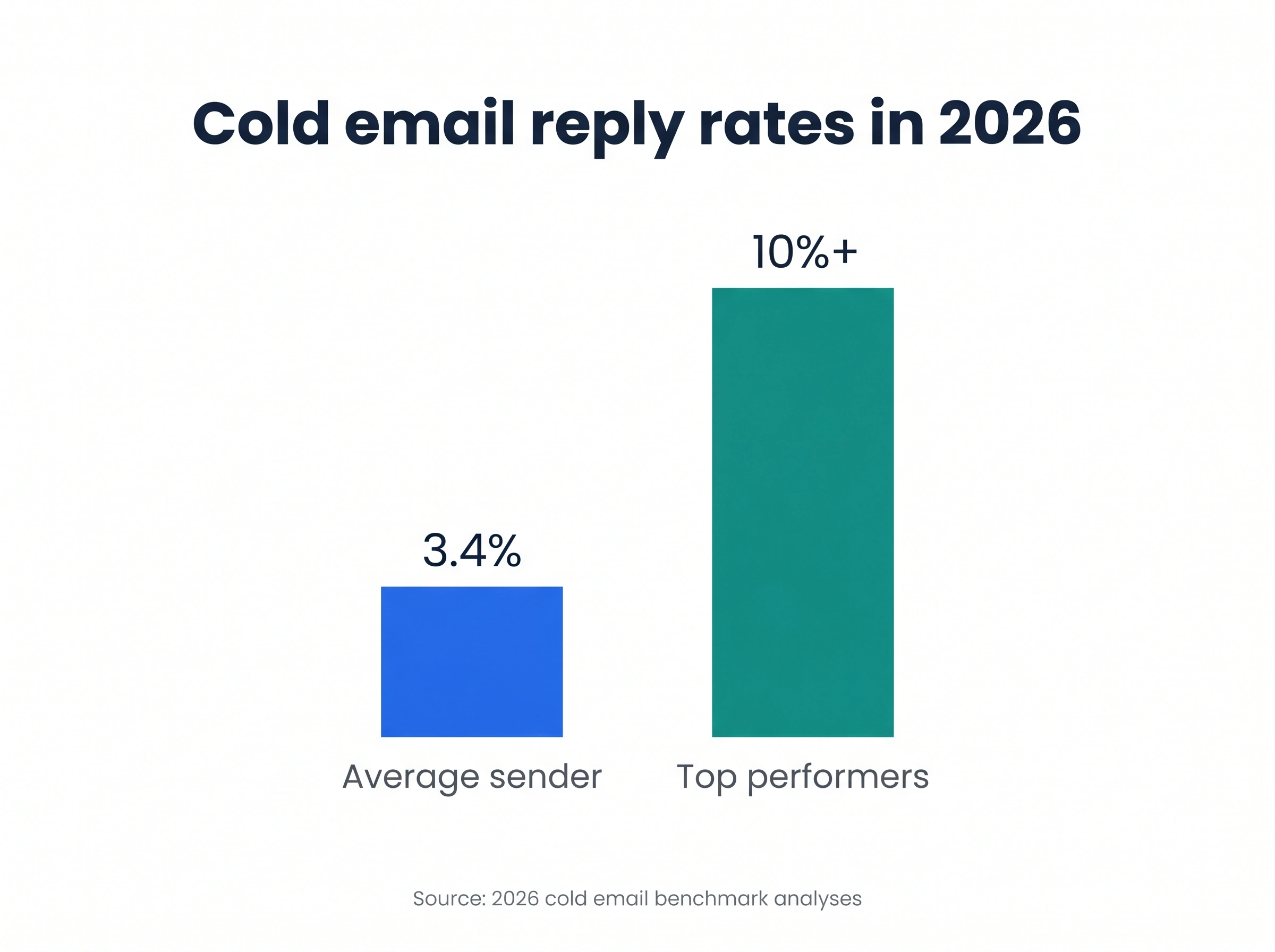
Most cold emails get ignored, and the data is blunt about why. The average cold email reply rate in 2026 sits between 3% and 3.5%, while the top performers clear 10%. That gap isn’t luck. It comes down to a handful of cold email best practices that the winners run every single send, and the rest skip.
So this guide pulls the 11 that actually move your reply rate, each one tied to a current benchmark and a fix you can apply today. No fluff, no theory you can’t use. Just what works in 2026, why your numbers might be low, and the steps to lift them.
TL;DR for cold email best practices
Where these numbers come from
Before the benchmarks, a word on sourcing, because most cold email “stats” online get copied from a single blog post nobody fact-checked.
Two things ground every number below. First, our own scale: SmartReach.io, a cold email software that runs multichannel sequences and deliverability tooling in one place (its Sales Engagement plans put LinkedIn, calls and WhatsApp beside email), sees thousands of outbound emails a day and millions a year flow through the product. That gives us a clear, first-party read on what separates a campaign that replies from one that flops. We share that as rough scale, not invented precision.
Second, we cross-check our read against public 2026 benchmark studies, the big ones that analyze 100M+ cold emails across thousands of accounts. Where the public numbers disagree (and they often do), we say so and give you the reconciled range instead of cherry-picking the prettiest figure. Competitor benchmark reports get cited by what they measured, not by name. Named sources like Google, the FTC, HubSpot, and Boomerang get linked directly so you can check the primary data yourself.
That’s the standard for the whole guide. Now the practices.
11 cold email best practices that matter in 2026
Each practice below follows the same shape: the benchmark, why your number might be lagging, and the exact steps to fix it. Work through them in order. The first three move the needle most.
| Metric | 2026 benchmark |
|---|---|
| Reply rate | 3% to 3.5% average, 10%+ for top performers |
| Open rate | 27% to 44% (secondary metric, inflated by Apple MPP) |
| Bounce rate | under 2% (ideally below 1.5%) |
| Spam complaints | under 0.3%, aim below 0.1% |
| Email length | 50 to 125 words |
| Subject line | 6 to 10 words |
| Follow-ups | 4 to 7 touches per sequence |
| Send window | Tuesday to Thursday, 8 to 10am local time |
| Daily volume | 35 to 40 emails per inbox |
1. Verified, narrow lists reply at 2x the rate of bought lists
Targeting is the single biggest lever in cold email, and it’s not close. Verified email lists pull roughly 2x the reply rate of unverified lists, and 5 to 6x the reply rate of purchased lists, according to 2026 analyses of tens of millions of sends. A campaign aimed at 200 well-researched contacts will almost always beat a blast to 2,000 scraped ones.
Why your number is low
You’re probably sending to too many people who were never going to care. Bought lists are full of stale, role-based, and spam-trap addresses. Even self-built lists rot fast: B2B data decays around 30% a year as people change jobs. Wide targeting also forces generic copy, because you can’t speak to a specific pain when the list spans ten industries.
How to improve it
- Define one tight ideal customer profile: industry, company size, role, and a trigger (new funding, a new hire, a tech they just adopted).
- Build the list from that profile instead of buying it. SmartReach’s B2B Lead Finder and the ProspectDaddy email finder extension pull verified contacts that match your profile.
- Verify every address before sending so your bounce rate stays under 2% (more on that in practice 4).
- Cap each campaign to one segment so the copy can stay specific. Smaller, sharper, and slower beats big and generic.
If you want the full method, our guide to sales prospecting breaks down list-building step by step.
2. Deep personalization can lift replies by up to 142%
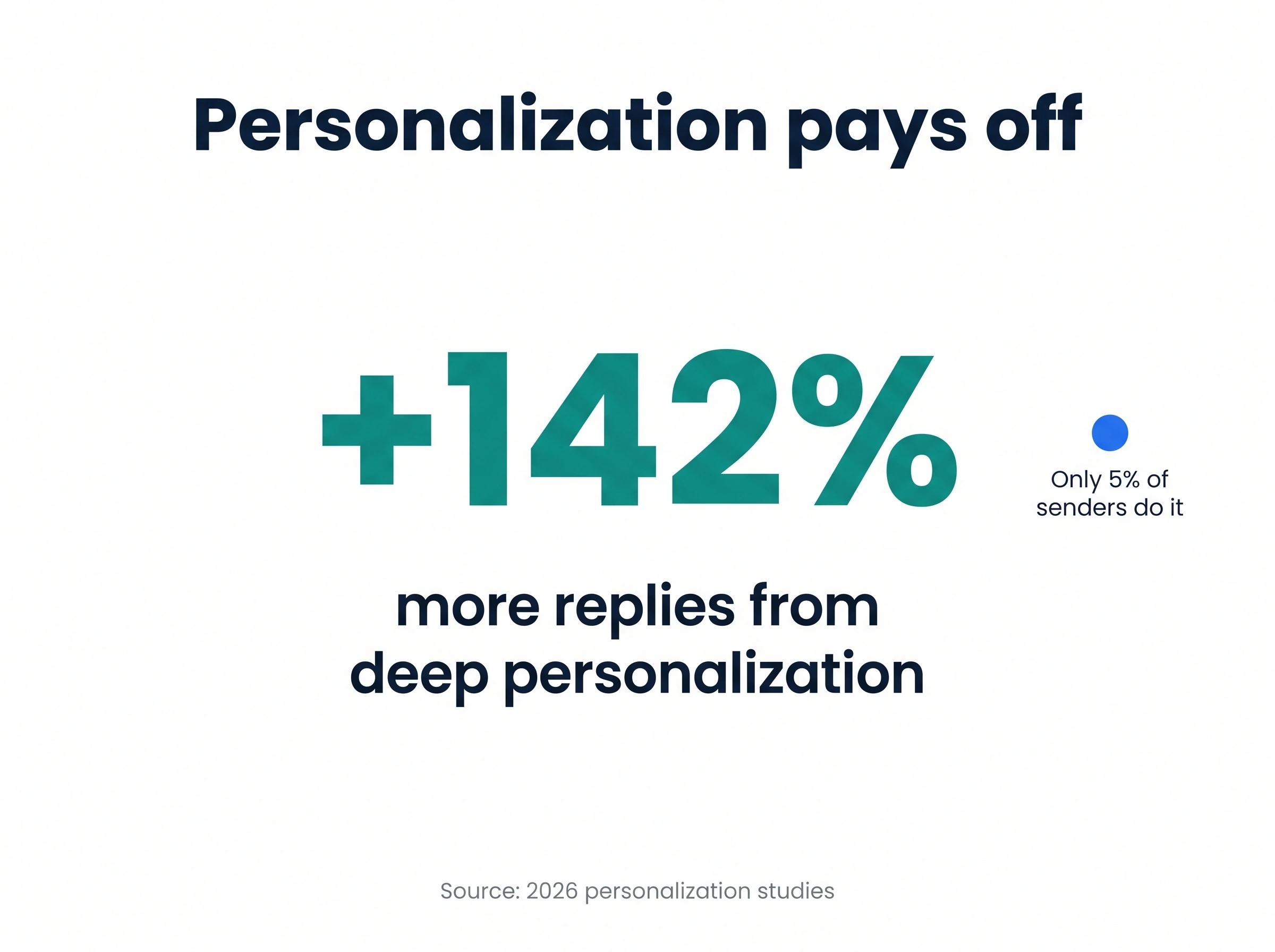
Personalization is where most senders leave the most money on the table. Going beyond a first-name merge tag, referencing the prospect’s role, their company’s recent move, or a specific problem they face, can lift reply rates by up to 142% per 2026 personalization studies. The catch: only around 5% of senders personalize every message. Do it well and you stand out instantly.
Why your number is low
“Hi {{first_name}}” isn’t personalization, it’s a mail merge, and prospects spot it in half a second. If your opening line could be pasted into any other prospect’s inbox without changing a word, it reads as a blast. Most senders skip real research because it feels slow at scale, so they default to generic and watch replies flatline.
How to improve it
- Open with one specific, true observation about the prospect or their company, not about you.
- Connect that observation to a problem you can actually fix. Relevance beats flattery.
- Use research-driven custom fields (recent funding, job change, a podcast they were on) instead of just name and company.
- Scale it without faking it: SmartReach’s Smart Email AI Agent drafts personalized openers from real prospect data, so 200 emails can each feel hand-written. Our personalize your cold emails playbook has more patterns.
3. Follow-ups drive 42% of all replies
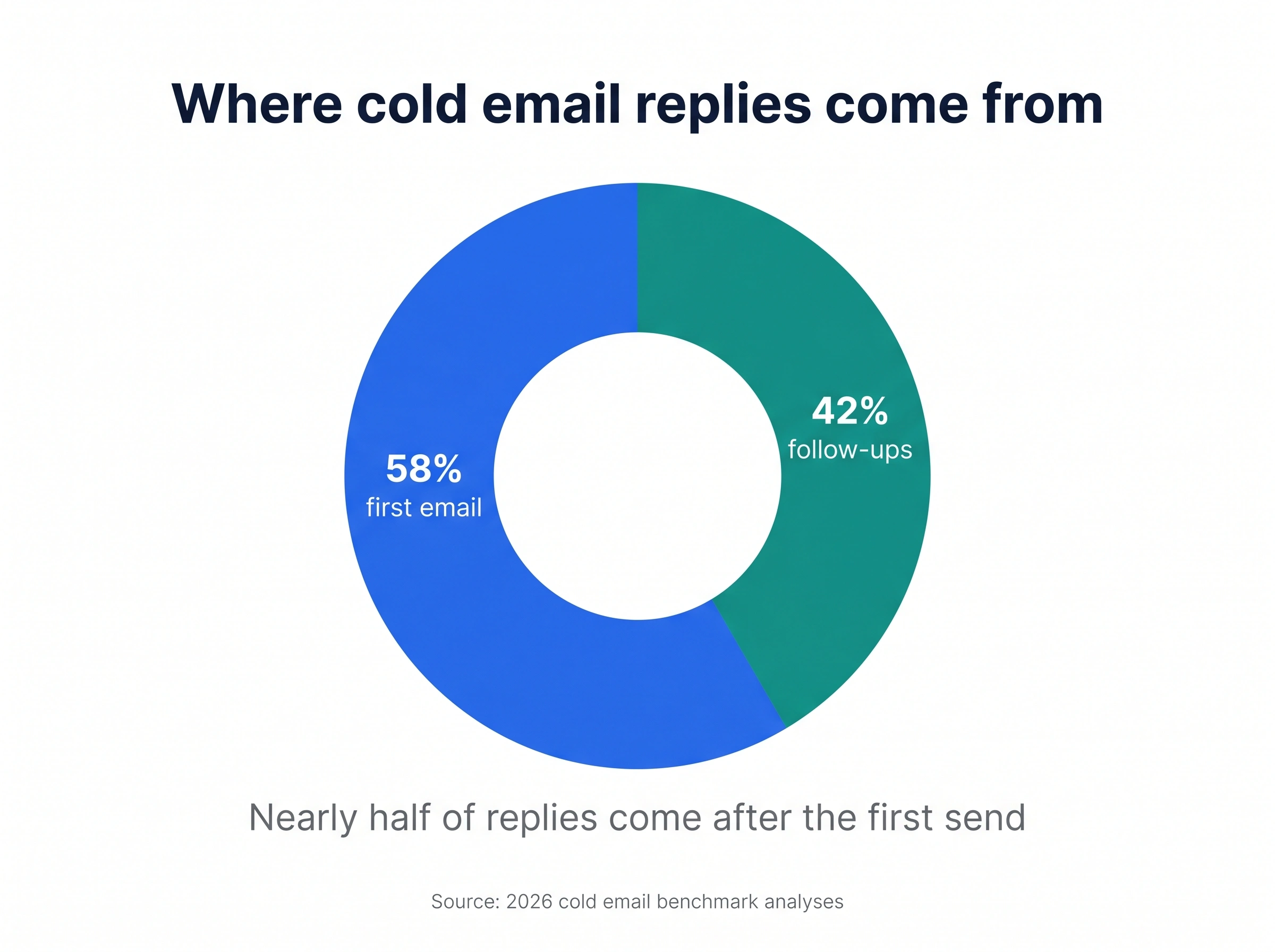
The biggest mistake in cold email is stopping after one send. Around 58% of replies come from the first email, which sounds like a reason to quit early until you read it the other way: the other 42% come from follow-ups. Skip them and you throw away nearly half your potential replies. The data points to 4 to 7 total touches as the sweet spot.
Why your number is low
You’re sending one email and calling it a campaign. Or you’re following up with “just checking in,” which adds no value and trains the prospect to ignore you. Timing hurts too: waiting longer than 5 days to follow up cuts your reply odds by about 24%, so slow, irregular sequences leak replies.
How to improve it
- Plan a 4 to 7 step sequence before you send the first email, not after.
- Send the first follow-up 3 to 4 days after the opener, then space the rest 3 to 7 days apart.
- Make every follow-up add something: a new angle, a case study, a useful resource. Never “bumping this to the top of your inbox.”
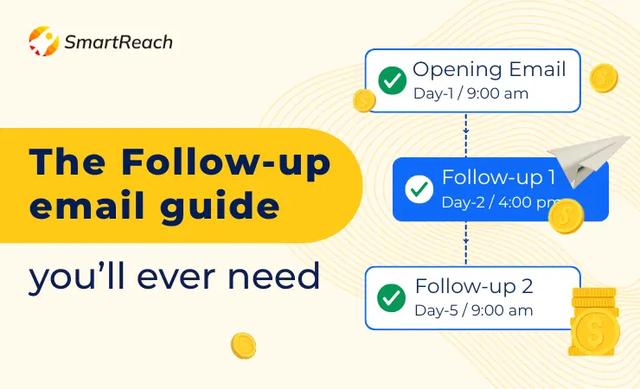
- Automate the cadence so nothing slips. SmartReach’s AI automations build and time the sequence for you, and our follow-up email guide shows what to write in each step. End the sequence with a short break-up email, which often pulls the reply that all the polite nudges couldn’t.
4. A bounce rate over 2% puts your whole domain at risk
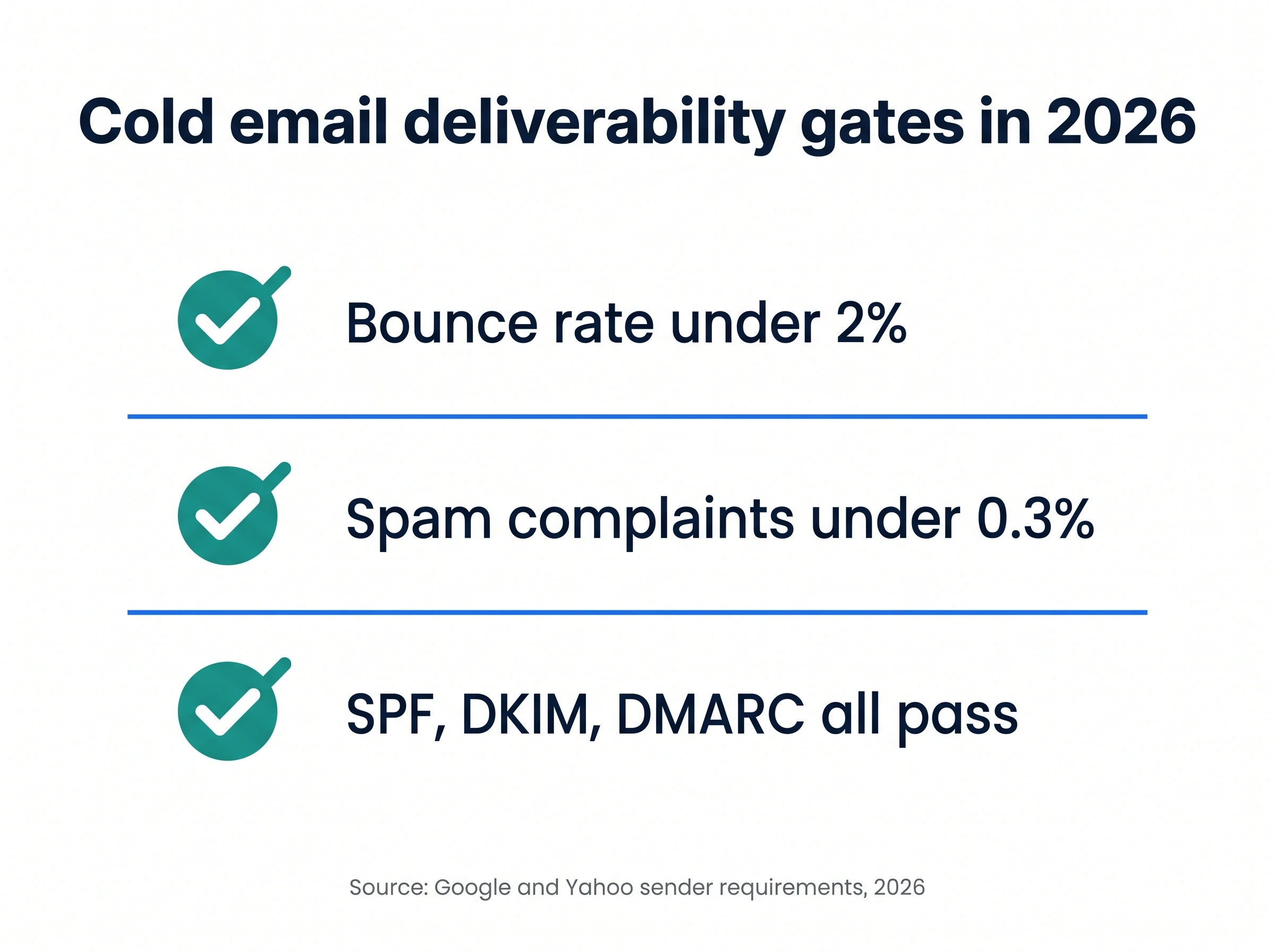
Deliverability is the practice nobody sees until it breaks. Top senders keep their bounce rate under 2% (ideally below 1.5%), and a rate over 5% can sink your domain reputation fast. Google and Yahoo also require bulk senders to keep spam complaints under 0.3%, and they suggest aiming below 0.1%. Cross those lines and your emails land in spam no matter how good the copy is.
Why your number is low
Three usual suspects: an unverified list (high bounces), missing authentication, or a cold domain you’re sending too hard, too fast. Since February 2024, Google’s sender guidelines treat SPF, DKIM, and DMARC as pass-or-fail gates, not nice-to-haves. Fail one and you’re flagged before a human ever reads the subject line.
How to improve it
- Set up SPF, DKIM, and DMARC on every sending domain and confirm all three pass 100% of the time. Our free email authentication checker confirms all three in one lookup.
- Verify the list before every campaign to hold bounce under 2%.
- Warm new inboxes for 2 to 4 weeks before real sends. SmartReach’s AI email warmup builds reputation gradually, and inbox rotation spreads volume so no single inbox gets cooked.
- Run a spam test report through Deliver4Sure before you launch, so you catch placement problems while they’re still fixable. Our email deliverability guide covers the full setup.
5. Multichannel sequences reply at 3 to 4x the rate of email alone
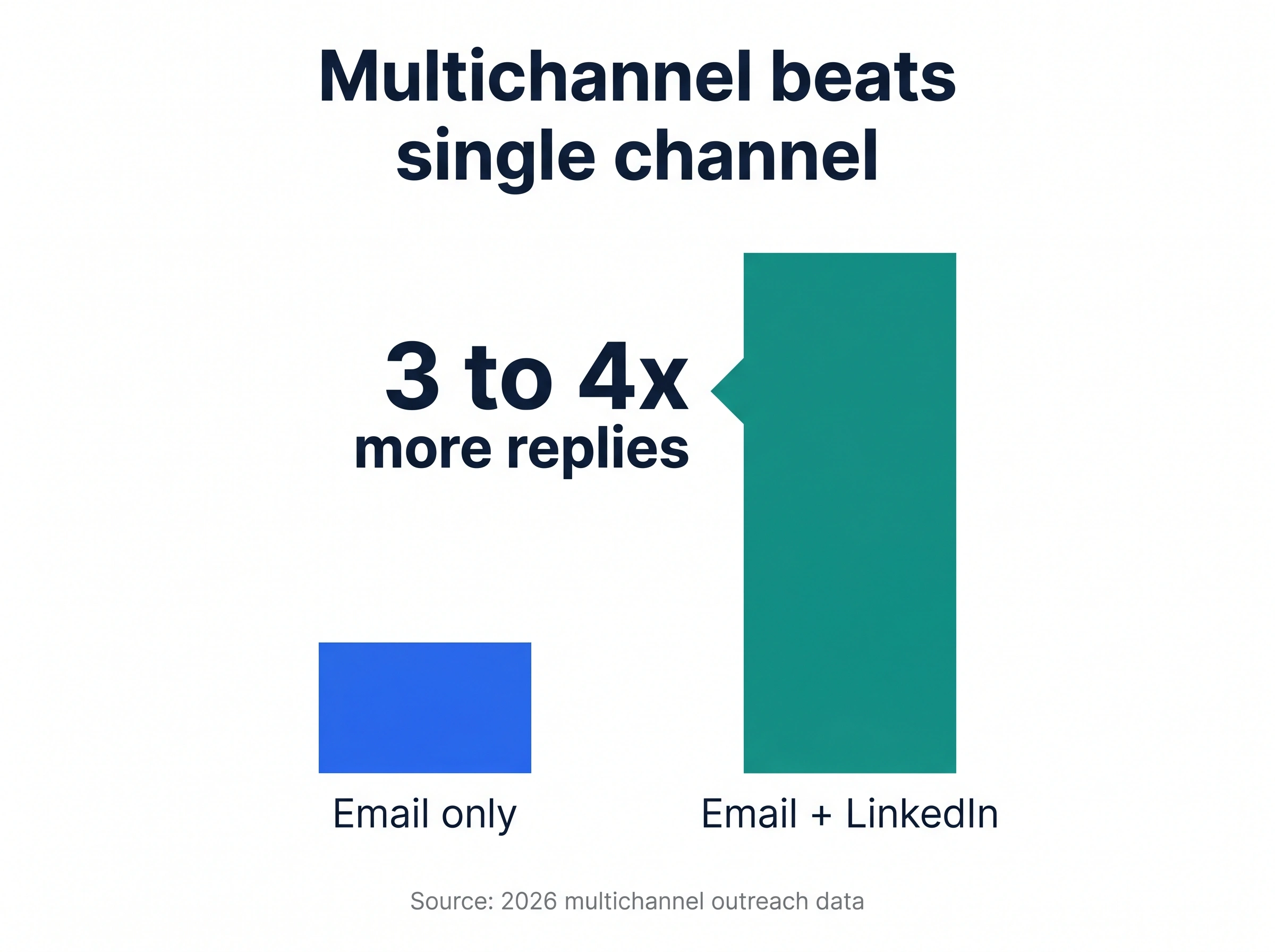
Email-only outreach is leaving replies on the table. Pairing cold email with LinkedIn touches lifts reply rates 3 to 4x over a single channel, and well-run multichannel sequences hit 15 to 25% reply rates on tight ICPs per 2026 outreach data. Combining channels generates roughly 50% more replies than running either one alone.
Why your number is low
You’re betting everything on one inbox. If the prospect doesn’t check email, or your message lands in a crowded promotions tab, you’ve got no second path to them. Email-only also gives you one shot at trust, when a LinkedIn view plus an email feels far more human than two emails.
How to improve it
- Map a sequence that mixes channels: a LinkedIn connection on day 1, an email on day 3, a LinkedIn message on day 7, an email follow-up on day 10.
- Keep the message consistent across channels so it feels like one person, not three bots.
- Add a call step for high-value accounts. Voice plus email plus LinkedIn beats any single channel.
- Run it from one place so the timing holds together. SmartReach’s omnichannel platform sequences email, LinkedIn, and calls in a single flow instead of three disconnected tools.
6. Subject lines of 6 to 10 words win the open
Your subject line decides whether anything else matters. Lines of 6 to 10 words (roughly 30 to 43 characters) tend to get the best response, because mobile screens cut off after about 6 to 9 words. For senior executives, even shorter wins: 1 to 5 words reads like a note from a peer, not a pitch.
Why your number is low
Long, clever, or salesy subject lines get truncated on mobile or trigger the “this is an ad” reflex. Anything with “free,” heavy caps, or a fake “Re:” reads as spam. Vague lines (“Quick question”) are so overused they’ve stopped working.
How to improve it
- Write the subject last, after the body, so it reflects the actual message.
- Keep it to 6 to 10 words, lowercase or sentence case, no salesy punctuation.
- Hint at the value or the specific reason you’re reaching out, don’t summarize the whole email.
- Steal from what already works: our 165 B2B cold email subject lines and the subject line and body copy guide give you tested patterns.
7. Emails of 50 to 125 words get the most replies
Short wins. A Boomerang study of 40 million emails found that messages between 50 and 125 words had the best response rates, above 50%. Cold email rewards brevity even more, because the reader owes you nothing and will bail at the first sign of work.
Why your number is low
You’re explaining too much. Long emails bury the ask, demand effort the prospect won’t spend, and look like a wall of text on a phone. If your email needs scrolling, it needs cutting. Most senders try to close in the first email instead of just earning a reply.
How to improve it
- Aim for 50 to 125 words total. Read it aloud, if you run out of breath, it’s too long.
- One idea per paragraph, two sentences max per paragraph.
- Cut every sentence that’s about you and keep the ones about them.
- Treat the email as the intro, not the sale. The goal is a reply, not a signature.
8. One CTA beats two every time
Every email should ask for exactly one thing. The moment you offer two options (“book a call or reply or check out our site”), you split attention and lower the odds of any action. A single, low-friction ask consistently outperforms a menu of choices.
Why your number is low
You’re asking for too much, too soon. “Book a 30-minute demo” is a big yes from a stranger. Multiple CTAs feel like work, and work gets deleted. Burying the ask in the middle of a paragraph doesn’t help either.
How to improve it
- Pick one CTA per email and make it the easiest possible yes.
- Early in a sequence, ask for interest (“Worth a quick look?”), not a meeting.
- Put the CTA on its own line so it’s impossible to miss.
- Save the calendar link for after they’ve shown interest. Match the ask to the temperature of the relationship.
9. Tuesday to Thursday, 8 to 10am local time gets the most opens
Timing won’t save a bad email, but it lifts a good one. The strongest windows for B2B sends are Tuesday through Thursday, 8 to 10am in the prospect’s local timezone. That’s when inboxes get checked and before the day buries your message.
Why your number is low
You’re likely sending in your timezone, not theirs, so a 9am send hits a prospect three zones away at 6am and sinks under everything else by the time they log on. Monday mornings and Friday afternoons are dead zones, and weekend sends read as either desperate or careless.
How to improve it
- Send by the prospect’s local time, not your own.
- Stick to Tuesday to Thursday mornings for the first touch.
- Spread sends across the window instead of firing all at once, which also protects deliverability.
- Let the tool handle the math. SmartReach’s send scheduling and holiday calendar ships emails in each prospect’s timezone and pauses on local holidays so you’re never the brand emailing during a national day off.
10. A/B testing one variable at a time is how top senders compound gains
The best cold email teams treat every campaign as an experiment. Testing one variable at a time (subject line, opener, or CTA) with at least 100 emails per version is what separates steady improvement from guessing. Personalized subject lines alone have moved reply rates from 3% to 7% in tested campaigns, a 133% lift.
Why your number is low
You’re changing three things at once, so you never learn what worked. Or your test groups are too small (20 emails won’t tell you anything statistically real). Many senders never test at all and just reuse whatever they wrote first.
How to improve it
- Test one element per experiment: subject, first line, or CTA. Never two at once.
- Use at least 100 emails per variant so the result means something.
- Measure reply rate as the primary signal, not open rate (open rate is unreliable now, see the trends section).
- Keep the winner, then test the next variable. SmartReach’s built-in A/B testing splits your variants automatically and reports the winner by reply rate, and its detailed analytics let the data, not your gut, make the call.
11. Cap sends at 35 to 40 per inbox per day, and stay consistent
Volume discipline is the practice that keeps everything else alive. Sending more than 35 to 40 emails per day per inbox burns sender reputation, especially on newer domains. Consistency matters more than bursts: a steady daily rhythm builds trust with inbox providers, while spiky sending looks like a bot.
Why your number is low
You’re trying to hit a number instead of protecting a domain. Blasting 500 emails from one inbox in a morning is the fastest way into the spam folder. Stop-start sending (nothing for a week, then a flood) trips the same alarms.
How to improve it
- Hold each inbox to 35 to 40 sends a day, and ramp new inboxes up slowly.
- To send more, add more inboxes and rotate across them rather than overloading one.
- Keep a steady daily volume instead of batching everything into one session.
- Use inbox rotation to spread sends automatically, so you can scale volume without scaling risk. Slow and consistent is what compounds.
Cold email templates that get replies
Templates are a starting point, not a script. Send any of these word-for-word and they’ll read like everyone else’s. Use them as a frame, then make each one specific to the prospect using practice 2.
1. The intro email
Subject: a quick idea for {{company}}
Hi {{first_name}}, I noticed {{specific observation}}. We help {{role}} teams fix {{specific problem}}, usually getting {{concrete result}}. Worth a quick look?
2. The first follow-up (2 to 3 days later)
Subject: re: a quick idea for {{company}}
Hi {{first_name}}, floating this back up in case it got buried. Here’s a 90-second example of how {{similar company}} handled {{problem}}: {{link}}. Open to a quick chat?
3. The value follow-up (4 to 5 days later)
Subject: thought this might help
Hi {{first_name}}, no pitch here, just useful: {{resource or insight relevant to their role}}. If {{problem}} is on your radar this quarter, happy to share what’s working for teams like yours.
4. The break-up email (end of sequence)
Subject: should I close your file?
Hi {{first_name}}, I haven’t heard back, so I’ll assume the timing’s off and stop reaching out. If that’s wrong, just reply “later” and I’ll circle back next quarter. All the best.
Want more than four? Our library of 200+ cold email templates covers nearly every outreach scenario.
How to write a cold email that gets responses
Here’s the whole process, start to finish. Follow these steps in order and every practice above falls into place without you having to think about it. Budget about 10 minutes per first draft once the list is built. It gets faster with reps.
- Pick one tight segment. One industry, one role, one trigger. “VP of Sales at 50 to 200 person SaaS companies that just raised a Series B” beats “salespeople.” The narrower the segment, the easier every later step gets, because you’re writing to one kind of person with one kind of problem.
- Research the prospect for 60 seconds. You’re hunting for one true, specific thing: a recent hire, a product launch, a post they wrote, a tool already in their stack. You don’t need a dossier. One real detail is enough to prove you’re not blasting a list.
- Write the body first, 50 to 125 words. Lead with them, not you. Name the one problem you solve, back it with one proof point (a number, a client, a result), then stop. Resist the urge to explain your whole product. The body’s only job is to earn a reply, not to close the deal.
- Add a single, low-friction CTA. Ask for interest, not a 30-minute demo. “Worth a quick look?” or “Want the 2-minute breakdown?” gets a yes far more often than a calendar link does on a first touch. One ask, on its own line, impossible to miss.
- Write the subject line last. Now that the body exists, the subject can reflect it. Keep it to 6 to 10 words, lowercase or sentence case, no “free,” no fake “Re:,” no shouty caps. Hint at the value, don’t summarize the whole email.
- Read it aloud before you send. This is the fastest quality check there is. If it sounds like one human talking to another, keep it. If it sounds like a brochure or a robot, cut words until it doesn’t. Run out of breath partway through? It’s too long.
- Plan 4 to 7 follow-ups up front. Map the full sequence before you send touch one, because nearly half your replies will come from these. Each follow-up adds something new: a fresh angle, a case study, a useful resource. Make the last one a short break-up email.
- Send at the right time. Tuesday to Thursday, 8 to 10am in the prospect’s local timezone, not yours. Spread the batch across the window instead of firing it all at once, which also protects your deliverability.
- Test one variable, then repeat. Measure reply rate, not open rate. Change one thing (the subject, the opener, or the CTA), run it across at least 100 contacts, keep the winner, and test the next thing. That’s how a decent campaign compounds into a great one.
Here’s what steps 3 to 5 look like put together:
Subject: a quick idea for {{company}}
Hi {{first_name}}, saw {{company}} just opened six new SDR roles. Teams scaling that fast usually hit a wall on ramp time. We helped {{similar company}} cut new-rep ramp from 90 days to 45. Worth a quick look?
Short, about them, one proof point, one ask. That’s the whole game.
That’s the engine. Everything else in this guide is refinement layered on top of it.
Cold email psychology: what makes people respond
Tactics get you in the inbox. Psychology gets you the reply. The strongest cold emails quietly do five things, and most of them have nothing to do with your product.
They make it about the recipient. People respond to messages that fit their world, not yours. Open with their situation, their problem, their goal. The fastest way to lose a reader is to spend the first line talking about your company.
They establish quiet credibility. A relevant client name, a shared connection, or a specific result builds trust without bragging. Social proof works because people look to others before they act. One concrete proof point beats three adjectives.
They speak to a real pain or a real want. The email either eases a frustration the prospect already feels or offers something they actually want. If it does neither, there’s no reason to reply, no matter how polite it is.
They’re simple enough to answer in one breath. Short, plain, and concrete. The easier an email is to read and reply to, the more replies it gets. Complexity is friction, and friction kills response.
They come from a place of respect, not need. A little genuine appreciation (“loved your talk on X”) lands far better than pressure. Gratitude and humility multiply responses, while desperation repels them. You’re starting a conversation between equals, not begging for a meeting.
Put plainly: the goal of a cold email isn’t to sell. It’s to earn a reply that shows interest. Sell after they raise their hand.
What to do when you get an interested reply
Getting the reply is the start, not the finish, and this is where a lot of deals quietly die. Here’s how to handle a warm response without scaring it off.
Read their intent first. Do they want more info, have a doubt, or barely understand the offer yet? Figure out what they actually need before you fire back a calendar link.
Reply fast. A response within minutes (or at least the same hour) keeps the conversation feeling live and human. Speed signals that a real person is on the other end.
Keep it about them. Don’t get over-excited and dump every feature. Listen, ask, and let them shape the context for your offer.
Don’t pour everything on them. A full pitch, ten features, an infographic, a PDF, and a calendar link all at once is too much to digest. Share only what answers their question right now.
Answer the question, then stop pushing. Give a real answer or invite more questions. It’s fine to stay on email longer before a call. When the moment for a call is right, you’ll feel it, so don’t force it.
Always define the next step. Every reply and every call should end with a clear, small next action both sides understand. That’s how a warm reply becomes a pipeline, not a dead thread.
Should I mention competitors?
Short answer: sometimes, carefully. Naming a competitor your prospect already uses can be a sharp relevance signal, it shows you did your homework and you understand their stack. The risk is sounding negative or picking a fight.
The rule is simple: reference, don’t trash. “I saw you’re running {{competitor tool}}, a lot of teams your size hit {{specific limit}} with it around now” is relevant and useful. “{{Competitor}} is terrible, switch to us” is a fast delete.
Three guidelines:
- Only name a competitor if it adds real context. If it doesn’t sharpen your point, leave it out.
- Frame around the prospect’s problem, not the rival’s flaws. Talk about the limit they’re hitting, not how bad the other tool is.
- Stay factual and neutral. Let the prospect draw the conclusion. Confident beats combative every time.
Used with restraint, a competitor mention proves you’re paying attention. Overused, it makes you look insecure.
System that doesn't feel spammy
The line between “outreach” and “spam” isn’t about volume, it’s about whether the prospect feels like a person or a row in a spreadsheet. Two things keep you on the right side: killing tired clichés, and staying compliant.
Start by deleting the lines your prospects have read a thousand times and learned to ignore:
- “With one click, you can make your business problem go away.”
- “Click this link for more information.”
- “Give me a call on…”
These read as templated, lazy, and all about you. Replace each with something specific: a real observation, a concrete result, a single easy ask. If a sentence could appear in any company’s email, cut it.
The compliance side keeps your sends legal and your domain alive:
- In the US, follow the FTC’s CAN-SPAM rules: an accurate “from” name, an honest subject, a real address, and an easy opt-out you honor within 10 business days.
- In the EU, GDPR expects a clear legal basis (like legitimate interest) before you contact someone, and faster opt-out handling.
- Everywhere, make it effortless to unsubscribe. A respected opt-out protects your reputation more than it costs you a lead.
In SmartReach.io the compliance side is two toggles rather than a policy document.
- Open the campaign and go to Channel Setup
- Select Unsubscribe Text/Link and turn on Include an unsubscribe option in emails
- Turn on Add prospect who unsubscribe to Do Not Contact category, so an opt-out is honored across every future campaign automatically
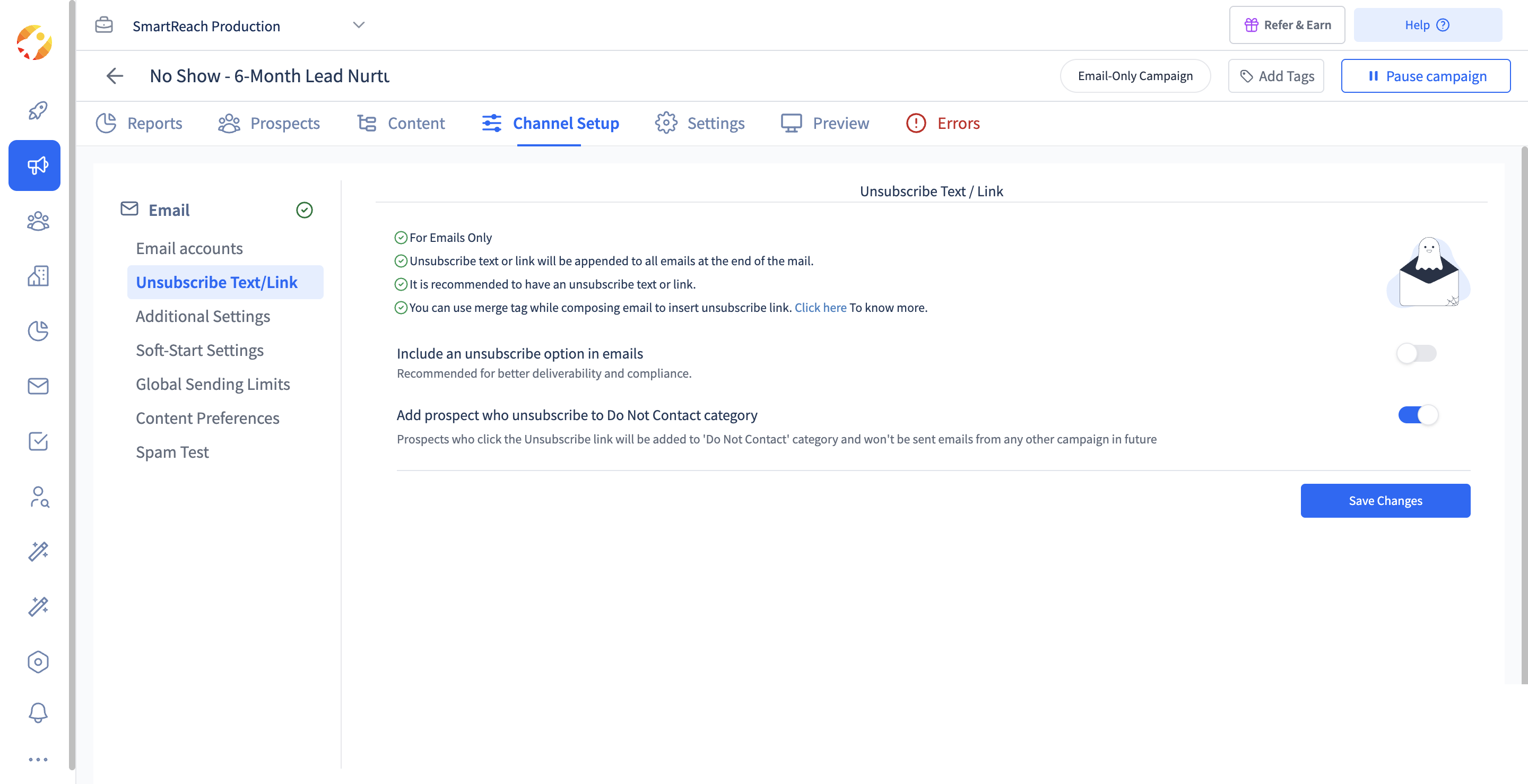 Unsubscribe settings in a SmartReach.io campaign. The CAN-SPAM opt-out and the suppression list, handled from one screen.
A system that doesn’t feel spammy is really just one that respects the reader’s time, inbox, and choice. Do that and deliverability, replies, and trust all follow.
How to get past gatekeepers
Sometimes the person you need to reach sits behind an assistant, an info@ inbox, or a “we’ll pass it along.” Gatekeepers aren’t the enemy, they’re doing their job. The move is to make their job easy, not to dodge them.
- Be worth passing along. Gatekeepers forward messages that are clearly relevant to their boss and clearly not a generic pitch. Specificity is your pass.
- Be respectful and direct. Say who you are, why you’re reaching out, and who you’re hoping to reach. Politeness and clarity open more doors than tricks.
- Go multichannel. If email stalls, a LinkedIn message to the decision-maker (or a short call) often reaches the person directly. This is another reason multichannel sequences win.
- Ask for the right contact, not the meeting. “Who’s the best person to talk to about {{topic}}?” is an easy yes for a gatekeeper, and it hands you a warm internal referral.
Treat the gatekeeper as an ally who can route you, and you’ll get further than any clever workaround.
Trends shaping 2026
Cold email keeps working, but the rules tightened this year. Four shifts matter most.
Signal-based outbound is now the standard for top teams. According to HubSpot’s sales research, a large majority of top-performing teams now trigger outreach off intent signals (a new hire, funding, a tech change), up sharply from a few years ago. Signal-based campaigns hit 15 to 25% reply rates, around 5x the average. Spraying a static list is the old way.
AI personalization moved from gimmick to baseline. The best teams use AI to research role, context, and timing, not just to swap in a first name. Contextual personalization at scale is the new bar, and prospects can tell the difference.
Deliverability enforcement got stricter. With Google and Yahoo holding spam rates under 0.3% and treating authentication as pass-or-fail, sender reputation now decides reach more than copy does. Engagement quality (real replies, time spent reading) increasingly drives inbox placement.
Multichannel is no longer optional. Inboxes are smarter and average reply rates have drifted down, so the teams winning in 2026 spread touches across email, LinkedIn, and calls instead of leaning on email alone. Open rate, inflated by Apple Mail Privacy Protection, has quietly stopped being a trustworthy metric, so smart teams measure replies and meetings instead.
The throughline: 2026 rewards precision over volume. Fewer, sharper, better-timed messages beat more.
The bottom line
Cold email isn’t dead, it’s just unforgiving of lazy sends. The teams clearing 10% reply rates aren’t writing magic copy. They target tightly, personalize for real, follow up 4 to 7 times, protect deliverability, and spread touches across channels. Every practice in this guide points at the same idea: respect the prospect’s time and earn the reply, don’t demand it.
You don’t have to fix all 11 at once. Pick the three with the biggest gap between where you are and where the benchmarks say you could be, usually targeting, personalization, and follow-ups, and start there.
Frequently asked questions
What is the best structure for a cold email?
Keep it to four parts: a personalised opener about the prospect, one clear problem you solve, a short proof point, and a single low-friction call to action. Aim for 50 to 125 words total, one idea per short paragraph, and write the subject line last, once you know what the email actually says. Anything that describes you rather than them can usually come out.
How long should a cold email be?
50 to 125 words is the sweet spot. A Boomerang study of 40 million emails found messages in that range got the best response rates. If your email needs scrolling on a phone, it’s too long. Cut anything that’s about you instead of the prospect.
Is cold emailing legal?
Yes, in most places, if you follow the rules. In the US, the CAN-SPAM Act allows cold B2B email as long as your “from” name and subject are honest, you include a real address, and you offer an easy opt-out. The EU’s GDPR is stricter and expects a clear legal basis like legitimate interest. Always make unsubscribing easy.
How many follow-ups should I send?
Four to six touches in a sequence, spaced three to seven days apart, captures most of the replies you are going to get; past that the return drops and the spam risk climbs. SmartReach.io automates the cadence and halts it the moment someone responds. It recommends staying under 40 emails a day per mailbox, spread across several inboxes, to protect deliverability.
What's a good cold email reply rate in 2026?
The average sits around 3 to 3.5%. Anything above 5% is solid, and top performers clear 10%, with tightly targeted multichannel campaigns hitting 15 to 25%. Reply rate is the metric to watch, since open rate is now unreliable thanks to Apple Mail Privacy Protection.
What's the best time to send a cold email?
Tuesday through Thursday, 8am to 10am in the prospect's local timezone, draws the most opens and replies. Send by their clock rather than yours, and avoid Monday mornings, when the weekend backlog is still being cleared, and Friday afternoons. Spreading sends across the window rather than firing them at once also protects deliverability, because a burst from one mailbox is what providers throttle.
How do I keep cold emails out of spam?
Authenticate every sending domain with SPF, DKIM, and DMARC, keep your bounce rate under 2% by verifying lists, hold spam complaints under 0.3%, warm up new inboxes, and cap sends at 35 to 40 per inbox per day. Run a spam test before launching so you catch placement issues early.
Stop juggling tools
Book more meetings on every channel
Join 5,000+ teams running multichannel outreach from one sequence, with deliverability built in.