When Is the Best Time to Send Your Cold Emails?

On this page
Ever wondered why some cold emails get replies while others don’t?
It’s not always about the email content—it’s often about the email timing.
Yes, timing in cold email plays an important role in the success of the overall campaign.
Finding out that best time to send cold emails can help you optimise your cold email campaigns for – more opens & replies.
Think about it: your prospects have busy schedules, overflowing inboxes, and limited attention spans.
Sending your email at the right moment gives it a better chance to stand out and get the response you’re hoping for.
But figuring out the perfect time isn’t easy.
Every industry and audience is different, and what works for one might not work for another.
That’s where ‘Best Time to Send Report‘ by SmartReach.io comes handy.
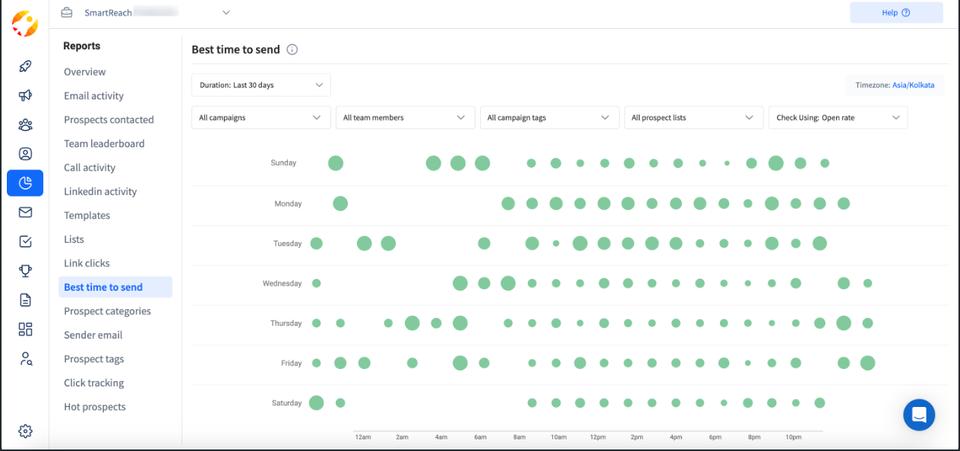
This report analyzes your past campaigns and provides data-driven insights to help you pinpoint the time slots that gives you the maximum email opens and replies.
Whether it’s mid-morning, midweek, or another sweet spot, SmartReach ensures your emails hit the inbox at just the right moment.
This way you send emails at the perfect time when the prospects are most likely open your emails and reply it.
Try it for FREE inside SmartReach.io (14-Day Free trial – no credit card required).
Now let’s see the other stats regarding the best time to send email.
When is the best time to send cold emails?
While there’s no one-size-fits-all answer, timing does play a significant role in ensuring your email gets noticed.
For most industries, the ideal windows for sending cold emails are between 9 A.M. and 11 A.M. or 1 P.M. and 4 P.M., as these are the hours when professionals are typically active and engaged with their inboxes.
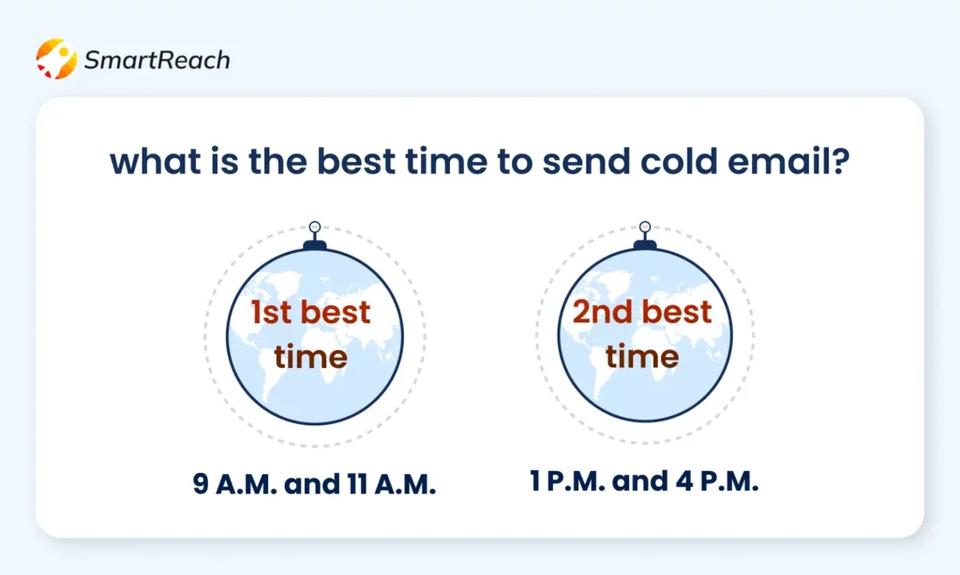
Research by CoSchedule supports this, highlighting that people are more alert and responsive during these times.
However, avoid sending emails late in the day. Post-5 P.M., many are winding down, making it less likely for your message to grab their attention.
Pro tip: Use these timeframes as a starting point, but remember that the “best time” can vary depending on your audience’s industry, time zone, and habits.
How does timing affect sending cold emails?
Timing can make or break the success of your cold email outreach.
Here’s how it plays a role:
➡️ Visibility
Sending emails when your prospects are most likely to check their inbox increases the chances of your email being seen.
Emails sent during low-activity times often get buried under newer messages.
➡️ Engagement
Reaching out during peak productivity hours, like mid-morning or early afternoon, aligns with when recipients are more focused, making them more likely to engage with your email.
➡️ Avoiding overload
Sending emails at the right time helps you stand out, as you avoid the inbox clutter that typically builds up overnight or during non-business hours.
➡️ Higher response rates
Well-timed emails show an understanding of your recipient’s routine and habits, increasing the likelihood of a positive response.
In short, thoughtful timing ensures your cold email gets noticed, read, and acted upon, making it a critical factor in outreach success.
Best days to send cold emails
Choosing the right day to send cold emails can significantly impact your open, click, and reply rates.
According to research by Siege Media, Monday takes the lead with the highest open rate (just over 20%), a 4.3% click rate, and a 2.8% reply rate.
Early in the week seems to be ideal because majority of the business decision-makers are more receptive to pitches during this time.
As the week progresses, engagement rates tend to dip, likely due to the increasing workload and shifting priorities.
Wednesday also stands out as a strong contender, particularly if reply rates are your focus.
While its open rate (17.2%) is slightly lower than Monday, its reply rate (2.6%) is almost on par.
The best time to send cold emails (As per industry & niche)
The best time to send cold emails can vary by industry, as each sector has its own unique workflow and recipient behavior.
Here’s a guide to optimal times for sending cold emails across different industries:
#1 Software & SaaS
- Best Time → Tuesday to Thursday, 9 A.M. to 11 A.M.
- Why→ Professionals in this industry are generally focused on finding tools to solve specific problems. Mid-morning during the workweek allows for engagement when they’re likely planning their tasks or considering software solutions.
____________________
#2 Real Estate
- Best Time → Wednesday and Thursday, 10 A.M. to 12 P.M.
- Why→ Real estate professionals are often in the field, showing properties or meeting with clients. Midweek emails catch them when they have a break or are scheduling their next steps for the week.
__________________________
#3 Marketing & Advertising
- Best Time → Monday and Tuesday, 9 A.M. to 10 A.M.
- Why → Marketing and advertising professionals start the week planning their campaigns. Early emails will likely get more attention before they dive into meetings and strategy sessions.
________________________
#4 Finance & Accounting
- Best Time: Tuesday to Thursday, 10 A.M. to 12 P.M.
- Why: With many finance professionals focused on data-heavy tasks, mid-morning emails avoid the rush of early-day activities, such as reviewing reports, making them more likely to engage.
_________________________
#5 Healthcare & Medical Services
- Best Time → Monday, Wednesday, and Thursday, 8 A.M. to 10 A.M.
- Why → Healthcare professionals often have tight schedules with patient appointments and rounds. Early morning emails are more likely to be seen before their day becomes too packed.
___________________________-
#6 E-Commerce
- Best Time → Tuesday and Thursday, 11 A.M. to 1 P.M.
- Why → E-commerce professionals are often focused on sales trends and online customer behavior. Mid-morning and early afternoon offer a sweet spot for catching them between peak activity.
____________________________
#7 Education & Training
- Best Time → Tuesday and Wednesday, 9 A.M. to 11 A.M.
- Why → Educators and training providers are typically in classes or sessions earlier in the day. Mid-morning during the week is when they’re more likely to check emails in between lessons or preparation periods. For paper helper services, consider also sending emails Sunday evening or Monday morning when students are most likely panicking about upcoming assignment deadlines.
Sending right timed emails with SmartReach.io
Sending out cold emails at a particular time of the day can be quite hectic, especially if your cold outreach tool doesn’t provide a scheduling option.
SmartReach.io is the perfect solution for all your scheduling and timing-related issues.
SmartReach’s AI-enabled cold email automation helps to scale your outreach by creating multiple personalized email sequences effortlessly.
It generates dynamic content variations, optimizes email timing, and ensures higher deliverability.
SmartReach provides a couple of options for getting your email timing right such as –
- sending emails as per your prospect’s time zone based on your email list and
- the ‘best time to send report’ that gives the numbers based on your outreach campaign.
First let’s see how you can set your prospect’s time zone ⤵️
Step 1 ➡️ Sign up with SmartReach.io and create your 1st campaign (for free).
Step 2 ➡️ Create your email sequence, add prospects and set up the channels for your outreach
Step 3 ➡️ Next come to the campaign setting, where you can set the time and day of sending your outreach messages.
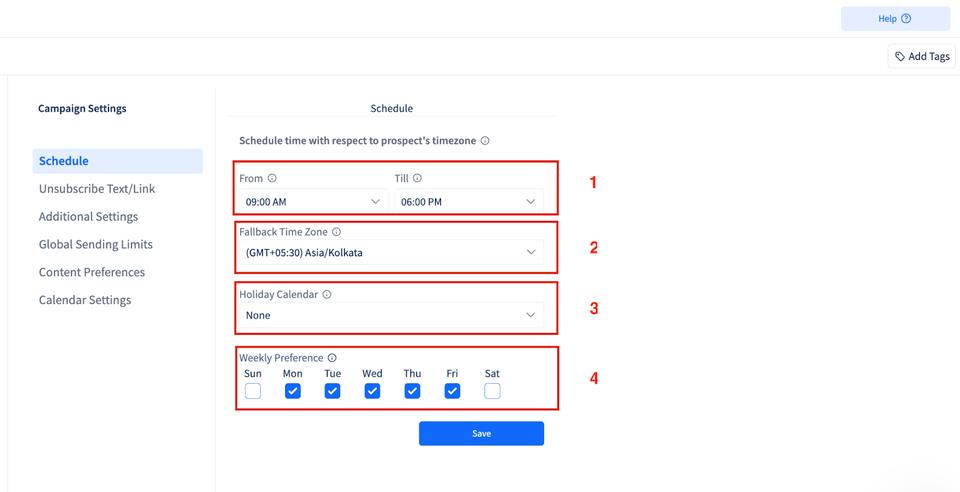
With campaign setting, you can ⤵️
- You can select the time slot between which you wish to send your emails or messages.
- Select the time under which your prospects fall, so automatically between the time zone & time slot your prospect would receive your message.
- If you wish not to send emails on particular holidays, then you can add the holiday calendar, which will stop the email from going out on those particular dates.
- Lastly, you can select the days on which you wish to send your outreach message.
Next, let’s check the ‘best time to send’ report.
Head over to the reports section and click on ‘Best time to send’.
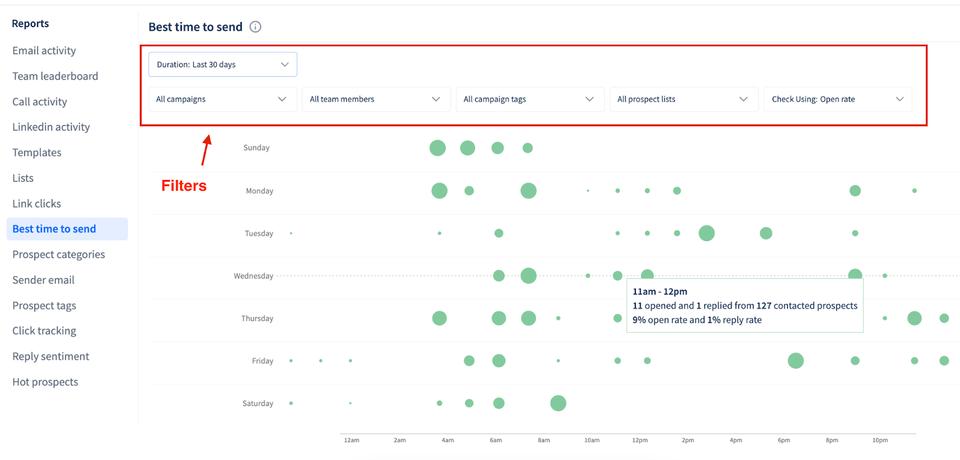
The report offers a variety of filters, which you can set based on your requirements.
The reports contain green dots of different sizes. When you hover over the dot, you will get the details like open rate, reply rate, prospect contacted, and the time slot.
Based on the report you can analyse which time works the best for you and optimize your outreach campaign for better efficiency.
7 Things to remember while choosing your time
Timing is crucial when sending cold emails to ensure they’re seen and acted upon.
Here are key factors to consider when determining the best time for your outreach:
#1 Know your audience’s work schedule
Consider the workday structure of your target audience.
Some industries, like tech, may work more flexible hours, while others, like healthcare or finance, may have strict schedules.
Tailor your timing to when they are likely to be active and engaged with their inbox.
#2 Consider time zones of the prospects
Always account for time zones, especially if you’re reaching out to people in different regions.
Use email scheduling tools like SmartReach.io to ensure your emails arrive at the optimal time for the recipient, regardless of where they are located.
#3 Avoid early mornings or late evenings
Sending emails too early (before 8 A.M.) or late in the evening (after 6 P.M.) can result in them being buried under a flood of messages or overlooked.
Aim for mid-morning or early afternoon for better visibility and engagement.
#4 Don’t overlook midweek
Research shows that emails sent on Tuesday, Wednesday, or Thursday generally get better results than on Mondays (when people are catching up) or Fridays (when they’re winding down).
Aim to send during these prime days.
#5 Test and optimize your email timings
Use A/B testing to experiment with different times and days to understand what works best for your audience.
Pay attention to open rates, click-through rates, and reply rates to continuously optimize your outreach strategy.
#6 Keep your subject line compelling
Even if you send your email at the perfect time, a lackluster subject line can cause your email to be ignored.
Pair your perfect timing with a strong, engaging subject line that piques curiosity and promises value.
Read more: How to Write Cold Email Subject Line & Body Copy?
#7 Be consistent with your emails
Sending emails at the same time consistently can help build familiarity.
If your audience expects emails at a certain time of day or week, they may begin to recognize and prioritize your outreach.
Best time to send cold emails: F.A.Q.s
What is the best day of the week to send cold emails?
Tuesday, with Wednesday and Thursday close behind. Monday inboxes are crowded with everything that arrived over the weekend, so a cold email competes with the whole backlog, and Friday afternoons lose attention to the weekend. The day matters less than the timezone though: sending Tuesday on your clock into a prospect eight hours ahead lands on Tuesday night, which is nobody's best day.
What is the best time to send out sales emails?
Mid-morning, roughly 10am to 11am in the recipient's own timezone. By then the overnight backlog has been cleared and the day's meetings have not taken over, so a new message arrives at the top of a list someone is actually reading. The second-best window is early afternoon, about 1pm to 3pm, once people return to their desks.
What is the best time to send an email to get a response?
Between 9am and 11am local to the prospect. Replies correlate with when a message is read rather than when it is sent, and that window is when most people triage an inbox rather than skim it. An email that arrives overnight sits below everything that landed since, which is why send-time scheduling by recipient timezone beats picking one clock for the whole list.
What are the best hours to send cold emails?
Between 8am and 10am in the prospect's own timezone performs best, with a smaller lift from 1pm to 3pm. The timezone matters more than the hour, which is why sending on your own clock flattens results. SmartReach.io schedules each send in the recipient's local time and spreads volume across connected inboxes, keeping each under the 40 a day it recommends.
Is it better to send an email on Friday or Monday?
Monday, narrowly, but neither is the day to pick if you have a choice. Friday afternoon loses attention to the weekend, and Monday morning competes with the backlog that built up across it. If the calendar forces one of the two, send Monday late morning once the backlog has been cleared rather than first thing, and keep the subject line short.
What day of the week has the best email open rate?
Tuesday and Thursday, which sit between the Monday backlog and the Friday wind-down. Treat open rate carefully as a metric though: Apple Mail Privacy Protection pre-loads tracking pixels, so a meaningful share of recorded opens never happened. Reply rate is the number to steer on, and it follows roughly the same mid-week pattern without the measurement noise.
What is the best day to email prospects?
Tuesday, with Wednesday and Thursday close behind on both opens and replies. The bigger lever is consistency rather than the day itself: a sequence that lands on a predictable cadence in the prospect's working hours outperforms one timed to a chart. Send in their timezone, spread volume across the window, and keep each mailbox under the daily limit you have warmed it to.
Stop juggling tools
Book more meetings on every channel
Join 5,000+ teams running multichannel outreach from one sequence, with deliverability built in.