From 18 meetings per month to 160 qualified conversations in 90 days

An electronics manufacturer was hitting a wall.
They had the product. They had the certifications. They’d spent years getting the technical specs right.
But pipeline was thin. Growth had stalled at 18 qualified meetings per month across the entire European Union.
Here’s what they were doing: sending cold emails from their primary domain (putting deliverability at risk), manually researching prospects on LinkedIn (consuming 20+ hours each week), running email-only campaigns (missing prospects who live on LinkedIn), and juggling five different tools that refused to talk to each other.
Note: We’re using a made-up name “EuroConnect Manufacturing” as we haven’t yet received approval to publish our client’s actual name. But this is a mid-size electronics components manufacturer reaching out to procurement and engineering decision-makers specifically across the European Union.
The setup that wasn’t working
EuroConnect had three Business Development Representatives (BDRs). Smart people who knew the product cold.
But they were spending most of their time on admin work instead of conversations.
Manual list building ate up 20 hours weekly. Each BDR would scroll through LinkedIn, copy names into spreadsheets, search for email addresses, validate them one by one. By the time they finished a list, half the prospects had moved on.
They were sending from their main domain (euroconnect.com) which meant every bounce, every spam complaint, every unsubscribe was damaging the same inbox they used for customer support and vendor relationships.
And when someone didn’t respond to email? That was it. No follow-up on LinkedIn. No phone call. The conversation just died.
They weren’t losing because of their product. They were losing because their outreach process had more holes than a fishing net.
What changed in two weeks
EuroConnect moved everything to SmartReach and rebuilt their entire motion.
Not slowly. Not over months. Two weeks.
Here’s what they did:
Protected their primary domain
They bought six pre-authenticated secondary domains through SmartReach’s domain marketplace. Each domain got three mailboxes. Now they had 18 sending addresses that could scale volume without touching their main domain.
If one domain got flagged? It wouldn’t affect customer communications. It wouldn’t damage their sender reputation with existing partners.
Smart move: They used domains similar to their primary (euroconnect-sales.com, euroconnect-sales.de) so prospects wouldn’t think it was spam.
Stopped the research grind
Instead of 20 hours of manual LinkedIn hunting, they used SmartReach’s Prospecting tool i.e. ProspectDaddy to build ICP-matched lists in minutes.
They’d run a search on LinkedIn for: “Procurement Director, electronics manufacturing, Germany, 50-500 employees.” The tool uses its internal algorithm to provide verified contacts with business email addresses, LinkedIn profiles and other enriched data.
What used to take a full workday now took 15 minutes.
Met prospects where they actually are
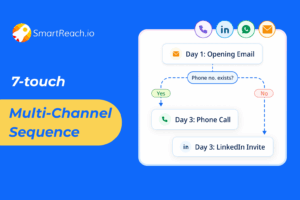
They built multi-channel sequences combining email, LinkedIn, and calling.
Day 1: Email introduction
Day 3: LinkedIn connection request
Day 5: Follow-up email
Day 7: Phone call
Day 10: LinkedIn message to connections
Day 14: Final email with case study
Prospects who ignored email responded on LinkedIn. Prospects who didn’t connect picked up the phone. The channels reinforced each other instead of competing.
Scaled volume safely
They added 18 email accounts with inbox rotation. Instead of sending 200 emails daily from one inbox, they were sending 900 daily across 18 inboxes (i.e. 50 emails per mail box and not more than 150 email per pay per domain).
The key? They used SmartReach’s soft-start feature to ramp up gradually. Started at 5 emails per inbox daily, increased by 15% every day. No deliverability drops.
Fixed their deliverability issues
Since they bought mailboxes from Google Workspace, Microsoft365 and SMTP (all via smartreach domain marketplace). They turned on ESP Matching i.e. sending from Gmail to Gmail addresses, from Outlook to Outlook addresses. This single change improved open rates from 19% to 43%.
Due to SmartReach’s built-in email validation system, they were able to auto-run free email validation on every list before launching. Invalid addresses got filtered out. Bounce rates dropped from 8% to under 1%.
Cut email writing time by 70%
EuroConnect split their approach based on data quality.
For prospects with enriched data (company news, recent expansions, tech stack, funding rounds) they used SmartReach’s Magic Content feature. It pulled that enriched information and wrote hyper-personalized emails that referenced specific details.
For prospects without enriched data, they used the AI Content Sequence Generator to create complete multi-step sequences. They’d input their ICP, value proposition, and desired outcome. The AI would generate the entire sequence i.e. subject lines, body copy, follow-ups, Spintax variations.
What used to take 45 minutes per sequence now took 3 minutes.
Each email looked handwritten. No two prospects got identical copy.
Eliminated CRM double-entry
They connected HubSpot with bi-directional sync. When a prospect replied in SmartReach, it updated in HubSpot. When a deal closed in HubSpot, it marked the prospect as won in SmartReach.
No more copying and pasting between systems. No more “wait, did we already email this person?” confusion.
Six hours weekly of admin work: gone.
The numbers after 90 days
Meetings booked: 160 (up from 54 total in previous 90 days)
Pipeline created: €2.8M (up from €920K)
Closed deals: €465K (up from €128K)
Time spent on admin: Down 68%
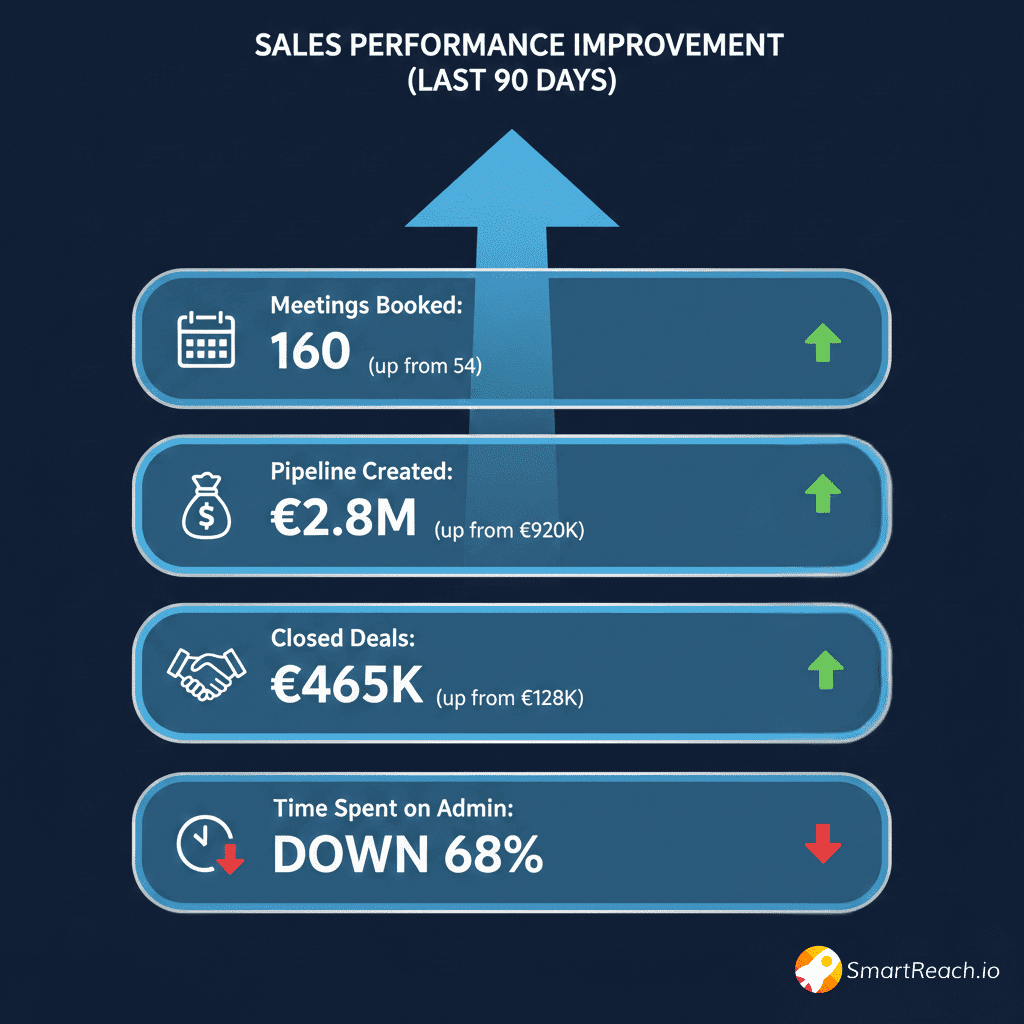
Same team size. Same budget. Completely different results.
Here’s what made the difference: they stopped patching together tools that each solved one narrow problem.
They moved to a platform that handled the entire workflow i.e. prospecting, sequencing, deliverability, multi-channel execution, reply management, and reporting.
Everything in one place. Nothing falling through cracks.
The campaigns that actually worked
Let’s talk specifics.
| Campaign 1: Procurement Directors, Germany |
| Target: 1,200 prospects Channels: Email + LinkedIn + Phone Open rate: 41% Reply rate: 8.2% Meetings booked: 47 Pipeline created: €890K |
This campaign worked because they led with a clear value proposition: “We’re helping manufacturers like [Company Name] reduce component costs by 22% without compromising on quality.”
The subject line? “Re: Component sourcing for [Company Name]”
Simple. Direct. Got opened.
| Campaign 2: Engineering Managers, France |
| Target: 890 prospects Channels: Email + LinkedIn Open rate: 38% Reply rate: 6.4% Meetings booked: 32 Pipeline created: €615K |
This one focused on technical specifications. They sent a comparison chart in the first email showing their components vs. the competition.
Prospects who replied were already educated. Sales cycles were 30% shorter.
| Campaign 3: Supply Chain VPs, Multi-Country |
| Target: 650 prospects Channels: Email + Phone Open rate: 44% Reply rate: 9.1% Meetings booked: 38 Pipeline created: €720K |
The winning move? They called two days after the first email, when the subject line was still fresh in the prospect’s mind.
“Hi, I’m following up on the email I sent about component sourcing. Do you have 90 seconds?”
Connection rate jumped to 18% because the call felt like a natural continuation of the email.
What they track now
EuroConnect monitors 11 metrics daily:
- Deliverability rate (emails reaching inbox vs. spam)
- Open rate by ESP (Gmail vs. Outlook performance)
- Reply rate by channel (email vs. LinkedIn vs. phone)
- Meeting show rate (booked vs. actual attendance)
- Pipeline value by campaign
- Time to first reply (how fast prospects respond)
- Sequence drop-off points (where prospects stop engaging)
- Domain health scores (sender reputation tracking)
- Response sentiment (positive vs. negative vs. neutral)
- Close rate by source (which campaigns generate revenue)
- Cost per qualified meeting
The last one is critical. They know exactly what each meeting costs them. When a campaign’s cost per meeting creeps above €75, they pause and optimize.
This level of visibility? Impossible when they were using five disconnected tools.
The mistakes they made (so you don’t have to)
Mistake 1: Launching too fast on new domains
In week one, they started sending 50 emails per day from brand-new domains. Bounce rates spiked. They got flagged.
The fix: They used domain warm-up for 14 days before launching campaigns. Problem solved.
Mistake 2: Generic personalization
Early emails said “Hi {{First Name}}, I noticed you work in manufacturing…”
Generic. Lazy. Reply rate: 2%.
They switched to: “Hi {{First Name}}, I saw {{Company Name}} recently expanded into automotive components. We’re helping similar manufacturers reduce sourcing costs by {{Percentage}}…”
Reply rate jumped to 7%.
Lesson: Personalization without relevance is just mail merge with extra steps.
Mistake 3: Not testing subject lines
They assumed technical prospects wanted technical subject lines. Wrong.
“New component specifications available” got a 12% open rate.
“Quick question about your Q2 sourcing” got a 39% open rate.
They started A/B testing everything. Open rates improved across the board.
Mistake 4: Ignoring negative replies
When prospects said “not interested,” they just marked them as closed.
Big mistake.
Now they have a re-engagement sequence for “not now” prospects. Six months later, they reach out again with new case studies, updated pricing, or market changes.
18% of those prospects eventually convert. That’s found money.
Why this worked when other approaches didn’t
Most companies fail at outbound because they’re solving the wrong problems.
They obsess over subject lines when their emails aren’t even reaching the inbox.
They hire more reps when the real issue is a broken process.
They buy more tools when they can’t even use the ones they have.
EuroConnect succeeded because they fixed the system, not the symptoms. All with the assistance of SmartReach’s Success Team.
They didn’t just need better emails. They needed:
- Infrastructure that could scale without breaking
- Processes that didn’t depend on manual work
- Visibility into what was actually working
- Tools that talked to each other instead of creating silos
SmartReach gave them all of that in a single platform.
The result? BDRs spent 70% of their time on conversations instead of admin. Reply rates tripled. Pipeline grew 3x.
The compounding effect
Here’s what nobody tells you about fixing your outbound motion:
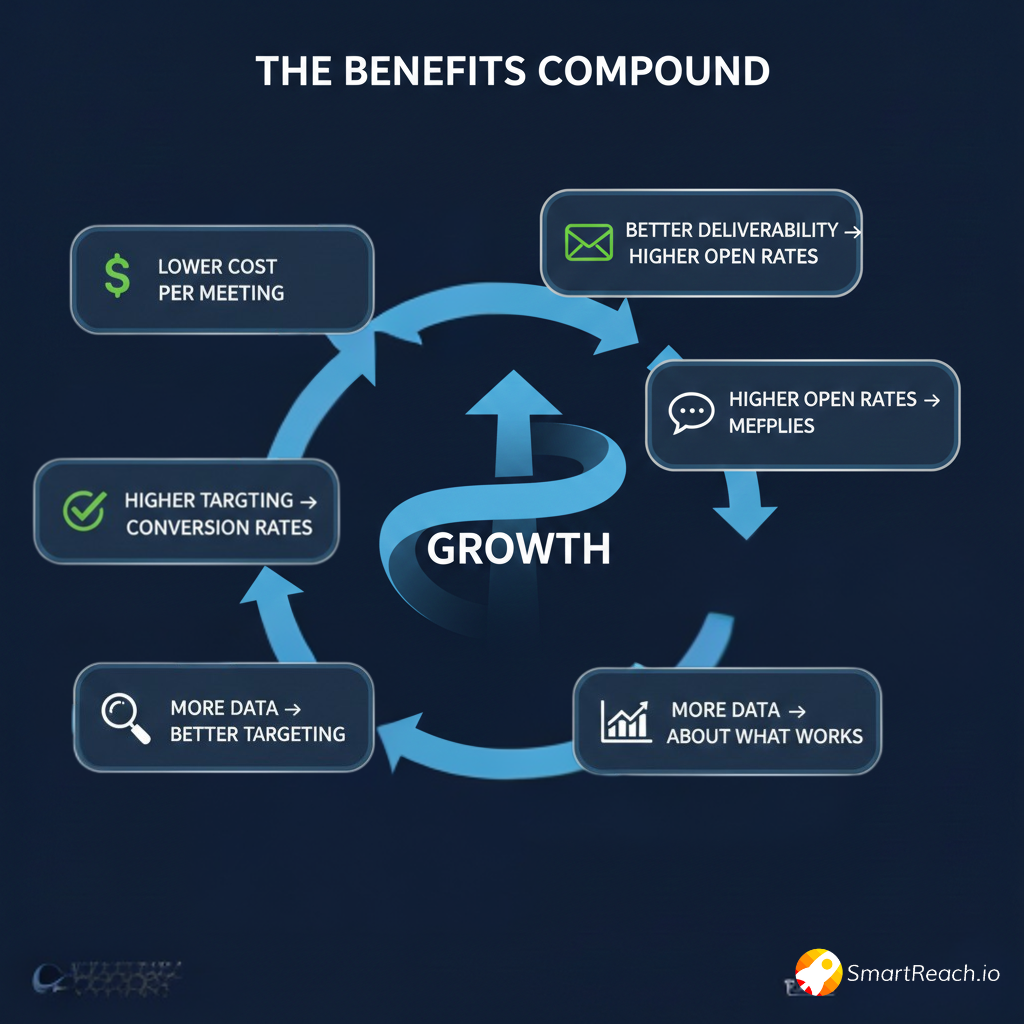
The benefits compound.
- Better deliverability means higher open rates.
- Higher open rates mean more replies.
- More replies mean more data about what works.
- More data means better targeting.
- Better targeting means higher conversion rates.
- Higher conversion rates mean lower cost per meeting.
Six months in, EuroConnect’s cost per qualified meeting dropped from €89 to €34.
That’s not incremental improvement. That’s a completely different business model.
What’s next for EuroConnect
They’re now running 14 active campaigns across 8 European countries.
They’ve hired two more BDRs to handle the volume of inbound interest.
They’re testing video messages as a fourth channel (early results: 62% watch rate).
And they’re planning to expand into the UK market in Q2.
Same playbook. Different geography.
The system they built isn’t fragile. It’s repeatable.
Read my article on:
Breaking into European markets | What actually moves the needle in b2b outreach
The bottom line
EuroConnect didn’t reinvent cold outreach. They just stopped making it harder than it needs to be. They consolidated their tools, fixed their infrastructure, and built repeatable processes that scale.
If you’re sending cold emails from your primary domain, manually building lists, and wondering why growth has stalled, you’re making the same mistakes they were.
The question isn’t whether you should fix it.
The question is how much pipeline you’re willing to lose before you do.
Want to see if a unified outbound platform could work for your team?
SmartReach offers a 14-day free trial with full platform access, no credit card required.
Start your free trial here →